Bill Lawrence "Q" Box
Moderator: Dave Mudgett
-
Keith Hilton
- Posts: 3788
- Joined: 1 May 1999 12:01 am
- Location: 248 Laurel Road Ozark, Missouri 65721
- State/Province: Missouri
- Country: United States
Bill Lawrence "Q" Box
Does anyone remember the "Q" Box Bill Lawrence had at one time? What did Bill claim the box did? Thanks.
-
Brian Hollands

- Posts: 362
- Joined: 15 Jan 2018 12:10 pm
- Location: Geneva, FL USA
- State/Province: -
- Country: United States
https://www.wildepickups.com/products/filter
He'd called it a "Q filter". I read it then and read it now and still don't know what it does...
He'd called it a "Q filter". I read it then and read it now and still don't know what it does...
'81 Sho-bud LDG, 2 EMCI's
-
Keith Hilton
- Posts: 3788
- Joined: 1 May 1999 12:01 am
- Location: 248 Laurel Road Ozark, Missouri 65721
- State/Province: Missouri
- Country: United States
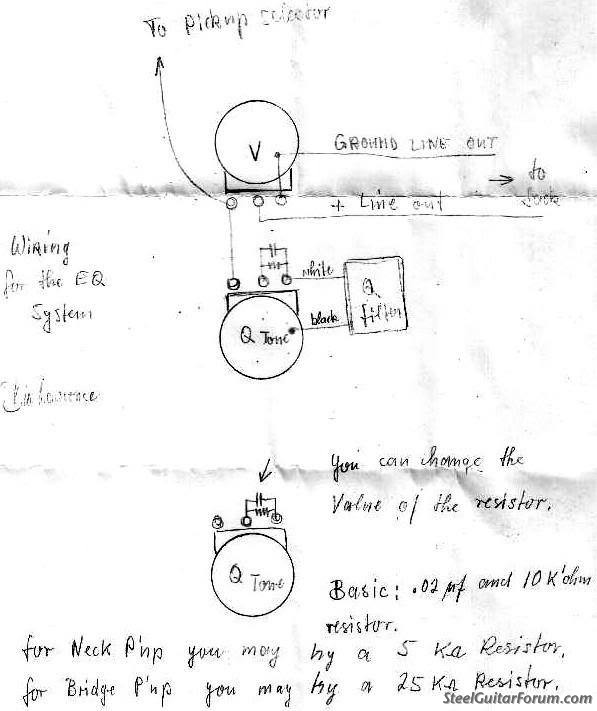
Bill was a interesting guy. Paul Franklin Senior introduced us in St.Louis. Brian, in the picture you see Bill's Q filter, and you also see a resistor and a capacitor. The picture tells me the Q filter is a replacement for the resistor capacitor tone control components. The Q filter has a inductor, capacitor and resistor. The inductor changes the Q of the filter. In very simple terms--- MEANING the inductor makes changes in frequency at the filter's resonate point. The inductor also has other effects on the action of the capacitor and resistor. I see Bill's Q filter as a improved tone control, improved over just a resistor and capacitor.
Very interesting, because I have been working on a special kind of "adjustable" Q filter. What my Q filter will do is solve the problem of a person not being able to get the sound they want. Instead of twisting knobs on a amplifier all night, dial in what you want with the one knob Q control. Like changing pickups by turning the special Q control. Set your tone controls on your amp where you like them. Then if you ever encounter having to change your sound to fit the situation, the Q filter will do that without touching the tone controls on your amp. Actually it is revolutionary. Bill's Q filter is only a one inch cube. The Q filter I am working on is a circuit board 4 inches by 4 inches.
Very interesting, because I have been working on a special kind of "adjustable" Q filter. What my Q filter will do is solve the problem of a person not being able to get the sound they want. Instead of twisting knobs on a amplifier all night, dial in what you want with the one knob Q control. Like changing pickups by turning the special Q control. Set your tone controls on your amp where you like them. Then if you ever encounter having to change your sound to fit the situation, the Q filter will do that without touching the tone controls on your amp. Actually it is revolutionary. Bill's Q filter is only a one inch cube. The Q filter I am working on is a circuit board 4 inches by 4 inches.
-
Stu Schulman

- Posts: 6523
- Joined: 15 Oct 1998 12:01 am
- Location: Ulster Park New Yawk (deceased)
- State/Province: -
- Country: United States
I think that Jon Light showed me one of those,I'd never seen one before.
Steeltronics Z-pickup,Desert Rose S-10 4+5,Desert Rose Keyless S-10 3+5... Mullen G2 S-10 3+5,Telonics 206 pickups,Telonics volume pedal.,Blanton SD -10,Emmons GS_10...Zirctone bar,Bill Groner Bar...any amp that isn't broken.Steel Seat.Com seats...Licking paint chips off of Chinese Toys since 1952.
-
Stu Schulman
- Posts: 6523
- Joined: 15 Oct 1998 12:01 am
- Location: Ulster Park New Yawk (deceased)
- State/Province: -
- Country: United States
Keith,When you get ready to sell the new box I would be interested.
Steeltronics Z-pickup,Desert Rose S-10 4+5,Desert Rose Keyless S-10 3+5... Mullen G2 S-10 3+5,Telonics 206 pickups,Telonics volume pedal.,Blanton SD -10,Emmons GS_10...Zirctone bar,Bill Groner Bar...any amp that isn't broken.Steel Seat.Com seats...Licking paint chips off of Chinese Toys since 1952.
-
Georg Sørtun

- Posts: 3854
- Joined: 2 Jun 2009 9:12 am
- Location: Mandal, Agder, Norway
- State/Province: -
- Country: United States
-
Keith Hilton
- Posts: 3788
- Joined: 1 May 1999 12:01 am
- Location: 248 Laurel Road Ozark, Missouri 65721
- State/Province: Missouri
- Country: United States
-
David Nugent
- Posts: 4905
- Joined: 2 Nov 2001 1:01 am
- Location: Gum Spring, Va.
- State/Province: -
- Country: United States
-
Keith Hilton
- Posts: 3788
- Joined: 1 May 1999 12:01 am
- Location: 248 Laurel Road Ozark, Missouri 65721
- State/Province: Missouri
- Country: United States
David, "The Q Factor" is defined as:
The Q, quality factor, of a resonant circuit is a measure of the “goodness” or quality of a resonant circuit. A higher value for this figure of merit corresponds to a more narrow bandwith, which is desirable in many applications. More formally, Q is the ratio of reactive power to average power in the circuit reactance and resistance, respectively.
The Q factor is somewhat different than the EQ, although both alter the frequency response.
The circuit I am working on can change the entire timbre of the sine wave produced by a guitar. Think of it this way, it would be like changing the pickup on your guitar, only with the knob on a electronic circuit. Like changing the sound of a humbucking pickup to the sound a single coil. Like changing the number of coils on a pickup, only doing it with the knob on a electronic circuit. Almost as good as a cure for cancer.
The Q, quality factor, of a resonant circuit is a measure of the “goodness” or quality of a resonant circuit. A higher value for this figure of merit corresponds to a more narrow bandwith, which is desirable in many applications. More formally, Q is the ratio of reactive power to average power in the circuit reactance and resistance, respectively.
The Q factor is somewhat different than the EQ, although both alter the frequency response.
The circuit I am working on can change the entire timbre of the sine wave produced by a guitar. Think of it this way, it would be like changing the pickup on your guitar, only with the knob on a electronic circuit. Like changing the sound of a humbucking pickup to the sound a single coil. Like changing the number of coils on a pickup, only doing it with the knob on a electronic circuit. Almost as good as a cure for cancer.
-
Tom Campbell
- Posts: 1824
- Joined: 8 Jun 2001 12:01 am
- Location: Houston, Texas, USA
- State/Province: Texas
- Country: United States
-
Michael Brebes
- Posts: 1281
- Joined: 4 Aug 1998 11:00 pm
- Location: Northridge CA
- State/Province: -
- Country: United States
My guess is that it was a notch filter, where the inductor and capacitor set up a frequency for the notch filter. With a potentiometer, it would make it possible to adjust the depth of the notch filter. The notch was probably somewhere in the mid frequencies.
Michael Brebes
Instrument/amp/ pickup repair
MSA D10 Classic/Rickenbacher B6/
Dickerson MOTS/Dobro D32 Hawaiian/
Goldtone Paul Beard Reso
Mesa Boogie Studio Pre/Hafler 3000
RP1/MPX100
Instrument/amp/ pickup repair
MSA D10 Classic/Rickenbacher B6/
Dickerson MOTS/Dobro D32 Hawaiian/
Goldtone Paul Beard Reso
Mesa Boogie Studio Pre/Hafler 3000
RP1/MPX100
-
Keith Hilton
- Posts: 3788
- Joined: 1 May 1999 12:01 am
- Location: 248 Laurel Road Ozark, Missouri 65721
- State/Province: Missouri
- Country: United States
-
Dave Mudgett
- Moderator
- Posts: 10556
- Joined: 16 Jul 2004 12:01 am
- Location: Central Pennsylvania and Gallatin, Tennessee
- State/Province: Pennsylvania
- Country: United States
Technically, to an electrical engineer, the Q-factor is generally defined as the ratio of the resonant frequency of an RLC (Resistance-Inductance-Capacitance) filter to the bandwith of the resonant peak of said filter, i.e., f[sub]r[/sub]/Δf, where f[sub]r[/sub] is the center frequency of the resonance peak and Δf is frequency difference between the one-half amplitude points. As the Q goes up, the resonant peak gets narrower, in a relative sense, so that the filter emphasizes or deemphasizes a relatively narrower band of frequencies, depending how it's used in the circuit.
Traditional guitar pickups are natural RLC filters (as are speakers), and have one or more varyingly strong resonant peaks that define important parts of the sound of the pickup. In a series RLC circuit, Q is proportional to the square root of inductance, and inversely proportional to resistance times the square root of capacitance - i.e., Q = sqrt(L/C)/R. So, other things being the same, hotter-wound pickups (higher resistance R) tend to have lower Q (and a broader resonant peak) than lower-wound pickups (lower resistance). The idea of inserting a separate RLC filter is to modify the resonant peak(s). Given a fixed inductance L, the overall resonant peak can be broadened or sharpened by modifying R and C. How it affects the sound depends on how it's inserted in the circuit - it can be inserted to emphasize the peaks' frequencies or deemphasize them.
I had one of Bill's old, old Q filters in a guitar years ago - worked as advertised. It used the tone pot as a variable resistor, with the tone capacitor, to significantly modify the overall response of the guitar. I used it mainly to sharpen up the response of a humbucker guitar.
I would talk to Bill at NAMM in Nashville whenever I would go, several times. Cool guy, I always enjoyed talking with him. His pickups are different in the sense that he treated the inductance as a significant design parameter, so you can't generalize about the sound of his pickups based on resistance measurements alone. As well as being a fine musician, he was a true electrical engineer, and I guess it takes one to know one, ha.
I guess Brad should be the final word on this, but I believe they are totally different. The Freeloader presents a variable input impedance load to the pickup, I'm pretty sure there is no inductor in there. I believe the Black Box with variable input impedance control is pretty much the same type of thing, but based on tubes instead of solid-state.
Traditional guitar pickups are natural RLC filters (as are speakers), and have one or more varyingly strong resonant peaks that define important parts of the sound of the pickup. In a series RLC circuit, Q is proportional to the square root of inductance, and inversely proportional to resistance times the square root of capacitance - i.e., Q = sqrt(L/C)/R. So, other things being the same, hotter-wound pickups (higher resistance R) tend to have lower Q (and a broader resonant peak) than lower-wound pickups (lower resistance). The idea of inserting a separate RLC filter is to modify the resonant peak(s). Given a fixed inductance L, the overall resonant peak can be broadened or sharpened by modifying R and C. How it affects the sound depends on how it's inserted in the circuit - it can be inserted to emphasize the peaks' frequencies or deemphasize them.
I had one of Bill's old, old Q filters in a guitar years ago - worked as advertised. It used the tone pot as a variable resistor, with the tone capacitor, to significantly modify the overall response of the guitar. I used it mainly to sharpen up the response of a humbucker guitar.
I would talk to Bill at NAMM in Nashville whenever I would go, several times. Cool guy, I always enjoyed talking with him. His pickups are different in the sense that he treated the inductance as a significant design parameter, so you can't generalize about the sound of his pickups based on resistance measurements alone. As well as being a fine musician, he was a true electrical engineer, and I guess it takes one to know one, ha.
Is this similar to the Sarno Freeloader or Black box.
I guess Brad should be the final word on this, but I believe they are totally different. The Freeloader presents a variable input impedance load to the pickup, I'm pretty sure there is no inductor in there. I believe the Black Box with variable input impedance control is pretty much the same type of thing, but based on tubes instead of solid-state.
-
Keith Hilton
- Posts: 3788
- Joined: 1 May 1999 12:01 am
- Location: 248 Laurel Road Ozark, Missouri 65721
- State/Province: Missouri
- Country: United States

-
Keith Hilton
- Posts: 3788
- Joined: 1 May 1999 12:01 am
- Location: 248 Laurel Road Ozark, Missouri 65721
- State/Province: Missouri
- Country: United States
-
Lee Baucum

- Posts: 10859
- Joined: 11 Apr 1999 12:01 am
- Location: McAllen, Texas (Extreme South) The Final Frontier
- State/Province: Texas
- Country: United States
-
Michael Brebes
- Posts: 1281
- Joined: 4 Aug 1998 11:00 pm
- Location: Northridge CA
- State/Province: -
- Country: United States
According to the schematic and description, it's got to be a modified notch filter. It was used to thin out the sound of a humbucker without having to split coils.
Michael Brebes
Instrument/amp/ pickup repair
MSA D10 Classic/Rickenbacher B6/
Dickerson MOTS/Dobro D32 Hawaiian/
Goldtone Paul Beard Reso
Mesa Boogie Studio Pre/Hafler 3000
RP1/MPX100
Instrument/amp/ pickup repair
MSA D10 Classic/Rickenbacher B6/
Dickerson MOTS/Dobro D32 Hawaiian/
Goldtone Paul Beard Reso
Mesa Boogie Studio Pre/Hafler 3000
RP1/MPX100
-
Peter Harris
- Posts: 420
- Joined: 18 Jan 2011 1:52 pm
- Location: South Australia, Australia
- State/Province: -
- Country: United States

-
Keith Hilton
- Posts: 3788
- Joined: 1 May 1999 12:01 am
- Location: 248 Laurel Road Ozark, Missouri 65721
- State/Province: Missouri
- Country: United States
Michael, I think you are correct. I personally think Bill Lawrence was trying to make a humbucker sound like a single coil. Maybe that and more. The key is the inductor. Capacitors deal with voltage, inductors deal with current.
When you combine capacitors, and inductors, magic sometimes happens. It seems to me you don't see inductors used as much as you used to. I suppose because of cost and size. Bill Lawrence was highly respected by everyone in the guitar world. Hartley Peavey once told me how he respected Bill's work. Bill was not easy to understand. When we talked about pickups, Bill launched into a dissertation about magnetism and eddie currents. I could not get a word in edge-ways.
When you combine capacitors, and inductors, magic sometimes happens. It seems to me you don't see inductors used as much as you used to. I suppose because of cost and size. Bill Lawrence was highly respected by everyone in the guitar world. Hartley Peavey once told me how he respected Bill's work. Bill was not easy to understand. When we talked about pickups, Bill launched into a dissertation about magnetism and eddie currents. I could not get a word in edge-ways.
-
Patrick Huey

- Posts: 806
- Joined: 7 Nov 2014 8:38 am
- Location: Nacogdoches, Texas, USA
- State/Province: Texas
- Country: United States
Jerry,Jerry Roller wrote:Hey Keith, if I name it can I have one? That's how I got my Hil-tone!
Jerry
How about the “Hilton Q “Rollerâ€
Roll them tones with the Hilton Q Roller! Get yours today at Roller music!
Pre RP Mullen D10 8/7, Zum 3/4, Carter S-10 3/4, previous Cougar SD-10 3/4 & GFI S-10 3/4, Fender Steel King, 2 Peavey Session 500's, Peavey Nashville 400, Boss DD-3, Profex-II, Hilton Digital Sustain, '88 Les Paul Custom,Epiphone MBIBG J-45, Fender Strat & Tele's, Takamine acoustics, Marshall amps, Boss effects, Ibanez Tube Screamer, and it all started with an old cranky worn out Kay acoustic you could slide a Mack truck between the strings and fretboard on!!
-
Donny Hinson
- Posts: 21830
- Joined: 16 Feb 1999 1:01 am
- Location: Glen Burnie, Md. U.S.A.
- State/Province: -
- Country: United States
-
Keith Hilton
- Posts: 3788
- Joined: 1 May 1999 12:01 am
- Location: 248 Laurel Road Ozark, Missouri 65721
- State/Province: Missouri
- Country: United States
There are many types of filters,a Q-filter, and graphic EQ are two different types of filters. The term Q-filter is different than a EQ filter. With that said, a EQ filter could be set to have a similar response as a Q filter. In this post David Nugent said; "I noticed that on most of the Quilter Pro Block heads they feature a Tri-Q knob in place of the three band EQ."
In this post Dave Mudgett gave a great technical description of a Q-filter. One thing missing from the technical description is---A Q-filter does not always have to have a inductor in the components. For example: Take a 2nd Order Sallen Key filter, with adjustable gain components. Altering the gain components will change the Q of the filter. In the case of the 2nd order Sallen Key Filter, there is no inductor, only a OP Amp, with resistors and capacitors. Granted, most of the old time filters involving the Q factor had inductors. The 2nd Order Sallen Key filter with adjustable gain is only one of many ways to change the Q of a filter.
Donny, typically a EQ filter is a filter with sliding adjustable frequencies. The Q factor of a filter is a totally different thing than an EQ filter. I say different, but can be made somewhat similar. The big difference is how the Q of the filter is adjusted. For example: With the 2nd order Sallen Key filter, the Q is adjusted with variable gain. With the EQ filter, you have to slide a bunch of frequency sliders. Other types of filters have different ways of altering the Q of that particular filter. I hope I have made it clear for you Donny.
In this post Dave Mudgett gave a great technical description of a Q-filter. One thing missing from the technical description is---A Q-filter does not always have to have a inductor in the components. For example: Take a 2nd Order Sallen Key filter, with adjustable gain components. Altering the gain components will change the Q of the filter. In the case of the 2nd order Sallen Key Filter, there is no inductor, only a OP Amp, with resistors and capacitors. Granted, most of the old time filters involving the Q factor had inductors. The 2nd Order Sallen Key filter with adjustable gain is only one of many ways to change the Q of a filter.
Donny, typically a EQ filter is a filter with sliding adjustable frequencies. The Q factor of a filter is a totally different thing than an EQ filter. I say different, but can be made somewhat similar. The big difference is how the Q of the filter is adjusted. For example: With the 2nd order Sallen Key filter, the Q is adjusted with variable gain. With the EQ filter, you have to slide a bunch of frequency sliders. Other types of filters have different ways of altering the Q of that particular filter. I hope I have made it clear for you Donny.
-
Dennis Detweiler
- Posts: 3984
- Joined: 8 Dec 1998 1:01 am
- Location: Solon, Iowa, US
- State/Province: Iowa
- Country: United States
-
Keith Hilton
- Posts: 3788
- Joined: 1 May 1999 12:01 am
- Location: 248 Laurel Road Ozark, Missouri 65721
- State/Province: Missouri
- Country: United States
I have thought of a simpler way to explain a Q-filter to my good friend Donny Hinson.
Think of a Q-filter this way; A sine wave goes above and below the DC reference. The positive sine wave looks like a wave on the ocean. The negative sine wave looks just like the positive sine wave, only turned upside down.
A Q-filter can bring the peaks of the waves closer together, or can bring the peaks of the waves further apart.
In doing this the Q-filter can alter much more than the highs, the lows, or the mids. The Q-filter can alter the entire spectrum, and timbre, of the sound/tone one hears.
Like changing out a guitar pickup to another type of pickup. Like changing out an amplifier to a different type of amplifier. Like changing out a speaker to a different kind of speaker.
I see it as a cure for those times when a person turns ever tone knob on a amplifier and still everything sounds awful. I see if as a cure for a bad sounding guitar, or a bad sounding amplifier.
First question should be; Will adjusting my Q filter be difficult. Adjusting my Q-filter will be as easy as turning "one" knob. Let me say that again, "ONE KNOB"!
Think of a Q-filter this way; A sine wave goes above and below the DC reference. The positive sine wave looks like a wave on the ocean. The negative sine wave looks just like the positive sine wave, only turned upside down.
A Q-filter can bring the peaks of the waves closer together, or can bring the peaks of the waves further apart.
In doing this the Q-filter can alter much more than the highs, the lows, or the mids. The Q-filter can alter the entire spectrum, and timbre, of the sound/tone one hears.
Like changing out a guitar pickup to another type of pickup. Like changing out an amplifier to a different type of amplifier. Like changing out a speaker to a different kind of speaker.
I see it as a cure for those times when a person turns ever tone knob on a amplifier and still everything sounds awful. I see if as a cure for a bad sounding guitar, or a bad sounding amplifier.
First question should be; Will adjusting my Q filter be difficult. Adjusting my Q-filter will be as easy as turning "one" knob. Let me say that again, "ONE KNOB"!