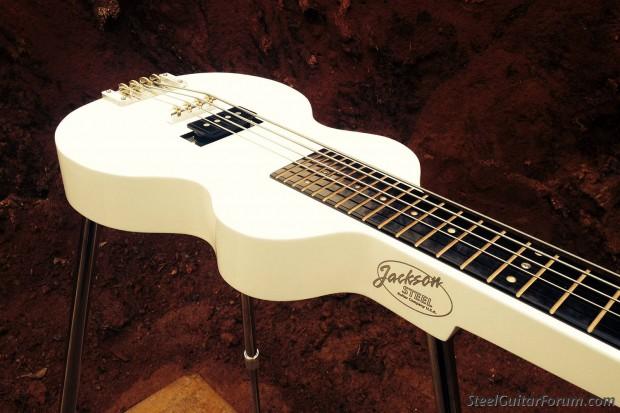
http://www.ebay.com/itm/Ted-Crocker-Bos ... 2261309823
|
The Steel Guitar Forum Store
Visit Our Catalog for Strings, Instruction, Music and Accessories |
Click Here to Send a Donation
Steel Guitar Links |
Moderator: Brad Bechtel




Anyone can use the most expensive equipment and materials. I have grave doubts about whether the materials have any effect on the tone of an electric instrument. I've been building both acoustic and electric instruments for nearly 60 years. When I build acoustic instruments I use good tonewoods, because they really make a difference. For electric instruments, you might as well use plywood and offcuts from pallets. Build a toilet seat out of ebony or plastic and it performs the same function.Keith Glendinning wrote:...it's simple to make an amateur, though playable Lap Steel, but other makers use the finest materials and state of the art equipment ...



Alan Brookes wrote:Anyone can use the most expensive equipment and materials. I have grave doubts about whether the materials have any effect on the tone of an electric instrument. I've been building both acoustic and electric instruments for nearly 60 years. When I build acoustic instruments I use good tonewoods, because they really make a difference. For electric instruments, you might as well use plywood and offcuts from pallets. Build a toilet seat out of ebony or plastic and it performs the same function.Keith Glendinning wrote:...it's simple to make an amateur, though playable Lap Steel, but other makers use the finest materials and state of the art equipment ...
Keith Glendinning wrote:...it's simple to make an amateur, though playable Lap Steel, but other makers use the finest materials and state of the art equipment ...
Alan Brookes wrote:...I have grave doubts about whether the materials have any effect on the tone of an electric instrument...
Perhaps what I said was on over-simplification. Hardwoods do have more sustain with more overtones, whilst, as you rightly said, I once built a lap steel out of stainless steel and it was tone dead. I'm a definite believer in not having a separate neck, and having the strings passing through the body and anchored at the back. On the other hand, I've built lap steels out of swamp ash, which is what Fender used for many years, and, compared with ones that I've build out of cedar, there seems to be little difference.W. Johnson wrote:...I've made lap steel guitars from Eastern Maple, Mahogany, aluminum, and each have their distinctive tonal qualities and sustain qualities. Mahogany will have a more mellow warm tone, Maple produces a bright sound, and aluminum produces an extremely bright tone. My material of choice is aluminum, and I have to compensate for the brightness of the metal by the way that I construct the pickup, and also placement of the pickup (distance from the bridge.)
Through the body string mounting, or in the bridge string mounting, also affects tone and sustain, especially sustain. Using brass, aluminum, plastic, bone, for the nut/bridge will also change things up.
Every single aspect of the lap steel guitar, including materials used, affect both sustain and tone.
To say that only the strings and the pickup affect the tone, this is not supported by my short and limited experience and observations.
You yourself have commented about building a lap steel from stainless steel, and commented that it didn't sound good. Please correct me if I'm incorrect on this...
 (Yes, I know it has frets.)
 Awesome response Alan, thanks.Alan Brookes wrote:Keith Glendinning wrote:...it's simple to make an amateur, though playable Lap Steel, but other makers use the finest materials and state of the art equipment ...Alan Brookes wrote:...I have grave doubts about whether the materials have any effect on the tone of an electric instrument...Perhaps what I said was on over-simplification. Hardwoods do have more sustain with more overtones, whilst, as you rightly said, I once built a lap steel out of stainless steel and it was tone dead. I'm a definite believer in not having a separate neck, and having the strings passing through the body and anchored at the back. On the other hand, I've built lap steels out of swamp ash, which is what Fender used for many years, and, compared with ones that I've build out of cedar, there seems to be little difference.W. Johnson wrote:...I've made lap steel guitars from Eastern Maple, Mahogany, aluminum, and each have their distinctive tonal qualities and sustain qualities. Mahogany will have a more mellow warm tone, Maple produces a bright sound, and aluminum produces an extremely bright tone. My material of choice is aluminum, and I have to compensate for the brightness of the metal by the way that I construct the pickup, and also placement of the pickup (distance from the bridge.)
Through the body string mounting, or in the bridge string mounting, also affects tone and sustain, especially sustain. Using brass, aluminum, plastic, bone, for the nut/bridge will also change things up.
Every single aspect of the lap steel guitar, including materials used, affect both sustain and tone.
To say that only the strings and the pickup affect the tone, this is not supported by my short and limited experience and observations.
You yourself have commented about building a lap steel from stainless steel, and commented that it didn't sound good. Please correct me if I'm incorrect on this...
Where the difference does show, and I've always believed this, is when you have an acoustic/electric instrument, such as an archtop guitar, and, to some extent, a console steel with a fixed back. The acoustical properties definitely get fed back through the pickups. Likening a solid lap steel to a console steel is like comparing a Telecaster to a Gretsch White Falcon. I have an old Rickenbacker D8 console steel with a sealed back, the sort that Don Helms used to play at one time, and when I compare it with a Stringmaster it's a totally different sound.
Sorry for going a bit off-topic. When it comes to having a lap steel equivalent of a bass guitar, I wonder how different that would be to having a fretless electric bass play the same part. I'm not going to be selling my Fender Precision Bass for some time.

Well rip them off!Alan Brookes wrote:I wonder how different that would be to having a fretless electric bass play the same part. I'm not going to be selling my Fender Precision Bass for some time.


If you're going to take the steel guitar down into the realms of the bass you really need bass guitar strings, machine tuners that will cope with them, and a bass guitar pickup. It's not enough to just lower the pitch of strings until they're slack. I've been there, done that, and failed. To get a real growling bass you need thick strings and a pickup designed for them.Stephen Cowell wrote:...Unfortunately the SM's pickups don't do bass strings well...
Well, Alan, I had the first two... and it's the last one I'm complaining about. Here's a repost of what I did with mine... just about the only way to get bass strings to fit an SM.Alan Brookes wrote:If you're going to take the steel guitar down into the realms of the bass you really need bass guitar strings, machine tuners that will cope with them, and a bass guitar pickup. It's not enough to just lower the pitch of strings until they're slack. I've been there, done that, and failed. To get a real growling bass you need thick strings and a pickup designed for them.Stephen Cowell wrote:...Unfortunately the SM's pickups don't do bass strings well...
Stephen Cowell wrote:I just strung up my third neck (22.5") with .095-.038... I was able to work the ball ends out of some short-scale bass strings (Fender 5250XL) using needle-nose pliers, mixed with a few bass singles (expensive!) and other regular strings. Very cool... my ceramic bar doesn't work so well on them, having to use a big steel bar instead. Using Gmin/Bb6 with these gauges:
.038 F
.049 D
.060 Bb
.066 G
.070 F
.075 D
.086 Bb
.095 G
The needle-nose technique involved grabbing the ball end through the 'Y' so that the tip was just past the groove... you then spin the pliers, working the wire out of the groove like a tire on a changing machine. Once you get 1/3 of the way around you can take another tool and pop the wire over the edge of the ball. Squeeze the loop so that it will hold a regular ball, then bend the loop/ball (parallel to the squeezed direction) so it will go down into the keyhole on the plate easily. You can unwind some wrap if the loop is too tight, or if the wrap wire interferes with the pliers.
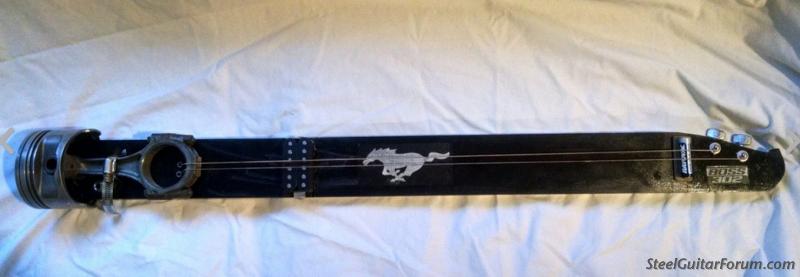
I kinda like the idea of a bass slide guitar. The SlideKing, I hope to make myself a slide bass (possibly from aluminum?). I don't think I'll use a engine piston, though. I also liked the palm lever.Mark Eaton wrote:Lonnie Bennett on SteelKing guitar with one palm lever and Zane King on the bass version at the Texas convention, March 2015. No doubt some of our members were in the room for this demo. Zane has put up some videos here in the past of the various iterations of the SlideKing:
https://www.youtube.com/watch?v=2yL_vTNHkWI
Zane, presumably in his home studio playing the SlideKing bass with a backing track in a short video of 55 seconds.
https://www.youtube.com/watch?v=5r5fCNrvFDg
I'm not sure what it all means, a specialty bass lap steel. Is it "another tool in the toolbox" - or is it an instrument for "the steel guitarist who has everything."
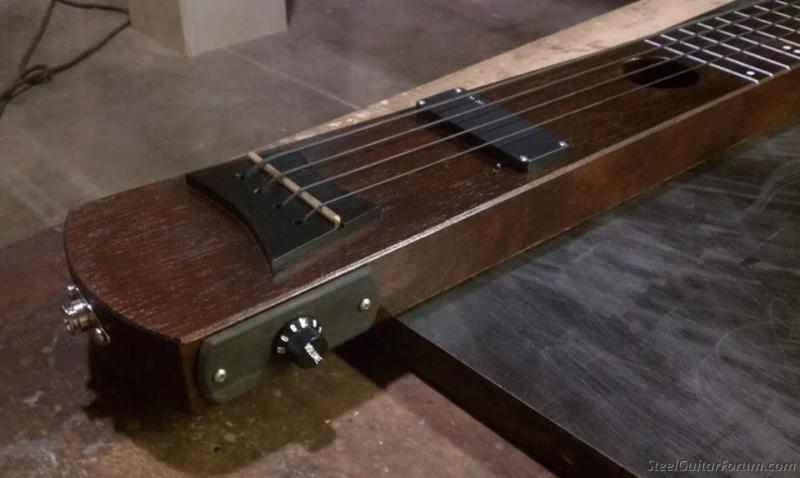
 , and it can be yours now for only $500!