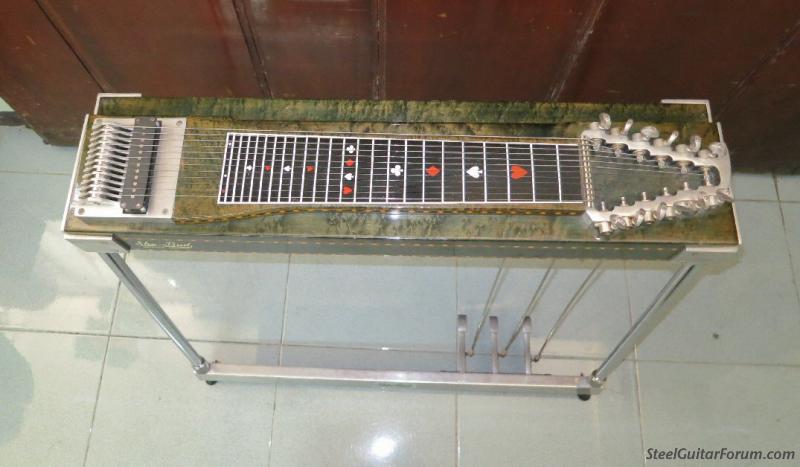
Being a glutton for punishment, I have another Sho-Bud restoration project I've begun - this one a Pro II round-front. The finish was in very bad shape with large sections missing between the necks, and lots of cracks. Also (unknown when I bought it) the front apron had separated from the top at each end, pulled out by the screws through the front of the end-plate, which fit loose.
First the pics:
before:


You can see the apron sticking out beyond the top.
After: this pic was taken today, after stripping, bleaching, staining, and initial coats of lacquer. There will be many more coats of lacquer added, then I will rub it out to (hopefully) a glossy shine:

Info on fixing the apron: I think the cause is the cabinet shrinking, so that the endplates fit loose. I have the opposite problem with my Zumsteel Uni that has been here in the warm, moist air of the Philippines for 2 years - the wood seems to be expanding, slightly opening up the joints where the mica meets in the corners. Fo bro Don Brown, who lives up the road a bit, has had the same problem with his Kline.
This Sho-Bud came from Taos, New Mexico, so perhaps the dry air there led to it shrinking. The amounts are very tiny - maybe 3/32" was the widest gap at the endplates. But that is enough to break the joint. This Sho-Bud does not have plugs in the apron like my 1975 12-string does - covering either screws or dowels (not sure what Sho-Bud used) which would have reinforced this joint.
Despite lacquer, laminate, etc, wooden instruments are not completely stable, so can expand and contract small amounts with changing conditions. To avoid the problems caused by this, as others have pointed out, avoid sudden changes of temp, and also try to keep the humidity from getting too low in winter where you keep your steel.
So, the fix - just removing the endplates let the wood return about 2/3rds of the way on its own in a few days. From there it was very easy to use clamps to bring it back into line and glue it up. First, bar clamp it from front to back, pulling the apron into alignment. Use blocks of wood not only for padding the clamps, but also by having them overlap the top edge the clamps can not pull the apron too far in (the reverse problem!) or break the back apron loose. Also, a clamp to hold the apron down against the top.
For glue, I used a good epoxy resin. I'm a boatwright, so am use to using epoxy on wood and know it is very strong (the joint is stronger than the wood). I am not familiar with whatever carpenter's glue would be available to me here in the Philippines. With epoxy, do not squeeze the clamps extremely tight - just snug them up so everything is is straight and tight - you don't want to squeeze all the resin out. Note: this is not epoxy glue you buy at the hardware store, but a better quality epoxy that is thinner (to penetrate the wood grain). WEST System is an excellent epoxy for wood available most places.
Whatever glue is used, be sure to mask the parts of the guitar that will be seen and wipe up glue that gets squeezed out before it sets up. Probably the trickiest part is getting the glue into the joint. I used a screwdriver to gently pry the joint open, propped the cabinet at an angle where the glue would run into the joint from the inside of the cabinet, then used a piece of plastic to push the epoxy into the joint.
I was planning on refinishing the guitar, but did the repair before stripping the cabinet - if epoxy gets on any unfinished wood, it will penetrate into the surface grain, and that area will not take stain like the rest of the instrument.
Finish - the blond is what you get when you bleach a brown-stained piece of maple - some of the stain remains in the grain, actually highlighting the grain far more than just leaving it natural. You can get this with a blond instrument by putting on a stain, then wiping most of it off. Fortunately, both James and one other person (sorry, don't know the name) have posted images of brown 'Bud's that have been stripped and bleached so I had a pretty good idea what the result would be. The stain in the bleached section ended up more pinkish-brown compared to the original brown, but that's ok - I wanted to do a reddish-brown on the aprons and neck, so they look good together.
The dark is ReRanch's "Dark Red Mahogany" - I just added a small portion of the bottle to a pint or so of alcohol and ended up with way more than I needed. It looks very brown when applied (after drying, anyway) but is more red once covered with lacquer.
I sprayed the stain on, but think if I did it again I'd just wipe it on. I put on too think a layer on the front apron on the first coat and the lacquer/stain ran, so ended up wiping it mostly off, the then re-applying stain with a rag, and was happy with how that worked.
After stripping the guitar and storing it for a bit here in the tropics before getting it refinished, it seems to have returned to its original size - endplates fit better now. Since I expect to continue living in the tropics, I do not think there will any further problem with shrinkage. If I moved to a dry climate I would watch for any signs of change, and loosen the screws slightly that go into the aprons from the front and back of the endplates. If you have a guitar that already has a gap between the wood and the endplates, I'd suggest shimming it between the endplates and the aprons - the gap will be there, but the stress on the apron will not be.
Well, that's probably way more info than most people want, but someone someday will find something useful in there somewhere!
So, now waiting for decals and other parts coming from the States.