I am happy to say that yesterday I was able to play my '66-67 ShoBud rack and barrel model for the first time. I have been in agony trying to make it adjust to playing in-tune and with pedal action that I can live with.
Yes I know now what "Bud" tone is But this is really harmonically diferent. The only thing that I can figure is the 23 inch scale length is a big part of the soft and very sweet tone. I have only ever played Carter guitars the last five or 6 years. They all sounded great, but not like this.
Am I having auditory hallucinations from the overwhelming joy of havinf a functioning steel, or am I hearing something you've hallucinated too?
Are there other PSG's with that short scale?
RICK ABBOTT
Sho~Bud D-10 Professional #7962
Remington T-8, Sehy #112
1975 Peavey Pacer 1963 Gibson Falcon
Erv, this one is 23" I just checked it again. I had never seen such a thing.
The ShoBud folks on the Forum including Mr. Coop lead me to believe that it is a late '66 Crossover, made before the deal with Baldwin. The changer is likely a one-off model. It is single R/L like the others.
RICK ABBOTT
Sho~Bud D-10 Professional #7962
Remington T-8, Sehy #112
1975 Peavey Pacer 1963 Gibson Falcon
I have a Sho-bud that was converted to 24 inches in 1959 but started life as 25.
I have had a 25 inch Bigsby, and now Bigsby necks that are the 24 plus inches -- what occurs when 25 inches shrinks in casting and a 25 inch scale neck is used as the basis for a pattern.
I have heard stories about a 22 inch Sho-bud scale, but, as John Dean said in Watergate hearings, "I can neither confirm, nor deny."
I bought this guitar in 1976 in Germany, in a music shop of Karlsruhe where there are some US Army troops.
It has a Push Pull system and has a 23 inches scale. It was a C6 5+2. I have transformed it to a E9 3+4.
I don't know the brand of this guitar. Perhaps somebody can help me to discover the origin of this guitar.
This Baldwin Cross over is a 23" scale, from the factory, the changer IS original. This guitar is authentic in every way. There were about 20 built this way in the beginning. David Jackson changed his design to the standard finger model because of , tone, string breakage and cost.
This guitar original and rare? YOU BET IT IS!
Some of you sharp guys that collect original literature will notice that THIS is the guitar in the first printed promo literature. This is a very collectable guitar, not worth much to play, but very rare AND COLLECTABLE. For a while, the value may be low, but in the next 20 years, this could be a sleeper with great value to come.
Sho-Buds ONLY 23" scale. Another great David Jackson inovation, look what he is still doing today! This guys brain never sleeps.
Patrick, I enjoyed your pictures of the "Push-Pull" changer, weirdest one I have ever seen , but I see how it works, very interesting!
Those boys across the pond never did do anything simply. I know, I have a V-12 BMW.
The first 7 MSAs were built using a very similar system, I still have one. (1963)
Any idea who these guitars were built for? The serial number is M0 7035. Would I be stupid if I put an E-raise KL on it? I have that change on a pedal now and I hate it. I wouldn't want to harm it, but I dont have any other guitar to play.
RICK ABBOTT
Sho~Bud D-10 Professional #7962
Remington T-8, Sehy #112
1975 Peavey Pacer 1963 Gibson Falcon
Rick, these guitars were built for music stores only. The ones that handled "Baldwin" products. They were just sold through the store.
Personally, I'd not add the lever, ever. Why add it? You can play with what's there, no one else will ever know, the only value your guitar has now is its originality and good condition. Don't throw that away just to have a knee lever on a guitar that really isn't that good to play anyway. Sustain on these guitars wasn't very good when new either, but it is the fore-runner to the Pro series. The "Pro series was Sho-Bud's most money making line ever. This was the start of the great things that were soon to come in the seventies.
David spent may nights without sleep on this guitar design, along with those to come a little later.
(24 1/4") Or: Twenty four thousand, two hundred fifty thousandths, or two feet and a quarter of an inch, or: 1598432270.29 % of a metric yard. (Or possibly---------------- .
Hey Rick! Told ya! I'm glad you kept it. I woulda bought it, but I knew I was getting a 1959 Madison Permanent, and still have the Fingertip to do, so,,,,,
I woulda loved to have it, but I'm glad you're keepin' it original!
What are these switches function? One seems to shut off the C6 pickup and one makes the E9 neck sound thin and awful or just silent. I don't like 'em whatever they are.
John B. the rack is in and set for 2 C6 pulls, 5 and 6 pedal of course. I need to re-install the pedals, but the racks are really easy to set up for dedicated pedals for each neck. I was so green about the mechanics when I got it that I just flipped and pulled out the clutter I feel much more confident now!
RICK ABBOTT
Sho~Bud D-10 Professional #7962
Remington T-8, Sehy #112
1975 Peavey Pacer 1963 Gibson Falcon
Should be coil tap switches. Yer right! If they're not coil-tappin', they may be messed up. Or maybe the pickups are messed up. You'll have to experiment. Get out your VOM!
 But this is really harmonically diferent. The only thing that I can figure is the 23 inch scale length is a big part of the soft and very sweet tone. I have only ever played Carter guitars the last five or 6 years. They all sounded great, but not like this.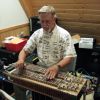







 I feel much more confident now!
 Nah, only 3 or 4.
