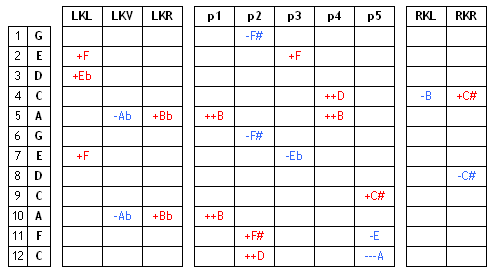
WHO invented tuning a steel guitar from the bottom (bass strings) up?.......especially when you're playing with other stringed instruments?
JUST Curious. For decades it was standard practice to tune from the top down.
Was it a country picker who decided this method is better? Or, was it an advent of the Rock & Roll crowd?
HOW DO YOU tune your steel? Bottoms UP or top down? This might help some of the old timers learn to do it right after having dones so for so many years....eh?
TUNING Technique
Moderators: Dave Mudgett, Brad Bechtel
-
Ray Montee (RIP)

- Posts: 9506
- Joined: 7 Jul 1999 12:01 am
- Location: Portland, Oregon (deceased)
- State/Province: Oregon
- Country: United States
-
C Dixon
- Posts: 7348
- Joined: 4 Aug 1998 11:00 pm
- Location: Duluth, GA USA
- State/Province: -
- Country: United States
-
Doug Seymour
- Posts: 1039
- Joined: 4 Aug 1998 11:00 pm
- Location: Jamestown NY USA (deceased)
- State/Province: -
- Country: United States
OH, My goodness! You two, I never realized it made any difference. I think I always tuned them "UP". That is I got them in tune.
1st band with the accordion, later I'm not sure maybe a pitch pipe for the "C" on C6th,
come to think of it, I had an "E" tuning fork, til my buddy shamed me with his electronic tuner! He waited til I got my steel in tune & then proved I had a "tin" ear
with his "marvelous electronic tuner"! Oh, well, never too old to learn something new?
1st band with the accordion, later I'm not sure maybe a pitch pipe for the "C" on C6th,
come to think of it, I had an "E" tuning fork, til my buddy shamed me with his electronic tuner! He waited til I got my steel in tune & then proved I had a "tin" ear
with his "marvelous electronic tuner"! Oh, well, never too old to learn something new?
-
Larry Miller
- Posts: 1393
- Joined: 11 May 2001 12:01 am
- Location: Dothan AL,USA
- State/Province: -
- Country: United States
-
Roger Rettig

- Posts: 11177
- Joined: 4 Aug 2000 12:01 am
- Location: Naples, FL
- State/Province: -
- Country: United States
-
Rick Aiello

- Posts: 5043
- Joined: 11 Sep 2000 12:01 am
- Location: Berryville, VA USA
- State/Province: -
- Country: United States
Get ready to yawn:
Because guitar strings (piano, etc) are not "ideal" (behave as the math dictates) ..... the overtones of a vibrating string are not necessarily perfect harmonics ... Elasticity issues basically ....
To differentiate between the ideal harmonics and the pitches actually produced .... the overtones produced by the string are called partials. Although the partials are very close to the ideal harmonic series, they can differ.
The harmonics of a vibrating string tend to be sharp of the natural harmonic series. This becomes more pronounced as the string is made shorter or thicker.
Pianos have their bass strings tuned alittle flat ... so that their partials "agree" with the middle strings fundamentals ...
The high register strings are tuned alittle sharp so that the middle string's partials don't clash with the high strings fundamentals ...
They call it a "stretched tuning" ...
If you start tuning your steel at the bass strings and tune up ... then your high strings will be a little sharp ...
I got an email the other day ...
<BLOCKQUOTE><font size="1" face="Verdana, Arial, Helvetica">quote:</font><HR><SMALL>
Please start teachin' high school again .... you're drivin' us nuts
</SMALL><HR></BLOCKQUOTE>
Sorry y'all ...
------------------
My Steel Shoes Site
<FONT SIZE=1 COLOR="#8e236b"><p align=CENTER>[This message was edited by Rick Aiello on 29 January 2003 at 12:32 PM.]</p></FONT>
Because guitar strings (piano, etc) are not "ideal" (behave as the math dictates) ..... the overtones of a vibrating string are not necessarily perfect harmonics ... Elasticity issues basically ....
To differentiate between the ideal harmonics and the pitches actually produced .... the overtones produced by the string are called partials. Although the partials are very close to the ideal harmonic series, they can differ.
The harmonics of a vibrating string tend to be sharp of the natural harmonic series. This becomes more pronounced as the string is made shorter or thicker.
Pianos have their bass strings tuned alittle flat ... so that their partials "agree" with the middle strings fundamentals ...
The high register strings are tuned alittle sharp so that the middle string's partials don't clash with the high strings fundamentals ...
They call it a "stretched tuning" ...
If you start tuning your steel at the bass strings and tune up ... then your high strings will be a little sharp ...
I got an email the other day ...
<BLOCKQUOTE><font size="1" face="Verdana, Arial, Helvetica">quote:</font><HR><SMALL>
Please start teachin' high school again .... you're drivin' us nuts
</SMALL><HR></BLOCKQUOTE>
Sorry y'all ...
------------------
My Steel Shoes Site
<FONT SIZE=1 COLOR="#8e236b"><p align=CENTER>[This message was edited by Rick Aiello on 29 January 2003 at 12:32 PM.]</p></FONT>
-
Dave Birkett
- Posts: 449
- Joined: 9 Jan 2002 1:01 am
- Location: Oxnard, CA, USA
- State/Province: -
- Country: United States
I can't think of a guitar player who doesn't turn his first string first. So I tune my open 4th string on the E9 and the open 2nd string on the C6 to an electronic tuner. Then I tune out the beats. This puts me with the guitar(s), at least when the first song starts. Then the guitars start going out of tune. I wish they would use heavier strings.
-
Ken Williams

- Posts: 771
- Joined: 4 Aug 1998 11:00 pm
- Location: Arkansas
- State/Province: Kansas
- Country: United States
Years ago, I went "living room" jamming at a guy's house that I really didn't know that well. After getting set up, guitar player turns to the bass player and says "give me an E", thens starts trying to tune his little E string with the lowest note on the bass. I knew I was in for an interesting night. As far as acoustic guitar goes, it seems like it works pretty good for me to start on the low D then tune the high D(2nd string,3rd fret)with the low D, then go from there. Every string should be a 5th of something else at that point. Of course, I'm speaking of doing this without the benefit of a tuner.
Ken
Ken
-
Pete Burak
- Posts: 6560
- Joined: 2 Oct 1998 12:01 am
- Location: Portland, OR USA
- State/Province: -
- Country: United States

-
Roger Rettig
- Posts: 11177
- Joined: 4 Aug 2000 12:01 am
- Location: Naples, FL
- State/Province: -
- Country: United States
I said earlier, 'C's and 'E's first...' - I should have elaborated: Third and fourth string respectively (C6,E9), then work down, and tuning the top couple of strings last.
I think I do it this way because I can get very close to a 'C' and an 'E' without a tuner - not 'perfect pitch' by any means(!), but out of sheer familiarity.
Ken - I love your story about the guitar tuning his 1st to the bass-player's 4th - yikes!!!
------------------
Roger Rettig
I think I do it this way because I can get very close to a 'C' and an 'E' without a tuner - not 'perfect pitch' by any means(!), but out of sheer familiarity.
Ken - I love your story about the guitar tuning his 1st to the bass-player's 4th - yikes!!!
------------------
Roger Rettig
-
Roy Ayres

- Posts: 3191
- Joined: 9 Oct 2002 12:01 am
- Location: Riverview, Florida, USA, R.I.P.
- State/Province: Florida
- Country: United States
I have always tuned high-to-low. In the "old days" (40's and 50's)if there was an accordian or piano in the band I tuned to their pitch by ear, otherwise I was happy to tune to the guitar or other "tunable" instrument -- or to a tuning fork. At one point many years ago, I built a home-made tuner by mounting a tuning fork in the back of my open-back amp with a home-made pickup consisting of a small magnet wrapped with No. 42 copper wire and plugged into an unused channel of the amp. After going to pedals, I always tried to make sure I was 440-A and insisted that everyone tune to me so I wouldn't have to retune my pedals. Now-days, I tune the first string of each neck to a cheap electronic tuner, then tune the rest in high-to-low order by ear. I never worry about harmonics because, to me, if it sounds in tune, it IS in tune. I always play a few chords and push a few pedals to make sure it sounds in tune at various positions, etc. Old fashioned thinking, but it works for me and I don't get "you're out of tune" complaints.
-
Ray Montee (RIP)
- Posts: 9506
- Joined: 7 Jul 1999 12:01 am
- Location: Portland, Oregon (deceased)
- State/Province: Oregon
- Country: United States
I'm with you Pete and will stand behind you all the way............at least at a safe distance.
I've found more folks here on the forum talking about their practice of tuning bottom up and it has amazed me. When you try to play with one of them, they usually end up considerably sharp to the rest of the group. I tho't perhaps because of my old age, I was doing something wrong. It's hard to remember things any more.
Say now, WHAT was the question?
I've found more folks here on the forum talking about their practice of tuning bottom up and it has amazed me. When you try to play with one of them, they usually end up considerably sharp to the rest of the group. I tho't perhaps because of my old age, I was doing something wrong. It's hard to remember things any more.
Say now, WHAT was the question?
-
Jesse Pearson
- Posts: 1552
- Joined: 27 Nov 2002 1:01 am
- Location: San Diego , CA
- State/Province: California
- Country: United States
Well, I'm new to non-pedal steel. My main instrument is guitar. I learned a trick years ago from a fellow Texan named "Eric Johnson". Using a tuner, you tune the first three heavy strings, then tune the next three skinny strings at the 12th fret octave using harmonics. This gives you a tempered tuning, which is what Rick Aiello is talking about. I could never understand why steel players talked about their tunings from the highhest note on down in pitch to the lowest note. Since tunings are some kind of chord, it makes more sense to me to spell the tunings from low to high. After reading your posts on tuning up mostly by ear, I think maybe tuning the high notes first and going down works better for steels and that must be the reason steels players spell their tunings from high to low. Light Bulb...! 
-
Hans Holzherr

- Posts: 503
- Joined: 28 Jan 2003 1:01 am
- Location: Münchenbuchsee, Switzerland
- State/Province: -
- Country: United States
-
Jerry Hayes R.I.P.

- Posts: 7489
- Joined: 3 Mar 1999 1:01 am
- Location: Virginia Beach, Va.
- State/Province: West Virginia
- Country: United States
I just tune everything with an electronic tuner and have for years and I'm always in tune with the band. I just tune my 3rds to 438 and everything else straight up. When I do lead guitar gigs with other steelers over the years the ones who've been out of tune have been for the most part "ear tuners" or "harmonic tuners". The first steel player I ever worked with who was really in tune was a guy in California named Steve Silver in 1977 who used a Korg tuner for both necks......JH
------------------
Livin' in the Past and the Future with a 12 string Mooney Universal tuning.
------------------
Livin' in the Past and the Future with a 12 string Mooney Universal tuning.
-
Ken Williams
- Posts: 771
- Joined: 4 Aug 1998 11:00 pm
- Location: Arkansas
- State/Province: Kansas
- Country: United States
I tune the 4th string(E) with a tuner, then tune the 8th string with the 4th. Then I tune the 5th string using 4th string as a reference. From there, I have a system of tuning the remaining strings but I don't go in any particular order. I just tune which ever string I think of next. The method is always the same but the order differs from time to time, if that makes any sense.
Ken
Ken
-
David Doggett

- Posts: 8088
- Joined: 20 Aug 2002 12:01 am
- Location: Bawl'mer, MD (formerly of MS, Nawluns, Gnashville, Knocksville, Lost Angeles, Bahsten. and Philly)
- State/Province: -
- Country: United States
On E9th I tune the open Es (4 and  to a tuner. Then I turn off the tuner and put the bar at the C fret (any fret near the center of your playing area will do) and tune all the other strings by ear to some commonly used chord involving the 4 and 8 (this works best if the 4 and 8 are either the root or 5th). This automatically accounts for my bar pressure. Because of the bar pressure, the strings will not be too well in tune open, but on pedal steel I hardly ever play open strings. I tune the strings as well as the pedals and knees this same way.
There are some strings that don't naturally fit into an easily tunable chord with 4 or 8. These I tune from some string already tuned to 4 or 8. For example, the 5th string forms a chord with strings 1 and 2; with its pedal down, the 5th string forms a chord with 7 and 9. This latter tuning should be checked with the B&C pedals down, because the 7th string is the root for that minor chord, and so must match it well, which is more important than using the 7th string in a scale run, or in a 9th chord (some dissonance is unnoticeable or acceptable in these applications).
As a matter of practicality it is easier for me to hear when I tune a lower string to a higher, than vice versus. Maybe some of the things said above explain why that is.
Sometimes beginners (or me when I've had a few) can hear that something is out of tune, but aren't sure if it is flat or sharp. Close your eyes and slant the bar slightly until the two strings sound in tune. Then look at the bar and it will tell you which string is flat or sharp.
For me, tuning by ear with the bar near the middle of the neck is simpler and gets better playing results than tuning beats, harmonics, or all the more complicated methods. When it sounds right by ear for the chords I play, then it will sound good when I play songs with those chords. Other methods may be more technically correct, but may not sound as good in play. As Yogi Berra said, "In theory, theory works best. But in practice, it don't always." (or something like that)
------------------
Student of the Steel, and cheap instrument connoisseur: customized 1970 Sho-Bud Maverick, Fessy S12U, Emmons S12 E9 P/P, Nashville 400, Fender Squire, Peavey Transtube Supreme into JBL 15", 1968 Gibson J50, '60s Kay arch-top, 7-string Raybro, customized Korean Regal square-neck, roundneck Dobro 90C, 1938 Conn Chu Berry tenor sax, '50s Berg mouthpiece, Hamilton upright piano. You make it, I'll play it (more or less)
<FONT SIZE=1 COLOR="#8e236b"><p align=CENTER>[This message was edited by David Doggett on 30 January 2003 at 02:54 PM.]</p></FONT>
to a tuner. Then I turn off the tuner and put the bar at the C fret (any fret near the center of your playing area will do) and tune all the other strings by ear to some commonly used chord involving the 4 and 8 (this works best if the 4 and 8 are either the root or 5th). This automatically accounts for my bar pressure. Because of the bar pressure, the strings will not be too well in tune open, but on pedal steel I hardly ever play open strings. I tune the strings as well as the pedals and knees this same way.There are some strings that don't naturally fit into an easily tunable chord with 4 or 8. These I tune from some string already tuned to 4 or 8. For example, the 5th string forms a chord with strings 1 and 2; with its pedal down, the 5th string forms a chord with 7 and 9. This latter tuning should be checked with the B&C pedals down, because the 7th string is the root for that minor chord, and so must match it well, which is more important than using the 7th string in a scale run, or in a 9th chord (some dissonance is unnoticeable or acceptable in these applications).
As a matter of practicality it is easier for me to hear when I tune a lower string to a higher, than vice versus. Maybe some of the things said above explain why that is.
Sometimes beginners (or me when I've had a few) can hear that something is out of tune, but aren't sure if it is flat or sharp. Close your eyes and slant the bar slightly until the two strings sound in tune. Then look at the bar and it will tell you which string is flat or sharp.
For me, tuning by ear with the bar near the middle of the neck is simpler and gets better playing results than tuning beats, harmonics, or all the more complicated methods. When it sounds right by ear for the chords I play, then it will sound good when I play songs with those chords. Other methods may be more technically correct, but may not sound as good in play. As Yogi Berra said, "In theory, theory works best. But in practice, it don't always." (or something like that)
------------------
Student of the Steel, and cheap instrument connoisseur: customized 1970 Sho-Bud Maverick, Fessy S12U, Emmons S12 E9 P/P, Nashville 400, Fender Squire, Peavey Transtube Supreme into JBL 15", 1968 Gibson J50, '60s Kay arch-top, 7-string Raybro, customized Korean Regal square-neck, roundneck Dobro 90C, 1938 Conn Chu Berry tenor sax, '50s Berg mouthpiece, Hamilton upright piano. You make it, I'll play it (more or less)
<FONT SIZE=1 COLOR="#8e236b"><p align=CENTER>[This message was edited by David Doggett on 30 January 2003 at 02:54 PM.]</p></FONT>
-
Roy Ayres
- Posts: 3191
- Joined: 9 Oct 2002 12:01 am
- Location: Riverview, Florida, USA, R.I.P.
- State/Province: Florida
- Country: United States
-
Jim Palenscar
- Posts: 6031
- Joined: 4 Aug 1998 11:00 pm
- Location: Oceanside, Calif, USA
- State/Province: -
- Country: United States
-
Wayne Cox
- Posts: 805
- Joined: 1 Aug 2002 12:01 am
- Location: Chatham, Louisiana, USA * R.I.P.
- State/Province: -
- Country: United States
Some pedal steels have more "cabinet drop" than others. Keeping that in mind,here's my E9 tuning technique: With the A & B pedals both depressed,I tune both the E strings straight up 440. I release the pedals and check the meter to see what the E strings register now (usually around 441 or 442). Now I proceed to tune all of the other strings to the same reference point without depressing any pedals. Next I tune the pedals (depressed)to straight up 440. Sometimes an odd string gauge or an extra light string gauge will cause me to make an adjustment or two,but that's basically it.
If there was no cabinet drop,I would probably tune my thirds to 438 or 439. Im usually in tune untill the air conditioner kicks in or the guitar player's insrument warms up to his body heat. Why can't they just wear the doggoned thing for 3 minutes before tuning? I know I would if I could. ~~W.C.~~ <FONT SIZE=1 COLOR="#8e236b"><p align=CENTER>[This message was edited by Wayne Cox on 30 January 2003 at 05:37 PM.]</p></FONT>
If there was no cabinet drop,I would probably tune my thirds to 438 or 439. Im usually in tune untill the air conditioner kicks in or the guitar player's insrument warms up to his body heat. Why can't they just wear the doggoned thing for 3 minutes before tuning? I know I would if I could.
~~W.C.~~ <FONT SIZE=1 COLOR="#8e236b"><p align=CENTER>[This message was edited by Wayne Cox on 30 January 2003 at 05:37 PM.]</p></FONT>-
Andy Volk
- Posts: 10527
- Joined: 4 Aug 1998 11:00 pm
- Location: Boston, MA
- State/Province: Massachusetts
- Country: United States
-
Bobby Lee

- Site Admin
- Posts: 14863
- Joined: 4 Aug 1998 11:00 pm
- Location: Cloverdale, California, USA
- State/Province: -
- Country: United States
A harp player plays the highest string with the thumb. I sometimes wonder why steel guitars have the low strings closest to the player.
I tune top down when I'm using a tuner. When I tune by ear, I tune the root note to a tuner and then use harmonics from there, so it's sort of "inside out".
------------------
<small><img align=right src="http://b0b.com/b0b.gif" width="64" height="64">Bobby Lee - email: quasar@b0b.com - gigs - CDs
Sierra Session 12 (E9), Williams 400X (Emaj9, D6), Sierra Olympic 12 (C6add9), Sierra Laptop 8 (D13), Fender Stringmaster (E13, A6), Roland Handsonic, Line6 Variax (coming soon)
I tune top down when I'm using a tuner. When I tune by ear, I tune the root note to a tuner and then use harmonics from there, so it's sort of "inside out".
------------------
<small><img align=right src="http://b0b.com/b0b.gif" width="64" height="64">Bobby Lee - email: quasar@b0b.com - gigs - CDs

Sierra Session 12 (E9), Williams 400X (Emaj9, D6), Sierra Olympic 12 (C6add9), Sierra Laptop 8 (D13), Fender Stringmaster (E13, A6), Roland Handsonic, Line6 Variax (coming soon)