I noticed that the viola has exactly the same range as my marimba, so I ordered some viola music to beef up my reading skills. When the music arrived, I discovered that it's all in the alto clef.
Does anyone here routinely switch clefs when reading music? Should I transcribe it to treble clef, which I can read pretty well?
If I can assume that the music sounds an octave lower than it's played (like a guitar), treble clef would just move all of the notes up a notch. I guess that I don't really understand the rationale behind using the alto clef.
------------------
<font size="1"><img align=right src="http://b0b.com/b0b2005.gif" width="78 height="78">Bobby Lee (a.k.a. b0b) - email: quasar@b0b.com - gigs - CDs, Open Hearts
Williams D-12 E9, C6add9, Sierra Olympic S-12 (F Diatonic)
Sierra Laptop S-8 (E6add9), Fender Stringmaster D-8 (E13, C6 or A6) My Blog </font>
Alto Clef
Moderator: Dave Mudgett
-
Joy Wofford
- Posts: 239
- Joined: 22 Jun 2005 12:01 am
- Location: Battle Creek, Michigan, USA
- State/Province: Michigan
- Country: United States
Hi b0b....here's an article that really explains it very well.
http://www.johnmcgann.com/clefs.html
Joy
Well, now I'm editing this because I didn't mean to imply that you didn't understand about clefs, lol. But this article explains the "why" of using an alto clef. Generally it's for orchesteral numbers. I mean so that all of the various parts of a piece can come together as glue. It just makes it easier for a member to picture their "place" within the "whole", so to speak. <font size="1" color="#8e236b"><p align="center">[This message was edited by Joy Wofford on 08 November 2005 at 12:55 PM.]</p></FONT>
http://www.johnmcgann.com/clefs.html
Joy
Well, now I'm editing this because I didn't mean to imply that you didn't understand about clefs, lol. But this article explains the "why" of using an alto clef. Generally it's for orchesteral numbers. I mean so that all of the various parts of a piece can come together as glue. It just makes it easier for a member to picture their "place" within the "whole", so to speak. <font size="1" color="#8e236b"><p align="center">[This message was edited by Joy Wofford on 08 November 2005 at 12:55 PM.]</p></FONT>
-
Bobby Lee

- Site Admin
- Posts: 14863
- Joined: 4 Aug 1998 11:00 pm
- Location: Cloverdale, California, USA
- State/Province: -
- Country: United States
-
John McGann
- Posts: 1248
- Joined: 29 May 2003 12:01 am
- Location: Boston, Massachusetts, USA * R.I.P.
- State/Province: -
- Country: United States
Thanks b0b! The article I wrote (just about 2 weeks ago- made the rounds fast!) explains that clef reading is really just a way of looking at how the bass and treble clef "merge" at different points. For alto clef (which i am reading nowadays to play viola stuff on octave mandolin capoed 5th fret), you want to see middle C as the middle line. The 2 lines above it are the BOTTOM two lines of treble clef, and the two lines below are the TOP 2 lines of bass clef.
Of course, if you haven't read a lot of bass clef, it may be a bit weirder for you!
Once you get the hang of it, though, the great thing is you can transpose without transposing- like the trick of reading Eb alto sax parts by imagining bass clef and adding 2 flats, Bb trumpet parts by adding 2 flats and imagining tenor clef.
The real reason for these clefs is to avoid ledger lines. "They are too hard to read" ROTFLMAO!!!
Learning to "see" this is a real trip, but also pretty fun when it starts to come together.
------------------
http://www.johnmcgann.com
Info for musicians, transcribers, technique tips and fun stuff. Joaquin Murphey transcription book, Rhythm Tuneup DVD and more...
<font size="1" color="#8e236b"><p align="center">[This message was edited by John McGann on 08 November 2005 at 02:08 PM.]</p></FONT>
Of course, if you haven't read a lot of bass clef, it may be a bit weirder for you!
Once you get the hang of it, though, the great thing is you can transpose without transposing- like the trick of reading Eb alto sax parts by imagining bass clef and adding 2 flats, Bb trumpet parts by adding 2 flats and imagining tenor clef.
The real reason for these clefs is to avoid ledger lines. "They are too hard to read"
ROTFLMAO!!!Learning to "see" this is a real trip, but also pretty fun when it starts to come together.
------------------
http://www.johnmcgann.com
Info for musicians, transcribers, technique tips and fun stuff. Joaquin Murphey transcription book, Rhythm Tuneup DVD and more...
<font size="1" color="#8e236b"><p align="center">[This message was edited by John McGann on 08 November 2005 at 02:08 PM.]</p></FONT>
-
Earnest Bovine
- Posts: 8369
- Joined: 4 Aug 1998 11:00 pm
- Location: Los Angeles CA USA
- State/Province: -
- Country: United States
Sounds like a lot of work.<SMALL>Should I transcribe it to treble clef, which I can read pretty well?</SMALL>
Better you should just read treble clef parts. A flute book, played an octave lower, may be best since the low note is C. There is tons of violin music but that goes down to G and will probably go too high for you marimba also.
You could learn alto clef, but you won't need it for anything else besides score reading and viola playing. Schubert is the only exmple I can think of for trombone in alto clef; everybody else used tenor clef for high trombone parts.
-
Bill Hatcher
- Posts: 7306
- Joined: 6 Nov 1998 1:01 am
- Location: Atlanta Ga. USA
- State/Province: -
- Country: United States
-
Charlie McDonald

- Posts: 11065
- Joined: 17 Feb 2005 1:01 am
- Location: out of the blue
- State/Province: -
- Country: United States
-
Jim Cohen

- Posts: 21845
- Joined: 18 Nov 1999 1:01 am
- Location: Philadelphia, PA
- State/Province: Pennsylvania
- Country: United States


-
Bobby Lee
- Site Admin
- Posts: 14863
- Joined: 4 Aug 1998 11:00 pm
- Location: Cloverdale, California, USA
- State/Province: -
- Country: United States
I tried it last night, and it's a real mind-bender. I'm thinking of posting a cheat chart on the wall.
These arrangements of Bach's cello suites for viola are really nice on marimba. I can tell that once I get fluent at reading the alto clef, I'll really enjoy playing them.
------------------
<font size="1"><img align=right src="http://b0b.com/b0b2005.gif" width="78 height="78">Bobby Lee (a.k.a. b0b) - email: quasar@b0b.com - gigs - CDs, Open Hearts
Williams D-12 E9, C6add9, Sierra Olympic S-12 (F Diatonic)
Sierra Laptop S-8 (E6add9), Fender Stringmaster D-8 (E13, C6 or A6) My Blog </font>
These arrangements of Bach's cello suites for viola are really nice on marimba. I can tell that once I get fluent at reading the alto clef, I'll really enjoy playing them.
------------------
<font size="1"><img align=right src="http://b0b.com/b0b2005.gif" width="78 height="78">Bobby Lee (a.k.a. b0b) - email: quasar@b0b.com - gigs - CDs, Open Hearts
Williams D-12 E9, C6add9, Sierra Olympic S-12 (F Diatonic)
Sierra Laptop S-8 (E6add9), Fender Stringmaster D-8 (E13, C6 or A6) My Blog </font>
-
David Doggett

- Posts: 8088
- Joined: 20 Aug 2002 12:01 am
- Location: Bawl'mer, MD (formerly of MS, Nawluns, Gnashville, Knocksville, Lost Angeles, Bahsten. and Philly)
- State/Province: -
- Country: United States
b0b, unless you are going to play those viola pieces with an orchestra, I don't see the point in your learning to read the alto clef. Playing solo, the range of your instrument (marimba) does not have to be in the same range as the instrument a piece of music is written for. For example, flute music would all have to be written with additional clef lines above the treble staff, if a piano and flute were reading on the same staff. But instead, the flute music is written an octave lower than it sounds, to keep it conveniently within the treble clef. So it sounds an octave higher than written. It is just the opposite for guitar. However, you could read either a flute part or a guitar part (or any other C instrument part) on marimba. If you played with a flute and guitar, you could all three read the same part, and you would all be playing in three octaves, with your marimba being the middle octave. Each instrument would automatically be playing in its own octave and range. This only works for C instruments. I assume your Marimba is a C instrument, like piano, harp, violin and vibes. You can play parts for Eb, Bb, etc. instruments. They have been transposed to fit in the middle of whatever clef they are written for. Thus, they will automatically be toward the middle of your marimba range. This will be fine as long as you are playing solo. But with an orchestra, you would have to transpose back to the concert key to play along.
Another problem with reading viola parts is that they are mostly single note parts. You play the marimba with two hands, like a piano. You are like a piano player who plays with only one or two fingers. For that reason, I would look for simplified piano arrangements. Of course, you will have to learn to read the bass clef with your left hand. But I would think that marimba music is written in two clefs, like piano; so that would be time well spent. Learning to read alto clef just to play viola parts seems a lot of trouble for questionable reasons. Playing solo, you can still read the viola parts as if they were on the treble clef. You will be a few tones higher than they were written for, but that wont matter unless you are accompanied by an orchestra reading the concert score.
There is lots of simple piano music out there. Any music store that caters to piano students will have tons. I found a whole series of books of simplified versions of everything from Bach to Joplin. Even for piano music that is not dumbed down, you can mostly get by playing the top note of all the chords with your right mallet, and the bottom note of all the left hand chords with your left mallet.
So it would seem to me to make sense to dump the viola music (or play it solo, as if it were written in treble clef); and instead learn to read bass clef, which opens up the whole world of piano music. Many pieces written for other instruments have been transcribed for piano; but rarely the other way around. Piano is by far the biggest world there is for written music.
Another problem with reading viola parts is that they are mostly single note parts. You play the marimba with two hands, like a piano. You are like a piano player who plays with only one or two fingers. For that reason, I would look for simplified piano arrangements. Of course, you will have to learn to read the bass clef with your left hand. But I would think that marimba music is written in two clefs, like piano; so that would be time well spent. Learning to read alto clef just to play viola parts seems a lot of trouble for questionable reasons. Playing solo, you can still read the viola parts as if they were on the treble clef. You will be a few tones higher than they were written for, but that wont matter unless you are accompanied by an orchestra reading the concert score.
There is lots of simple piano music out there. Any music store that caters to piano students will have tons. I found a whole series of books of simplified versions of everything from Bach to Joplin. Even for piano music that is not dumbed down, you can mostly get by playing the top note of all the chords with your right mallet, and the bottom note of all the left hand chords with your left mallet.
So it would seem to me to make sense to dump the viola music (or play it solo, as if it were written in treble clef); and instead learn to read bass clef, which opens up the whole world of piano music. Many pieces written for other instruments have been transcribed for piano; but rarely the other way around. Piano is by far the biggest world there is for written music.
-
Earnest Bovine
- Posts: 8369
- Joined: 4 Aug 1998 11:00 pm
- Location: Los Angeles CA USA
- State/Province: -
- Country: United States
-
Earnest Bovine
- Posts: 8369
- Joined: 4 Aug 1998 11:00 pm
- Location: Los Angeles CA USA
- State/Province: -
- Country: United States
-
Earnest Bovine
- Posts: 8369
- Joined: 4 Aug 1998 11:00 pm
- Location: Los Angeles CA USA
- State/Province: -
- Country: United States
b0b, I see here
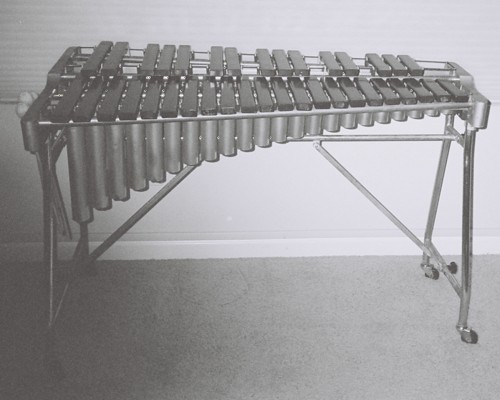
that your marimba has a 3 octave C-to-C range.
Of course it's appropriate to transpose music to fit the range of your instrument. All the better if you can find something that only needs to move by an octave, since that's trivial.
Maybe you would be better off reading Bach from the cello parts in bass clef, playing an octave higher. I don't know if you read bass clef, but if not, it might make more sense to learn bass clef before you learn alto. OTOH, you could really corner the market and get all the gigs for alto-clef-reading mariimba players in your area.
Werner Icking's archive has all this stuff: http://icking-music-archive.org/ http://icking-music-archive.org/ByComposer/J.S.Bach.html
I print these out here, and they look great.
He has the 6 violin suites transposed down for cello, which is what I recommend for you (up an octave), as well as the cello suites, which are easier than the violin suites.
Also he has the cello suites transposed up for violin, which is the way I play them on ext E9 pedal steel, down an octave like guitar players do it.
that your marimba has a 3 octave C-to-C range.
Of course it's appropriate to transpose music to fit the range of your instrument. All the better if you can find something that only needs to move by an octave, since that's trivial.
Maybe you would be better off reading Bach from the cello parts in bass clef, playing an octave higher. I don't know if you read bass clef, but if not, it might make more sense to learn bass clef before you learn alto. OTOH, you could really corner the market and get all the gigs for alto-clef-reading mariimba players in your area.
Werner Icking's archive has all this stuff: http://icking-music-archive.org/ http://icking-music-archive.org/ByComposer/J.S.Bach.html
I print these out here, and they look great.
He has the 6 violin suites transposed down for cello, which is what I recommend for you (up an octave), as well as the cello suites, which are easier than the violin suites.
Also he has the cello suites transposed up for violin, which is the way I play them on ext E9 pedal steel, down an octave like guitar players do it.