Hey Friends,
This topic may have been covered before, but here we are.
Just curious what you all think the 'correct' posture should be for sitting down playing pedal steel, lap steel, etc.?
Do you think your thighs should be parallel to the floor, knees 90 degrees? Your pedal steel adjusted just low enough to grab the levers? Or the pedal steel 'locked in' where you 'climb into' your playing position?
I know every situation is unique. For instance, a very tall player, a very short player, etc. I'm curious how your setup works best for you without wrecking your back and posture?
Also, how do you maintain your posture and body while not performing?
I'd really appreciate your thoughts.
Thanks, have a great day!
Posture While Performing
Moderator: Dave Mudgett
-
Tony Rincon
- Posts: 165
- Joined: 11 Aug 2010 9:09 am
- State/Province: -
- Country: United States
-
Jim Pitman
- Posts: 2049
- Joined: 29 Aug 1998 12:01 am
- Location: Waterbury Ctr. VT 05677 USA
- State/Province: -
- Country: United States
My recommendation may not match others but here are my observations:
Your seat should be high enough that your legs from the knees up should be parallel to the floor or slightly lifted off the front edge of the seat.
The legs of you pedal steel should be long or short enough that you knees have some clearance under the mechanisms but not so far away one must lift a leg to actuate a lever.
IF you mean posture while not playing yet seated at the PSG for any length of time for any reason, I recommend getting a pack-a-seat with a back rest. You can give your back a break once in a while by leaning back against it. I think I don't ever rest against it while playing which may be a backrest depth issue in my case. - It's way back there, yet I appreciate having it.
Buck Reid points out your elbows should be pulled in close to your body while picking. This makes the stroke of you fingers perpendicular to the strings without bending your wrist. In fact he had this recommendation for me after observing my posture.
Hope this is helps.
Your seat should be high enough that your legs from the knees up should be parallel to the floor or slightly lifted off the front edge of the seat.
The legs of you pedal steel should be long or short enough that you knees have some clearance under the mechanisms but not so far away one must lift a leg to actuate a lever.
IF you mean posture while not playing yet seated at the PSG for any length of time for any reason, I recommend getting a pack-a-seat with a back rest. You can give your back a break once in a while by leaning back against it. I think I don't ever rest against it while playing which may be a backrest depth issue in my case. - It's way back there, yet I appreciate having it.
Buck Reid points out your elbows should be pulled in close to your body while picking. This makes the stroke of you fingers perpendicular to the strings without bending your wrist. In fact he had this recommendation for me after observing my posture.
Hope this is helps.
-
Joseph Lazo
- Posts: 350
- Joined: 20 Jan 2024 8:31 am
- Location: Wisconsin, USA
- State/Province: Wisconsin
- Country: United States
I'm kind of surprised this post didn't get more replies.
This comment got my attention, though:
"Buck Reid points out your elbows should be pulled in close to your body while picking. This makes the stroke of your fingers perpendicular to the strings without bending your wrist. In fact he had this recommendation for me after observing my posture."
Having the fingers perpendicular to the strings is one of the biggest problems I have with pedal steel. I'm so used to using just my fingers on "regular" guitar, and having them pluck the strings at a 45 degree angle, that holding my picking hand so that my fingers pluck at a right angle to the strings seems nearly impossible, and really uncomfortable.
So, my right elbow is not pulled in close to my body when playing.
I can't be the only one who finds it really awkward to pluck the strings at a right angle, can I?
Also, another ergonomic issue that hasn't been addressed yet is the position of the arms. Should they be level with the guitar? Or should they be slightly higher? I've seen photos of players with their arms slightly lower than the guitar, and this seems like a really bad idea.
Anyone?
[/i]
This comment got my attention, though:
"Buck Reid points out your elbows should be pulled in close to your body while picking. This makes the stroke of your fingers perpendicular to the strings without bending your wrist. In fact he had this recommendation for me after observing my posture."
Having the fingers perpendicular to the strings is one of the biggest problems I have with pedal steel. I'm so used to using just my fingers on "regular" guitar, and having them pluck the strings at a 45 degree angle, that holding my picking hand so that my fingers pluck at a right angle to the strings seems nearly impossible, and really uncomfortable.
So, my right elbow is not pulled in close to my body when playing.
I can't be the only one who finds it really awkward to pluck the strings at a right angle, can I?
Also, another ergonomic issue that hasn't been addressed yet is the position of the arms. Should they be level with the guitar? Or should they be slightly higher? I've seen photos of players with their arms slightly lower than the guitar, and this seems like a really bad idea.
Anyone?
[/i]
-
Ian Rae

- Posts: 6182
- Joined: 10 Oct 2013 11:49 am
- Location: Redditch, England
- State/Province: -
- Country: United Kingdom
Jim covered most things. I would add that the overriding consideration regarding arm posture is that the wrists should be straight.
Your fingers are making strong repetitive movements, and if the tendons are pulling round a corner then trouble lies ahead.
I used to teach young trumpet players who wanted to hold the instrument so that it looked somehow "cool". I would ask them if they still wanted to be playing at my age, and if necessary I would explain about the ropes and pullies.
At the pedal steel I keep both my wrists straight* and take no notice of my elbows
*to be precise, I keep my left wrist flat - obviously it angles in the horizontal plane
Your fingers are making strong repetitive movements, and if the tendons are pulling round a corner then trouble lies ahead.
I used to teach young trumpet players who wanted to hold the instrument so that it looked somehow "cool". I would ask them if they still wanted to be playing at my age, and if necessary I would explain about the ropes and pullies.
At the pedal steel I keep both my wrists straight* and take no notice of my elbows
*to be precise, I keep my left wrist flat - obviously it angles in the horizontal plane
Make sleeping dogs tell the truth!
Homebuilt keyless U12 7x5, Excel keyless U12 8x8, Williams keyless U12 7x8, Telonics rack and 15" cabs
Homebuilt keyless U12 7x5, Excel keyless U12 8x8, Williams keyless U12 7x8, Telonics rack and 15" cabs
-
Ricky Davis

- Posts: 11558
- Joined: 4 Aug 1998 11:00 pm
- Location: Rocky Top Ranch, Bertram, Texas USA and Liberty Hill, Tx
- State/Province: Texas
- Country: United States
Well knowing Physical Therapy; I can tell you the best posture would be as much "Less Tension" you can have with positions and movements.
Like for example; with Elbows out; you are putting more tension on shoulders. The more knees are bent; the more tension it takes to keep them in that position. The bending of Wrists; puts added tension on tendons and ligaments...
Sitting up straight back; ads best circulation and cutting down on Tensions; will give you the longevity to playing and progression; you want...Go To It!!!!
Show me a pic of you playing and I can probably fix many limits to your playing.
Ricky
Like for example; with Elbows out; you are putting more tension on shoulders. The more knees are bent; the more tension it takes to keep them in that position. The bending of Wrists; puts added tension on tendons and ligaments...
Sitting up straight back; ads best circulation and cutting down on Tensions; will give you the longevity to playing and progression; you want...Go To It!!!!
Show me a pic of you playing and I can probably fix many limits to your playing.
Ricky
Ricky Davis
Email Ricky: sshawaiian2362@gmail.com
Email Ricky: sshawaiian2362@gmail.com
-
Bill C. Buntin
- Posts: 1414
- Joined: 14 Nov 2000 1:01 am
- Location: Cleburne TX
- State/Province: -
- Country: United States
Whatever position you choose to be in that is comfortable. And still maintain all necessary rudimentary movements. There isn’t a true etched in stone standard. I agree with the arms pulled in. I think the forearms should be basically level. This varies a good deal between s10 /s12, universals and sd10/d10. Example, as a d10 player I tend to lean over a bit when on the front neck. My posture then changes more upright on c6.
Reece Anderson was adamant with me at the beginning of my journey. 1-to consistently sit behind fret 15-the same all the time. 2.-Chair or stool of specific height based on my body size etc. legs level and ability to comfortably move the knees. 3. - do not look at your feet. The feet movements have to be second nature. 4- do not look at your right hand. Focus on the bar hand. All of these things have to be second nature. The posture you need to accomplish these things , for me, just naturally became evident.
Reece Anderson was adamant with me at the beginning of my journey. 1-to consistently sit behind fret 15-the same all the time. 2.-Chair or stool of specific height based on my body size etc. legs level and ability to comfortably move the knees. 3. - do not look at your feet. The feet movements have to be second nature. 4- do not look at your right hand. Focus on the bar hand. All of these things have to be second nature. The posture you need to accomplish these things , for me, just naturally became evident.
-
Jeremy Reeves

- Posts: 243
- Joined: 4 Jul 2018 9:13 am
- Location: Springfield, IL, USA
- State/Province: -
- Country: United States
-
Joseph Lazo
- Posts: 350
- Joined: 20 Jan 2024 8:31 am
- Location: Wisconsin, USA
- State/Province: Wisconsin
- Country: United States
So, when playing "regular" guitar, my wrist is straight -- in line with my forearm-- and my fingers contact the strings at a 45 degree angle. I've never had any wrist problems.
Now, with pedal steel, I'm given to understand that my arm should stay right at my side and fingers should pluck perpendicular to the strings. This is a completely unnatural position for my wrist.
It's not like my forearm is angled way off of my body. I just checked and measured the gap between my torso and my right arm... 4". That doesn't seem like a big issue, and I haven't felt any tension in my shoulder, but now I'm wondering if I need to rethink my hand position and try to train myself to hold my hand differently.
Now, with pedal steel, I'm given to understand that my arm should stay right at my side and fingers should pluck perpendicular to the strings. This is a completely unnatural position for my wrist.
It's not like my forearm is angled way off of my body. I just checked and measured the gap between my torso and my right arm... 4". That doesn't seem like a big issue, and I haven't felt any tension in my shoulder, but now I'm wondering if I need to rethink my hand position and try to train myself to hold my hand differently.
-
Jeremy Reeves
- Posts: 243
- Joined: 4 Jul 2018 9:13 am
- Location: Springfield, IL, USA
- State/Province: -
- Country: United States
-
Joseph Lazo
- Posts: 350
- Joined: 20 Jan 2024 8:31 am
- Location: Wisconsin, USA
- State/Province: Wisconsin
- Country: United States
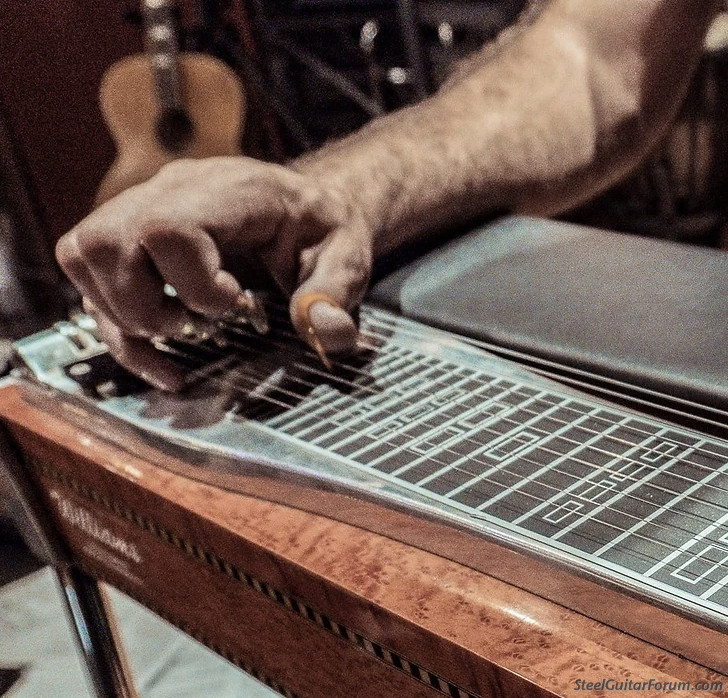
I went looking for shots of right hand position.
This one looks like the wrist is in alignment with the forearm, fingers plucking perpendicular to the strings. This feels unnatural when I try it, like I'm clawing at something...really awkwardly.
This shows Pete Drake's right elbow a few inches from his side, and his wrist angled. This is about how I think my position looks.

This one looks like the wrist is in alignment with the forearm, fingers plucking perpendicular to the strings. This feels unnatural when I try it, like I'm clawing at something...really awkwardly.
This shows Pete Drake's right elbow a few inches from his side, and his wrist angled. This is about how I think my position looks.
-
Ian Rae
- Posts: 6182
- Joined: 10 Oct 2013 11:49 am
- Location: Redditch, England
- State/Province: -
- Country: United Kingdom
-
Fred Treece

- Posts: 4826
- Joined: 29 Dec 2015 3:15 pm
- Location: California, USA
- State/Province: California
- Country: United States
Yes, as close to 90° as possible.Do you think your thighs should be parallel to the floor, knees 90 degrees?
Top of right thigh just clears the back apron when foot is on volume pedal.Your pedal steel adjusted just low enough to grab the levers?
I pay attention to my mom’s voice in the memory banks from when I was 8 years old and turning tall and skinny, telling me to sit or stand up straight. Shoulders back, head high. Also, floor exercises, stretches, walking.Also, how do you maintain your posture and body while not performing?
Regarding the hand position, who better than Buck Reid for advice? I like the fingerpicks to hit the strings straight on. This means my thumb pick strikes strings at an angle, which bugs me a little bit. So whatever lateral angle that means for my forearm, that’s what it is. Elbow not far from rib cage, but definitely not held right against it. Vertical angle of forearm, agree with others - 90°.
-
Dave Russell
- Posts: 14
- Joined: 13 Dec 2024 12:09 pm
- Location: Washington, USA
- State/Province: Washington
- Country: United States
Here is the first of 5 videos that I watched on this topic done by a guy named James Shelton. They were in a group of 162 Youtube videos that someone on here put together on learning E9 Pedal Steel.
https://youtu.be/widGd62mbBA?si=dXe-0EbWspxIWMDv
https://youtu.be/widGd62mbBA?si=dXe-0EbWspxIWMDv
Are you dancing or are you playing music?
Yes.
Yes.
-
Joseph Lazo
- Posts: 350
- Joined: 20 Jan 2024 8:31 am
- Location: Wisconsin, USA
- State/Province: Wisconsin
- Country: United States
Dave, thanks for linking to that excellent video. I wish I had seen that when I first started, but am relieved to see I'm pretty much doing exactly what he recommends doing with the right hand.
Interesting his comment about getting better tone by having the pick hit the string at an angle, rather than straight-on/perpendicular to the string. That's how my fingers hit the strings on "guitar", that's how they're making contact with them on the steel, too.
Like this:

As opposed to this:

Interesting his comment about getting better tone by having the pick hit the string at an angle, rather than straight-on/perpendicular to the string. That's how my fingers hit the strings on "guitar", that's how they're making contact with them on the steel, too.
Like this:
As opposed to this:
-
Dave Russell
- Posts: 14
- Joined: 13 Dec 2024 12:09 pm
- Location: Washington, USA
- State/Province: Washington
- Country: United States
-
Gary Wessels

- Posts: 23
- Joined: 28 Dec 2022 9:35 am
- Location: Vernon, British Columbia, Canada
- State/Province: -
- Country: United States
Here's a little wrinkle to consider:
Jeff Newman, in "right hand alpha", as he's teaching pick blocking, teaches to have the crease in your right hand over the highest string being picked at any given time. I can't see how one can keep their wrist straight and play with the hand oriented so far toward front of the guitar. It's really awkward but he says it'll get better.
I can't really play like that.
He also emphasizes that the only way to get good tone is to have the SIDE of the finger pick the string.
When you watch Buddy, his wrists are straight and he is using the sides of his picks. My hand looks more like his than like Jeff Newman's, but most of my blocking is with picks and fingertips.
Some hot players hold their right hand like JD Crowe did on the banjo, with knuckles flat to the guitar top. Others adopt Buddy's 45 degree angle of the back of the hand.
I'm not sure what to say the right way is.
Anyone have any insights on this?
Gary
Jeff Newman, in "right hand alpha", as he's teaching pick blocking, teaches to have the crease in your right hand over the highest string being picked at any given time. I can't see how one can keep their wrist straight and play with the hand oriented so far toward front of the guitar. It's really awkward but he says it'll get better.
I can't really play like that.
He also emphasizes that the only way to get good tone is to have the SIDE of the finger pick the string.
When you watch Buddy, his wrists are straight and he is using the sides of his picks. My hand looks more like his than like Jeff Newman's, but most of my blocking is with picks and fingertips.
Some hot players hold their right hand like JD Crowe did on the banjo, with knuckles flat to the guitar top. Others adopt Buddy's 45 degree angle of the back of the hand.
I'm not sure what to say the right way is.
Anyone have any insights on this?
Gary
-
Brett Day
- Posts: 5451
- Joined: 17 Jun 2000 12:01 am
- Location: Pickens, SC
- State/Province: -
- Country: United States
I try different things, my right hand stays near the pickup while my arm will rest on my steel's pad or sometimes it doesn't touch the pad. My seat stays near the volume pedal so my right foot can handle the volume pedal and my left foot works the A & B pedals. Since I don't use knee levers a lot, I just let the pedals raise and lower the strings and sometimes I extend the fingers of my right hand.
-
Dave Magram
- Posts: 776
- Joined: 10 Jan 2003 1:01 am
- Location: San Jose, California, USA
- State/Province: California
- Country: United States
Optimal right-hand postures for blocking effectively
I don't believe there is only "ONE Right Way" to shape and position your right hand, because there are several different blocking techniques in use currently, and the "right (optimal) way" depends on which blocking (muting) technique you are using.Gary Wessels wrote: I'm not sure what to say the right way is. Anyone have any insights on this? Gary
I’ve fortunately had the great opportunity to watch a lot of steel guitar players perform live and on video. Here are my observations regarding right-hand "posture and positioning" for muting previously picked notes…
One’s right-hand posture mainly depends on:
● Which technique you are using to block the notes,
● And based on that technique, how high your hand is positioned above the strings--which affects the fingerpick blade angle.
THREE HAND-POSTURES FOR PALM-BLOCKING
1A ) Some players stiffly extend the little finger of their right-hand straight out to flatten out the big crease in their palm, and appear to block only with the edge of their hand. Examples are Lloyd Green, Tom Brumley, and many others. Doug Jernigan uses a rather unusual version of this method in which he anchors his ring finger.
 Lloyd Green
You can see Tom on YouTube with Buck Owens; "Cajun Fiddle" shows Tom's picking style clearly (starts at 0:34 minutes): https://www.youtube.com/watch?v=gZIzsDN_fDQ
This posture causes your hand to stay very close to the strings.
1B ) Some players extend their little finger in a very relaxed way to lightly anchor to the first string, such as Jimmy Day, Bobby Black, Jeff Newman, and many others. This posture also causes your hand to stay very close to the strings.
 Jeff Newman
2 ) Some players curl their little finger (and/or ring finger) under their palm (to “fill in” the big crease in their palm) and use it to block the finger-picked notes. Good examples are Hal Rugg, Jay Dee Maness, and Joe Wright (when he palm-blocks), and many others. This posture causes your hand to rise slightly above the strings.
 Jay Dee Maness
3 ) Buddy Emmons has a unique way of blocking that is a “hybrid” of palm-blocking and fingertip-blocking (aka “pick-blocking”) in that he uses the edge of his hand to palm-block thumb-picked notes and ascending finger-picked notes, and the tip of his ring finger to block descending (middle) finger-picked notes. This allows him to play very fast single-note passages almost as if he were using a flat pick. Buddy Charleton appears to use Emmons’ “hybrid” technique.
As Buddy once described it: "I use (pick with) the thumb and second finger, muting with the palm edge and third finger. There are two occasions for using the palm edge. One, when picking with the thumb, and the other when going from a lower string to one higher. When going from a high string down to a lower string always use the third finger to mute." viewtopic.php?t=323447
This posture causes your hand to stay fairly high above the strings.
 Buddy Emmons
==============================================================.
POSTURE FOR FINGERTIP BLOCKING (aka “PICK-BLOCKING”)
4 ) Paul Franklin himself says in one of his videos that “finger-tip blocking” is a much more accurate description than “pick-blocking” for his innovative technique, because blocking with just the picks is only part of how he mutes the strings. Paul rarely lifts his hand from the strings as palm-blockers do.
Paul explains “fingertip blocking” in just 54 words on one of his blog posts: “For the ascending lines across ten strings, the backside of the thumb blocks (the previous note)… When picking descending lines moving across the ten strings I use the fronts of the ‘webbed’ fingers to accomplish the muting…. For the ascending lines across ten strings, the backside of the thumb blocks in the same fashion” https://paulfranklinmethod.com/tackling-blocking/
This posture causes your hand to stay higher above the strings than palm-blocking techniques 1 and 2, and slightly lower than Buddy’s hybrid technique 3.
 Paul Franklin
==============================================================.
FINGERPICK BLADE ANGLES
Because the different blocking techniques described above require different hand postures and positioning above the strings; fingerpick blade-angles seem to vary depending on the blocking technique being used:
Fingerpick blade-angles (measured from the bands to the tip of the blade) ranged:
● from ~26º for Paul Franklin (a “fingertip blocker”);
● to ~32º for Joe Wright (fingertip blocking & some palm-blocking);
● to ~34º for Buddy Emmons (a “hybrid” style combining fingertip blocking & palm-blocking);
● to ~35º for Bobby Black (mostly a palm-blocker with some fingertip blocking).
I measured the fingerpick blade angles above from photographs, except for Bobby Black, who graciously let me trace the angle of his actual fingerpicks.
Details on: viewtopic.php?t=298186&postdays=0&posto ... c&start=25
- Dave
Last edited by Dave Magram on 6 Jan 2025 8:53 pm, edited 2 times in total.
-
Gary Wessels
- Posts: 23
- Joined: 28 Dec 2022 9:35 am
- Location: Vernon, British Columbia, Canada
- State/Province: -
- Country: United States
-
Alan Struthers
- Posts: 92
- Joined: 4 Jun 2020 2:22 pm
- Location: New Jersey, USA
- State/Province: New Jersey
- Country: United States
-
Dave Magram
- Posts: 776
- Joined: 10 Jan 2003 1:01 am
- Location: San Jose, California, USA
- State/Province: California
- Country: United States
-
Tony Rincon
- Posts: 165
- Joined: 11 Aug 2010 9:09 am
- State/Province: -
- Country: United States
-
J D Sauser

- Moderator
- Posts: 3389
- Joined: 4 Aug 1998 11:00 pm
- Location: Wellington, Florida
- State/Province: Florida
- Country: United States
I think hands are attached to arms and arms to the upper body/shoulders.
The hand position should be relaxed and constant, in other words the picking should ALL come from same finger and hand position and thus the picking HAND should be able to hover over the strings freely to pick high or low string from a constant form and picking technique.
To do that, just like suggest to piano players, the under-arm should be horizontal and not resting on a back neck or one of these "pads", and to do that, the upper body should be vertical and not slouching over the guitar like a toad.
For me, being average height at just shy of 6ft, I find that most "steel guitar"-seats, like Pack'a'Seats are to low (especially when the rather copious cushioning starts to sag) and the result is a bad start to any sort of "posture" from the shoulders on down.
To close:
I've told this story several times.
I took a 3-day course on LapSteel with Maurice Anderson in 2000.
As I was feed instruction at an intensive rate and tried to apply all he tried to show me, Maurice would interrupt me every 30 minutes or hour and tell me to "Pause and re-arrange posture", "Reseat and situp straight!", "Watch that posture!".
It was as intensive as I remember classic horseback riding lessons!
But I must say that every time I stopped, reseated myself up straight, repositioned my lap steel, I played better.
I still to that now every day. Every hour or so, I feel Maurice telling me "watch your posture" and I go on fresh again.
Posture is a big deal... J-D.
The hand position should be relaxed and constant, in other words the picking should ALL come from same finger and hand position and thus the picking HAND should be able to hover over the strings freely to pick high or low string from a constant form and picking technique.
To do that, just like suggest to piano players, the under-arm should be horizontal and not resting on a back neck or one of these "pads", and to do that, the upper body should be vertical and not slouching over the guitar like a toad.
For me, being average height at just shy of 6ft, I find that most "steel guitar"-seats, like Pack'a'Seats are to low (especially when the rather copious cushioning starts to sag) and the result is a bad start to any sort of "posture" from the shoulders on down.
To close:
I've told this story several times.
I took a 3-day course on LapSteel with Maurice Anderson in 2000.
As I was feed instruction at an intensive rate and tried to apply all he tried to show me, Maurice would interrupt me every 30 minutes or hour and tell me to "Pause and re-arrange posture", "Reseat and situp straight!", "Watch that posture!".
It was as intensive as I remember classic horseback riding lessons!
But I must say that every time I stopped, reseated myself up straight, repositioned my lap steel, I played better.
I still to that now every day. Every hour or so, I feel Maurice telling me "watch your posture" and I go on fresh again.
Posture is a big deal... J-D.
__________________________________________________________
Was it JFK who said: Ask Not What TAB Can Do For You - Rather Ask Yourself "What Would B.B. King Do?"
A Little Mental Health Warning:
Tablature KILLS SKILLS.
The uses of Tablature is addictive and has been linked to reduced musical fertility.
Those who produce Tablature did never use it.
I say it humorously, but I mean it.
Was it JFK who said: Ask Not What TAB Can Do For You - Rather Ask Yourself "What Would B.B. King Do?"
A Little Mental Health Warning:
Tablature KILLS SKILLS.
The uses of Tablature is addictive and has been linked to reduced musical fertility.
Those who produce Tablature did never use it.
I say it humorously, but I mean it.