Roger Rettig wrote:I'm getting over-tuning symptoms on my C pedal...
If it's over-tuned that means one or both rods are partially engaging the finger(s) in the neutral position, no slack. If that's the case then, yes, backing out that stop screw on the pedal crank a little to the increase the overall range of travel for the pull should correct the problem. Backing out the stop screw will give the pull rods more slack in the neutral position. If that's the case you might need to re-adjust the pedal height slightly afterward too, that will be obvious.
If the rods both currently have slack when neutral then something else is going on. I've never worked on one of those LLIII counterforce rods, but it possible that could be influencing or inhibiting the pedal's range of motion too.
All lies and jest, still a man hears what he wants to hear and disregards the rest - Paul Simon
I'm intrigued, though. To my knowledge, those pedal-range screws have never been touched in the life of the guitar. I may have caused a problem myself with all the moving around I've been doing.
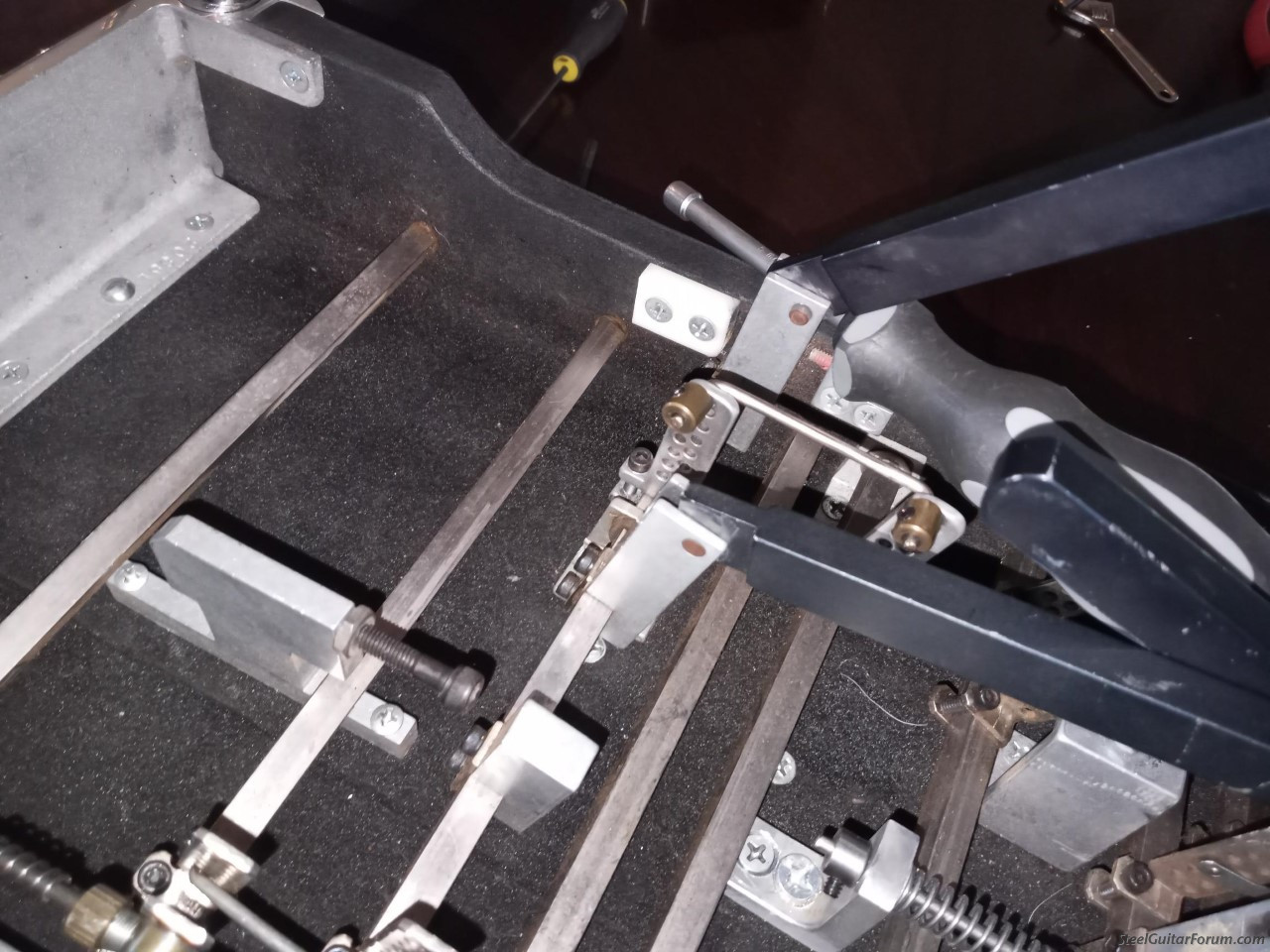
I'm now having to move the knee-lever 'stop' (a white plastic block screwed into the back apron) to allow sufficient movement for raising 1,2 and 7. That lever previously lowered the Es. I will have to drill a new hole and reposition the stop.
Roger Rettig wrote:I'm getting over-tuning symptoms on my C pedal (my #1).
All I see is a set-screw behind the front-apron. I don't think that gives the pedal more room to move but I could, of course, be wrong.
Yes, that screw on the welded piece was designed to give more pedal travel. But it appears your guitar is not working as designed because the pedal-return springs have all been removed. At this point, you probably don't want to replace them, but the likely correction for your problem is still more travel for the cross shaft or pull rods, or using a heavier gauge string.
(I'm probably in the minority, but I would never recommend removal of the pedal-return springs.)
Some steel-tech (I’ve forgotten who) assured me that they were unnecessary. I lack knowledge about these things now but, back then, it was easy to blind me with science.
I still have them, actually, but I believe the screws (eyelets?) went AWOL.
That also reminds me that Bobbe Seymour declared the counterforce to be useless and a waste of money. I don't know, but I do believe mine was disabled years ago. I don't know how to confirm that but the word was that it made the pedals feel heavier.
Come to think of it, several different techs have adjusted things over the years. I'd drive through Nashville on my way home from my Summer gig and get the guitar cleaned. My favourites have been Buck Reid and Tyler Hall. It felt the best after they'd gone through it but they weren't always available.
My changers appear to be 'at rest' (level with each other) although my hex-tuners are all over the place.
I was having some over-tuning issues - particularly on E9 pedals A and C. I've adjusted the pedal travel to allow more room and it's helped a lot. Why that was necessary, I don't know - I never touched the first three pedals at at all in all my alterations.
Jon Light was kind enough to respond to a question and told me to look for 1/8th" inch 'slack when pulling on the hex-tuners. I have almost none which concerns me.
Right now, the guitar plays in tune. I'll check periodically.
I still can't figure out why I have sixteen pedal springs (they were removed from the guitar by an erstwhile tech); all the LeGrande pictures I can find only show one per pedal.
Re: rod slack -- if the guitar is standing up on its legs, gravity & the weight of the pedals will take up that slack. In that case, you may have to pull on the nylon tuner harder than you expect since you are actually pulling the pull train including the pedal. For that reason, it is easier to test for slack with the guitar upside down in its cradle. Nothing wrong with the other way but you can get deceived if you don't pull hard enough.
I give myself 7 out of 10 for effort but things have finally come back to bite me.
Two problems with pulls not returning to pitch: one is my A pedal on E9. It seemed fine at first but now it's returning sharp. Jon has suggested the possibility of rods binding with each other and inhibiting their full range of motion.
It's the same on string 4 on C6 - my A to A# lever is now unpredictable in its return.
Fortunately for me (after having declared publicly that 'I can take care of this myself'!), my old friend Russ Wever is stopping by to visit me tomorrow. I have no doubt he'll diagnose the problems at a glance.
How old are the strings? Older strings will tend to return slightly sharper as they gradually harden over the apex of the changer finger from the repeated motion of pedal/lever changes. This mostly affects plain strings, but should be near the top of the list of things to try when diagnosing this sort of problem.
Steel guitars are fun, aren't they?
All lies and jest, still a man hears what he wants to hear and disregards the rest - Paul Simon
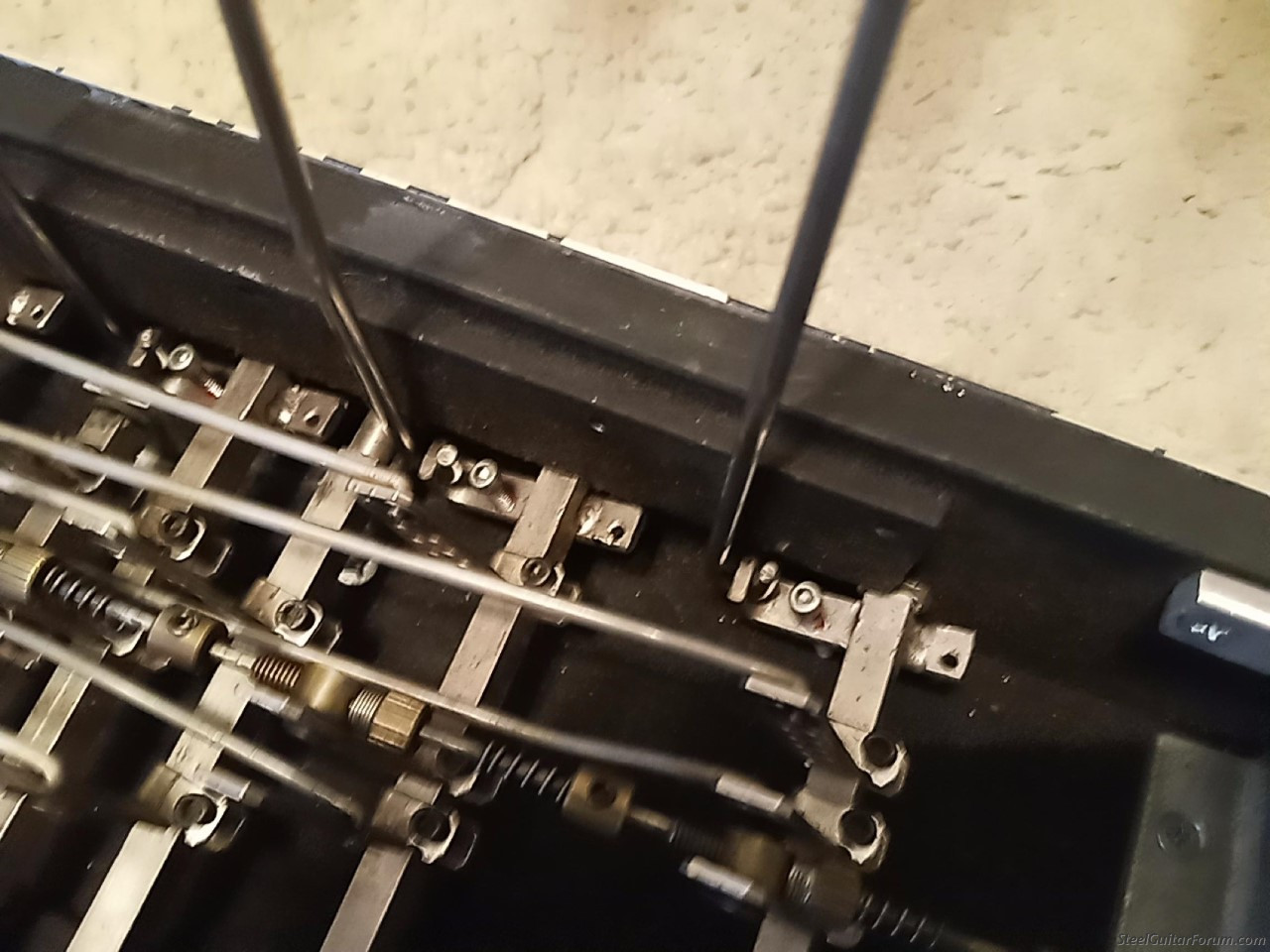
The area around picture #1 up top -- I would not object if you were to post more & better pictures from several angles. I keep looking at that and wishing I could see more & better stuff.
Much. But unfortunately they just make me want to get my hands on it and touch things. There is so much that I'd like to move a hair, straighten, reroute. But it just points out the limits of what *I* can do from afar. I need to touch & move & observe.
I think it needs pulling apart and rerodding, almost from scratch. If it had come from the factory with 8+9, they'd have fitted everything accordingly.
One example of a compromise is the far bell-crank on LKL1. It's pulling strings 1 and 2 because there's simply no room for two bell-cranks at that spot.
Ideally, one should remove existing rods and cranks when adding a new one so that there's room for everything. But those darned E-clips are so frustratingly awkward that I hesitate to remove one unless it's vital. It would feel like 'two steps back and one forward.
Thanks for looking! My old pal Russ Wever is visiting today - I imagine he'll have a suggestion or three.
Roger Rettig: Emmons D10, B-bender Teles, Martins, and a Gibson Super 400!
----------------------------------
I appreciate everyone's input; there have been some invaluable tips.
Russ Wever dropped in and we had a great day! Not only has it been too long since I spent time with my old friend, he also spotted - and fixed - some trouble spots that were buried.
RKR was loose at its mounting and was moving laterally. In addition, a couple of lower-return springs were getting lazy so we turned those a bit. He spotted some loose bell-cranks and did a little rerouting of rods.
One sour spot (C6: p6 + RKR; raising the 4th to A#) is unfixable. It's one of those perpetual rabbit holes (like using the F lever three frets up on E9) that I'd wasted a lot of time on. That loose knee-lever didn't help, though.
Glad you had a successful day with Russ. Pretty aggravating when you have trouble pinpointing a problem, and a 2nd pair of eyes are almost always a benefit as they were here.
Quite so, Dale, and the problems he found could not possibly have revealed themselves to Jon, Norman, Ian or Donny because they lay at the other end.
In any case, lack-of-tension in the lower-helper springs has to be physically diagnosed.
I am going to re-attach the pedal-springs behind the front apron. Donny remarked on it and Russ felt the benefit slightly outweighed any other consideration.
My goodness, that RKR feels better now! The 5th string is consistent and behaving as it should, there's no over-tuning, there's sufficient slack everywhere and it looks far more tidy and 'parallel' underneath.
One thing was watching Russ deal with those darned E-clips. It was an education: he always removed the bell-crank-and-rod and dealt with them far easier off the guitar.
Apparently, the tool I have for fitting/removing them is made for the P/P E-clips which are different from the LeGrande ones. No wonder I struggled with them.