

|
The Steel Guitar Forum Store
Visit Our Catalog for Strings, Instruction, Music and Accessories |
Click Here to Send a Donation
Steel Guitar Links |
Moderator: Brad Bechtel

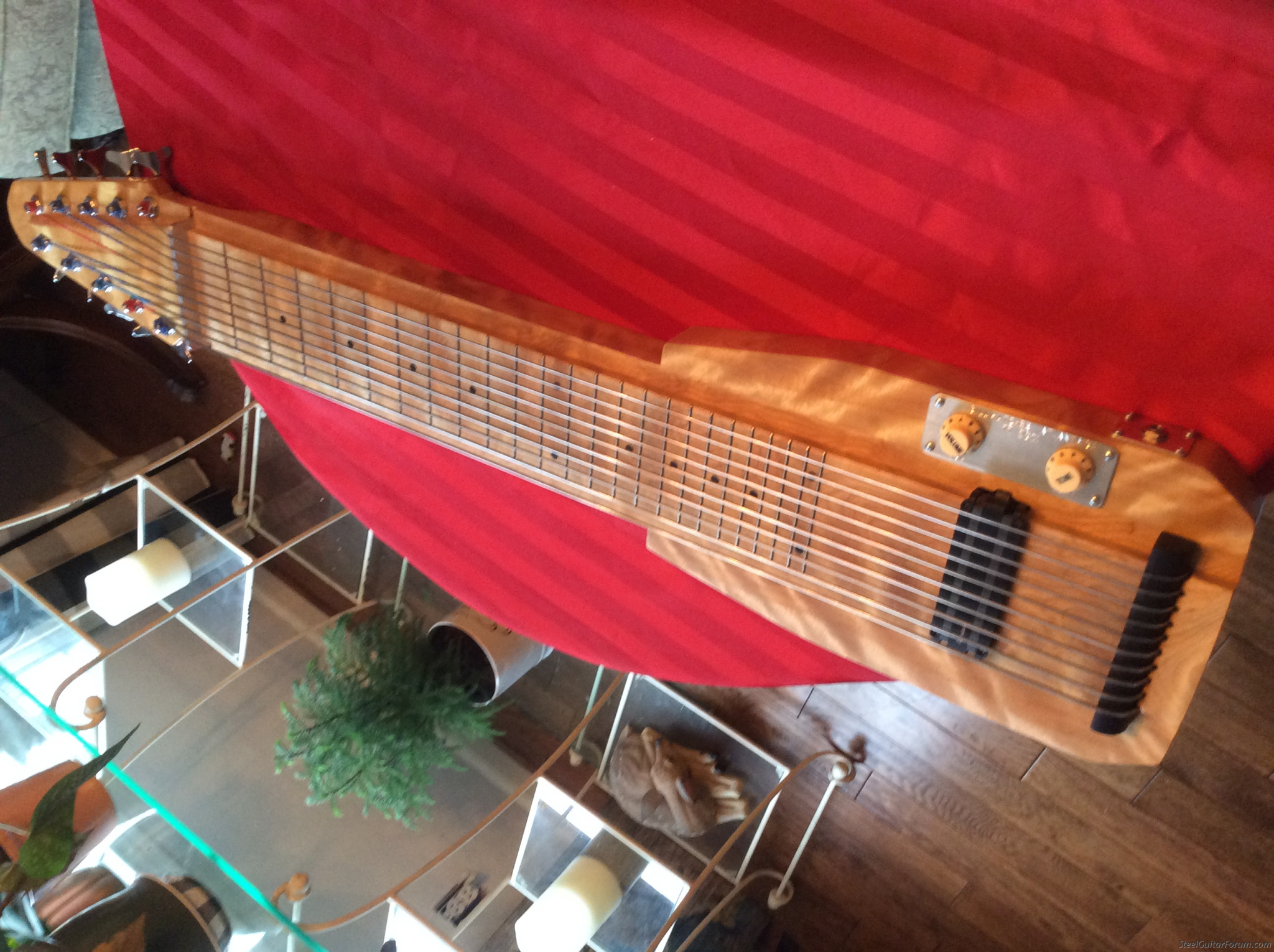
The tuning is E G G# A Bb B C C# D E. The low E can also be tuned down to D to give the 5 under the G. It’s a very unique tuning.David Becker wrote:That is gorgeous! I can only imagine how it sounds. What is the tuning?






Is this lap steel tuned down a full octave, E1 to E3, like a bass guitar? I sure hope that forum member on the receiving end of this deal posts some samples!Bill Hatcher wrote:The tuning is E G G# A Bb B C C# D E. The low E can also be tuned down to D to give the 5 under the G. It’s a very unique tuning.David Becker wrote:That is gorgeous! I can only imagine how it sounds. What is the tuning?
One thing I have discovered with lap basses is the weight of the bar determines the amount of sustain you get. That’s true on any lap steel, but it is even more so on a bass. Big heavy bar....lots of sustain. If you need to play faster and busier lines, then lighten up on the bar.
yes it is down in the elec bass range. i tried to play just a simple tune on it. missed a note or two, but you can see how big and wonderful it sounds. all flat wound strings. 1.10" heavy bar. https://youtu.be/ldVNzowBC9MAllan Revich wrote: Is this lap steel tuned down a full octave, E1 to E3, like a bass guitar? I sure hope that forum member on the receiving end of this deal posts some samples!
WOW! That is so cool. Especially since this is not “your” tuning, you certainly made it sound pretty darned nice.Bill Hatcher wrote:yes it is down in the elec bass range. i tried to play just a simple tune on it. missed a note or two, but you can see how big and wonderful it sounds. all flat wound strings. 1.10" heavy bar. https://youtu.be/ldVNzowBC9MAllan Revich wrote: Is this lap steel tuned down a full octave, E1 to E3, like a bass guitar? I sure hope that forum member on the receiving end of this deal posts some samples!




the nut is made from thick aluminum. i thought about ebony, but there is side pressure after the strings go across the nut and some make minor angles to the post of the gear so the aluminum is better. aluminum is a good material for nuts or bridges. there is reason to think that aluminum transmits the energy to the body faster than other materials like brass. the slots are compensated a little for the big low strings. since you are dealing with playing one string at a time mostly, the compensation is not as critical as with a multistring standard lap where you have to press the bar down and cover lots of strings.JB Bobbitt wrote:Would you please tell us about the nut? Custom? Are the slots compensated for the string diameter? How'd you do that?
For me, that would be the most time-consuming and frustrating part.
Thanks a heap
its all up to YOU now!Steve Atwood wrote:This build was a challenge in many ways, but Bill is an adventurous guy and he likes that. He's patient too when things come up that have to be dealt with and sticks with it until the job is completed up to his very high standards.
First he had to work out what the scale of the guitar should be to get the best sound out of the strings that would be used for the custom tuning. That involves testing strings on a mock-up with a moveable bridge. There was some re-thinking on that when I decided to go for ten strings instead of nine (also on the design of the headstock to accomodate the big tuning machines).
Another challenge was working out an overall length that contained enough mass to provide the best sound and sustain, without being too long and heavy. He thought of a way to put the tuners under the guitar, and as a side project built the four-string bass which you've seen in another thread (viewtopic.php?p=3044726#3044726), but decided that wouldn't be practical for a ten-string.
String gauges for the tuning had to be determined and then strings found online, and they're not all available as single strings, especially flatwounds. Wound lengths and silk lengths vary between string makers.
Other issues came up that I'm not remembering, but the last challenge was string spacing - very painstaking work, coming up with a consistent distance between the outsides of adjacent strings (not on-center because of the thickness of the strings), that would be as wide as possible without the high and low strings being too close to the ends of the pickup.
I'm expecting the guitar to arrive tomorrow and have some ideas for some samples to post.
Thanks Bill!
