Last week I went for my knee lever (7th string raise F# —> G#). As it raised there was a pop and the note went back to F#. Seemed like the nylon tuning nut stripped. I ordered some 3/16†nylon hex bar and cut to length. But getting it on the threaded rod end is a problem. Many posts I’ve found say to manually screw out on to the rod and let the rod thread the nut.
Well, the rod isn’t sharp at the end so I got a starter hole going with a wood screw. But I can not get the rod to go any further. I then tried drilling out the center of the nut. That started out ok but I couldn’t keep it straight.
Anyone have any tips here? I’m just not seeing a good way to do this other than continue attempting to drill a straight hole down the middle. I have four feet of hex bar... but I don’t know if I’ll get anywhere.
Installing new nylon tuning nut
Moderator: Dave Mudgett
-
D. Scheindlin
- Posts: 250
- Joined: 3 Sep 2009 8:20 pm
- Location: Texas, USA
- State/Province: Texas
- Country: United States
-
Dick Wood

- Posts: 3078
- Joined: 2 May 2005 12:01 am
- Location: Springtown Texas, USA
- State/Province: Texas
- Country: United States
-
Gene Tani

- Posts: 1165
- Joined: 14 Mar 2019 8:07 pm
- Location: Pac NW
- State/Province: -
- Country: United States
I recently got tuning nuts from psgparts.com and https://www.williamsguitarcompany.com/s ... ories.html
depending on what size you need
depending on what size you need
- keyless Sonny Jenkins laps stay in tune forever!; Carter PSG
- The secret sauce: polyester sweatpants to buff your picks, cheapo Presonus channel strip for preamp/EQ/compress/limiter, Diet Mountain Dew
- The secret sauce: polyester sweatpants to buff your picks, cheapo Presonus channel strip for preamp/EQ/compress/limiter, Diet Mountain Dew
-
D. Scheindlin
- Posts: 250
- Joined: 3 Sep 2009 8:20 pm
- Location: Texas, USA
- State/Province: Texas
- Country: United States
-
Bobby D. Jones
- Posts: 3312
- Joined: 17 May 2010 9:27 am
- Location: West Virginia, USA
- State/Province: West Virginia
- Country: United States
Most factory made tuning nuts are actually casted in a die with the center hole cast for the thread root diameter of a certain size pull rod, Depending on the make of guitar.
To make those nuts from solid 3/16" hex bar stock is a job in itself. The solid stock has to be turned in an lathe to make a precision hole in the exact center of the stock. If not exact center they will wobble and drag in some changer systems.
There is 3 sizes of center holes needed to match the tuning nut to the rod size. Some steels have 3/32" rods, (GFI + ?). Some use 7/64", (Emmons). and 1/8" (Old MSA + ?).
Then there is different lengths of tuning nuts according to the manufacture. Old MSA's 3/8" long hole drilled completely through. GFI 1 1/2" long with 1" center hole.
I will lathe drill them if you want. If interested E-Mail me here through the forum.
To make those nuts from solid 3/16" hex bar stock is a job in itself. The solid stock has to be turned in an lathe to make a precision hole in the exact center of the stock. If not exact center they will wobble and drag in some changer systems.
There is 3 sizes of center holes needed to match the tuning nut to the rod size. Some steels have 3/32" rods, (GFI + ?). Some use 7/64", (Emmons). and 1/8" (Old MSA + ?).
Then there is different lengths of tuning nuts according to the manufacture. Old MSA's 3/8" long hole drilled completely through. GFI 1 1/2" long with 1" center hole.
I will lathe drill them if you want. If interested E-Mail me here through the forum.
-
Ian Rae

- Posts: 6182
- Joined: 10 Oct 2013 11:49 am
- Location: Redditch, England
- State/Province: -
- Country: United Kingdom
Put the drill bit in the vice and the nut in the drill chuck; in a drill press is best but on the bench is ok too if you make a guide from a scrap of wood.
Delrin machines better that nylon.
Delrin machines better that nylon.
Make sleeping dogs tell the truth!
Homebuilt keyless U12 7x5, Excel keyless U12 8x8, Williams keyless U12 7x8, Telonics rack and 15" cabs
Homebuilt keyless U12 7x5, Excel keyless U12 8x8, Williams keyless U12 7x8, Telonics rack and 15" cabs
-
D. Scheindlin
- Posts: 250
- Joined: 3 Sep 2009 8:20 pm
- Location: Texas, USA
- State/Province: Texas
- Country: United States
-
D. Scheindlin
- Posts: 250
- Joined: 3 Sep 2009 8:20 pm
- Location: Texas, USA
- State/Province: Texas
- Country: United States
Well I can’t do anything with the hex bar. Just don’t have the right tools. I ordered some nuts from Williams - way too short. Bobby, somehow I missed your generous offer but emailed you a couple days ago.
In the meantime, I was playing on Monday and went to drop my Es and nothing happened on the 4th string. That nut is no longer holding either and to make matters worse, for some reason that rod is split into two lengths coupled by a hex nut and that was stripped as well.
Thursday I finally had a few moments to think about it and a lightbulb went off. First I took one of the new too-short nuts and drilled it through on both sides to use as a coupling nut for the two-piece rod. The rod threads are pretty light so I put a few drops of cyanoacrylate on the threads first and that’s now solid. Then for the rod end at the changer, I took the old stripped nut, cut it down to size and drilled through it, widening it enough that it would slide along the rod without binding. I put that on the rod end first and then put one of the new nuts on the very end. This gives me the length I need to tune up properly. Not perfect, but it does the job and seems to be holding stable!
In the meantime, I was playing on Monday and went to drop my Es and nothing happened on the 4th string. That nut is no longer holding either and to make matters worse, for some reason that rod is split into two lengths coupled by a hex nut and that was stripped as well.
Thursday I finally had a few moments to think about it and a lightbulb went off. First I took one of the new too-short nuts and drilled it through on both sides to use as a coupling nut for the two-piece rod. The rod threads are pretty light so I put a few drops of cyanoacrylate on the threads first and that’s now solid. Then for the rod end at the changer, I took the old stripped nut, cut it down to size and drilled through it, widening it enough that it would slide along the rod without binding. I put that on the rod end first and then put one of the new nuts on the very end. This gives me the length I need to tune up properly. Not perfect, but it does the job and seems to be holding stable!
-
Bobby D. Jones
- Posts: 3312
- Joined: 17 May 2010 9:27 am
- Location: West Virginia, USA
- State/Province: West Virginia
- Country: United States
-
Ian Rae
- Posts: 6182
- Joined: 10 Oct 2013 11:49 am
- Location: Redditch, England
- State/Province: -
- Country: United Kingdom
-
D. Scheindlin
- Posts: 250
- Joined: 3 Sep 2009 8:20 pm
- Location: Texas, USA
- State/Province: Texas
- Country: United States

-
Larry Bressington
- Posts: 2818
- Joined: 6 Jul 2006 12:01 am
- Location: Nebraska
- State/Province: Nebraska
- Country: United States
Just a tip on installing new nylon tuners, they can be very tight to install new when they are cutting a new thread and sometimes the rod will bind up and twist. I have found that using a battery operated screwdriver to be the answer, or maybe a slow drill with socket on the end. Run the nylon in and out half dozen times until it's still firm but usable by hand to turn. When these are made the holes are undersized and meant to cut as they are installed, otherwise they would be sloppy and have no wear and tear life on them.
-
Bobby D. Jones
- Posts: 3312
- Joined: 17 May 2010 9:27 am
- Location: West Virginia, USA
- State/Province: West Virginia
- Country: United States
When there is a shortage of plastic/nylon tuning nuts, If you do not have access to a lathe and tooling it is near impossible to make tuning nuts unless you had a jig made on a lathe to start the drill and maintain center in the plastic/nylon rod stock you can buy. Here is a picture of the set up I used to make Tuning Nuts for Mr. Scheindlin.
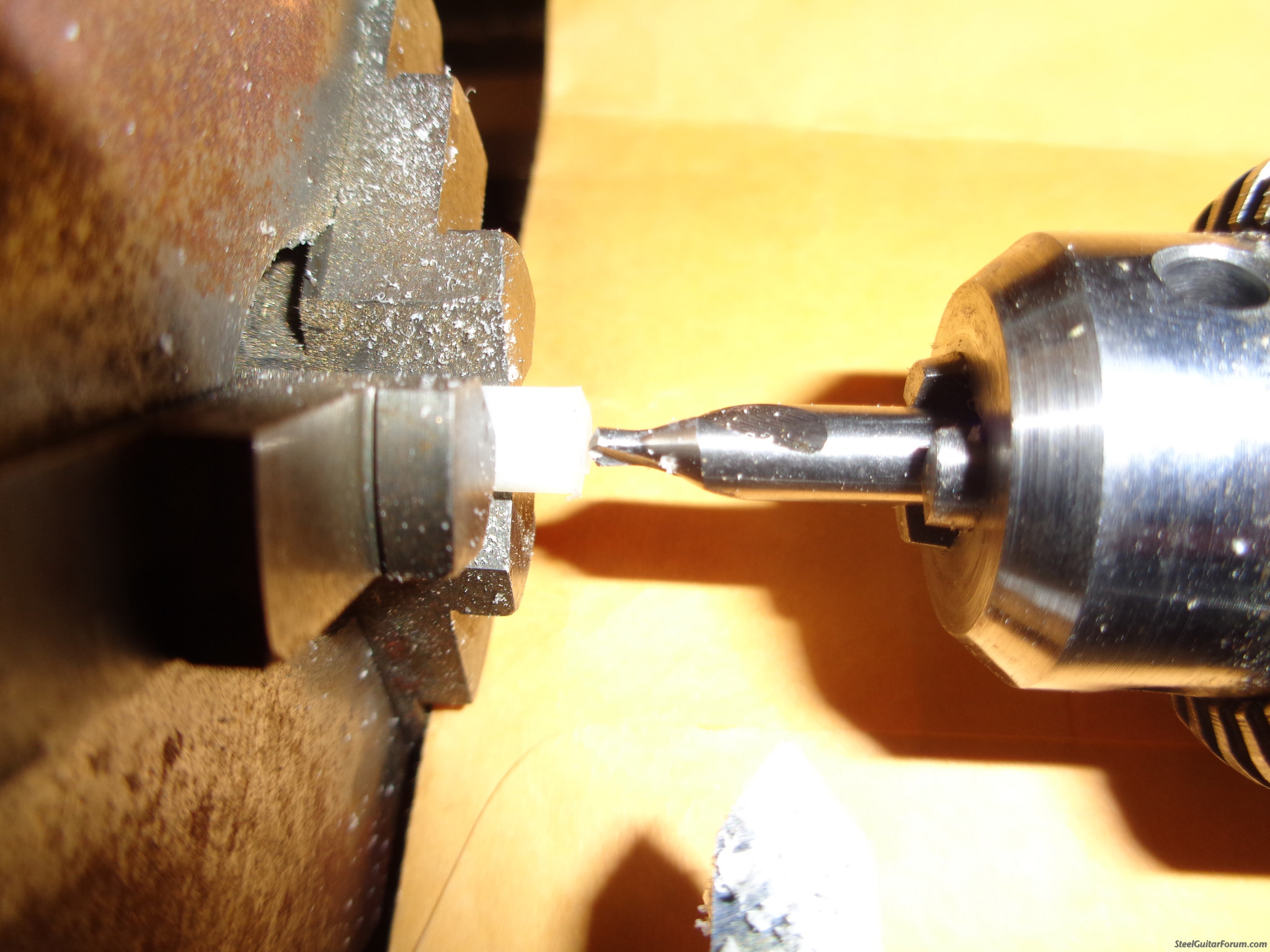
The drill bit is called a center drill, Is a specific tool to drill in the exact center of a rod or shaft, For Tail stock support or to start drill bits exact in the center.
The drill bit is called a center drill, Is a specific tool to drill in the exact center of a rod or shaft, For Tail stock support or to start drill bits exact in the center.