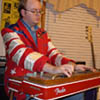
Those anchors or extensions you see at the bridge are factory. the purpose was to shorten the length of the string to prevent breaking.That is one fine 400 guitar. More than likley a 57 model.
That's the same nut and bridge as Sneaky's. My '57 1000 Does NOT have the roller nut or bridge, BTW.<font size="1" color="#8e236b"><p align="center">[This message was edited by Jim Sliff on 06 December 2005 at 09:09 PM.]</p></FONT>
Jim those roller bridges were an in field modification done by saleman and Fender Service Centers. Shortly after the factory then made them stock from production. It is obvious if you have no bridge assembly as that shown in the photo, it was not modified in the field or at an "Authorized Fender Service Center" This information can be obtained in Richard Smith's book "Fender The Sound Heard Round The World".
Most of the early-types (flat pickup) that I've seen don't have the "in field" modification. It'd be interesting to look at one closely and compare it to the roller nuts on later guitars to see what COULD be used as roller nuts/brideges on the ones with straight bars.
Although my bar-type 1000, which I lube with dry Teflon lubricant, hasn't broken a string yet.
Followup - I just compared the pictures to my 1000, and 1) the bridge uses completely different positions for mounting holes. The stock ones use two vertical screw-through plates at the hog rings while the "upgrade uses 4 screws into the body; 2) the stock nut is mounted with two screws through the top - the mounting on the "upgade" isn't apparent. The "field modification" had to be pretty complicated with a bunch of drilling involved.<font size="1" color="#8e236b"><p align="center">[This message was edited by Jim Sliff on 06 December 2005 at 09:14 PM.]</p></FONT>
I wouldn't mind having rollers on mine. Maybe we can all chip in and have some made.
Tommy Spurlock in Texas said he had some made for his guitars. I'll call him and see if he has any extra. When I talked to hin a few months ago he said he was having a bunch of parts made. He plans on carrying on the Sneaky Pete legacy and is converting old cable guitar to rods.
I was also thinking about talking to Gene Parsons who invented the B-Bender. He is a master machinest and has a shop 2 hours away. He also plays old Fender PSGs and he would understand what we're after. He charges $50 an hour just to draw the plans for the parts so I may try to generate some interest and sell some parts just to hopefully break even. I have some ZB parts in mind for him too.
Hopefully I'll move ahead on this after the Holidays.
Dave
I'll let you know.<font size="1" color="#8e236b"><p align="center">[This message was edited by Dave Zirbel on 07 December 2005 at 09:00 AM.]</p></FONT>
Gary - how about I send you the bridge and nut off my C6 1000 neck to measure for dimensions and mounting? I could include pics of the existing mounting as well.
I too am interested in this. I wonder if the great tone we all love from these guitars will be lost in switching to a roller nut. I'm looking forward to the results.
Patrick
Actually it seems to be working pretty well! I've just been busy and forgot to answer. The only downside is string changing - the moving parts tend to use gravity and go upside-down. When playing they work fine, though, with no discernable difference in tone.
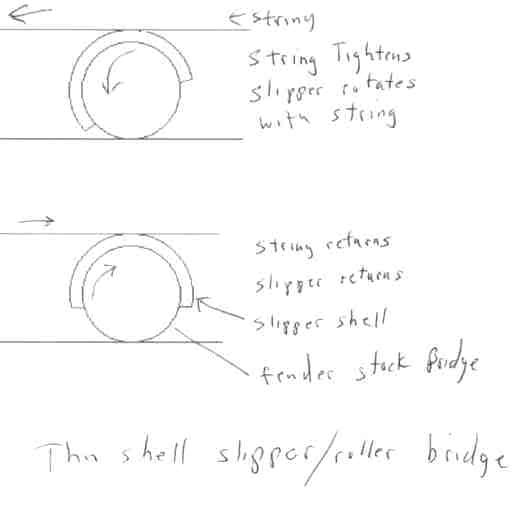
jim. i made those "slipper shells" so they would snap off the bridge by pulling up on them. as you put one string on you could snap the shell on first or leave the new string loose enough to pull it up and snap the shell on under it.
this pic is posted on a couple of other threads. hot subject right now. Here's what Gary made - when I changed strings I didn't even them out...that's why the gaps...but it makes no difference. They work great. this neck is tuned to the top-8 of E9, and I have yet to break a 3rd...or any...string, and it's ben used a lot. Proof's in the pudding, and this is a great idea that works!
The hognose rings probably make more difference in string breakage than the bridge. With the rings the string ball end is at about a 45 degree angle - without and attached directly to the changer, it's nearly 90 degrees, and a weak spot in the system.