I have a single neck C6th Carter professional - yes, I bought it that way because my interest is more in writing and recording music than in playing in a bar band. I have five foot pedals and four knee levers installed. I have changed pedal 1 (4, on a doubleneck) to give me Bb's instead of B's. Jeff Lampert and some other posters recommend that you put this change on a knee lever, so that it can be combined with pedal changes. What would you recommend for the changes to be put on LKL, LKR, and RKR? I want to keep the RKL and the last four pedals standard so that I can still use tab. I could add a L vertical pedal if it seems worthy (I almost certainly will be sending her off to Carter to do the mechanics, unless there is a better alternative). Currently my LKL drops the middle G to F, the LKR drops the high E to D, the RKL is standard (C to B) and the RKR drops both A's to Ab. I have a G on top and want to keep that, and the second pedal (5 on a doubleneck) raises the top G to a Ab as well as doing the standard things. I don't think I could handle the complexity and oddity of Paul Franklin's tuning.
P.S. (I LOVE bar bands, I'm just too old and settled to DO that anymore....)
Recommend knee levers for C6th - technical
Moderator: Dave Mudgett
-
David Mason

- Posts: 6079
- Joined: 6 Oct 2001 12:01 am
- Location: Cambridge, MD, USA
- State/Province: -
- Country: United States
-
C Dixon
- Posts: 7332
- Joined: 4 Aug 1998 11:00 pm
- Location: Duluth, GA USA
- State/Province: -
- Country: United States
-
Bobby Lee

- Site Admin
- Posts: 14863
- Joined: 4 Aug 1998 11:00 pm
- Location: Cloverdale, California, USA
- State/Province: -
- Country: United States
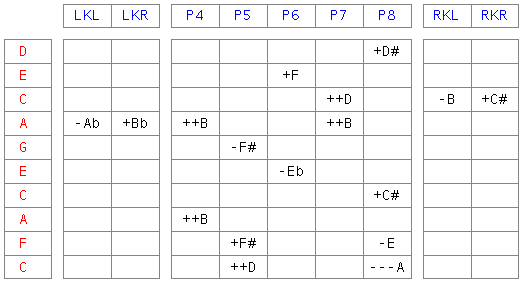
I think that Buddy Emmons' C6th pretty much covers all the bases:
<center>
</center>
------------------
<small><img align=right src="http://b0b.com/b0b.gif" width="64" height="64">Bobby Lee - email: quasar@b0b.com - gigs - CDs
Sierra Session 12 (E9), Williams 400X (Emaj9, D6), Sierra Olympic 12 (C6add9), Sierra Laptop 8 (D13), Fender Stringmaster (E13, A6),
Roland Handsonic, Line 6 Variax
<center>
</center>
------------------
<small><img align=right src="http://b0b.com/b0b.gif" width="64" height="64">Bobby Lee - email: quasar@b0b.com - gigs - CDs

Sierra Session 12 (E9), Williams 400X (Emaj9, D6), Sierra Olympic 12 (C6add9), Sierra Laptop 8 (D13), Fender Stringmaster (E13, A6),
Roland Handsonic, Line 6 Variax
-
David L. Donald

- Posts: 13700
- Joined: 17 Feb 2003 1:01 am
- Location: Koh Samui Island, Thailand
- State/Province: -
- Country: United States
I have been in discussion with Crowbear about this till the phone died and he needed sleep.
Trying to find that
G to C9 C#m7b5 D9 classic passing chord thang.
I think on the BE C6 that could be
RKR w P4 or am also asleep?
(Next morning...) I think C#dim would be a correct passing chord here also. P5 for 1st inversion? But for 2nd or 3rd inversion I am at a loss still.<FONT SIZE=1 COLOR="#8e236b"><p align=CENTER>[This message was edited by David L. Donald on 12 March 2003 at 02:30 AM.]</p></FONT>
Trying to find that
G to C9 C#m7b5 D9 classic passing chord thang.
I think on the BE C6 that could be
RKR w P4 or am also asleep?
(Next morning...) I think C#dim would be a correct passing chord here also. P5 for 1st inversion? But for 2nd or 3rd inversion I am at a loss still.<FONT SIZE=1 COLOR="#8e236b"><p align=CENTER>[This message was edited by David L. Donald on 12 March 2003 at 02:30 AM.]</p></FONT>
-
Sam Minnitti
- Posts: 192
- Joined: 11 Mar 2002 1:01 am
- Location: New Rochelle, NY
- State/Province: New York
- Country: United States
I am in the process of contemplating additional knees for my C6 neck as well, but would like to keep it to 4 knee levers total for that neck. I have to make the decision to either raise string 3 or lower string 5 on RKR. I see Buddy does not have the string 5 whole tone drop. Comments invited
Also, can someone give examples of how they might use the ½ step raise on string 1 (pedal as shown in Buddy’s setup.
Thanks
Also, can someone give examples of how they might use the ½ step raise on string 1 (pedal
as shown in Buddy’s setup.Thanks
-
Al Marcus

- Posts: 9440
- Joined: 12 May 1999 12:01 am
- Location: Cedar Springs,MI USA (deceased)
- State/Province: -
- Country: United States
David-You are thinking! That LKL middle G to F (5thstring)is an important pull if you want to get deep into chords. Reece used that on his Bb6 tuning about 30years ago. I use it on my E6 tuning , on mine it is B to A. resolves down to the subdominant.
Your LKR E to D(2nd string) is also very good, gives the D top for your D7-9 chord and also a sus. chord.
But on that knee lever I would also put the 6th string E to D and that with the LKL would give you a full F6 Subdominant for one thing.
Reece used all these pulls to get his very modern jazz sounds.
I won't go into a full explanation of other things you can do with it for now. Going to bed...al
Your LKR E to D(2nd string) is also very good, gives the D top for your D7-9 chord and also a sus. chord.
But on that knee lever I would also put the 6th string E to D and that with the LKL would give you a full F6 Subdominant for one thing.
Reece used all these pulls to get his very modern jazz sounds.
I won't go into a full explanation of other things you can do with it for now. Going to bed...al
-
Jeff Lampert
- Posts: 2696
- Joined: 8 May 2000 12:01 am
- Location: queens, new york city
- State/Province: New York
- Country: United States
David M.,
I agree with everyone who suggests using BE's setup as sort of a 4-knee lever C6 standard. However, it should be noted that the 3rd string C->C# raise was developed in the context of having a D note on the 1st string. It provided a way to get the first string G note (and C6 chord inversion with G on top) for those players that opt to have a first string D note instead, by simply moving up 3 frets and engaging the C->C# pull. However, since you are keeping the G note on top, the C->C# pull is less useful, although any pull obviously has value. Also keep in mind that you can get the 3rd string C# note by split-tuning pedal 7 with RKL which lowers string 3 from C->B. It's clumsy, and you have to be aware of the 4th string being pulled, but the note is there. On the other hand, there is no F note available. I agree with Carl and feel that the G->F pull has tremendous use, providing an otherwise unavailable note. Another option is to lower the E to D to provide another unavailable note, but the harmonies are much less interesting with the D note than they are with the F note. With all that being said, it probably is still best to use BE's setup as a launching pad from which to figure out what else you want and what you don't need. .. Jeff
------------------
Jeff's Jazz
I agree with everyone who suggests using BE's setup as sort of a 4-knee lever C6 standard. However, it should be noted that the 3rd string C->C# raise was developed in the context of having a D note on the 1st string. It provided a way to get the first string G note (and C6 chord inversion with G on top) for those players that opt to have a first string D note instead, by simply moving up 3 frets and engaging the C->C# pull. However, since you are keeping the G note on top, the C->C# pull is less useful, although any pull obviously has value. Also keep in mind that you can get the 3rd string C# note by split-tuning pedal 7 with RKL which lowers string 3 from C->B. It's clumsy, and you have to be aware of the 4th string being pulled, but the note is there. On the other hand, there is no F note available. I agree with Carl and feel that the G->F pull has tremendous use, providing an otherwise unavailable note. Another option is to lower the E to D to provide another unavailable note, but the harmonies are much less interesting with the D note than they are with the F note. With all that being said, it probably is still best to use BE's setup as a launching pad from which to figure out what else you want and what you don't need. .. Jeff
------------------
Jeff's Jazz
-
Buck Dilly
- Posts: 1340
- Joined: 17 May 2001 12:01 am
- Location: Branchville, NJ, USA * R.I.P.
- State/Province: -
- Country: United States
Dave-I resisted changing the hi G to a D for a while. Adding the C to C#change helps resolve that. The hi D gives so many other new options that is it is really worth trying. I like the basic Emmons changes but have recently decided adding 3 knees. Adding low E up to F rather than G down to F, either is good. I have also opted for raising the low C to D rather than lowering the E to that D. Both are useful but different. If you have only 4 knees perhaps you should consider adding a few more, as long as you are having some work done? I worked with 4 knees for 2 years before deciding on changes. I tuned up those string to the new changes to see how useful they would really be.