Ha ha! I guess I didn't tell you about your signature model? My fault.
I think a really fun about about learning about the metal working side of things is learning about the tools. Because there's no 'finessing' with steel (you can't just sand by hand), and obviously a big part of the economy is driven by things built with steel there has been a huge amount done to come up with tools that make steel do what you want it to. Shears as big as a room, flangers, bead rollers... there's a tool for it all. Contrast that with the wood working side, I have a router and I make jigs so the router can do different things.
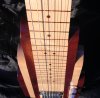
It was like that with soldering. Of course it was tough in the beginning, because there is THE tool for it, and I wasn't using it. And for rounding over the edges (see above picture) I use a flap sander on my grinder to rough them in (carefully) then a different type of flap sander on my drill to get an even roundness and then an orbital sander to polish it up.
There's a reason some guitar makers sign their e-mails to each other 'Keep Sanding' and for these there is no escape. The steel must be brought up to a shine because that will give the natural translucency needed for the patina. Carborundum is a brand favored by auto body guys, and it cuts fast. Great stuff. I start out at 220. Then 320, 400, then 600. It took a bit to get used to what going through the grits looks like on steel. When I get to 600, I really use up the disc and it starts to polish quickly. You can see in the picture the shine achieved with a couple worn 600 grit disc, and then the last two #'s of steel wool. I keep those worn 600 grits around for the patina.
And then the patina. I went to estate sales and bought old saws, looked online at rusty box cars, perused knife maker forums and talked to print makers. I had the idea of what I wanted in my head. The trouble with most patinas is 1) They aren't translucent and 2) They aren't dichromatic- they don't have more than one color. An old cabin is attractive because your eye sees different shades of color. Violin makers use a light stain under a dark stain and then sand through in places because it's pleasing to the eye. So I had an idea of what I was looking for but going about finding it was a chore.
Print maker's (and knife makers) use ferric chloride as an 'etchant'. It eats away at the soft parts of the steel and leaves a pretty beautiful patina. Printmakers will 'draw' (more complicated than that) on brass with wax etc. so the pattern isn't removed by the FC. The problem I discovered was 1) print makers tanks are big, kept warm, and aerated. Essential to the process, and though I tried there wasn't really a way to do it on a big guitar, especially repeatedly. 2) As I found out from the head sword maker at zombietools.com,- yes, I searched EVERYWHERE- knife makers use a higher carbon steel than the mild steel I use. The FC never gave me any sort of patina. It just turned things gray. The same happened when using vinegar- another knife maker trick.
So I kept looking. You can't just rust it, it will keep rusting. (Although in some cases you can add potassium dichromate as a rust stop). Adding patina to steel has been around a long time, and there a huge number of chemicals and application methods (Hot, cold, buried, submerged etc). The chemicals I ended up using is sort of a diluted gun bluing chemical (although not technically) and a chemical used on cast iron Japanese tea pots. The patinas don't work on the silver solder, so stained glass window makers have a sulfuric acid patina to darken solder. I use that to blend it in.
I won't rehash the amount of time I spent on things that didn't work. I shudder to think of it. Even the place that makes the patinas didn't know how to use them. If someone taking on such a project and needs direction, get a hold of me and I can help you. The trick is keeping things subtle by making a base, accenting it in spots, blending with the worn 600 grit pad to make the accents subtle, steel wool-ing to restore translucency and then hot applying the Japanese brown. It's hard to get a picture of it, but you can see a translucent palette of grays and browns. The patina isn't on the metal, it IS the metal and that's what makes it natural. Butcher's Bowling Alley Wax is preferred by metal guys, you apply it hot so it gets in the pores and the surface moisture isn't trapped under the wax it dries hard and you buff it out.


A closer shot of the patina: