Hi all,
I took an interest in the pedal steel about a year ago when I got to hang out with Tim Wright for a couple of afternoons here in Indianapolis. I'd never seen one up close before that, found it pretty fascinating. Since then I've lurked around this site occaisionally, reading up on the subject. My background is in keyboards, but I've dabbled with guitar and a number of other instruments. I'm 27.
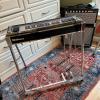
I just bought an old MSA Sidekick. $250 including a Goodrich pedal. (Good deal?) It's in just-OK shape cosmetically but the mechanics seem sound. The thing is, at some point it's had a 2nd knee lever installed. When I got it home, neither of the knee levers were set up for any of the common copedents I could find online, so I took them apart and got the RKR lever dropping both E's to Eb/D#, which was the factory setting and seems to be pretty common. Any suggestions for a good way to use the 2nd knee lever?
New member & advice needed
Moderator: Dave Mudgett
-
Michael Hutchison
- Posts: 55
- Joined: 15 Sep 2011 9:39 am
- Location: Indianapolis, USA
- State/Province: Indiana
- Country: United States
-
Paul Sutherland
- Posts: 2742
- Joined: 8 Mar 2007 3:45 pm
- Location: Placerville, California
- State/Province: California
- Country: United States
Raise both Es to F.
If you can't do that, due to limitations of the guitar's changer, then the second best option, IMO, would be to lower the second string from D# to D, and lower the ninth string from D to C#.
Alternatively on the second best option, you could lower the second string a half tone and raise the eighth string a half tone. That gives you a bit of both the first option and the second.
If you can't do that, due to limitations of the guitar's changer, then the second best option, IMO, would be to lower the second string from D# to D, and lower the ninth string from D to C#.
Alternatively on the second best option, you could lower the second string a half tone and raise the eighth string a half tone. That gives you a bit of both the first option and the second.
-
Michael Hutchison
- Posts: 55
- Joined: 15 Sep 2011 9:39 am
- Location: Indianapolis, USA
- State/Province: Indiana
- Country: United States
-
b0b

- Posts: 29079
- Joined: 4 Aug 1998 11:00 pm
- Location: Cloverdale, CA, USA
- State/Province: -
- Country: United States
RKL is a good idea for the E lowers. LKL is the most common place for the E raises, as it works naturally with the first pedal.Michael Hutchison wrote:I didn't think about it at the time, but would I have been smarter to set up the RKL lever to lower the E's, so the RKR lever can raise them? This seems more intuitive. Is that how most people do it?
-𝕓𝕆𝕓- (admin) - Robert P. Lee - Recordings - Breathe - D6th - Video
-
Paul Sutherland
- Posts: 2742
- Joined: 8 Mar 2007 3:45 pm
- Location: Placerville, California
- State/Province: California
- Country: United States
-
Michael Hutchison
- Posts: 55
- Joined: 15 Sep 2011 9:39 am
- Location: Indianapolis, USA
- State/Province: Indiana
- Country: United States
-
b0b
- Posts: 29079
- Joined: 4 Aug 1998 11:00 pm
- Location: Cloverdale, CA, USA
- State/Province: -
- Country: United States
That's not what I suggest. Many pro players see an advantage in having the E lowers on the right knee (typically RKL), and the raises on the left (LKL). We've had that argument before, and I agree with them.Paul Sutherland wrote:Most steel are now sold with the E lowers on LKR, and the E raises on LKL, as Bob suggests.
You are correct that most steels are now sold with with the E lowers on LKR, but many players move it to RKL after a few years of experience. It gives you smoother changes in the A+F position.
-𝕓𝕆𝕓- (admin) - Robert P. Lee - Recordings - Breathe - D6th - Video
-
b0b
- Posts: 29079
- Joined: 4 Aug 1998 11:00 pm
- Location: Cloverdale, CA, USA
- State/Province: -
- Country: United States
I would set up the other right lever to lower string 2 a half step, then explore the option of adding a LKL for the E to F changes. It's not difficult to add a knee lever to those old guitars, and having the F changes on LKL is very standardized.Michael Hutchison wrote:Well, for me it will have to be RKR & RKL one way or another, because those are the only two levers I've got! Thanks for the help.
BTW, $250 was a killer deal for the MSA Sidekick + Goodrich pedal. You done good.
-𝕓𝕆𝕓- (admin) - Robert P. Lee - Recordings - Breathe - D6th - Video
-
Michael Hutchison
- Posts: 55
- Joined: 15 Sep 2011 9:39 am
- Location: Indianapolis, USA
- State/Province: Indiana
- Country: United States
-
Paul Sutherland
- Posts: 2742
- Joined: 8 Mar 2007 3:45 pm
- Location: Placerville, California
- State/Province: California
- Country: United States
-
Dave Grafe

- Posts: 5372
- Joined: 29 Oct 2004 12:01 am
- Location: Hudson River Valley NY
- State/Province: -
- Country: United States
-
b0b
- Posts: 29079
- Joined: 4 Aug 1998 11:00 pm
- Location: Cloverdale, CA, USA
- State/Province: -
- Country: United States
You only get half of the functionality of the 2nd string if you don't lower it to D on a knee lever.
Sho-Bud Mavericks came with just one lever. It combined the two most essential knee lever changes: lower 2 D# to D and lower 8 E to D#. You wouldn't normally use these changes together, but they do give you the most bang for the buck when you only have one lever to play with. Shot Jackson had a stroke of brilliance there.
Sho-Bud Mavericks came with just one lever. It combined the two most essential knee lever changes: lower 2 D# to D and lower 8 E to D#. You wouldn't normally use these changes together, but they do give you the most bang for the buck when you only have one lever to play with. Shot Jackson had a stroke of brilliance there.
-𝕓𝕆𝕓- (admin) - Robert P. Lee - Recordings - Breathe - D6th - Video
-
Rex Thomas

- Posts: 1202
- Joined: 17 Jan 2002 1:01 am
- Location: Thompson's Station, TN
- State/Province: Tennessee
- Country: United States
knees, knees, & more knees
Tim Wright, he's a pretty good guy to hang out with. 
My 1st Sho-Bud was a 6139 as b0b describes & had that same knee setup; D#-D, E (8th)-D#. And yes, there are a ton of good licks on that lever alone. For me, I see more use with 4&8 +1/2 as I like that extra set of major chords it brings, but yeah, you'd be better served to get a LKL 4&8 raise 1/2 that works with the 1st pedal (5&10 +1).
So RKL 4&8 -1/2. (Yeah, 4&8 -1/2 really should be on RKL) On RKR, 2 is down a half, & since you're already dropping 8 -1/2 on RKL, I'd suggest having RKR dropping both 2&9 (D) down a half. That's also a pretty standardized setup.
Yep, them knees, them knees.
Also chiming in, yep, you sure did done good on that MSA deal!
My 1st Sho-Bud was a 6139 as b0b describes & had that same knee setup; D#-D, E (8th)-D#. And yes, there are a ton of good licks on that lever alone. For me, I see more use with 4&8 +1/2 as I like that extra set of major chords it brings, but yeah, you'd be better served to get a LKL 4&8 raise 1/2 that works with the 1st pedal (5&10 +1).
So RKL 4&8 -1/2. (Yeah, 4&8 -1/2 really should be on RKL) On RKR, 2 is down a half, & since you're already dropping 8 -1/2 on RKL, I'd suggest having RKR dropping both 2&9 (D) down a half. That's also a pretty standardized setup.
Yep, them knees, them knees.
Also chiming in, yep, you sure did done good on that MSA deal!
-
Richard Sinkler
- Posts: 17877
- Joined: 15 Aug 1998 12:01 am
- Location: Missoula
- State/Province: Montana
- Country: United States
Personally, I could do without the second string changes if I had tooYou only get half of the functionality of the 2nd string if you don't lower it to D on a knee lever.
Sho-Bud Mavericks came with just one lever. It combined the two most essential knee lever changes: lower 2 D# to D and lower 8 E to D#. You wouldn't normally use these changes together, but they do give you the most bang for the buck when you only have one lever to play with. Shot Jackson had a stroke of brilliance there.
I thought I heard that the reason for the way the Maverick knee lever was set up was because the changer wasn't able to raise AND lower the same string, like the fourth string. Was my info incorrect??
Carter D10 8p/7k, Dekley S10 3p/4k C6 setup, Regal RD40 Dobro (D tuning), Recording King Professional Dobro (G tuning), NV400, NV112, Ibanez Gio guitar, Epiphone SG Special (open G slide and regular G tuning guitar) .
Playing for 55 years and still counting.
Playing for 55 years and still counting.
-
b0b
- Posts: 29079
- Joined: 4 Aug 1998 11:00 pm
- Location: Cloverdale, CA, USA
- State/Province: -
- Country: United States
It can be done with a few extra parts, which would have added a buck or two to the cost of building the guitar. I don't know for sure, but everyone at Sho-Bud was certainly aware that Lloyd Green, the hottest session player on the planet at the time, did not lower his 4th string. The most essential knee changes then, as now, were the 2nd and 8th string half-step lowers. Combining them on one knee was as mechanically simple as it was musically improbable, and brilliant in my opinion.Richard Sinkler wrote:I thought I heard that the reason for the way the Maverick knee lever was set up was because the changer wasn't able to raise AND lower the same string, like the fourth string. Was my info incorrect??
If I had to choose just two levers, that would be one and the E to F raises would be the other. I always recommend 3 levers, though, because the 4th string lower is really useful too.
Lloyd Green still doesn't lower his 4th string, by the way.
-𝕓𝕆𝕓- (admin) - Robert P. Lee - Recordings - Breathe - D6th - Video
-
Mike Perlowin RIP
- Posts: 15171
- Joined: 4 Aug 1998 11:00 pm
- Location: Los Angeles CA
- State/Province: -
- Country: United States
I'd raise the E's to F.Michael Hutchison wrote: the factory setting and seems to be pretty common. Any suggestions for a good way to use the 2nd knee lever?
When you use the A pedal by itself, you get the relative minor of the chord with no pedals. (E becomes C# minor.) The knee lever that raises the E strings to F turns that minor chord into a major.
It also gives you a diminished chord with the pedals up and an augmented one with the A and B pedals down.
Which change goes on what knee lever is totally subjective. There is no right or wrong way to do it. Most players put the E to F change on the LKL, because as b0b said, we use that in conjunction with the A pedal a lot. But it's still a matter of personal preference rather than an ironclad rule.
Having the E raises and lowers on different knees makes it easier and to go from one to the other. But then as you progress and get a guitar with more knee levers you won't be able to use one of the levers with both the E raises and lowers. Having the E raises and lowers in the same knee allows for more possibilities, but makes it difficult (although not impossible) to go smoothly from one to the other without hearing the E note in between them.
This isn't an issue for you now, but it will be if or when you move up to a guitar with more knee levers. (which I think you should do ASAP.)
For whatever it's worth, my first steel, the green one shown in my avatar, came with both levers on the left knee. I moved the E lowers to the right knee for a while, but eventually I decided that I preferred them to be on the left and moved them back. As I said earlier, it's entirely a matter of personal preference.
BTW, $250 is a terrific price BTW, even without the volume pedal. You scored big time.
Please visit my web site and Soundcloud page and listen to the music posted there.
http://www.mikeperlowin.com http://soundcloud.com/mike-perlowin
http://www.mikeperlowin.com http://soundcloud.com/mike-perlowin
-
Rex Thomas
- Posts: 1202
- Joined: 17 Jan 2002 1:01 am
- Location: Thompson's Station, TN
- State/Province: Tennessee
- Country: United States
subjective; CORRECT
Now having said that, to get this to all make sense to you, if/when you get a chance, check out Tim's knee levers on either of his Emmons'.
Mike like me, is putting his self in your shoes in that if he had only 2 levers to work with, he'd use that RKR for E's to F's, which is what I'd do too because I see more use for that than 2 & 8 or 9 -1/2. And guys might/probably will come on here & balk about that, but thing is you've got yourself into an instrument that is VERY personalized, & I'm one to agree that 4&8 +1/2 is the best use for that RKR.
Now in the event that you get another knee for your MSA, if you'll try Tim's Emmons with P1 & LKL engaged, you'll see why most of us prefer the E's up 1/2 on LKL. So until then, I vote for 4&8 +1/2 on RKR. IMO you'll continue to get the most bang for your buck.
Mike like me, is putting his self in your shoes in that if he had only 2 levers to work with, he'd use that RKR for E's to F's, which is what I'd do too because I see more use for that than 2 & 8 or 9 -1/2. And guys might/probably will come on here & balk about that, but thing is you've got yourself into an instrument that is VERY personalized, & I'm one to agree that 4&8 +1/2 is the best use for that RKR.
Now in the event that you get another knee for your MSA, if you'll try Tim's Emmons with P1 & LKL engaged, you'll see why most of us prefer the E's up 1/2 on LKL. So until then, I vote for 4&8 +1/2 on RKR. IMO you'll continue to get the most bang for your buck.
-
Michael Hutchison
- Posts: 55
- Joined: 15 Sep 2011 9:39 am
- Location: Indianapolis, USA
- State/Province: Indiana
- Country: United States
Man, lots to think about. Thanks for taking the time to point all this out to me.
It took me a couple of days but I just realized that an E-F raise lets me have all three inversions of the major traids on any E, G# and B strings. And putting it on LKL makes complete sense in tha context. That seems worth doing for sure.
Lowering the 2 string is important because it's what gives me my dominant 7th chords, right?
It took me a couple of days but I just realized that an E-F raise lets me have all three inversions of the major traids on any E, G# and B strings. And putting it on LKL makes complete sense in tha context. That seems worth doing for sure.
Lowering the 2 string is important because it's what gives me my dominant 7th chords, right?
-
b0b
- Posts: 29079
- Joined: 4 Aug 1998 11:00 pm
- Location: Cloverdale, CA, USA
- State/Province: -
- Country: United States
Also because it gives you a scale tone in the II and V positions, and because it allows you to do parallel third harmonies sliding up and down on the first two strings. It's also the root of the major chord formed with the BC pedals. Without it, the 2nd string is almost useless.Michael Hutchison wrote:Lowering the 2 string is important because it's what gives me my dominant 7th chords, right?
You're right about the importance of the E to F lever. Having all 3 inversions of the major triad ties the whole tuning together. That's why it's a standard change. So to clarify, this is what I would recommend for a guitar with just 2 levers:
[tab] K1 K2
F#
D# -D
G#
E +F
B
G#
F#
E +F -D#
D
B [/tab]
But strive to add a 3rd lever as soon as you can, to decouple the changes on K2 and to get the 4th string lower. In the meantime, just remember that the note of the 4th string lower (D#) is always available on the 2nd string when you need it.
-𝕓𝕆𝕓- (admin) - Robert P. Lee - Recordings - Breathe - D6th - Video
-
Steve Lipsey
- Posts: 2154
- Joined: 9 May 2011 8:51 pm
- Location: Portland, Oregon, USA
- State/Province: Oregon
- Country: United States
Comment and Question from another newbie (me):
2nd string comment:
..And lowering the 2nd string also gives you the minor of the 5th chord on strings 1,2,5...
E-F question:
I see how E-F gives you sixth chords (seventh and major) with A pedal, and diminished chords (2 minor triads),
But I don't get where it gives you inversions of major triads - example please? Maybe just the hangover from last night's private party gig where the host kept handing tequila shots to the band, but I'm just not seeing what you mean...
Thanks!
2nd string comment:
..And lowering the 2nd string also gives you the minor of the 5th chord on strings 1,2,5...
E-F question:
I see how E-F gives you sixth chords (seventh and major) with A pedal, and diminished chords (2 minor triads),
But I don't get where it gives you inversions of major triads - example please? Maybe just the hangover from last night's private party gig where the host kept handing tequila shots to the band, but I'm just not seeing what you mean...
Thanks!
-
Paul Sutherland
- Posts: 2742
- Joined: 8 Mar 2007 3:45 pm
- Location: Placerville, California
- State/Province: California
- Country: United States
-
Steve Lipsey
- Posts: 2154
- Joined: 9 May 2011 8:51 pm
- Location: Portland, Oregon, USA
- State/Province: Oregon
- Country: United States
Thanks, Paul! So that is just another way of looking at the A+F 6th chord at the root, moving it up till is is a root chord again, in a different inversion....got it!
And by the way, Paul, thank you for posting your youtube instructional videos - you have a real gift for articulating potentially very confusing subjects in a completely clear, concise way that is instantly understandable and usable, both due to your clear style and choices of what to include - and what not to include!
And by the way, Paul, thank you for posting your youtube instructional videos - you have a real gift for articulating potentially very confusing subjects in a completely clear, concise way that is instantly understandable and usable, both due to your clear style and choices of what to include - and what not to include!
-
Mike Perlowin RIP
- Posts: 15171
- Joined: 4 Aug 1998 11:00 pm
- Location: Los Angeles CA
- State/Province: -
- Country: United States
EVERYTHING is important. That's why you need 2 more knee levers. Add them to your current steel is probably the most economical way to do this, but if you are serious about becoming a steel player, you might want to consider upgrading to a better guitar.Michael Hutchison wrote:Man, lots to think about.....
Lowering the 2 string is important because ....
Please visit my web site and Soundcloud page and listen to the music posted there.
http://www.mikeperlowin.com http://soundcloud.com/mike-perlowin
http://www.mikeperlowin.com http://soundcloud.com/mike-perlowin
-
Michael Hutchison
- Posts: 55
- Joined: 15 Sep 2011 9:39 am
- Location: Indianapolis, USA
- State/Province: Indiana
- Country: United States
Well, I moved one of my levers so now I have a LKL raising the E's to F. Took about 2 minutes of playing around with that setup to figure out why it's popular. The next thing is to get my RKR dropping 2 & 9. Then if I can find the parts for cheap, I'll add another lever or two, otherwise I'll stick with this as-is while I look for something more long-term.
I bought this sidekick for pretty cheap... any thoughts on what I ought to be able to sell it for when I upgrade? Tried looking at eBay, none have sold there recently.
Thanks again.
I bought this sidekick for pretty cheap... any thoughts on what I ought to be able to sell it for when I upgrade? Tried looking at eBay, none have sold there recently.
Thanks again.