Why are most blusey songs played in E maj.??
Moderator: Dave Mudgett
-
Austin Tripp
- Posts: 855
- Joined: 10 Aug 2008 3:03 pm
- Location: Westminster SC
- State/Province: -
- Country: United States
Why are most blusey songs played in E maj.??
I sat in with a group last night from Macon GA and they played a lot of blues covers, I dont know they name of the the tunes but 95% of the blues songs were played in the key of E and had the basic 1 4 5 4 1 chord progression. Why? The only blues song we played in a different key was Ode to Billy Joe and it was in C. I was just wondering though. Thanks all
"Hotrod"
Steel guitarist for Cody Jinks
Member CMA
Mullen Artist
Steel guitarist for Cody Jinks
Member CMA
Mullen Artist
-
Dave Mudgett
- Moderator
- Posts: 10540
- Joined: 16 Jul 2004 12:01 am
- Location: Central Pennsylvania and Gallatin, Tennessee
- State/Province: Pennsylvania
- Country: United States
Probably because a normally-tuned 6-string guitar (and bass guitar) is (mostly) a 4th interval tuning with E (the I) at the ends and the A (IV) and B (V) one string in . This gives a large number of open strings to work with - open strings are not only easier to play, but have a different tonality than playing mainly in closed positions. A lot of this goes back a long way - the low E and low A are heavily pedaled in a lot of blues, and it creates a distinct effect.
Myself, I also find my baritone voice better pitched to keys near E, which (to me) works well for the gravelly gutbucket sound of a lot of blues.
Myself, I also find my baritone voice better pitched to keys near E, which (to me) works well for the gravelly gutbucket sound of a lot of blues.
-
Keith Cordell

- Posts: 3054
- Joined: 9 Feb 2005 1:01 am
- Location: San Diego
- State/Province: -
- Country: United States
-
Mike Perlowin RIP
- Posts: 15171
- Joined: 4 Aug 1998 11:00 pm
- Location: Los Angeles CA
- State/Province: -
- Country: United States
This is my modified 3 neck stringmaster, with cam levers on 2 of the necks to yield 2 different tunings on each neck, for just that reason. The front one can be played in either D or G, the middle in either A or C. The rear neck is fixed on an E chord.Keith Cordell wrote:Agreed, Dave. I love the sound of open strings playing against what I am doing with my fingers, a lot like Paul Black or RL Burnside would have going on. With lap steel I keep guitars tuned to different keys when I can so I can use the open strings for more intricate passages.
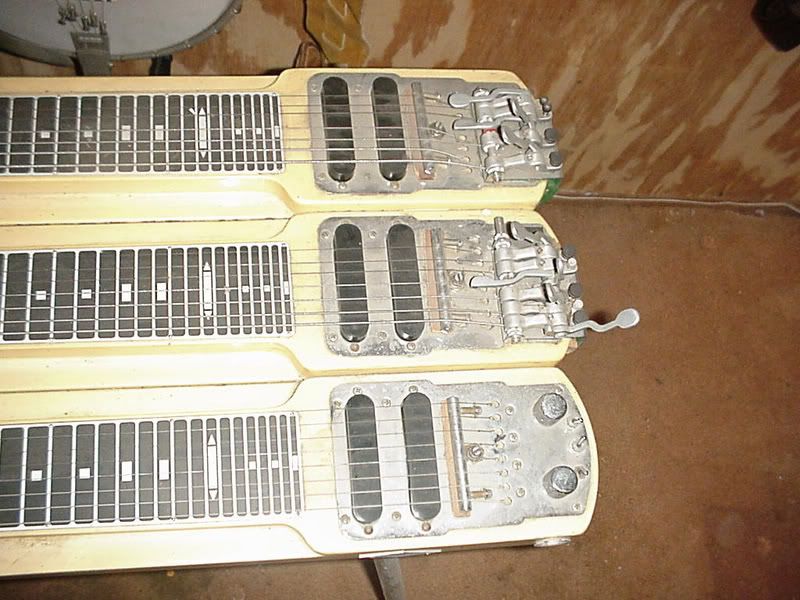
It was necessary to move the controls to the rear neck. As you can see, I eliminated the original neck selector switches from necks 1 and 2 and installed individual on/off switches for each neck on the 3rd.
When I was gigging, if there was room on stage, I would take this to gigs along with my MSA and alternate between them, occasionally stitching from one to the other on the same song.
Please visit my web site and Soundcloud page and listen to the music posted there.
http://www.mikeperlowin.com http://soundcloud.com/mike-perlowin
http://www.mikeperlowin.com http://soundcloud.com/mike-perlowin
-
Bob Simons

- Posts: 604
- Joined: 18 Feb 2008 11:25 am
- Location: Kansas City, Mo, USA
- State/Province: Kansas
- Country: United States
Dave is correct. E has the advantage of open strings and convenient nut position chords. Blues guitar relies heavily on reference to traditional supporting riffs on the lower strings which are easily executed in E, and ultimately it refers to an acoustic tradition which was mostly executed in nut position.
Perhaps another part of the problem, Austin, is that you think "Ode to Billy Joe" is a blues tune!
Perhaps another part of the problem, Austin, is that you think "Ode to Billy Joe" is a blues tune!
Zumsteel U12 8-5, MSA M3 U12 9-7, MSA SS 10-string, 1930 National Resonophonic, Telonics Combo, Webb 614e, Fender Steel King, Mesa Boogie T-Verb.
-
Dave Mudgett
- Moderator
- Posts: 10540
- Joined: 16 Jul 2004 12:01 am
- Location: Central Pennsylvania and Gallatin, Tennessee
- State/Province: Pennsylvania
- Country: United States
Let me also say that the type of thing I talked about in my earlier post is one of many styles of blues, and emphatically not the full story. But that is the primary blues style that has been adopted for blues-rock, which is what most bands saying they play "blues" play these days, IMO. That is why so many bands like this hardly ever move from E.
But if one wants to think about blues in the full sense, there is a lot more. First, in the Delta/Memphis/Chicago blues tradition, modified tunings are frequently used to allow open strings in different keys, as Keith mentioned, and show the strong relationship to traditional acoustic blues. Second, a very different line of blues incorporated elements of swing jazz, and adopted more horn-oriented keys, which are generally closed-position on guitar. This started in Texas and moved to the west coast - people like T-Bone Walker, Roy Brown, and Pee Wee Crayton, and carried on now by bands like the Mighty Flyers (and their descendants) and Roomful of Blues (and their descendants.) By the 60s or 70s, these ideas and more gradually filtered into the playing of many modern blues artists, but not so much blues-rock, which tended to stick to the more basic forms, most of which are more squarely on-the-beat and less swingin'.
But if one wants to think about blues in the full sense, there is a lot more. First, in the Delta/Memphis/Chicago blues tradition, modified tunings are frequently used to allow open strings in different keys, as Keith mentioned, and show the strong relationship to traditional acoustic blues. Second, a very different line of blues incorporated elements of swing jazz, and adopted more horn-oriented keys, which are generally closed-position on guitar. This started in Texas and moved to the west coast - people like T-Bone Walker, Roy Brown, and Pee Wee Crayton, and carried on now by bands like the Mighty Flyers (and their descendants) and Roomful of Blues (and their descendants.) By the 60s or 70s, these ideas and more gradually filtered into the playing of many modern blues artists, but not so much blues-rock, which tended to stick to the more basic forms, most of which are more squarely on-the-beat and less swingin'.
-
Jerry Hayes R.I.P.
- Posts: 7489
- Joined: 3 Mar 1999 1:01 am
- Location: Virginia Beach, Va.
- State/Province: West Virginia
- Country: United States
Mike, that's a pretty ingenious flip lever setup you've got on that Stringmaster. Did Borisoff fix you up with those flip levers? They look like the ones from a HipShot bender unit. I have one or two of those laying around if you want another one....JH in Va.
Don't matter who's in Austin (or anywhere else) Ralph Mooney is still the king!!!
-
Mike Perlowin RIP
- Posts: 15171
- Joined: 4 Aug 1998 11:00 pm
- Location: Los Angeles CA
- State/Province: -
- Country: United States
You guessed right Jerry. They are Hipshot units and Dave Borisoff set the system up before he moved to New York. Dave also got me started playing steel in the first place. He loaned me his Maverick when he graduated to a D-10.Jerry Hayes wrote: Did Borisoff fix you up with those flip levers? They look like the ones from a HipShot bender unit.
Dave is a fine steel player and also plays dobro and (the B word).
BTW thanks for the offer of the spare levers, but I also have a couple of extras.
Please visit my web site and Soundcloud page and listen to the music posted there.
http://www.mikeperlowin.com http://soundcloud.com/mike-perlowin
http://www.mikeperlowin.com http://soundcloud.com/mike-perlowin
-
Bill Hatcher
- Posts: 7306
- Joined: 6 Nov 1998 1:01 am
- Location: Atlanta Ga. USA
- State/Province: -
- Country: United States
Re: Why are most blusey songs played in E maj.??
Simple.Austin Tripp wrote:I sat in with a group last night from Macon GA and they played a lot of blues covers, I dont know they name of the the tunes but 95% of the blues songs were played in the key of E and had the basic 1 4 5 4 1 chord progression. Why?
E is the "peoples" key.
-
David Doggett

- Posts: 8088
- Joined: 20 Aug 2002 12:01 am
- Location: Bawl'mer, MD (formerly of MS, Nawluns, Gnashville, Knocksville, Lost Angeles, Bahsten. and Philly)
- State/Province: -
- Country: United States
If you go back to the old folk-blues pioneers, they often played in open tunings, whether they played slide or fingered. Open E works well with a standard set of guitar strings, which already has Es on the first and last strings. Open A, with the 3rd on top and 5th on bottom also was a favorite. To avoid string breakage, these were often dropped a whole step to give open D and G tunings.
They soloed without a bass player, and provided bass by thumping the low strings with their thumb, while adding chords, pentatonic riffs, and melodies with their fingers.
When they began to use standard tuning, the key of E still allowed them to play bass easily on the bottom strings. A was also very common for the same reason. Both E and A provide a "power chord" on the bottom strings. This is simply a 1 5 1 chord without a 3rd. This modal approach allows the bottom strings to work well under both major and minor pentatonic melodies, as well as pure modal blues that mostly avoids the 3rd altogether.
In addition to useful bass strings, the E chord on standard tuning provides a high 1 on the first string, which is the most important and most powerful note for pentatonic and modal blues melodies.
Even if there is a bass player, the low power chords of E and A are useful for rhythm work. So those keys are just naturals for guitar blues.
Another advantage for those keys is that switching to the minor of either the E or A chord is very simple, and maintains the familiar bass strings for playing minor blues. This is not true for a key like C or G.
I play pedal steel and sax in a blues band. When it's just the guys singing, they mostly stick to E and A, whichever fits the vocal best. But we have found we can vary the sound by doing the occasional tune in G or D, or even B.
We now have a female vocalist who very carefully chooses keys that she feels best fit her voice. She will call almost any key - F, Bb, Eb, whatever. One reason I play blues pedal steel rather than slide guitar or lap steel is the ease of playing in any key. You have to give up the open string hammer-ons and pull-offs, but once you get use to playing blues with the extra strings and the pedals and levers, it's all there, and the key becomes irrelevant to how you play. If you play with horns and jazzers, they also like those odd flat keys.
They soloed without a bass player, and provided bass by thumping the low strings with their thumb, while adding chords, pentatonic riffs, and melodies with their fingers.
When they began to use standard tuning, the key of E still allowed them to play bass easily on the bottom strings. A was also very common for the same reason. Both E and A provide a "power chord" on the bottom strings. This is simply a 1 5 1 chord without a 3rd. This modal approach allows the bottom strings to work well under both major and minor pentatonic melodies, as well as pure modal blues that mostly avoids the 3rd altogether.
In addition to useful bass strings, the E chord on standard tuning provides a high 1 on the first string, which is the most important and most powerful note for pentatonic and modal blues melodies.
Even if there is a bass player, the low power chords of E and A are useful for rhythm work. So those keys are just naturals for guitar blues.
Another advantage for those keys is that switching to the minor of either the E or A chord is very simple, and maintains the familiar bass strings for playing minor blues. This is not true for a key like C or G.
I play pedal steel and sax in a blues band. When it's just the guys singing, they mostly stick to E and A, whichever fits the vocal best. But we have found we can vary the sound by doing the occasional tune in G or D, or even B.
We now have a female vocalist who very carefully chooses keys that she feels best fit her voice. She will call almost any key - F, Bb, Eb, whatever. One reason I play blues pedal steel rather than slide guitar or lap steel is the ease of playing in any key. You have to give up the open string hammer-ons and pull-offs, but once you get use to playing blues with the extra strings and the pedals and levers, it's all there, and the key becomes irrelevant to how you play. If you play with horns and jazzers, they also like those odd flat keys.
-
Jeff Valentine

- Posts: 303
- Joined: 25 Jan 2008 3:27 pm
- Location: Colorado Springs, USA
- State/Province: Colorado
- Country: United States
-
Mike Schwartzman
- Posts: 426
- Joined: 22 Sep 2008 8:21 am
- Location: Maryland, USA
- State/Province: Maryland
- Country: United States
I've played in lots of blues bands. Many bands use the key of E (A also) to play many tunes. Thankfully, some of the bands have choosen other keys also to more suit whoever is doing vocals at the time.
This thread reminds me of a quote attributed to Muddy Waters talking about blues bass playing...he said, "If you're playing anything but E or A, then you just showin' off."
I'm looking foward to playing some pedal steel blues in the future. The little I've done so far seems to adapt really well in any key. It's particularly beautiful and haunting on minor blues stuff.
This thread reminds me of a quote attributed to Muddy Waters talking about blues bass playing...he said, "If you're playing anything but E or A, then you just showin' off."
I'm looking foward to playing some pedal steel blues in the future. The little I've done so far seems to adapt really well in any key. It's particularly beautiful and haunting on minor blues stuff.
Emmons Push Pull, BMI, Session 400, Home of the Slimcaster Tele.
-
David Doggett
- Posts: 8088
- Joined: 20 Aug 2002 12:01 am
- Location: Bawl'mer, MD (formerly of MS, Nawluns, Gnashville, Knocksville, Lost Angeles, Bahsten. and Philly)
- State/Province: -
- Country: United States
Well, just an aside about the horn keys. Most flats and sharps are more complicated to finger than the "white" notes on horns, especially the woodwinds. For non-blues playing, the easy keys on any instrument are C, F and G, because they have no or only one easy flat or sharp. On a Bb instrument those are the concert keys of Bb, Eb, and F. On an Eb instrument those are the concert keys of Eb, Ab, and Bb. So that's why horns like those flat keys, because for them they are C, F and G.
Oddly enough, the blues scale introduces flat 3rds, 5ths and 7ths; so, for horns, blues in the keys (their keys) of C, F and G end up with some difficult flats. As it turns out, the concert keys of E and A are F# and B for Bb instruments, and are C# and F# for Eb instruments. But the blues scale flats end up on "white" notes in those keys, and the remaining flats or sharps are easy ones. So, once you get use to them, the guitar blues keys of E and A are easy fingering on horns. I'm so use to playing in concert E and A for blues/rock sax that I am rusty in the traditional horn-friendly flat keys.
Oddly enough, the blues scale introduces flat 3rds, 5ths and 7ths; so, for horns, blues in the keys (their keys) of C, F and G end up with some difficult flats. As it turns out, the concert keys of E and A are F# and B for Bb instruments, and are C# and F# for Eb instruments. But the blues scale flats end up on "white" notes in those keys, and the remaining flats or sharps are easy ones. So, once you get use to them, the guitar blues keys of E and A are easy fingering on horns. I'm so use to playing in concert E and A for blues/rock sax that I am rusty in the traditional horn-friendly flat keys.
-
Herb Steiner
- Posts: 12636
- Joined: 4 Aug 1998 11:00 pm
- Location: Briarcliff TX 78669, pop. 2,064
- State/Province: -
- Country: United States
I'm constantly amazed at the horn players I work with. Scott Benner and Steve Vague on saxes, Marcus Graff and EJ Johnson on trumpet. No matter the key, they're excellent sight readers and excellent improvisors.
We really only do a few "blues" per se, like "Route 66" or some western swing blues-based tunes. Mostly its Sinatra/Cole/Bennett/Darin stuff.
Our arranger will of course write the charts in the friendliest keys possible; Gb instead of F#, Ab instead of G#, etc. But we play to the singer's voice and not to the fingers of the players.
I generally prefer thinking in flat keys to sharp keys anyway. Just the way I view the instrument's fretboard.
We really only do a few "blues" per se, like "Route 66" or some western swing blues-based tunes. Mostly its Sinatra/Cole/Bennett/Darin stuff.
Our arranger will of course write the charts in the friendliest keys possible; Gb instead of F#, Ab instead of G#, etc. But we play to the singer's voice and not to the fingers of the players.
I generally prefer thinking in flat keys to sharp keys anyway. Just the way I view the instrument's fretboard.
My rig: Infinity and Telonics.
Son, we live in a world with walls, and those walls have to be guarded by men with steel guitars. Who's gonna do it? You? You, Lt. Weinberg?
Son, we live in a world with walls, and those walls have to be guarded by men with steel guitars. Who's gonna do it? You? You, Lt. Weinberg?
-
David Doggett
- Posts: 8088
- Joined: 20 Aug 2002 12:01 am
- Location: Bawl'mer, MD (formerly of MS, Nawluns, Gnashville, Knocksville, Lost Angeles, Bahsten. and Philly)
- State/Province: -
- Country: United States
Horns are a different world. You only play one note at a time, so you don't have to think much about harmony, except maybe for arpeggios, or to follow the chord progression. It's like playing everything on one string. But, each key is a completely different set of fingering and notes to remember. It's like if somebody changes the tuning on your steel guitar for each song, pedals and levers too. And, unless you only play with guitar bands, you end up having to know all twelve keys, and that's a lot. And there are the minors, and the pentatonics, and then all those modes.
But that's just for playing by ear and improvising. If you grow up reading music, and you have the sheet music, that takes most of the pain out of playing in different keys. See the note, play the note. Who cares what key we are in. Well, you do have to remember the sharps and flats from the key signature. But you get pretty used to that, until you come to a key like F#, or C#m.
As complicated as pedal steel is, the string intervals and pedal and lever changes are the same in all keys. You just shift to a different place on the fret board. That's one of the simplifying factors that make these complicated beasts playable at all.
But that's just for playing by ear and improvising. If you grow up reading music, and you have the sheet music, that takes most of the pain out of playing in different keys. See the note, play the note. Who cares what key we are in. Well, you do have to remember the sharps and flats from the key signature. But you get pretty used to that, until you come to a key like F#, or C#m.
As complicated as pedal steel is, the string intervals and pedal and lever changes are the same in all keys. You just shift to a different place on the fret board. That's one of the simplifying factors that make these complicated beasts playable at all.
-
Joachim Kettner

- Posts: 7688
- Joined: 14 Apr 2009 1:57 pm
- Location: Germany
- State/Province: -
- Country: United States
-
Mark Lind-Hanson

- Posts: 430
- Joined: 21 Dec 2004 1:01 am
- Location: Menlo Park, California, USA
- State/Province: California
- Country: United States
I think the Open E tuning is most agreeable to blues changes, certainly it simplifies things when playing with a slide. And because it's an easily remembered fingerboard pattern from first position up it lends itself easily to a wider range of lead runs perhaps.
It's a good question, though, why did so many old blues songwriters pick E major as a starting point, so often. Perhaps it's just the psychological elements of the key of E- a little less merry than D, say.
It's a good question, though, why did so many old blues songwriters pick E major as a starting point, so often. Perhaps it's just the psychological elements of the key of E- a little less merry than D, say.
-
Mark Treepaz

- Posts: 408
- Joined: 27 Feb 2006 1:01 am
- Location: Hamburg, New York USA
- State/Province: New York
- Country: United States
Right you are. In my 35+ years of playing trumpet, most of the keys I played in were C,D,G,A,Bb,Eb and F (concert), which puts my Bb Trumpet into the keys of D, E, A, B, C, F and G. The biggest factor in keys where horns are involved is that certain keys are just plain ackward to finger and therefore soloing and improvising can become very "clumsy". Needless to say, the Nashville Number System doesn't work with horns.David Doggett wrote:Horns are a different world. You only play one note at a time, so you don't have to think much about harmony, except maybe for arpeggios, or to follow the chord progression. It's like playing everything on one string. But, each key is a completely different set of fingering and notes to remember. It's like if somebody changes the tuning on your steel guitar for each song, pedals and levers too. And, unless you only play with guitar bands, you end up having to know all twelve keys, and that's a lot. And there are the minors, and the pentatonics, and then all those modes.
Sho-Bud LDG, Gretsch Syncromatic Lap Steel, Fender Steel King amp, Bach Stradivarious 37 Trumpet, Getzen Eterna Flugelhorn, 68 Fender Precision Bass
-
Mike Perlowin RIP
- Posts: 15171
- Joined: 4 Aug 1998 11:00 pm
- Location: Los Angeles CA
- State/Province: -
- Country: United States
Question: Why can't or don't they make horns that are set up so that the fingerings the sharp keys are just as easy as those in the flat keys? Wouldn't it just be a matter of altering the size of the horns (or perhaps just the mouthpiece) a little?Mark Treepaz wrote:
Right you are. In my 35+ years of playing trumpet, most of the keys I played in were C,D,G,A,Bb,Eb and F (concert), which puts my Bb Trumpet into the keys of D, E, A, B, C, F and G. The biggest factor in keys where horns are involved is that certain keys are just plain ackward to finger and therefore soloing and improvising can become very "clumsy".
Please visit my web site and Soundcloud page and listen to the music posted there.
http://www.mikeperlowin.com http://soundcloud.com/mike-perlowin
http://www.mikeperlowin.com http://soundcloud.com/mike-perlowin
-
Mark Treepaz
- Posts: 408
- Joined: 27 Feb 2006 1:01 am
- Location: Hamburg, New York USA
- State/Province: New York
- Country: United States
In the case of a trumpet or any brass instrument with only three valves, it isn't that the fingerings for the individual notes themselves are complicated, but rather, the order of the progressive valve combinations in certain keys. Unlike woodwinds which have several key combinations, brass instruments rely upon facial physics of the player to form the notes. For example, the second and third valves are used for Eb/D#, Ab/G#. The first valve when used alone is used for Bb/A#, F, D. Etc., etc. Therefore, facial physics have to work in concert with the valving in order to form the notes. For example, the first valve used for a low Bb below the staff also is the same used for Bb in the middle of the staff as well as Bb above the staff. The only difference is the changes in muscle formation and embrochure. I guess that my point here is that when you throw those certain more common modes of valve/muscle movements out of the more familiar patterns, there enters the "clumsiness" factor.Mike Perlowin wrote:Question: Why can't or don't they make horns that are set up so that the fingerings the sharp keys are just as easy as those in the flat keys? Wouldn't it just be a matter of altering the size of the horns (or perhaps just the mouthpiece) a little?Mark Treepaz wrote:
Right you are. In my 35+ years of playing trumpet, most of the keys I played in were C,D,G,A,Bb,Eb and F (concert), which puts my Bb Trumpet into the keys of D, E, A, B, C, F and G. The biggest factor in keys where horns are involved is that certain keys are just plain ackward to finger and therefore soloing and improvising can become very "clumsy".
Possibly more in line with your question...In addition to the typical Bb trumpet, there are also C trumpets and D trumpets that are used mostly in classical music. These were designed to help alleviate the problem of difficult fingering in classical (and some pop)music where changing keys is not an option.
Sho-Bud LDG, Gretsch Syncromatic Lap Steel, Fender Steel King amp, Bach Stradivarious 37 Trumpet, Getzen Eterna Flugelhorn, 68 Fender Precision Bass
-
David Doggett
- Posts: 8088
- Joined: 20 Aug 2002 12:01 am
- Location: Bawl'mer, MD (formerly of MS, Nawluns, Gnashville, Knocksville, Lost Angeles, Bahsten. and Philly)
- State/Province: -
- Country: United States
If you are asking why so many horns are in keys like Bb and Eb, it has to do with the history of brass bands. They simply picked keys that sounded good on the horns. Since the whole band was in those keys, they simply played in the keys that were easy, such as Bb and Eb. It is only when mixing those horns with all the other C concert instruments (keyboards, strings, guitars) that it causes problems. They made C tenor saxes in the '20s and '30s, for amateurs to play along with pianos and be able to read piano sheet music. But the pros preferred the deeper Bb tenor tone, and just learned to deal with the difficult fingerings in some keys.Mike Perlowin wrote:Question: Why can't or don't they make horns that are set up so that the fingerings the sharp keys are just as easy as those in the flat keys? Wouldn't it just be a matter of altering the size of the horns (or perhaps just the mouthpiece) a little?
-
Mike Perlowin RIP
- Posts: 15171
- Joined: 4 Aug 1998 11:00 pm
- Location: Los Angeles CA
- State/Province: -
- Country: United States
Understood, but given that same idea, why can't or don't they make horns set to A, at least for those players who play in guitDavid Doggett wrote: They made C tenor saxes in the '20s and '30s, for amateurs to play along with pianos and be able to read piano sheet music. But the pros preferred the deeper Bb tenor tone....
BTW, when I joined the Jerry Eugene band, I replaced a Sax player named Vince Sandoval who could play in all the sharp keys, no sweat. When Vince left, Jerry shifted the focus of the band from 50's rock to country. (Although we still played a lot of the band's original repertoire.)
Please visit my web site and Soundcloud page and listen to the music posted there.
http://www.mikeperlowin.com http://soundcloud.com/mike-perlowin
http://www.mikeperlowin.com http://soundcloud.com/mike-perlowin
-
David Doggett
- Posts: 8088
- Joined: 20 Aug 2002 12:01 am
- Location: Bawl'mer, MD (formerly of MS, Nawluns, Gnashville, Knocksville, Lost Angeles, Bahsten. and Philly)
- State/Province: -
- Country: United States
Probably just the general inertia of horn players. Advanced players know their repertoire in the traditional keys, and all the band and orchestra music is written for horns in the traditional keys. And it's the advanced players who teach the new ones. Today it would be expensive to tool up to manufacture a horn in a non-traditional key, and there's no guarantee they could sell enough to make it worthwhile. It would be like a steel manufacturer contemplating making a D10 pedal steel with 16" necks to be tuned to A9 and F6, or 36" necks to be tuned to C9 and G6. Would there really be a market for that?Mike Perlowin wrote:...why can't or don't they make horns set to A, at least for those players who play in guit
Also, keep in mind that there is a locked-in relationship between the keys and horns of different sizes. For example, Alto and Baritone saxes are both in Eb. So a player can switch between those different sizes and still play all their repertoire in the same familiar keys. Likewise, Tenor and Soprano saxes are both in Bb. So when Coltrane picked up Soprano toward the end of his career, he didn't have to switch keys on all the songs he already knew on Tenor.
-
Alan Brookes

- Posts: 13227
- Joined: 29 Mar 2006 1:01 am
- Location: Brummy living in Southern California
- State/Province: California
- Country: United States
The guitar is designed to be played in E. It's no surprise that that's the easiest key to play the blues in. I find that G is also a good key to play the blues in. But I usually downtune my guitar by a semitone. That way the easiest key to play the blues in is Eb, which is also all the black notes on the piano.
-
Mike Perlowin RIP
- Posts: 15171
- Joined: 4 Aug 1998 11:00 pm
- Location: Los Angeles CA
- State/Province: -
- Country: United States
Somebody needs to invent capos for horns.
Please visit my web site and Soundcloud page and listen to the music posted there.
http://www.mikeperlowin.com http://soundcloud.com/mike-perlowin
http://www.mikeperlowin.com http://soundcloud.com/mike-perlowin