Mandolin question
Moderator: Dave Mudgett
-
Darryl Hattenhauer

- Posts: 1725
- Joined: 16 Nov 2005 1:01 am
- Location: Phoenix, Arizona, USA
Mandolin question
Why are so few mandos made with rosewood back and sides? Since bluegrassers like that dark tone, I'm wondering why rosewood apparently doesn't produc it the way it does on an acoustic guitar. There must be a scientific explanation, and there are a lot of engineers and other technologists on SGF who would know right off.
Steel crazy after all these years.
$100 reward for info leading to the purchase of a fender D8 white, yellow, or butterscotch.
$100 reward for info leading to the purchase of a fender D8 white, yellow, or butterscotch.
-
Alan Brookes

- Posts: 13227
- Joined: 29 Mar 2006 1:01 am
- Location: Brummy living in Southern California
There are many different instruments currently being called "mandolins". The original Neapolitan Mandoline is a small, steel-strung lute, with a round back. People in the U.S. usually refer to them nowadays as "potato bugs", though the term is not used in Europe. There was also a gut-strung Italian Mandoline, which has a flat body, with the strings attached to a fixed bridge. Both of those instruments often use rosewood as one of the types of splines at the back, and often for the top, though the top is more often spruce.
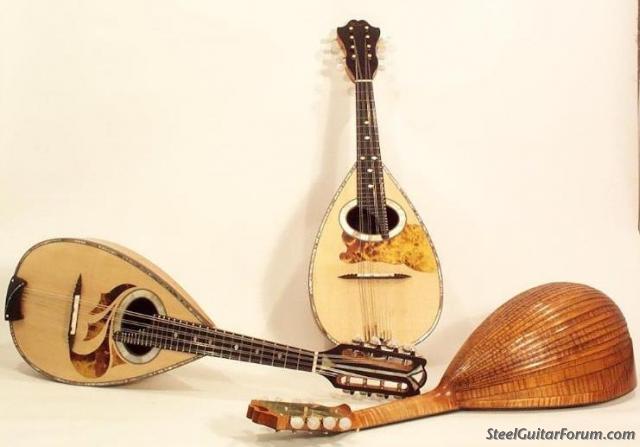
Another type of mandolin has a flat top with a round soundhole, and either a flat or slightly arched back. They would be better termed tenor citterns. Rosewood is sometimes used on those.
http://www.paulshippey.co.uk/rosewood%2 ... ry%201.htm

Moving into the 20th century, the traditional mandolines were difficult to hold, and they suffered from the same problem as the lute, they moved around on your lap unless you stood them on a cloth of some sort. At the time, the "cello" guitar came into popularity, combining the body style of a small cello with the neck of a guitar, producing the archtop guitar that is now so popular. Gibson applied that technology to the mandoline, producing the f-hole, almost-flat-backed instrument we know as the A type. This became immediately popular, as it was easier to hold and to build. The A-type led on to the F-type, which has become traditional in bluegrass and country music. In reality, most of the difference between an F-type and A-type mandolines is cosmetic. The basic body shape is the same. Try playing bluegrass on a traditional mandoline: it's very awkward.


Why is rosewood not used ? Sometimes it is. I think there are so many fewer mandolin players compared to guitarists that there aren't so many variations offered. If you wanted a mandolin made entirely out of rosewood I could find you no end of luthiers who would build you one.
I'm going to refer your question to some luthiers who specialise entirely in mandolins and see if I can get you an answer. In the meantime, check out my friend Michael Lewis's website. He's one of the best mandolin craftsmen in the West. I notice that he uses many different types of woods, and offers rosewood as an option for backs.
http://www.michaellewisinstruments.com/

Another type of mandolin has a flat top with a round soundhole, and either a flat or slightly arched back. They would be better termed tenor citterns. Rosewood is sometimes used on those.
http://www.paulshippey.co.uk/rosewood%2 ... ry%201.htm
Moving into the 20th century, the traditional mandolines were difficult to hold, and they suffered from the same problem as the lute, they moved around on your lap unless you stood them on a cloth of some sort. At the time, the "cello" guitar came into popularity, combining the body style of a small cello with the neck of a guitar, producing the archtop guitar that is now so popular. Gibson applied that technology to the mandoline, producing the f-hole, almost-flat-backed instrument we know as the A type. This became immediately popular, as it was easier to hold and to build. The A-type led on to the F-type, which has become traditional in bluegrass and country music. In reality, most of the difference between an F-type and A-type mandolines is cosmetic. The basic body shape is the same. Try playing bluegrass on a traditional mandoline: it's very awkward.
Why is rosewood not used ? Sometimes it is. I think there are so many fewer mandolin players compared to guitarists that there aren't so many variations offered. If you wanted a mandolin made entirely out of rosewood I could find you no end of luthiers who would build you one.
I'm going to refer your question to some luthiers who specialise entirely in mandolins and see if I can get you an answer. In the meantime, check out my friend Michael Lewis's website. He's one of the best mandolin craftsmen in the West. I notice that he uses many different types of woods, and offers rosewood as an option for backs.
http://www.michaellewisinstruments.com/
-
Alan Brookes
- Posts: 13227
- Joined: 29 Mar 2006 1:01 am
- Location: Brummy living in Southern California
I received the following response this morning from Michael Lewis:
"...Regarding rosewood for mandolin tops, I suppose it COULD be used, but usually spruce is favored because of it's light weight and strength. Many rosewoods tend to split rather easily, more so than spruce. Tradition. I suppose rosewood COULD be used for a top, it would give a "different" range of sound.
Regards,
Michael"
So, there you have it, from the horse's mouth.
"...Regarding rosewood for mandolin tops, I suppose it COULD be used, but usually spruce is favored because of it's light weight and strength. Many rosewoods tend to split rather easily, more so than spruce. Tradition. I suppose rosewood COULD be used for a top, it would give a "different" range of sound.
Regards,
Michael"
So, there you have it, from the horse's mouth.
-
Darryl Hattenhauer
- Posts: 1725
- Joined: 16 Nov 2005 1:01 am
- Location: Phoenix, Arizona, USA
Thanks so much, Alan.
As Michael says, rosewood is not stable enough for a top. But I'm happy to see on his site that he sometimes uses it for back and sides.
The Ritz series tight-waisted ones are interesting. I've never seen that before.
Although I knew about bowlbacks, I had no idea about the origin of archtops guitars.
Aren't the two-point types (as shown on Michael's site) mostly for jazz?
dh
As Michael says, rosewood is not stable enough for a top. But I'm happy to see on his site that he sometimes uses it for back and sides.
The Ritz series tight-waisted ones are interesting. I've never seen that before.
Although I knew about bowlbacks, I had no idea about the origin of archtops guitars.
Aren't the two-point types (as shown on Michael's site) mostly for jazz?
dh
Steel crazy after all these years.
$100 reward for info leading to the purchase of a fender D8 white, yellow, or butterscotch.
$100 reward for info leading to the purchase of a fender D8 white, yellow, or butterscotch.
-
Alan Brookes
- Posts: 13227
- Joined: 29 Mar 2006 1:01 am
- Location: Brummy living in Southern California
I don't know who buys that particular style. The jazz mandolin players that I've come across tend to use the F-style.Darryl Hattenhauer wrote:...Aren't the two-point types (as shown on Michael's site) mostly for jazz?
I've used each of the sorts for each of the types of music I play, but my main use is...
F-type: Country, Bluegrass, Blues.
A-type: Folk.
Neapolitan: Mediaeval and Early Music.
All classical mandoline pieces are played on the traditional Neapolitan style. I've never heard of anyone using an F-style mandolin to play Beethoven's mandoline pieces, for example. I guess it's just tradition. The same tradition that says you don't put machine tuners on violins, violas and violoncellos, although on double basses it seems to be okay. I've fitted bass guitar tuners to both my cello and violas because they stay in tune better.

Here's a gut-strung mandoline, as I was referring to in my original post. I have an album of this type with lute accompaniment. It sounds like a high-pitched lute, which, of course, it is...

It's sometime called the pandorine.
Check out this website. I think you'll find it interesting...
http://www.atlasofpluckedinstruments.com/mandolins.htm
-
Mike Perlowin RIP
- Posts: 15171
- Joined: 4 Aug 1998 11:00 pm
- Location: Los Angeles CA
I think F vs A style is less importa.
Here are my 2 Rigel "Blue babies"

Here are my 2 Rigel "Blue babies"
Please visit my web site and Soundcloud page and listen to the music posted there.
http://www.mikeperlowin.com http://soundcloud.com/mike-perlowin
http://www.mikeperlowin.com http://soundcloud.com/mike-perlowin
-
Glenn Suchan
- Posts: 2368
- Joined: 24 Sep 1998 12:01 am
- Location: Austin, Texas
In light of this thread, I've included info links to a luthier I went to highschool with: Martin Brunkalla. Martin started out building violins, and at the urging of a client, started building mandolins. He also builds, violas, guitars (with a floating soundboard/bridge, called "Freedom-Top" [patent pending]), and acoustic bass guitars with the "Freedom-Top".
http://brunkalla.com/
Martin's Mandolin page:
http://brunkalla.com/MANDOLINS.html
Here's a gallery page with pics of various "pickers" checkin' out Martin's violins:
http://brunkalla.com/GALLERY_MISC.html
Here's a link to an interview with Martin from the June/July 2007, Mel Bay web magazine, "Mandolin Sessions":
http://www.mandolinsessions.com/jun07/Mendel.html
Keep on pickin'!
Glenn
http://brunkalla.com/
Martin's Mandolin page:
http://brunkalla.com/MANDOLINS.html
Here's a gallery page with pics of various "pickers" checkin' out Martin's violins:
http://brunkalla.com/GALLERY_MISC.html
Here's a link to an interview with Martin from the June/July 2007, Mel Bay web magazine, "Mandolin Sessions":
http://www.mandolinsessions.com/jun07/Mendel.html
Keep on pickin'!
Glenn
-
Darryl Hattenhauer
- Posts: 1725
- Joined: 16 Nov 2005 1:01 am
- Location: Phoenix, Arizona, USA
A thousand thanks for all of the info.
The atlas of plucked instruments is quite a resource. Before I saw Michaels site, I didn't know a mando with an archtop guitar shaped body existed. At the atlas, I learned that there is a history of them, and that the name is mandolinetto. So I'm going to google that when I'm done here.
Also the atlas discusses the taro patch and tiple. Maybe the 8-string Martin O18T Nick Reynolds played should be in this league somewhere, but it's bigger than any of the above.
I didn't know that Brunkalla makes mandos. I'll get back to reading that interview with him tonight. In the meantime, it was great to see the pic of Byron Berline.
I'll look up Rigel too. My recollection is that they are the touchstone of technologically advanced mandos, right?
Long live Tiny Moore
The atlas of plucked instruments is quite a resource. Before I saw Michaels site, I didn't know a mando with an archtop guitar shaped body existed. At the atlas, I learned that there is a history of them, and that the name is mandolinetto. So I'm going to google that when I'm done here.
Also the atlas discusses the taro patch and tiple. Maybe the 8-string Martin O18T Nick Reynolds played should be in this league somewhere, but it's bigger than any of the above.
I didn't know that Brunkalla makes mandos. I'll get back to reading that interview with him tonight. In the meantime, it was great to see the pic of Byron Berline.
I'll look up Rigel too. My recollection is that they are the touchstone of technologically advanced mandos, right?
Long live Tiny Moore
Steel crazy after all these years.
$100 reward for info leading to the purchase of a fender D8 white, yellow, or butterscotch.
$100 reward for info leading to the purchase of a fender D8 white, yellow, or butterscotch.
-
Ken Pippus
- Posts: 2726
- Joined: 8 Feb 2007 7:55 am
- Location: Langford, BC, Canada
All of the above information is correct, but in reference to the original question, I suspect the answer is simpler. There are essentially no rosewood archtop mandolins for the same reason there are (nearly) no rosewood archtop guitars. The priority for both has always been audibility: archtops were engineered to deliver Freddy Green-like bright, crisp chords which could be heard over a bunch of loud annoying horn players. Similarly, the bluegrass mandolin chop, or "chunk" had to cut through banjos and fiddles. Maple tends towards a hard, bright sound which has not been beaten for either of those applications.
KP
KP
-
Alan Brookes
- Posts: 13227
- Joined: 29 Mar 2006 1:01 am
- Location: Brummy living in Southern California
Yes, it's well put together, and there are a lot of YouTube cross-links, so you can watch and listen to the instruments being played. It's not all-encompassing, though, and there are some major omissions. I have several plucked string instruments in my collection that are not mentioned. But the website is continually being added to, and I'm going to be contacting him regarding some omissions, and a few errors that have gotten in.Darryl Hattenhauer wrote:...The atlas of plucked instruments is quite a resource...
I didn't see any mention of the extensive Hummel family, very little on Psalteries, nothing on the Trichordia. In fact the main failing seems to be regarding pre-Baroque instruments. He also refers to the Autoharp as a mechanised zither, whereas it doesn't come from the zither family, which has frets; it comes from the Psaltery family.
But overall it's a great resource which will only get better with time.
-
Darryl Hattenhauer
- Posts: 1725
- Joined: 16 Nov 2005 1:01 am
- Location: Phoenix, Arizona, USA
Ken,
I would think the instability of rosewood is why it's never used for a mando top. I've seen a few rosewood back and sides on mandolins, mandolas, and tiples. Since it's so rare, it must be that it doesn't work out for most applications. But Lewis makes mandolinettos with rosewood back and sides, so there must be some situations where it sounds good. Or maybe it's really difficult to make a mando with rosewood b&s, and only a gifted master like Lewis can do it.
Alan (and everybody)
I wrote to Lewis today and asked him for the measurements of his mandolinetto, and he promptly answered me back:
I would think the instability of rosewood is why it's never used for a mando top. I've seen a few rosewood back and sides on mandolins, mandolas, and tiples. Since it's so rare, it must be that it doesn't work out for most applications. But Lewis makes mandolinettos with rosewood back and sides, so there must be some situations where it sounds good. Or maybe it's really difficult to make a mando with rosewood b&s, and only a gifted master like Lewis can do it.
Alan (and everybody)
I wrote to Lewis today and asked him for the measurements of his mandolinetto, and he promptly answered me back:
So now my burning question is this: What does the guitar shape do to the sound? The waist makes a big difference in the sound of a dreadnaught compared to a jumbo. Would it be the same for mandos?Scale is standard f5 scale (13.875")
Nut width is flexible to suit the client
body depth is also a bit variable but usually close to 1 5/8"
upper bout 7 1/2"
waist 6 1/4"
lower bout 10 1/8"
Steel crazy after all these years.
$100 reward for info leading to the purchase of a fender D8 white, yellow, or butterscotch.
$100 reward for info leading to the purchase of a fender D8 white, yellow, or butterscotch.
-
Jerry Hayes

- Posts: 7489
- Joined: 3 Mar 1999 1:01 am
- Location: Virginia Beach, Va.
Here's my old F style......It has a spruce top and maple back and sides. The fingerboard is ebony. I've replaced the tuners as the old ones were in very bad shape and the buttons had disintegrated over time. I also put a heavier tailpiece on it that I got from Stewart/McDonald. I've also added a Fishman bridge with a built in pickup in it. The bridge is also made of ebony. All in all, it's the best mandolin I've ever had and it's played and used every week on the gig(s).....JH in Va.


Don't matter who's in Austin (or anywhere else) Ralph Mooney is still the king!!!
-
Darryl Hattenhauer
- Posts: 1725
- Joined: 16 Nov 2005 1:01 am
- Location: Phoenix, Arizona, USA
-
Jerry Hayes
- Posts: 7489
- Joined: 3 Mar 1999 1:01 am
- Location: Virginia Beach, Va.
Darryl, I have no idea of the age of it but from the finish cracking and all it must be pretty old! It didn't have any sticker inside when I got it about 13 years ago or so. Someone had painted the inside of it with black enamel for some reason. I also put a new pickguard on it as the original one was made of a sort of celuoid type material like the tuner buttons and had disintegrated a lot. All I can so about it is it sounds wonderful unplugged and projects very well. Plugged in, it's a very good acoustic tone. I usually just pull the plug out of my steel guitar and plug it right into the mandolin with no preamp needed......JH in Va.
Don't matter who's in Austin (or anywhere else) Ralph Mooney is still the king!!!
-
Darryl Hattenhauer
- Posts: 1725
- Joined: 16 Nov 2005 1:01 am
- Location: Phoenix, Arizona, USA
That's a nifty convenience.I usually just pull the plug out of my steel guitar and plug it right into the mandolin with no preamp needed
A blond Gibson F is pretty rare, isn't it?
It doesn't matter who's playing in Sacramento and Brisbane, Vance Terry is still the king.
Steel crazy after all these years.
$100 reward for info leading to the purchase of a fender D8 white, yellow, or butterscotch.
$100 reward for info leading to the purchase of a fender D8 white, yellow, or butterscotch.
-
Jerry Hayes
- Posts: 7489
- Joined: 3 Mar 1999 1:01 am
- Location: Virginia Beach, Va.
-
Billy Tonnesen
- Posts: 1882
- Joined: 2 Oct 2006 12:01 am
- Location: R.I.P., Buena Park, California
-
Alan Brookes
- Posts: 13227
- Joined: 29 Mar 2006 1:01 am
- Location: Brummy living in Southern California
I built this 10-string Electric Mandola a few years back. I've always thought having 5 courses gave a much better range. If you can judge the size from the chair next to it you will see that it's a few inches longer than an F-type mandolin, probably about the same size as a child's 1/2 sized electric guitar.

-
Darryl Hattenhauer
- Posts: 1725
- Joined: 16 Nov 2005 1:01 am
- Location: Phoenix, Arizona, USA
Billy,
Tiny said he first tried 4 strings when WW2 made strings expensive and hard to find. Although I've heard that violins had 5 strings ages ago, I don't know when Tiny got the idea for a 5-string electric, but I saw his Bigsby once a week when I took lessons from him almost a half century ago. The happiest and kindest man I've ever known.
Alan,
I'd be a lot better off if I had your luthier skills. But then, I'd be a lot better off if I had anybody's luthier skills. How do you tune it?
Tiny said he first tried 4 strings when WW2 made strings expensive and hard to find. Although I've heard that violins had 5 strings ages ago, I don't know when Tiny got the idea for a 5-string electric, but I saw his Bigsby once a week when I took lessons from him almost a half century ago. The happiest and kindest man I've ever known.
Alan,
I'd be a lot better off if I had your luthier skills. But then, I'd be a lot better off if I had anybody's luthier skills. How do you tune it?
Steel crazy after all these years.
$100 reward for info leading to the purchase of a fender D8 white, yellow, or butterscotch.
$100 reward for info leading to the purchase of a fender D8 white, yellow, or butterscotch.
-
Alan Brookes
- Posts: 13227
- Joined: 29 Mar 2006 1:01 am
- Location: Brummy living in Southern California
-
Darryl Hattenhauer
- Posts: 1725
- Joined: 16 Nov 2005 1:01 am
- Location: Phoenix, Arizona, USA
-
Alan Brookes
- Posts: 13227
- Joined: 29 Mar 2006 1:01 am
- Location: Brummy living in Southern California
They're all unison courses.
I do have a Trichordia, which is a mandolin with four triple courses, and on that instrument I tune it so that with each 3-string course, the two outside strings are in unison and the centre string an octave below.


I do have a Trichordia, which is a mandolin with four triple courses, and on that instrument I tune it so that with each 3-string course, the two outside strings are in unison and the centre string an octave below.
Last edited by Alan Brookes on 17 Apr 2009 1:39 pm, edited 1 time in total.
-
Darryl Hattenhauer
- Posts: 1725
- Joined: 16 Nov 2005 1:01 am
- Location: Phoenix, Arizona, USA
Wow. You've got me thinking about getting an instrument with courses of three strings because it would give a lot of possibilities for different combinations of string gauges and tunings. For example, on the lowest course, one of the outside strings could be an octave above the other outside string. And I could try intervals instead of octaves.
Steel crazy after all these years.
$100 reward for info leading to the purchase of a fender D8 white, yellow, or butterscotch.
$100 reward for info leading to the purchase of a fender D8 white, yellow, or butterscotch.
-
Alan Brookes
- Posts: 13227
- Joined: 29 Mar 2006 1:01 am
- Location: Brummy living in Southern California
I had the same idea some time ago. The hammer dulcimer has a bridge that divides all the strings 2:3. That means that hitting the strings with two hammers on both sides of the bridge simultaneously always gives exact harmony in 5ths. With that idea in mind I tuned a 12-string guitar in intervals of a 5th. The result was that you could only play one or two strings at a time as you almost always ended up in dischords. I haven't tried it on a lap steel. Bear in mind that harmonizing in 5ths is okay for folk songs and mediaeval songs or Gregorian chants, but it won't get you anywhere in jazz or the blues.Darryl Hattenhauer wrote:...I could try intervals instead of octaves.
-
Darryl Hattenhauer
- Posts: 1725
- Joined: 16 Nov 2005 1:01 am
- Location: Phoenix, Arizona, USA
Playing bluegrass runs on a 12-string tuned in 5ths might be interesting. Glenn Campbell played bluegrass runs on a 12-string ages ago. Don't know if he still does.
The pic above of the trapeze tailpiece on the Shippey got me to looking at all of the tailpieces at his site. He uses the trapeze tailpieces a lot more on his long-scale instruments, so they must be better for higher tension, right?
Why don't recent mandos use the clamshell tp (like the one on the Gibby above) very much?
The pic above of the trapeze tailpiece on the Shippey got me to looking at all of the tailpieces at his site. He uses the trapeze tailpieces a lot more on his long-scale instruments, so they must be better for higher tension, right?
Why don't recent mandos use the clamshell tp (like the one on the Gibby above) very much?
Steel crazy after all these years.
$100 reward for info leading to the purchase of a fender D8 white, yellow, or butterscotch.
$100 reward for info leading to the purchase of a fender D8 white, yellow, or butterscotch.