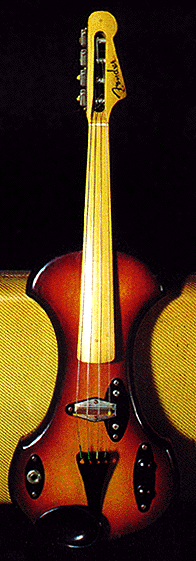
How do the frets affect vibrato ? Well, the classical guitar has frets and so does the lute, and both those instruments are played with vibrato. The difference is that with no frets vibrato is created by rocking the fingers against the fingerboard, whereas with frets you're rocking the fingers against the frets.
The main difference (other than the fact is that it's easier to play in tune) is the same difference between playing a regular guitar and a lap steel... sliding along the fingerboard. On a fretless instrument, or playing with a bar, as you slide the transition from one note to another is a glissando, whereas with frets you hear the notes that you're passing over for an instant. This is why the mountain dulcimer is so good for sliding along the fingerboard: having a diatonic fingerboard, when you slide the fingers you go from one note in the key to another without sounding the semitones.
As has been pointed out by others here, bowed instruments with frets are not new. The violin family replaced the viol family during the 16th to 18th centuries. Most viols had at least five strings, and the viola da gamba, the equivalent of the modern 'cello, had six.
Machine tuners on double basses have become the accepted norm during the 20th century, and the first instrument I experimented on was the violoncello (the 'cello), which I fitted up with bass guitar tuners several years ago. It just looked like a small bass, so no-one noticed. The tuners on the viola (above) are just guitar tuners, and a lot of people wouldn't notice them if I didn't point them out. This was a store-bought viola which I converted. If I were building one from scratch, which I shall some day, I wouldn't keep the mediaeval scroll on the headstock, I would finish the headstock like a mandolin. In fact, I've actually converted a mandolin to be played with a bow, by simply making the bridge curved so that the bow can reach the center strings. The problem there is that you need the cutaway so that the body doesn't touch the bow.
The problem with the bowing position I have yet to overcome. I broke my elbow as a kid and I find that holding the bow in the usual position becomes painful very quickly. Some fiddlers play with the instrument between the knees, which is the position that the viol used to be played in, and the 'cello still is.
The suggestion of using a power-driver wheel is not new. The hurdy-gurdy (otherwise known as the vielle) had an oak wheel covered in resin, that turned against the strings as you turned the handle. I once built a strohfidl, which works the same way but has a hummel body.