Paul,
While we're giving opinions, how about master builder Gene Field's:
<BLOCKQUOTE><font size="1" face="Verdana, Arial, Helvetica">quote:</font><HR><SMALL>Tuning knobs remain level. Twin shafts provide a perfectly balanced leverage ratio. No tools are required for tuning, however, a Phillips screwdriver is required when changing strings (no more lost Allen wrenches - click here to see the instruction sheet included with every keyless GFI steel). Fine tuning is much more precise than with keys. Available lever movement is more than twice the amount required for a more than adequate safety margin. No roller nut is required as there is no measurable movement at the nut. The problem of returning to pitch when raising and lowering the same string is virtually eliminated.
Keyless Tuning has many advantages.
When using keys for tuning, the excess string length needed to reach the keys from the nut causes vibration, taking energy from the main body of the string and decreasing sustain. This is eliminated with Keyless Tuning. Pedal and knee lever travel is decreased since there is less string to stretch. Pedal and knee lever action also feels more solid. The length of the instrument is shorter, therefore stronger, minimizing detuning while pressing pedals. Strings break less frequently since less movement of the bridge cam is required to acquire the same pitch. Undesirable overtones created by the excess string length are also eliminated with the keyless system. These overtones are detrimental to the pure tone of the instrument, as they will vary with string gauge, string length beyond the nut, and the location of the bar on the strings.
</SMALL><HR></BLOCKQUOTE>
I think Ralph knows a little something as well!
------------------
I'd rather be opinionated, than apathetic!
<font size="1" color="#8e236b"><p align="center">[This message was edited by Curt Langston on 23 May 2006 at 05:53 AM.]</p></FONT><font size="1" color="#8e236b"><p align="center">[This message was edited by Curt Langston on 23 May 2006 at 05:56 AM.]</p></FONT><font size="1" color="#8e236b"><p align="center">[This message was edited by Curt Langston on 23 May 2006 at 07:04 AM.]</p></FONT>
David D., it would be interesting to see a guitar built thusly (gearless head away from the nut) and evaluate the results.
For a 24" scale, an overhang of 6" would produce the third partial--two octaves above the fundamental, which would be a harmonic overtone.
But that would be ideal only for open strings. Once you place the bar on the string, the pitch of the 'overhang' segment won't relate to the note you're picking; or rather, it might still relate, but inharmonically. (As b0b pointed out, you're playing an F, e.g., and the overhang is still singing in E.)
Factoring in pedal pulls, the slight increase in nut-> machine segment tension will raise the overhang pitch slightly. While the tension change might increase proportionally with the tension in the scale length, I'm not sure the pitch would change proportionally. (Factoring in compensators, who knows what the results would be?)
So many factors in a pedal steel--you'd have to build one to evaluate it.
[As you know, pianos are scaled with sections of a given string guage; the variation in string length determines pitch within that section. Thus a piano scale can be mathematically calculated to approach an ideal, whereas it seems to me pedal steel scaling involves more of an experimental approach.]
So it's possible that the overtone interaction in a conventional machine head are the result of more or less random selection.
But these thought experiments may yield results toward a more perfect instrument, each being a clue about string performance. The beauty of steel is that it will never reach perfection, and promises a long evolution of the instrument.
Charlie...It appears that you like this subject...me too also.
Did you know that at least two PSG makers had the long overhang strings (5 & 6) such as to be 1/4 of the scale length = an octave relationship with the fundamental of the open string? My Sho Pro is off by 1/8" in the overhang. The older Emmons' may be more exact. By intent or accident?
Several Forum years back there was a good sized discussion re damping out the overhang effect. Many said that they used foam rubber, rubber grommets, plastic sleeves, etc. to rid themselves of the "annoying" effect.
At least one very prominent well known west coast picker uses spaghetti sleeves over these strings to reduce some effect that he hears from them...he plays the Emmons pp's.
When a change is activated, to the extent that there is no friction at the nut, the same "new" tension on the activated string will be on the overhang section. Length, gauge, and tension give the Hz, hence the new overhang Hz would match the new string Hz in the same manner as before activation. (caveat = that there are no other losses in the system).
The overhang on the end strings on keyheads are about the same length as some keyless strings.
The term "measure" seems to have different meanings to different Forum members. Re over return, I hold a difference between noticeable and measurable. Many LED and needle tuners won't have enough resolution to split cents. The Peterson VS-II has it's limitations also, but within a cent, one can tell return direction differences, hence the existence or non existence of the over return phenomena. Measurable to me is to be able to put a number on it with the designated measurement instrument, so that other interested parties can repeat the experiment/results.
When a string is picked the tuner (Peterson here) will read sharper than when the string vibration decays. Several things come to mind:
1. I don't think that I care much about any pitch change values that are less than the amount of pitch change due to how hard I pick.
2. What is the accuracy threshold of the tuner that I am using when presented with a complex waveform such as from a vibrating PSG string? Accuracy vs. amplitude vs. harmonic content = ? A 440 Hz sine wave is not the best benchmark for this purpose.
Some keyless/gearless PSGs have a roller nut. The amount of string stretch to get the 0.011" G# to pitch is about 1/2", less for fatter strings. The wrap approaches 1/2" in length. The stretch distance for a halftone increase on the 0.011" G# is about 0.040". A small amount(maybe 1/25th or so) of this is across the roller/nut. If there is friction, stiction, or detent problems with the roller, there will be pitch change coming and going. Enough to stop the show? doubtful because of the short pull. Rotate the roller and see if the value/apparent amount changes. In the case of the non roller nut, rotate the rod.
RE the "bell like" effect when the string is picked (attack): This can be captured, quantified (have a value placed on the effect), stored, and compared re harmonic content, down to at least 0.5 db using the FSA system in the peak capture mode. One problem would be that the way that the string is picked (pick gauges/angle/degree of aggressiveness) would enter into the measurement at these low difference levels; but the difference in instruments can be compared.
Location: Bawl'mer, MD (formerly of MS, Nawluns, Gnashville, Knocksville, Lost Angeles, Bahsten. and Philly)
State/Province: -
Country: United States
Postby David Doggett »
Thanks, PF, I'm sure I enjoy your posts more than you enjoy mine. But enough leghumping. In separating out opinions and facts, there are things that can be measured quantitatively with measuring devices (like Ed wants), but many of those things can also be heard well enough that our ears and experience can tell the difference, and those can be facts. I can't recall any of PF's statements that I wouldn't expect to stand up as facts. I think we all agree that current keyhead and keyless models sound different to trained ears. Now which sound one prefers is opinion. I think all the little mechanical things PF says noticeably affect tone do affect tone, and applying a measuring device would easily validate those. On the other hand the facts Curt claims that I think we all agree on are that the short overhang distance of current keyless models minimizes what we are calling hysteresis and the need for compensators, and the reduced changer movement minimizes string breakage. Nevertheless, in spite of these agreements, PF and many other steelers hear a difference in tone, prefer the keyed sound, and can deal with the hysteresis adequately with compensators. Others don't hear a difference, or hear it but accept the keyless sound.
I really don't have enough experience with the keyless sound to know if I could live with it. My first pedal steel was an old Maverick, with no nut rollers. The "nut" was just some string grooves in the single piece keyhead. The tone was good and solid, but the wound strings scratched as they were raised or lowered. When I swapped the keyhead with a more modern Sho-Bud head with nut rollers, I was shocked at the difference in tone. There was a very lively ringing sustain. It was like I had kicked the reverb up several clicks. And oddly enough, it was not just with the open strings. Somehow you could hear it with the bar anywhere on the neck, and with my fingers damping the strings behind the bar (can't explain that, but I also can't explain women, or the particle/wave nature of subatomic matter). I actually didn't like the new sound at first, because I wasn't use to it. But I've gotten use to it in all my subsequent pedal steels (my Emmons p/p setting the benchmark).
As I have said before, there is a factor other than the overhang harmonics that probably influences sustain. If a string is pegged close behind the nut, then the only way it can vibrate in front of the nut is to bend at the nut. If there is string length behind the nut that can vibrate in the opposite direction of the vibration in front of the nut, then the string can vibrate by "wagging" at the nut instead of bending. Such wagging would seem to absorb less vibrational energy that bending. An analogy with regular guitars might be the difference between strings attached to a tailpiece, and strings that go through the body directly behind the bridge. A similar phenomenon may occur at the changer. Allowing the string end to stand apart from the changer finger and hook with the ball on a pin may allow some slight vibration that requires less bending at the changer. This could be why the Franklins found better tone with changer pins than with wrapping the string close behind the changer with another manner of attachment. I have no problem believing that all these small things do matter in some way.
So I have no problem believing that PF and many other steelers can hear a big difference in the tone of keyed and keyless current models. And if they prefer the keyed tone, you can't argue with it. And if a keyhead with compensators gives them the tone they like, then that is the superior mechanical design for them. If someone finds the keyless tone acceptable, and likes the smaller body length, lack of compensators, and reduced string breakage, then that is the superior mechanical design for them. Which design is superior is based on our preferences and purposes, not on any platonic ideal of the perfect pedal steel design.
I'd still like to see a keyless head about 4"-6" from the nut, because if overhang is good for the tone of the middle strings, it should also be good for the outside strings. And the main advantage I see for keyless is the precision tuning.
------------------
<font size="1">Student of the Steel: Zum uni, Fender tube amps, squareneck and roundneck resos, tenor sax, keyboards
Ed, guage being the same, I guess it does make sense that increasing tension in both segments would raise the overhang pitch proportional to the scale length. If that's what you conclude. I guess.
An old big head guitar might be long enough to bolt on a keyless head.... Tempting.
Has anyone mentioned that if you pick the open 5th or 6th strings BEHIND the roller nut on an Emmons P/P you get a double octave of the open string.
Maybe that is relevant, no how can it be, it's damped as soon as you bar the string. (That is of course presuming that you're damping behind the bar like you're SUPPOSED to)
Basil (The Little 'B' )
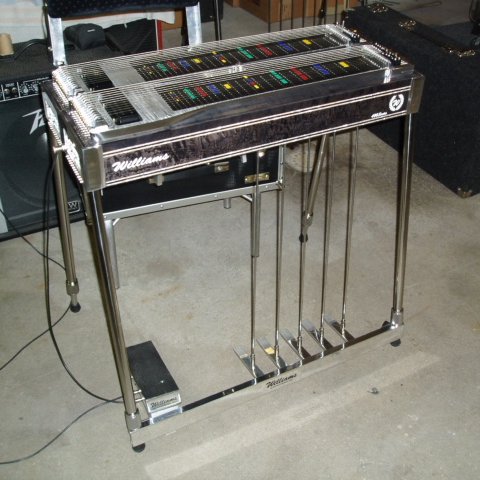
From the day I first saw Jerry Garcia playing one of those Fenders, I've always thought they looked so cool! I've never understood why some people think keyless guitars look funny. To me they look elegant. Here's mine: <p align="center"> </p>
Location: Bawl'mer, MD (formerly of MS, Nawluns, Gnashville, Knocksville, Lost Angeles, Bahsten. and Philly)
State/Province: -
Country: United States
Postby David Doggett »
Basilh, the Gene Fields Fender does raise the interesting question of extended string length at both ends. If extra length sounds good to some people behind the nut, even using the bar and damping behind it, why not have extra length at the bridge end, where there would be no left hand damping to interfere? Also, by not bending the string at a right angle, string breakage should be improved. I think some Excels do something like that, or maybe I'm thinking about Anapegs. <font size="1" color="#8e236b"><p align="center">[This message was edited by David Doggett on 24 May 2006 at 08:12 AM.]</p></FONT>
Geeze, it seems that some "keyless advocates" just want to continue to debate (argue?) with someone as experienced and accomplished as Paul Franklin?
And I thought I had a hard head!
I do admire Paul for hanging in there and explaining; very politely, I might add, and repeating the fact...that he just doesn't like keyless guitars!
(Neither do most professionals.)
Keyless lovers of the world...
<font size=4>Get over it!</font>
<font size=1>(This has been a public service announcement. We now return you to your regularly scheduled fruitless arguments, however "scientifically sound" they might be.)</font>
<BLOCKQUOTE><font size="1" face="Verdana, Arial, Helvetica">quote:</font><HR><SMALL>I do admire Paul for hanging in there and explaining; very politely, I might add, and repeating the fact...that he just doesn't like keyless guitars!
</SMALL><HR></BLOCKQUOTE>
That is the only fact he presented! The rest was opinion, and we all have opinions.
Don't be so intimidated by keyless technology! It won't hurt you.
We are not here to threaten you.
You are still welcome to play your keyed guitar.
Chill! <font size="1" color="#8e236b"><p align="center">[This message was edited by Curt Langston on 25 May 2006 at 04:00 PM.]</p></FONT><font size="1" color="#8e236b"><p align="center">[This message was edited by Curt Langston on 25 May 2006 at 04:39 PM.]</p></FONT><font size="1" color="#8e236b"><p align="center">[This message was edited by Curt Langston on 25 May 2006 at 04:42 PM.]</p></FONT>
Junior Martin -- a Cajun steeler that can play the piss out of the pedal steel -- just took delivery of an ExCel D-10 keyless -- your welcome Junior -- and loves it, says it's the best sounding and playing guitar he's ever had, and he's had a bunch.
Junior has been a pro player in the studio and on the stand for many years.
Everyone has an opinion. I don't have a keyless -- I like old Emmons guitar -- but to each his own. As for tone, whatever the steel is on Buddy Miller's CDs, that's the best sounding -- and played steel I've heard since the old guys started playing golf... -L-<font size="1" color="#8e236b"><p align="center">[This message was edited by Tom Quinn on 25 May 2006 at 04:57 PM.]</p></FONT>



 <font size="1" color="#8e236b"><p align="center">[This message was edited by Curt Langston on 23 May 2006 at 07:21 AM.]</p></FONT>



 </p>
</p>