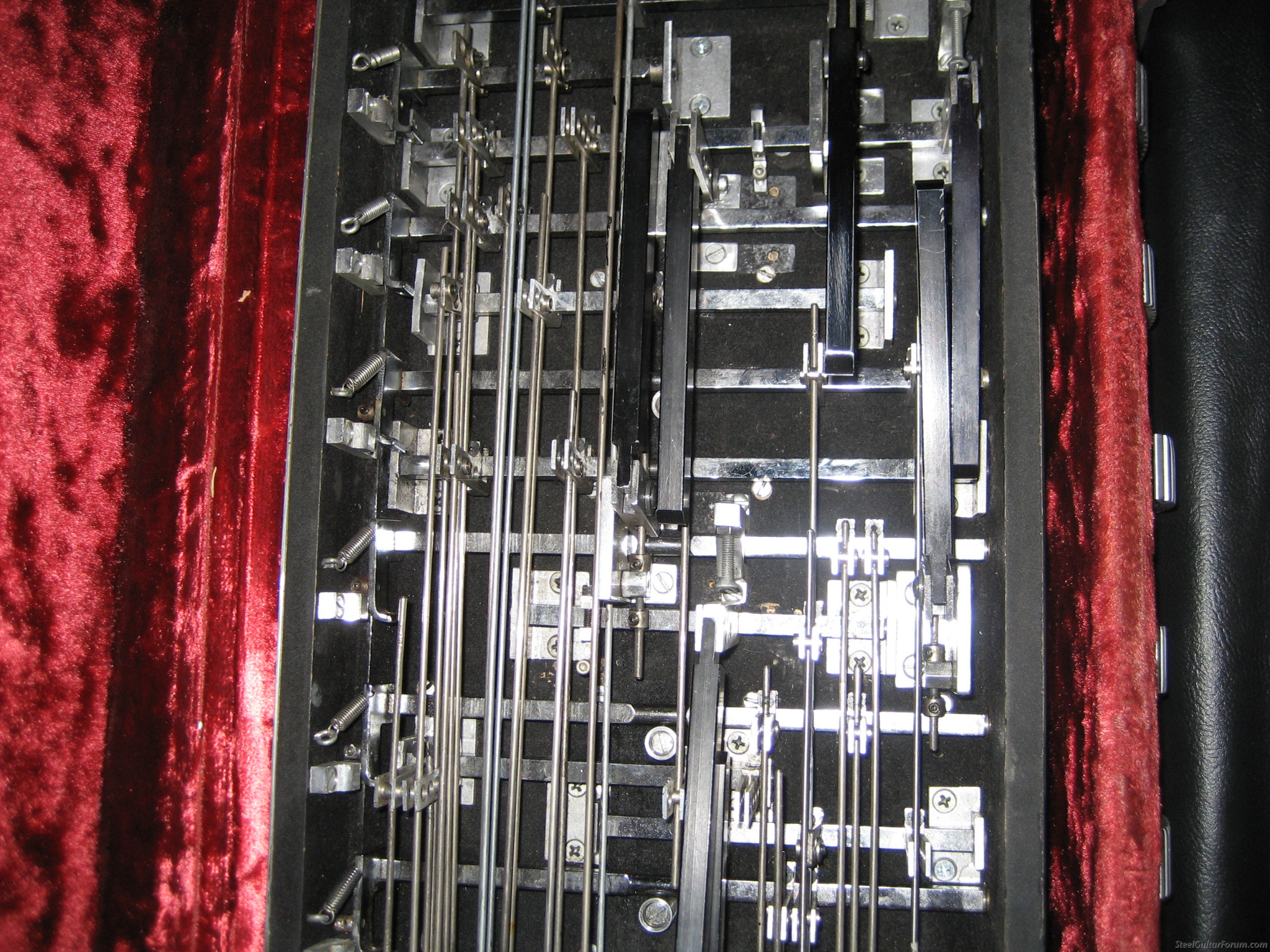
Dennis Detweiler wrote: string at the key head and see if the guitar goes sharp? Loosen the 1st string which would cause less stress on the axle. Then loosen the 6th string and see if it gets much worse from the center of the axle?
Yes, I just did this on an all-pull Marlen SD-10. Very slight detuning of the 6th sting when loosening string 1... but went 4 cents sharp when loosening string 5. Axle flex, I think. As for Sho-Buds, some were famous for cabinet flex issues. Detuning can come from either or both causes.
Bill, all this only seems off topic: it was introduced that "the axle isn't a thing... so how could the ACS really work if it's addressing the wrong root cause?" That idea needed to be addressed first, and I would love to hear from someone with this device on their guitar.
“Chris Lucker” wrote: Cross shafts are not hardened drill rod and they are typically skinnier than changer axles and span a longer distance between supports than a changer axle, even when they have a center support on a D10, for example. How can hardened drill rod be the focus and not the less hardened cross shaft?
Hardened steel is not a determiner of its defection or bending strength - that would its Young’s modulus which is a function of its metallic composition. Steel of all types rate about 200Gpa with stainless performing slightly less than mild steel. Exotic metals like Tungsten Carbine does very well and Diamond tops out a typical young modulus list https://www.liquisearch.com/youngs_modu ... ate_values
All I know is I can detect deflection of a D10 cross shaft with a dial indicator. And, when milling a flat on a Sho-Bud or Emmons or Marlen cross shaft to except another brand bellcrank (Sho-Bud 2 hole cranks on an Emmons cross shaft or vice versa for example), I need to support the cross shaft in the tailstock because of deflection. No support is needed for axle stock.
I should set up a dial indicator to measure deflection on various pedal racks.
Chris Lucker
Red Bellies, Bigsbys and a lot of other guitars.
Chris Lucker wrote:All I know is I can detect deflection of a D10 cross shaft with a dial indicator. And, when milling a flat on a Sho-Bud or Emmons or Marlen cross shaft to except another brand bellcrank (Sho-Bud 2 hole cranks on an Emmons cross shaft or vice versa for example), I need to support the cross shaft in the tailstock because of deflection. No support is needed for axle stock.
I should set up a dial indicator to measure deflection on various pedal racks.
Im not a milling expert but I wouldn't think you need to apply much sideways force to machine a rod.
I think you are onto right track to use a dial gauge and would be interested to see the results.
Also it doesn't surprise me the cross shafts need support as they are much smaller than an axle but their deflection shouldn't cause cabinet drop.
Chris Lucker wrote:Cross shaft flex is why JCH guitars and others have these supports to keep the cross shafts from flexing toward the changer:
It is very interesting that this is done but I dont understand what this has to do with cabinet drop effect which is on a different string to the one attached to the bellcrank
John Hyland wrote:
It is very interesting that this is done but I dont understand what this has to do with cabinet drop effect which is on a different string to the one attached to the bellcrank
Yes, John, you are right. Cross shaft flex is different
Chris Lucker
Red Bellies, Bigsbys and a lot of other guitars.
Ross Shafer wrote:I'd have to see it up close to be sure, but it looks like the set screws are positioned to bear against those bent tabs to limit axle flex. ...
just a semi-educated guess
As always, in my experience, Ross is right here. I have an ACS guitar and it works great to greatly reduce, if not eliminate cab drop. Not sure if it's limiting flex in the axle or inducing opposite flex (pushing the axle) to counter act drop created elsewhere.
The system works best when both A and B are pressed at the same time. There are slight intonation issues when releasing just one of those pedals though. All in all, better to have with than without. Plus you can always back the screws out for a conventional guitar.
Last edited by memphislim on 30 Oct 2021 9:33 am, edited 1 time in total.
And, to those of you who think cab drop is not a problem, this is not your thread. Go start a thread about that. We are discussing what we think is a problem/issue. Telling us that Buddy could play in tune does not change our determination to eliminate/reduce de-tuning.
That being said, I eliminated all drop out of a guitar by reducing the cabinet flex. I did nothing to the axle. The drop was around 3 cents before I stiffened the cabinet, zero after, no noticeable effect on tone or sustain. I don't want to give away my exact method because it may not work on all guitars. But, I like Chris' truss rod thoughts and plan to try that idea on other guitars. Basically, you want to pre-tension the body in the opposite direction of the pedal induced cabinet flex.