Well, the bottom line is it's all the same. We are all chasing the standards set by life-time professional virtuosos. They push any instrument to its limits, and it is very difficult for amateurs and less talented pros to chase those outer limits. The state of the art sounds we are chasing on lap and pedal steel are different, but equally difficult, because that are each the furthest limits able to be achieved by lifetime virtuosos.
But ignoring that, some instuments are more difficult than others for playing basic scales and melodies, with a little harmony. Steel guitar is a funny instrument in that all notes are not equally easy to get, in fact, some are near impossible. Except for the minor difference between white and black keys, all the notes of the chromatic scale are equally easy to hit (I play piano), and the same is true for most horns (I play sax). But a steel guitar only has the strings for a chord or two, not even the whole scale, much less the chromatic scale. Of course, for single string stuff you can move the bar to different frets. But moving the bar and your whole hand and arm is way less efficient than tickling the keys with your fingers. And if you want to add some harmony it gets very complicated fast. You end up using slants, nonintuitive string combinations. And you might have to move down the neck for a higher inversion, or up the neck for a lower one.
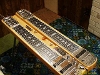
People might think that no pedals and fewer strings are easier, because there are fewer complicated choices - and maybe they are attempting simpler stuff. But to play a complicated melody, with accidentals, and complicated harmony and progressions is easier with additional strings, pedals and levers. It's not cheating if it allows you to do more stuff easier. So if you know how to use it, it is easier to play complicated stuff with the extra strings, pedals and levers. But because of all the choices, it seems more complicated to learn at first. So the answer is yes and no and maybe.