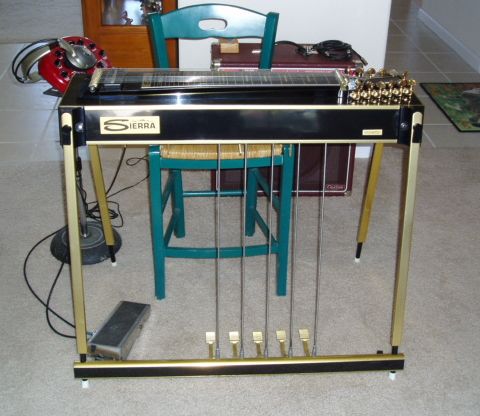
My 1978 Sierra Olympic is a really fine instrument. It came with a single coil Shields pickup, but I prefer the BL-712 most of the time.
<center> </center>
Some people don't like the looks of Sierra guitars, but I think this one is absolutely beautiful!
Hi guys
I have had two Sierras U-12"s Loved them both, weight was not a factor till I turned 70. I still have the 1997 Universal and do not see any reason to replace it. I would like to have a S-10 to play with but It would have to be a Sierra built by Ole Tom Baker. He is da man. Sierra Lives.
Norm Mcdaniel
Waco Tx
What are the modular pickup options for the circa: 1986 Sierra Crown U12? I don't want to re-wire the guitar to take a pickup that may not sound any better than the one have now.
Fred Glave wrote:What are the modular pickup options for the circa: 1986 Sierra Crown U12? I don't want to re-wire the guitar to take a pickup that may not sound any better than the one have now.
I bought a new Sierra Crown S-12 in 1984, and it had a 3-contact modular pickup slot. The slot also accepted 2-contact pickups. The pickup housings (2, 3 and 4 contacts) are available from Sierra - they really haven't changed at all over the years. Tom Baker can mount whatever pickup you have into a housing, or you can do it yourself. It involves soldering the wires, then gluing the pickup into the housing with silicone adhesive.
I really like the Sierra modular pickup system. I have an early to mid 70s Mica MSA that has been retrofitted with the Sierra system, and I also have a new Millennium, which of course also has modular pickups, so I am in a position to compare the 2.
I think the Sierra, with it's 4 contacts, is the better design because it accommodates different coil taps on the same pickup. I wish MSA had licensed it instead of coming up with a different one.
I can picture more manufactures opting for a modular pickup system, and an ensuing format war (not unlike Beta vs VHS) between the 2 systems.
I am a Sierra fan! I am also a fan of interchangeable pickups, dual output jacks,14 strings, keyless/gearless tuners, shorter guitars, longer scale length, square or octagonal cross shafts, Colet's as opposed to pipe thread leg attachments, quick release/drop down leg length adjustments, Positionable swing away knee levers, and such; That spells Sierra Session Series.
I also have the earlier model with fold up legs, round cross shafts, keyless (Stafford Elegante).
I like(d) Chuck Wright (can sort of tolerate his big boy David!), Danny Shields, Don Christensen, Bill Stafford, Tom Baker, Joe Wright, and others associated with the Sierra shop/instrument over the years.
When I wanted a 14 stringer with the changer on the players left, interchangeable bridge structure, integrated keyless/gearless tuner and changer with a 30" scale, strings spacing at both ends the same, and other variations from the norm, it was Sierra Session hardware reworked a bit that did the job. Tom Baker did the building...Don C the required machining. Photo of this are on the Forum somewhere...search under "BEAST" if interested.
In the 60s I was privileged to spend many hours with Chuck Wright. He not only was a class A builder but he played them with a deep love, and he was a nice guy too.
I enjoyed being with him in his shop and watching him working on his latest design and hearing of his dreams of making the perfect steel guitar.
I considered him a genius and cherished the time I got to spend with him. As with all great minds, life can be very cruel but Chuck never lost his passion for the elusive dream of being the premier of fine instruments. He and I also shared a great love of Curly Chalker's great playing, that I still miss. It's a shame Chuck isn't still in the mix of builders of quality guitars. (As the saying goes, "a mind is a terrible thing to waste.")
I became the owner of two U12 sierras the past year or two. One is keyless 8/6, the other keyed 8/5. (Both guitars purchased through this forum). I was very disappointed in the tone from the keyless model that came with a George L until I stuck on a truetone...what an amazing change. All the strings are clean and crystal clear..no muddiness at all on the bottom. It is the best guitar I have ever owned. The mechanics beat anything else I've ever owned. Stays in tune and smooth easy action, sounds like I'm a much better player than I really am.... Cons: Yeah, it's heavy..(Cadillacs outweigh Chevys!) but so is my MSA D12 (I can't lift that one any more). Also, IF a string should break (none has, yet), the changer design doesn't stop the string end from falling down into the changer. And despite many players saying otherwise, I find changing the strings on the keyless more difficult than with a keyed guitar....but the added scale length (25") of the keyless Sierra adds wow! to the sustain and the ability to harmonically pick in places I just couldn't get a beep from before....
I agree with you Gil concerning the tuning issue with the keyless head. I have three Sierra U12 and always break at least 2 strings when changing the G# and F# string. Guys that can do it effortlessly must have bionic arms or a hydraulic assist mechanism in their fore arm.
That drove me nuts until I learned to pull on the string at about 90 deg around the screw, then while pulling, "walked" the string up with the allen wrench to about a half tone below where I wanted it, then do the final tightening.
For me, the problem is gone as integrating the keyless tuner into the changer fingers = no pre tensioning required. This can be done without removing the changer.
Ed,
I try/tried that method...only problem is everytime I loosened the allen nut the string would lose all the stretch I initally gained.
I made a "contraption" using a regular key/machine that I can place in front of the allen screw and bring the string up to (almost) pitch. Its still tedious and I can still break a string if I am not careful of the angle I use. I just buy extra strings...if I can get 1 out of 2 thats great, 1 out of 3, I'll live with it.
Tom...the trick is not to release the pull on the string while working the allen wrench. At the first tightening you should hear the string freq increase as you tighten thescrew...keep the pull on, just barely loosen the wrench; tighten it again and you should hear the string increase in frequency again..etc etc.
Here is my new Sierra Session 12 uni.
This is the most beautiful made steel i have ever seen.
The detail is amazing and the sound is rich and clean.
All I got to now is to learn the tuning instead of sitting and admiring it. I'm afraid my photos don't do it justis..
I had a Crown Gearless U12 with the "outside mounted" folding legs. Mid '80's, I guess. Played great, stayed in tune great, extremely well made. It had what I think was maybe an early version of the modular pickup system that needed some refinement but it sounds like they have that under control now if you can mount most pickups in the cartridge. I was mighty proud of it!
I'm sure you are going to like it. Is it the 25" scale? I especially like the design of the LKL knee lever...a definite improvement.
I picked up one (used) just like it (U12 rosewood) a few weeks ago from a fella in Arizona. Its a transition Session model...has the Crown series logos, but the legs on the inside and it has square shafts. Also, it is the 24" scale.
I'm assuming you got the wheel-ez case...a big plus!
I have been playing a Sierra now for around 4 years now and it is the best steel i ever owned. I like the knee levers close to the back apron so I can sit back from the guitar a little and still reach them. I think the tone is secound to none ( for my taste, as Herby would say). The pedal action is smooth and positive. It stayes in tune GREAT, and the micro adjustments you can do with the keyless tuners is a plus also. Over all, I think a lot of steel players are missing out just because the may not like the shape of the aprons.
To Tom. yes it's a 25" scale and that makes a real big differenc , I find it easier to hear the melody and it sounds more like a Pedal Steel then any of the other two steel's i have (super pro & ZB ). Also i just upgraded the nashville 112 with the Burr Brown chips, this brings out the bottom end for a nice fat sound.
I'm still trying to set the guitar to my needs, the guitar is a little to tall for me so i'm not sure if i can shorten the front legs and still have enought ajustment on the pedal rods or could i cut some of the lower part or the legs and then ajust the front legs to raise the pedals,
at the moment the pedals are too low for me and i find it difficult to press the A & B pedals down fully , as the B pedal has Three raises on it and is a little stiffer then what i'm used to..
any advise would be welcome
A S-14 string Session was my second real pedal steel in 1993. What appealed to me, after playing a very old Sho Bud was the clean mechanics of the instrument. I could not test drive it or any other guitar because I lived quite far away from any steel guitar activity.
However, probably since that particular model was still pretty new, I was discontent with the mechanical functioning (or lack thereof) of the instrument. Pedal stops were mushy because of a bad design at the pedal hookup crank which not only stopped at the opposite side of the actual pedal hook, making the shaft rock, but also with it's set screw much too close to the shaft. Pedals would wiggle because the base was too narrow and the spacers would not give hold them snug. The changer was requiring too much energy and travel because of a bad choice of points of fulcrum and leverages and some left over burrs at the tuner fingers cut thru strings like butter until I disassembled it all and fixed the problem. The leg sockets made of aluminum would soon grip with the aluminum shaft of the leg (that's logical to occur with aluminum on aluminum)... and the legs remained stuck like welded. The knee levers which fold down 90 deg. to what most any other guitar's levers would (there is nothing wrong about doing things differently, but there should be an advantage to it), would only allow the setting of knee lever angles while affecting the tuning. And the reverse knee levers must have been the most complicated approach ever designed for such a simple task. Again, different is not bad, as long it's better.
Luckily, precision machine design was my professional education and even thou I lived in Ecuador at the time, I had access to good tool shops which allowed me to fix most of the issues and create alternative parts, just stopping short of creating a new changer.
Anyway, this was my experience and I have been told that I might have been particularly unlucky... I also found those who reported the same issues with these models.
Still one remains IMHO: We moved to Europe where steel guitars had become a known instrument, and still there the instrument met very limited acceptance as a musical instrument because of it's looks, and I think this may indeed be the main issue the brand faces with most of it models. Yes, key less guitars loose a lot of the "guitar"-analogy as far as optical recognition goes, but then Sierras (except maybe for their Artist series and the LapTop) has a history of very "different" (to put it nicely) looking instruments. That may appeal to some, others may not care, but I suspect many may not fall for the looks.
Then, there was not very smart marketing, at the time almost esclusively based on the endorsement by one master musician and hype like the claim of the tonal advantages of the extruded aluminum (channel) body or frame, which, as they implied, the "bell-like"-shape would further "bell-like" tonal characteristics. Now, when was the last time you've seen a bell with legs attached to it's rim and made of extrusion material, seriously? Actually, the instrument sounded good... but that certainly could not be the reason.
Actually, I came to like the guitar after I fixed most issues (besides the changer and the looks). I understand the they later addressed some of the mechanical issues themselves too.
I never found a guitar I could disassemble and try a completely new tuning and setup that easily. Once I did the whole thing several times over on one day.
And as I said, it was different but still good sounding guitar.
I'd have to say that the square legs and the plastic tightening 'lever' with the imitation 'gold' coloring on the early Sierras is what turned me off. I simply found it 'offensive' to my strict steel guitar tastes.
Then the keyless models came out........and to me that simply was 'too far out' for me to find palatable. The 'eye' just couldn't take that look.
It was sorta like when Datsun dumped their 240-280 series for the 300 and newer models. They just thro' away a classic 'look' that to me, was the basis for everything.
Are there any more of you out there in Forum-Land that find the visual.........side of the guitar to be an important influence on your choice of instruments? Let's hear from you.
Also, MY RICKS........it's the pickup that counts, IMHO. So why does changing pickups in a given instrument make it better? Is is still a Sierra with a different pickup, or is it now a "SOMETHING" else kinda guitar?
I think from a visual standpoint certain brands create a distinct image:
In front of the Penzoil Building in Houston, park a Lexus and next to it set up a black or white Sierra steel and they would visually fit. You would have to go down the street, to the old Cotton Exchange Building, to get a similar visual fit using a Sho-Bud next to a pick-up truck. The visual fit is in the design. Same idea can be carried through by what the player is wearing. Open neck sport shirt and sneakers for the Sierra player and western shirt and boots for the Sho-Bud player.
Is an Emmons still an Emmons if you change out the pickup for a True-Tone? Is a Carter still a Carter if it uses a Lawrence pickup? Is the Sierra still a Sierra if it has a Shields pickup in it?...I would hope so.
 </center>