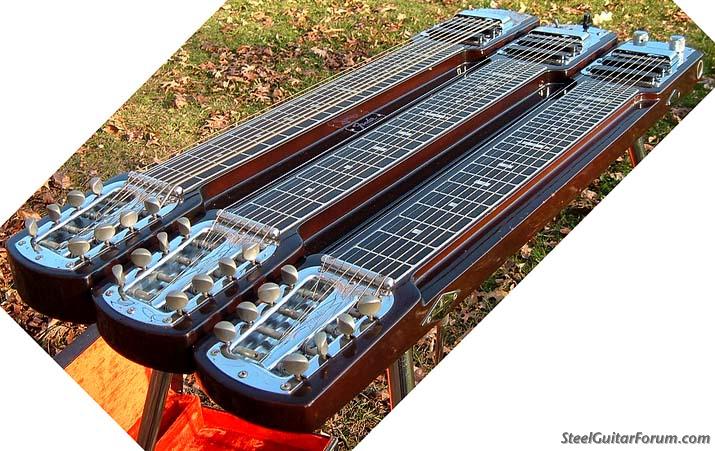
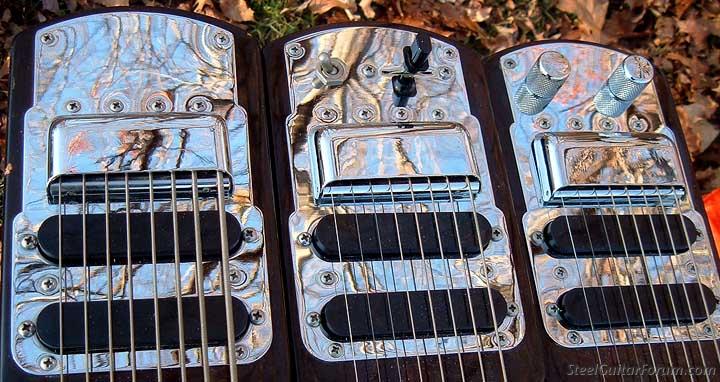
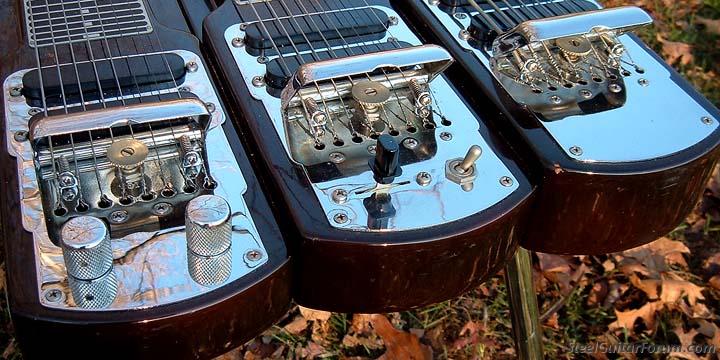
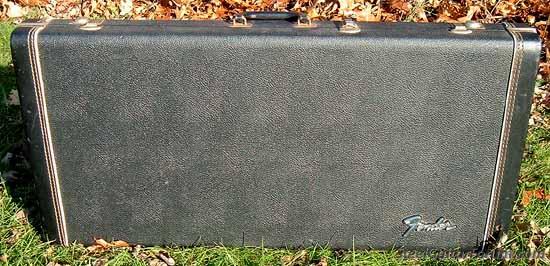
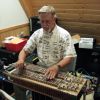
It's a 1967 and it has not been played much. I bought it a few yesrs ago from a woman who never learned to play it. The current tunings are C6, E13, and Leavitt.
Last edited by Doug Beaumier on 27 Dec 2011 10:25 pm, edited 3 times in total.
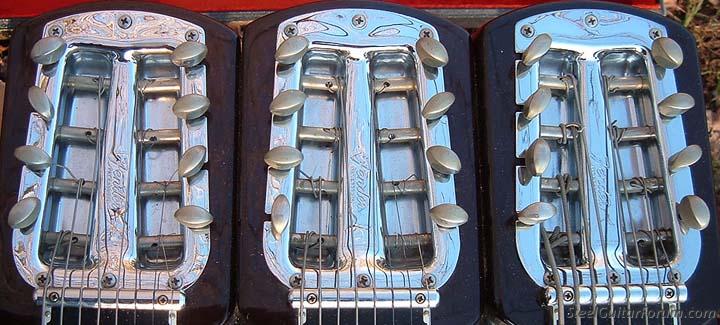
Rick, It's funny that you should mention the tuner buttons... when I first got this guitar I noticed that the tuner buttons were dull, and I thought it might be from wear. Later I noticed that some late-60s Fender guitars have dull nickel tuner buttons. Kluson made some like that, and I have seen them on old Emmons PSGs too. This stringmaster has that type of tuner button... plain, no chrome.
More on those tuner buttons... when I first got the guitar I tried to polish the buttons, but they remained dull, and I realized that they are not chromed. I have seen very few others like this however. Ron, it's interesting to hear that you have the same style tuner buttons on your stringmaster. I have seen this on a couple of regular electric guitars, some of the new reissue Fender guitars, an old Emmons PSG, and that's about it.
Joe, Longer scale lengths offer more Sustain, and some players would argue better tone. Short scale lengths allow for easier bar slants (because the frets are closer together).
Playing bar slants on a long scale steel guitar is particularly difficult on the lower frets, fret 1, 2, & 3 because the frets are so far apart.
I’ve played a few long scale lap steels that sustain like a piano! The Oahu Tonemaster and it’s Gold Tone clone come to mind. Personally, I prefer the shorter scale because of the easier bar slants. Short scale worked for Jerry Byrd. He played mostly 22 1/2" scale as far as I know, and he had plenty of tone! My T-8 is a 24 1/2" scale.
Stringmasters came in three scale lengths: 22 1/2", 24 1/2", 26"
There is a way to tell the scale length of a Stringmaster by looking at the fret markers: