Reece's 12-string style, substitutions, passings

Lap steels, resonators, multi-neck consoles and acoustic steel guitars

Moderator: Brad Bechtel

User avatar
David Doggett
Posts: 8088
Joined: 20 Aug 2002 12:01 am
Location: Bawl'mer, MD (formerly of MS, Nawluns, Gnashville, Knocksville, Lost Angeles, Bahsten. and Philly)
State/Province: -
Country: United States

Reece's 12-string style, substitutions, passings

Post by David Doggett »

Just got back from Reece Anderson's NYC workshop, and I thought I would summarize what I got out of it musically. I think Howard will be posting some photos in another thread, maybe under steel players.

There was some heated discussion on the Forum prior to the workshop, comparing Jerry Byrd's use of the 3rd on top to Reece's preference for the 5th on top. Having now seen Reece's presentation, I can now say that difference is trivial compared to all the other differences Between Reece's style and JB's style. It's like the differences between say Lloyd Green and Curly Chalker on pedal steel - both masters, but of completely different parts of the musical spectrum.

Reece plays a 12-string C6 tuning with 4 picks, and he uses all the strings and all the picks. He uses the traditional lap-style 2-string harmony and slants expertly, but sparingly. He mostly uses very fat 3- and 4-string jazz chords, and even strums 5 or more strings. He does not play much single-string melody with an occasional 2- or 3-string harmony below. Instead he plays 3- and 4-string chords below almost every melody note. He does not play alot of bebop horn lines like you hear in the 6th-neck jazz of Buddy Emmons, Doug Jernigan, and Jim Cohen; rather he plays a big-band derived style much like a jazz piano or organ player would - one thick chord blending into another. In the pedal steel world, it is closest to Bill Stafford - lots of beautiful low-string jazz chords.

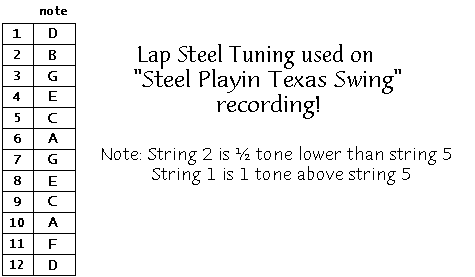
So the debate about whether JBs 6- and 8-string style is better is completely irrelevant and moot - they are totally different styles. Neither JB nor anyone else could play Reece's style on a 6- or 8-string instrument. And Although theoretically it could be done, Reece does not attempt to duplicate JB's style on his 12-string instrument. Reece dummed down most of his presentation so those of us on 6- and 8-string instruments could participate. But he made it clear that he wants what is essentially an 8-string high C6 tuning (5th on top), with two additional out-of-sequence high strings (similar to the two "chromatic" strings of a pedal steel; D and B I believe), and two additional low strings (F and D I believe). When asked about playing with fewer strings, he was quite honest that his heart was in the 12-string style. Even when asked what his tuning recommendation would be for a 10-string lap steel, he said, "Git a 12-string."

One of the contentious issues in the JB v Reece debate was that JB apparently considered the high C6 tuning (G or 5th on top) was too thin, and he preferred the more mellow and full sound with E (3rd) on top, giving an additional low string. This debate is only relevant for 6- and 8-string instruments, and really has nothing to do with Reece's style. He only uses the top strings for occasional melody notes and chimes. He mostly plays on the middle strings, with lots of thick low harmonies and strums – his playing is anything but thin. In spite of Reece himself recommending a G on top, at least for the workshop, for my money, if you want to stay with C6, you could get closer to his style on an 8-string with an E on top, and an F on bottom (a 6-string is virtually hopeless for his style). And actually what Reece mentioned was going to a lower tuning, still with the 5th on top; that is, an A6 with an E on top.

Okay, now to get to what his workshop was really about - substitutions and passing chords. It took me awhile to figure out what the heck he was talking about (okay, I got there late with a hangover – you cannot believe how many clubs and bars there are in New Yawk City, and everyone of them packed with gorgeous women on Saturday night). But here’s the gist of it, as best I can tell. He calls the chords a rhythm guitar player would play, the ones charted above standard notation in sheet music and fake books, “primary chords.” So a rhythm guitar (or a steel comping in the background) might play one or two chords in a bar (the musical measure kind, not one of those Saturday night NYC bars). Now you know all the single melody notes played over those one or two chords? Well, theoretically there is a full harmony chord for each one of those melody notes (we’re not talking fast bebop here, we’re talking more like vocal jazz standards and ballads). You don’t always have time to play those chords, but Reece plays all of them possible, and gets damn near most of them. He occasionally slacks off to two-string straight-bar or slant harmony, which he calls “suggested” chords, but he mostly plays big fat 3- and 4-string full chords like a piano player would. All those extra chords, that are played over the one or two chords the band is playing in a given measure, Reece calls “substitutions” or “passing” chords.

Most of us, on either pedal or lap steel, try to keep the harmony going along underneath the melody, but we use lots of single-string and 2-string stuff to work our way through a melody – not so Reece. In his “smart tab” he lays out a full chord with every melody note, and labels them below the tab in the number system and as either a primary, substitution or passing chord. Any experienced musician who tries to work out a song by ear is familiar with the dilemma of deciding which chord goes with which melody notes, and how often to change the chord. Reece just goes a little deeper than I think most people would, and he has tried to systematize it. The way he really wants you to learn from his smart tab is to go through and list out all the substitution and passing chords that are used with a particular primary chord (all in the number system). This allows you to build up a memory of number system substitution and passing chords that will work with particular primary chords as you work your way through the melody. And Reece is very efficient about getting those sub and passing chords with unique grips, to minimize having to jump all up and down the neck – and of course, that’s what all those extra strings are about. But even without the extra strings, myself and others sitting around me were discovering lots of new grips that had never occurred to us. Reece has some fret counting rules that help locate sub and passing chords. Of course, all the primary, sub and passing chords are the same, what you call it depends on the context, and how long you intend to stay on it.

Well, that’s what I got out of it. The neat thing is that it is all applicable to all songs, in almost any genre, and on any instrument that plays chords. You get the chords different ways, but it’s the same chords. So it is all applicable to both non-pedal, pedal steel, regular guitar, and keyboards. In Reece’s hands and system, a steel guitar is not merely a lead instrument, but it is also a chord machine.

Thanks, Reece. I got lots to work on. Image


------------------
<font size="1">Student of the Steel: Zum uni, Fender tube amps, squareneck and roundneck resos, tenor sax, keyboards


User avatar
Dave Van Allen
Posts: 6161
Joined: 4 Aug 1998 11:00 pm
Location: Souderton, PA , US , Earth
State/Province: -
Country: United States

Post by Dave Van Allen »

David- I think you got more out of the seminar hungover than I did stone cold sober.... Image
Jesse Pearson
Posts: 1552
Joined: 27 Nov 2002 1:01 am
Location: San Diego , CA
State/Province: California
Country: United States

Post by Jesse Pearson »

David, thanks for the run down. Did you guys touch on the subject of looking at the C6 tuning as being the C Dom7(mixolydian) position going from the 12th fret down to the 10th fret position and also doubling as the F maj7/9(Ionian) position from the 10th fret up to the 12th fret? I look at that 12th down to 10th position as just a Major 6th position/major blues scale box for country and extend from there.

I like your description of primary, substitution and passing chord application. I've been using Ricky Davis's chord finder to make chord charts from different points of view to try and find the same things you are talking about. I find scales that over lap chord voicings and arpeggio positions. I double check this with my JB, Don Helms, Little Roy Wiggins and Dewitt Scott books to compare chord voicing/scale application.
User avatar
HowardR
Posts: 8318
Joined: 3 Apr 1999 1:01 am
Location: N.Y.C.-Fire Island-Asheville
State/Province: -
Country: United States

Post by HowardR »

<SMALL> Did you guys touch on the subject of looking at the C6 tuning as being the C Dom7(mixolydian) position going from the 12th fret down to the 10th fret position and also doubling as the F maj7/9(Ionian) position from the 10th fret up to the 12th fret?</SMALL>

Dang! So that's what I missed while I was in the can...... Image
Rick Garrett
Posts: 1805
Joined: 13 May 2001 12:01 am
Location: Tyler, Texas
State/Province: Texas
Country: United States

Post by Rick Garrett »

Thanks for the update. I've been anxiously waiting to see what yall learned at the Reece's workshop. I didn't know he had "Smart Tab" for the 12 string tuning.

I have GOT to set aside some time to go spend a few hours with Reece. Now that I'm getting around on this tuning I need someone to tell me what the heck I'm doing. Image

Rick
User avatar
ebb
Posts: 1480
Joined: 4 Aug 1998 11:00 pm
Location: nj
State/Province: -
Country: United States

Post by ebb »

someone even brought a 6 string aiello fry pan which was quite beautifull. i didn't dare check the top string though
User avatar
David Doggett
Posts: 8088
Joined: 20 Aug 2002 12:01 am
Location: Bawl'mer, MD (formerly of MS, Nawluns, Gnashville, Knocksville, Lost Angeles, Bahsten. and Philly)
State/Province: -
Country: United States

Post by David Doggett »

DVA, the difference is I can write about it, but I heard you and Jim Cohen up there on the front row actually playing some of it.

Jesse, the introductory stuff about fret counting sort of got mixed up with the hangover, and I'm gonna have to get back to Reece on that; but he didn't use mode terminolgy.

Rick, the smart tab he handed out was for 8-string high C6. I don't know what he has for the full 12-string, that may still be a work in progress. He said we were sort of guinea pigs for the smart tab system (well he called us a few other things too, but we'll skip that).

You really have to give Reece credit for having a grand master plan. He designed and manufactures the instrument (His SuperSlide does not sound like a Rick or a Fender Stringmaster - it has a more mellow jazz tone, and is a marvelously finished modern instrument). He developed a new innovative tuning for it (which really has some serious lap steel advantages over previous pedal steel adapted 12-string E9, C6 and universal tunings - it is really a 12-string C6 maj7,9 / F maj7,9 / A min7,9 tuning, or something like that - calling it a 12-string C6 is a huge understatement). And now he is developing a modified tab system, chord theory system, and instruction course for his style, tuning and instrument. You could take it all to Hawaiian, country or Western swing, but it is ultimately suited for big band and modern jazz. I think it is cool he is developing a relationship to East Coast jazz pickers, because, any hardcore modern jazz guitarist who wanted to try steel would love this instrument, tuning and style.
User avatar
Bill McCloskey
Posts: 8543
Joined: 5 Jan 2005 1:01 am
Location: Nanuet, NY
State/Province: New York
Country: United States

Post by Bill McCloskey »

I guess now we'll find out how much we learned.

My take on the fret counting was that he was making the point that you can use the same passing chords for any movement that is the same.

In other words if you are going to the 4 chord from the 1 chord, that is a movement of 5 fret steps. In order to get there you can play a number of different passing chords. For instance you could play the 1-7th (ie. if in C play a C7th to get to the F).

Now that you know that you can apply the same passing chord to any 5 fret movement. So if you are going from the 5 chord to the 1 Chord (G to C in the key of C) that is the same as moving up 5 frets from the 7th fret to the 12th fret, in this case. Since this is a 5 fret movement, you think of the G chord as if it were the 1 chord so you can play a G7th to get to the C.

Better yet, this works if you are moving from the 2 chord to the 5 chord, the 3chord to the 6th chord, anything 5 fret movement. If it works for one, it will work for them all.

So once you know a passing chord that links a specific fret movement, it will apply to that same fret movement, no matter what chord you are playing.

And of course the smart tab identifies lots of passing chords which can then be added to your arsenal.<font size="1" color="#8e236b"><p align="center">[This message was edited by Bill McCloskey on 27 February 2006 at 01:00 PM.]</p></FONT>
User avatar
HowardR
Posts: 8318
Joined: 3 Apr 1999 1:01 am
Location: N.Y.C.-Fire Island-Asheville
State/Province: -
Country: United States

Post by HowardR »

<SMALL>for any movement</SMALL>

after that pasta dinner we had, mine went from minor to major.....talk about parallel keys.... Image<font size="1" color="#8e236b"><p align="center">[This message was edited by HowardR on 27 February 2006 at 12:36 PM.]</p></FONT>
Steve Alcott
Posts: 1629
Joined: 6 Sep 2002 12:01 am
Location: New York, New York, USA
State/Province: New York
Country: United States

Post by Steve Alcott »

For me, one of the most impressive aspects of the seminar was how well Reece was able to deal with players of various levels of experience and knowledge. The way he lays out his system is a little daunting at first, but then the little bells go off and you realise what's going on. The terminology is different from what a conservatory victim like me is used to, but once again the bell goes off, and you've got it. The last thing Reece did, which I thought was great, was to show us a little blues pocket that anyone could play and leave all of us with some confidence that we could actually do it. My thanks to Howard for organising and to Reece for schlepping (definition on request) all the way from Dallas.
User avatar
Hiro Keitora
Posts: 816
Joined: 29 Dec 1998 1:01 am
Location: New York, New York
State/Province: New York
Country: United States

Post by Hiro Keitora »

Well, actually, I was planning to bring D-8 Magnatone but it's kinda heavy to take a subway with. So I picked beloved frypan, but before the workshop, I checked with Howard about the proper tunning, so I changed from "E" top to "G"( Meaning all the strings had to come off to move over for that "G" to be on!).

On my D-10 pedal's C6 has "D" on top ala Jim Cohen. So it took me a while to get used to G on top again, but once I get confortable with it, it was quite fun. But, you're right. Perhaps 6 string lap wasn't the most efficent one for Reece's style, but what the heck, I had a blast.

Steve, make up a play-along CD of "Bebop horn line" C6 practice tracks! I'll be the first one to buy it!! <H>
Don McClellan
Posts: 1468
Joined: 13 Nov 1999 1:01 am
Location: California/Thailand
State/Province: California
Country: United States

Post by Don McClellan »

Reece,
When and where is the next one?
User avatar
HowardR
Posts: 8318
Joined: 3 Apr 1999 1:01 am
Location: N.Y.C.-Fire Island-Asheville
State/Province: -
Country: United States

Post by HowardR »

Reece & I had some cd rhythmn tracks that we cannot find.

They were Jamie Abersold jazz cds, Gerald Ross's Hawaiian tracks (shameless plug), Steve Alcott's Texas Dance Hall Favorites, and one other cd of tracks that I can't remember at the moment.

If these inadvertinely got shuffled into someone's mix, pleaase let us know.

There's a $100.00 reward payable by Bill McCloskey..... Image

update....although our "mystery" is solved, I'll leave this up as these track cds are highly recommended to be in everone's cd instruction materials.

I'll still leave the reward up though.... Image <font size="1" color="#8e236b"><p align="center">[This message was edited by HowardR on 28 February 2006 at 07:45 AM.]</p></FONT>
Reece Anderson
Posts: 2218
Joined: 21 Jun 1999 12:01 am
Location: Keller Texas USA, R.I.P.
State/Province: -
Country: United States

Post by Reece Anderson »

MY MISTAKE....and my most sincere apology to everyone concerned. The CD's were packed away in a box labeled SmarTabs, and in my rush to locate them I mistakenly assumed the box contained that for which it was labeled. I should have looked inside.....so, its all my fault and I apologize for my oversight.

When I get caught up I will be posting my impressions of the trip and my experiences.

I do wish to again thank my dear friends HowardR and Bill M. for being exceptional hosts, cheauffers, tour guides, travel agents and etc. Two of the finest most considerate and thoughtful people anyone would ever hope to meet.
User avatar
Drew Howard
Posts: 3926
Joined: 4 Aug 1998 11:00 pm
Location: 48854
State/Province: -
Country: United States

Post by Drew Howard »

Is this the Reece 12-string C6 tuning?

Image

thanks,
Drew

------------------
Image
<font size=1>Drew Howard - website - Fessenden guitars, 70's Fender Twin, etc.</font>


<font size="1" color="#8e236b"><p align="center">[This message was edited by Drew Howard on 28 February 2006 at 07:39 AM.]</p></FONT>
User avatar
Bill McCloskey
Posts: 8543
Joined: 5 Jan 2005 1:01 am
Location: Nanuet, NY
State/Province: New York
Country: United States

Post by Bill McCloskey »

yes Drew that is it.
User avatar
Bill Bosler
Posts: 317
Joined: 14 Apr 2004 12:01 am
Location: Schwenksville, Pennsylvania, USA
State/Province: Pennsylvania
Country: United States

Post by Bill Bosler »

Did Reece have any Smart Tab material specifically for his 12 string C6th tuning? I looked on his website and saw only material for E9 & C6 pedal steels.
User avatar
David Doggett
Posts: 8088
Joined: 20 Aug 2002 12:01 am
Location: Bawl'mer, MD (formerly of MS, Nawluns, Gnashville, Knocksville, Lost Angeles, Bahsten. and Philly)
State/Province: -
Country: United States

Post by David Doggett »

I'm still a little hazy about the fret counting stuff. Can anyone expand on what Bill M. said above? Is that all there was to it, or is there more?
Reece Anderson
Posts: 2218
Joined: 21 Jun 1999 12:01 am
Location: Keller Texas USA, R.I.P.
State/Province: -
Country: United States

Post by Reece Anderson »

Bill B....I do not as yet have SmarTab for the 12 string non pedal, but I have intentions of offering it for all string variations in the near future. I appreciate your interest.

David D....by the time you read this, you will have a private email from me.
User avatar
Bill McCloskey
Posts: 8543
Joined: 5 Jan 2005 1:01 am
Location: Nanuet, NY
State/Province: New York
Country: United States

Post by Bill McCloskey »

"I do not as yet have SmarTab for the 12 string non pedal, but I have intentions of offering it for all string variations in the near future."


Can't wait for that. Make it soon Reece.