Is it just me, or does anyone else have trouble getting both A and B pedals down to where they cleanly effect a major chord? If I press them both down in just the right way, I get a clean chord. But more often than not, the chord sounds "off" because one pedal is a little lower or a little higher than the other.
I'm playing a Zumsteel Encore, and have been thinking maybe this is just the way it is, that the pedal action is designed this way so one can slightly lift off of one pedal and then press down again to get that effect on purpose. It's a cool effect, but I keep coming back to the fact that I repeatedly flub a clean A+B pedal sound when I try to get it. And even when I do get a clean A+B pedal sound, if my foot shifts just slightly (which it often does) the chord goes out of tune.
A+B pedal question
Moderator: Dave Mudgett
-
Joseph Lazo
- Posts: 350
- Joined: 20 Jan 2024 8:31 am
- Location: Wisconsin, USA
- State/Province: Wisconsin
- Country: United States
-
Bill C. Buntin
- Posts: 1414
- Joined: 14 Nov 2000 1:01 am
- Location: Cleburne TX
- State/Province: -
- Country: United States
Joseph
First, I would get your pedals comfortable for your particular needs. By changing height and or pedal travel just enough so that AB go down to the same exact place (angainst the stop) every time. By doing this you are guaranteeing yourself that those pedals are going to repeat every time they are engaged. Then tune the strings accordingly. Then run through the movement until your foot feels the same on the pedals every time. Continue this process until it becomes second nature. This way you can concentrate on playing freely without stressing over whether the guitar is doing what it’s supposed to.
The same general principle applies to all the pulls, raises and drops all over the entire guitar.
The general concept is to have the pedal stop or knee lever stop and the string reach pitch at the same time.
Not to worry most all of us have fussed with this one time or another.
Good luck.
Bill
First, I would get your pedals comfortable for your particular needs. By changing height and or pedal travel just enough so that AB go down to the same exact place (angainst the stop) every time. By doing this you are guaranteeing yourself that those pedals are going to repeat every time they are engaged. Then tune the strings accordingly. Then run through the movement until your foot feels the same on the pedals every time. Continue this process until it becomes second nature. This way you can concentrate on playing freely without stressing over whether the guitar is doing what it’s supposed to.
The same general principle applies to all the pulls, raises and drops all over the entire guitar.
The general concept is to have the pedal stop or knee lever stop and the string reach pitch at the same time.
Not to worry most all of us have fussed with this one time or another.
Good luck.
Bill
-
Steve Lipsey
- Posts: 2154
- Joined: 9 May 2011 8:51 pm
- Location: Portland, Oregon, USA
- State/Province: Oregon
- Country: United States
I generally add in the nice touch of doing B pedal first with the inside edge of your foot and then coming down on A pedal with the outside edge...definitely seems easier to make both work cleanly in addition to adding a nice transition tone...
https://www.lostsailorspdx.com
Shoji & Williams S10s, Milkman "The Amp 100"+Missing Link Hybrid D-120
Ben Bonham Resos, 1954 Oahu Diana, 1936 Oahu Parlor
Shoji & Williams S10s, Milkman "The Amp 100"+Missing Link Hybrid D-120
Ben Bonham Resos, 1954 Oahu Diana, 1936 Oahu Parlor
-
Tucker Jackson
- Posts: 1938
- Joined: 8 Apr 2004 12:01 am
- Location: Portland, Oregon, USA
- State/Province: Oregon
- Country: United States
Hi, Joseph
If your body is centered near the 15th fret -- to basically match where the builder installed your knee levers and assumed you would sit -- you'll find that you need the A-pedal to be a little higher than the B.
On most guitars, a good relative height between the A and B works out so that they both bottom out level to the floor. In order for that to happen, at neutral, the A will be a little higher than B because it requires more travel to do it's thing.
If you don't know, the pedal height is adjustable by unscrewing the little locking-nut at the top of the barrel (the barrel being the thing at the end of the rod that attaches to the pedal). Once that locking-nut is loose, you'll be able to rotate the barrel to effectively shorten or lengthen the rod. Just one complete rotation of the barrel can make a noticeble difference in how the pedals feel under foot, so make small adjustments and then test it out.
If your body is centered near the 15th fret -- to basically match where the builder installed your knee levers and assumed you would sit -- you'll find that you need the A-pedal to be a little higher than the B.
On most guitars, a good relative height between the A and B works out so that they both bottom out level to the floor. In order for that to happen, at neutral, the A will be a little higher than B because it requires more travel to do it's thing.
If you don't know, the pedal height is adjustable by unscrewing the little locking-nut at the top of the barrel (the barrel being the thing at the end of the rod that attaches to the pedal). Once that locking-nut is loose, you'll be able to rotate the barrel to effectively shorten or lengthen the rod. Just one complete rotation of the barrel can make a noticeble difference in how the pedals feel under foot, so make small adjustments and then test it out.
-
Jon Light (deceased)
- Posts: 14336
- Joined: 4 Aug 1998 11:00 pm
- Location: Saugerties, NY
- State/Province: -
- Country: United States
Deliberate use of timing finesse on the A&B is an 'always on' tool.
But being able to consistently and reliably floor both pedals together and bottom them out 100% of the time is simply fundamental technique.
There are 5 things you need to consider to get there.
1) Good footwear? Is the sole firm enough to do the job?
2) Foot position. Have the foot anchored in the right place.
3) Practice.
4) Practice.
5) Practice.
edited to add that yes, absolutely, there are some mechanical adjustments that can fine tune pedal height and I am totally in favor of using these to optimize the guitar's fit to an individual's body.
But being able to consistently and reliably floor both pedals together and bottom them out 100% of the time is simply fundamental technique.
There are 5 things you need to consider to get there.
1) Good footwear? Is the sole firm enough to do the job?
2) Foot position. Have the foot anchored in the right place.
3) Practice.
4) Practice.
5) Practice.
edited to add that yes, absolutely, there are some mechanical adjustments that can fine tune pedal height and I am totally in favor of using these to optimize the guitar's fit to an individual's body.
-
Bobby D. Jones
- Posts: 3312
- Joined: 17 May 2010 9:27 am
- Location: West Virginia, USA
- State/Province: West Virginia
- Country: United States
If your guitar is set up Emmons A-B-C. If your left foot sets far to the left, The A pedal may need to be raised just a little higher than the B pedal, When the pedals hit their stops. As some have suggested.
So you are not stressing your ankle to hold both pedals against their stops.
If the guitar is a D10 with 8 pedals, Not much can be done.
EXCEPT, How good control do you have with B-C pedals????
If you have good control of the B-C pedals. You may have to consider becoming a DAYer, And Join us DAY SETUP players with C-B-A pedals. Lower E's on LKL, Raise E's on LKR. So you can move your foot about 3 inches to the right on A-B pedals. For better control.
If the guitar is S10. You may want to consider, Moving the pedals 2 or 3 pedal widths to the right, For a more straight down push on A-B pedals. For better control.
My first store bought guitar, MSA S10 had pedals 3 slots to right, Very straight down on A-B pedals.
Good Luck finding a cure for problem, Happy Steelin.
So you are not stressing your ankle to hold both pedals against their stops.
If the guitar is a D10 with 8 pedals, Not much can be done.
EXCEPT, How good control do you have with B-C pedals????
If you have good control of the B-C pedals. You may have to consider becoming a DAYer, And Join us DAY SETUP players with C-B-A pedals. Lower E's on LKL, Raise E's on LKR. So you can move your foot about 3 inches to the right on A-B pedals. For better control.
If the guitar is S10. You may want to consider, Moving the pedals 2 or 3 pedal widths to the right, For a more straight down push on A-B pedals. For better control.
My first store bought guitar, MSA S10 had pedals 3 slots to right, Very straight down on A-B pedals.
Good Luck finding a cure for problem, Happy Steelin.
-
Joseph Lazo
- Posts: 350
- Joined: 20 Jan 2024 8:31 am
- Location: Wisconsin, USA
- State/Province: Wisconsin
- Country: United States
-
Roger Rettig

- Posts: 11177
- Joined: 4 Aug 2000 12:01 am
- Location: Naples, FL
- State/Province: -
- Country: United States
Good advice from everyone.
Bobby's post caught my eye, though. I'm a 'Day' player and, in my case my C and B pedals have never been comfortable, even to the point where I'll avoid that combination. That's losing a great deal, though, so clearly unacceptable.
Bobby: I have my first pedal (my 'C') raised as far as it will go and quite a bit higher than my B. In a perfect world, I'd have it nearer to the B pedal. That would make life easier. Such alterations - even were they possible - would be beyond me.
I can't simply swivel my foot from 2 and 3 over to 1 and 2: I have to lift-and-place it.
I could never play Emmons!
Bobby's post caught my eye, though. I'm a 'Day' player and, in my case my C and B pedals have never been comfortable, even to the point where I'll avoid that combination. That's losing a great deal, though, so clearly unacceptable.
Bobby: I have my first pedal (my 'C') raised as far as it will go and quite a bit higher than my B. In a perfect world, I'd have it nearer to the B pedal. That would make life easier. Such alterations - even were they possible - would be beyond me.
I can't simply swivel my foot from 2 and 3 over to 1 and 2: I have to lift-and-place it.
I could never play Emmons!
Roger Rettig: Emmons D10, B-bender Teles, Martins, and a Gibson Super 400!
----------------------------------
----------------------------------
-
Per Berner

- Posts: 1993
- Joined: 10 Aug 2004 12:01 am
- Location: Skovde, Sweden
- State/Province: -
- Country: United States
-
Dave Grafe

- Posts: 5372
- Joined: 29 Oct 2004 12:01 am
- Location: Hudson River Valley NY
- State/Province: -
- Country: United States
Lots of helpful suggestions here, but I'm not certain your actual problem is being addtessed. Please clarify, which is it?
When you push both pedals all the way down to the stop the strings are out of tune.
• This is a tuning issue
When you push both pedals all the way down the notes change at different rates OR one pedal is much harder to push than the other.
• These are timing issues
When you try to push both pedals all the way down one goes all the way but the other doesn't without extra attention and effort to twist your foot sideways.
• This is a downrod length issue
Or is it something else? I'm not familiar enough with that instrument to give further advice, but fully understanding and communicating the problem is the best way to get it sorted.
When you push both pedals all the way down to the stop the strings are out of tune.
• This is a tuning issue
When you push both pedals all the way down the notes change at different rates OR one pedal is much harder to push than the other.
• These are timing issues
When you try to push both pedals all the way down one goes all the way but the other doesn't without extra attention and effort to twist your foot sideways.
• This is a downrod length issue
Or is it something else? I'm not familiar enough with that instrument to give further advice, but fully understanding and communicating the problem is the best way to get it sorted.
-
Joseph Lazo
- Posts: 350
- Joined: 20 Jan 2024 8:31 am
- Location: Wisconsin, USA
- State/Province: Wisconsin
- Country: United States
Dave, thanks for chiming in. I'll try to explain it best I can: It's like there's a "sweet spot" with both pedals down, but it's nearly impossible to accurately hit it every time. One pedal or the other ends up slightly too far down, or not down enough.
I haven't yet looked into adjusting the height of the A pedal, or checking to see that when both pedals are "floored" they're both actually floored equally. I'm not really sure how I would even do that... hold them down with my hand while I look at them from floor level?
FWIW, just eyeballing it looks as though A and B pedals are pretty much level, and C pedal is very slightly lower.
Also, I need to recharge my utility light so I can better see what's going on down there.
I haven't yet looked into adjusting the height of the A pedal, or checking to see that when both pedals are "floored" they're both actually floored equally. I'm not really sure how I would even do that... hold them down with my hand while I look at them from floor level?
FWIW, just eyeballing it looks as though A and B pedals are pretty much level, and C pedal is very slightly lower.
Also, I need to recharge my utility light so I can better see what's going on down there.
-
Dave Grafe
- Posts: 5372
- Joined: 29 Oct 2004 12:01 am
- Location: Hudson River Valley NY
- State/Province: -
- Country: United States
Every time you push a pedal the change should be exactly the same. When you say "sweet spot" it sounds like you have to do a partial depress to be in tune, and that's not how it's supposed to work. Tune the changes so that when A+B are ALL THE WAY DOWN together they are perfectly in tune, and then always push them all the way down.
As for pedal height it's not at all about being the same height it's about fitting your body so that you can (1) push the A+B or B+C combos easily and (2) rock your foot smoothly, from A+B together to A alone without pushing B and vice versa. This is very much about the flexibility of your ankle as it works the A+B pedals, and geometry, i.e. the horizontal location of pedals and levers relative to your seat. I find the B pedal is usually lower than either A or C but that's just what fits me.
As for pedal height it's not at all about being the same height it's about fitting your body so that you can (1) push the A+B or B+C combos easily and (2) rock your foot smoothly, from A+B together to A alone without pushing B and vice versa. This is very much about the flexibility of your ankle as it works the A+B pedals, and geometry, i.e. the horizontal location of pedals and levers relative to your seat. I find the B pedal is usually lower than either A or C but that's just what fits me.
-
Andrew Goulet

- Posts: 533
- Joined: 6 Oct 2010 7:05 pm
- State/Province: -
- Country: United States
+1 for Dave's post here. Even if your foot ends up tilted, you should be able to get those changes in tune by stomping them down as far as they go.
Plenty of good advice here.
I've found small adjustments to both pedal height and seat height make a big difference in comfort and consistency of pedal and lever changes.
Plenty of good advice here.
I've found small adjustments to both pedal height and seat height make a big difference in comfort and consistency of pedal and lever changes.
Marlen S12 pedal steel
12 string Bill Hatcher lap steel
ZT Club and Lunchbox
12 string Bill Hatcher lap steel
ZT Club and Lunchbox
-
Bobby D. Jones
- Posts: 3312
- Joined: 17 May 2010 9:27 am
- Location: West Virginia, USA
- State/Province: West Virginia
- Country: United States
Are the pedals actually touching the floor?
If the pedals are contacting the floor, That would be the problem. If the pedals are touching the floor, There should be a pedal stop up under the guitar near the pedal rod connection point. Should be a screw with a lock nut. Which may need adjusted, Some guitars has a plastic oval disc for setting pedal stop, Adjusted by loosening the screw, And turning the disc for contact. So the pedal hits the Stop before the pedal hits the floor.
Just a wild guess. Without pictures or video.
If the pedals are contacting the floor, That would be the problem. If the pedals are touching the floor, There should be a pedal stop up under the guitar near the pedal rod connection point. Should be a screw with a lock nut. Which may need adjusted, Some guitars has a plastic oval disc for setting pedal stop, Adjusted by loosening the screw, And turning the disc for contact. So the pedal hits the Stop before the pedal hits the floor.
Just a wild guess. Without pictures or video.
-
Don R Brown

- Posts: 2965
- Joined: 27 Dec 2011 9:20 am
- Location: Rochester, New York, USA
- State/Province: New York
- Country: United States
Joseph, if you have to do something other than putting the pedals all the way down to sound good, as others have said SOMETHING is not right.
Are there any other steel players in your area (or within reasonable distance) who could help you on this? I gather you are fairly new to the instrument. I believe once you have this issue resolved, you will be amazed at how much easier that particular part of the playing becomes. It's worth your effort to correct it.
Are there any other steel players in your area (or within reasonable distance) who could help you on this? I gather you are fairly new to the instrument. I believe once you have this issue resolved, you will be amazed at how much easier that particular part of the playing becomes. It's worth your effort to correct it.
Many play better than I do. Nobody has more fun.
-
Joseph Lazo
- Posts: 350
- Joined: 20 Jan 2024 8:31 am
- Location: Wisconsin, USA
- State/Province: Wisconsin
- Country: United States
Ok, here are a couple photos:
This is what the pedals look like. The pedal on far left is a "zero" pedal. It only lowers the lowest string. The A and B pedals are the second and third pedals.

This is what it looks like with the A and B pedals both pressed down fully:
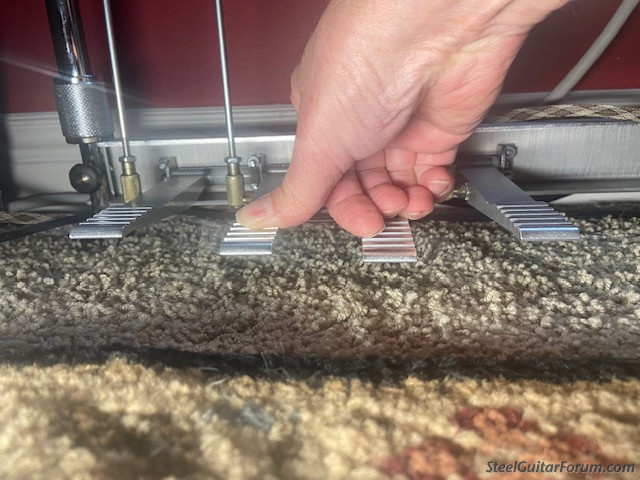
When I saw this photo, it clarified for me what I've noticed when playing-- when I press down on both at same time, I always have to press more on the B pedal than the A pedal. When I do this, my foot lifts slightly off the A pedal and puts the chord out of tune.
This is what the pedals look like. The pedal on far left is a "zero" pedal. It only lowers the lowest string. The A and B pedals are the second and third pedals.
This is what it looks like with the A and B pedals both pressed down fully:
When I saw this photo, it clarified for me what I've noticed when playing-- when I press down on both at same time, I always have to press more on the B pedal than the A pedal. When I do this, my foot lifts slightly off the A pedal and puts the chord out of tune.
-
John Hyland
- Posts: 490
- Joined: 6 Sep 2021 10:45 pm
- Location: South Australia
- State/Province: -
- Country: Australia
-
Dave Grafe
- Posts: 5372
- Joined: 29 Oct 2004 12:01 am
- Location: Hudson River Valley NY
- State/Province: -
- Country: United States
Excellent! Get your favorite playing shoes on for the next part:
Leaving the B pedal as it is, loosen the lock nut on the A pedal's lower rod connector, unhook it from the pedal and unscrew the connector 360° - i.e. one full revolution longer, then reconnect it to the pedal and see how it feels when you push them down together. Continue to loosen or tighten as needed until it's a comfortable fit and is naturally in tune, then tighten down the lock nut and you're golden.
Once you have the A+B pedals working together do the same with the B+C combination, again leaving the B pedal linkage alone. Loosen the C pedal lock nut and adjust the C rod connector so that it feels natural and complete to move from A+B to B+C and back.
And there are knee levers to consider. Give yourself enough room between LKL and LKR to swing your knee as needed when rocking pedals. Adjust the LKL to be clear when you lift the B pedal while holding A, and the LKR to leave room when holding the B and lifting the A pedal. The right knees can be closer together but should be aligned with the natural position of your knee when your foot is working the volune pedal.
Once you find your joy make certain the lock nuts are all tight and put some red Lockite on the threads to keep them that way.
Leaving the B pedal as it is, loosen the lock nut on the A pedal's lower rod connector, unhook it from the pedal and unscrew the connector 360° - i.e. one full revolution longer, then reconnect it to the pedal and see how it feels when you push them down together. Continue to loosen or tighten as needed until it's a comfortable fit and is naturally in tune, then tighten down the lock nut and you're golden.
Once you have the A+B pedals working together do the same with the B+C combination, again leaving the B pedal linkage alone. Loosen the C pedal lock nut and adjust the C rod connector so that it feels natural and complete to move from A+B to B+C and back.
And there are knee levers to consider. Give yourself enough room between LKL and LKR to swing your knee as needed when rocking pedals. Adjust the LKL to be clear when you lift the B pedal while holding A, and the LKR to leave room when holding the B and lifting the A pedal. The right knees can be closer together but should be aligned with the natural position of your knee when your foot is working the volune pedal.
Once you find your joy make certain the lock nuts are all tight and put some red Lockite on the threads to keep them that way.
-
Roger Rettig
- Posts: 11177
- Joined: 4 Aug 2000 12:01 am
- Location: Naples, FL
- State/Province: -
- Country: United States
The only other way for there to be a variable would be for the pedal-bar to flex ever-so slightly.
This, though, is a Zum Encore; if it's anything like my one was (sadly, it's now been sold), it'll be as stable as any top-of-the-line steel.
Make sure the pedal-bar is tightly located on the front legs. Any movement there, and the bar might 'rotate' a tiny bit, resulting in a lack of consistency as the pedals are engaged.
That's a long shot, though.
This, though, is a Zum Encore; if it's anything like my one was (sadly, it's now been sold), it'll be as stable as any top-of-the-line steel.
Make sure the pedal-bar is tightly located on the front legs. Any movement there, and the bar might 'rotate' a tiny bit, resulting in a lack of consistency as the pedals are engaged.
That's a long shot, though.
Roger Rettig: Emmons D10, B-bender Teles, Martins, and a Gibson Super 400!
----------------------------------
----------------------------------
-
Joseph Lazo
- Posts: 350
- Joined: 20 Jan 2024 8:31 am
- Location: Wisconsin, USA
- State/Province: Wisconsin
- Country: United States
Dave, thanks for the excellent instructions! I've got it now to where both A+B and B+C pedals bottom out uniformly. What a huge difference this makes! I can consistently get a clean major chord with A+B now.
I have to think through what you wrote about the knee levers, though. If I so much as make contact with the LKR lever, it's audible. I looked underneath the console and can see that just nudging the LKR lever affects the 7th string (the lower E), but does not affect the other E string (4th string). That 4th string only changes with real movement of the lever.
I'm new to pedal steel, but looking at this contraption my guess would be that the spring holding that 7th string should be tightened. Would that rectify how touch sensitive it is to LKR?
I have to think through what you wrote about the knee levers, though. If I so much as make contact with the LKR lever, it's audible. I looked underneath the console and can see that just nudging the LKR lever affects the 7th string (the lower E), but does not affect the other E string (4th string). That 4th string only changes with real movement of the lever.
I'm new to pedal steel, but looking at this contraption my guess would be that the spring holding that 7th string should be tightened. Would that rectify how touch sensitive it is to LKR?
-
Joseph Lazo
- Posts: 350
- Joined: 20 Jan 2024 8:31 am
- Location: Wisconsin, USA
- State/Province: Wisconsin
- Country: United States
-
Dave Grafe
- Posts: 5372
- Joined: 29 Oct 2004 12:01 am
- Location: Hudson River Valley NY
- State/Province: -
- Country: United States
No, that's a timing thing not a tension thing. Now you're getting to the real nitty gritty. I will address your E's on strings 4 and 8 (not the 7) but the principles are the same for any combination of strings affected by a single pedal or lever. You are going to need to turn the guitar over and see that for every pedal and lever there is at least one crossrod with bellcranks mounted on it. Hopefully the bellcranks on your guitar have multiple slots or holes that allow you to change how much of the fixed pedal travel converts via levetage to longer or shorter pulls on the changer fingers. The farther from the rod the longer/faster the change. In your case the 8 string is starting its pull before the 4 string, i.e. taking too long to make its pull, so progressively move the 8 string changer rod to a bellcrank hole FARTHER from the pivoting crossrod. This will effectively increase the travel of the changer so that once you retune the change it will begin later, thus less prone to going off before the other. The radial holes on the bellcranks and the changer fingers can be combined to time strings of every change to move together, although I don't know enough about you guitar to say how far it can go.Joseph Lazo wrote:. I looked underneath the console and can see that just nudging the LKR lever affects the 7th string (the lower E), but does not affect the other E string (4th string). That 4th string only changes with real movement of the lever.
I'm new to pedal steel, but looking at this contraption my guess would be that the spring holding that 7th string should be tightened. Would that rectify how touch sensitive it is to LKR?
Leverage...with the guitar upside down, the lower holes on the bellcranks are the slowest, producing the least travel, the higher holes the fastest, creating the longest pull. At the changer end the roles are reversed: the lower holes are the fastest, requiring the least amount of travel for a given change, and the higher holes the slowest, requiring longer pulls to affect the same change.
Every player a mechanic...
-
Joseph Lazo
- Posts: 350
- Joined: 20 Jan 2024 8:31 am
- Location: Wisconsin, USA
- State/Province: Wisconsin
- Country: United States
Thanks for that input, Dave. I'm going to get on this in the morning.
Yes, there are multiple holes on the bell cranks-- 5 total. Looking underneath the console, I can see that the bell cranks for the 8th string (my bad on thinking it was the 7th!), have rods mounted on the 2nd hole of one bell crank and on the 3rd hole on the other. For reference, what I'm calling the first hole is the one closest to the underside of the top board and the last hole is the one nearest the floor. So when you say to move where the rod connects to the crank farther from the crossrod, you mean moving it one hole further away (as in closer to the floor), right?
As a total noob to this, I'm finding it hard to comprehend the mechanics of the instrument. Really appreciate your input.
Yes, there are multiple holes on the bell cranks-- 5 total. Looking underneath the console, I can see that the bell cranks for the 8th string (my bad on thinking it was the 7th!), have rods mounted on the 2nd hole of one bell crank and on the 3rd hole on the other. For reference, what I'm calling the first hole is the one closest to the underside of the top board and the last hole is the one nearest the floor. So when you say to move where the rod connects to the crank farther from the crossrod, you mean moving it one hole further away (as in closer to the floor), right?
As a total noob to this, I'm finding it hard to comprehend the mechanics of the instrument. Really appreciate your input.
-
Doug Earnest

- Posts: 2262
- Joined: 29 Mar 2000 1:01 am
- Location: Branson, MO USA
- State/Province: -
- Country: United States
Joe, before you ever even think about moving any rods be sure to see if you can adjust for free play by checking the adjusting screw at the bottom of the knee lever mount, and in the case of your LKR also be sure the change is not over tuned. It's hard to say what a previous owner may have done.
The ultimate stop for this lever, and correct way to adjust the free play, is by adjusting the stop screw in the bracket on the rear apron of the guitar that the lever stops against.
This is described in the owners manual, located here on my site https://www.stageonesteelguitars.com/product-support
The manual can be downloaded as a .pdf file and printed if desired.
The ultimate stop for this lever, and correct way to adjust the free play, is by adjusting the stop screw in the bracket on the rear apron of the guitar that the lever stops against.
This is described in the owners manual, located here on my site https://www.stageonesteelguitars.com/product-support
The manual can be downloaded as a .pdf file and printed if desired.
-
Don R Brown
- Posts: 2965
- Joined: 27 Dec 2011 9:20 am
- Location: Rochester, New York, USA
- State/Province: New York
- Country: United States
Dave, I think blue threadlocker would be a better choice. The blue holds well, but CAN be backed off with a bit of effort if it's ever necessary to change things. The red type usually requires a torch to allow it to move, at least in automotive uses. You usually only use red where you are just about never going to need it off, and when it's life-or-death if it does come loose.Dave Grafe wrote: Once you find your joy make certain the lock nuts are all tight and put some red Lockite on the threads to keep them that way.
Many play better than I do. Nobody has more fun.