Finger Picks That Are Not Noisy
Moderator: Dave Mudgett
-
Melody Freeman
- Posts: 70
- Joined: 16 Jun 2024 5:13 am
- Location: Illinois, USA
- State/Province: Illinois
- Country: United States
Finger Picks That Are Not Noisy
Hi, what type of finger picks are the best when looking for some that have a warm sound, and are not noisy?
Melody Freeman
-
Dave Grafe

- Posts: 5372
- Joined: 29 Oct 2004 12:01 am
- Location: Hudson River Valley NY
- State/Province: -
- Country: United States
I imagine most pedal steel players use National or Dunlop picks, and the "blue Herco" thumbpick is also popular. There is no shortage of other designs but on the end managing pick noise and producing balanced tone are pretty much a right hand thing.
One thing that you can do to build right hand technique is to practice without an amp in a quiet(ish) room. You'll have to "pick it like you mean it" to hear it, and as you make that adjustment your blocking skills will improve from controlling the strings you just picked with exceptional verve and elan.
One thing that you can do to build right hand technique is to practice without an amp in a quiet(ish) room. You'll have to "pick it like you mean it" to hear it, and as you make that adjustment your blocking skills will improve from controlling the strings you just picked with exceptional verve and elan.
-
Rick Abbott
- Posts: 2215
- Joined: 20 Feb 2007 4:10 pm
- Location: Indiana, USA
- State/Province: Indiana
- Country: United States
If your picks are straight on your finger they will make more noise. Rotate them to match up with the angle your picking has. Mine is pretty far, but that's just me. You'll find your picking is more accurate too, maybe. Mine are Kyser Old Style.


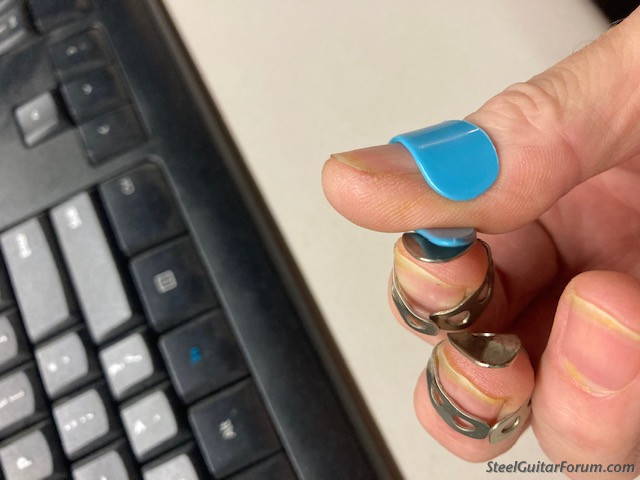
RICK ABBOTT
Sho~Bud D-10 Professional #7962
Remington T-8, Sehy #112
1975 Peavey Pacer 1963 Gibson Falcon
Sho~Bud D-10 Professional #7962
Remington T-8, Sehy #112
1975 Peavey Pacer 1963 Gibson Falcon
-
Dave Grafe
- Posts: 5372
- Joined: 29 Oct 2004 12:01 am
- Location: Hudson River Valley NY
- State/Province: -
- Country: United States
-
John Sims

- Posts: 693
- Joined: 18 Sep 2000 12:01 am
- Location: Ft. Lauderdale, FL
- State/Province: -
- Country: United States
Brass picks seem to have a mellower tone for me...
Best Regards,
John
1997 Carter U-12 Double Body-Natural Birdseye Maple-8p/5k, Peavey Nashville 1000 Amp, Goodrich L10K Vol. Pedal, Boss DD-3 Delay, Boss CE-5 Chorus, Behringer UMC-204HD Audio Interface, AKAI MPK Mini MK3 Professional Midi Keyboard/Controller, Gretsch Bobtail Resonator, Fender Banjo, Rondo SX Lap Steel (C6), DIY Lap Steel (Open D), and a few Mojo Hand Cigar Box Guitars (MojoHandGuitars.com).
John
1997 Carter U-12 Double Body-Natural Birdseye Maple-8p/5k, Peavey Nashville 1000 Amp, Goodrich L10K Vol. Pedal, Boss DD-3 Delay, Boss CE-5 Chorus, Behringer UMC-204HD Audio Interface, AKAI MPK Mini MK3 Professional Midi Keyboard/Controller, Gretsch Bobtail Resonator, Fender Banjo, Rondo SX Lap Steel (C6), DIY Lap Steel (Open D), and a few Mojo Hand Cigar Box Guitars (MojoHandGuitars.com).
-
Jim Cooley

- Posts: 1878
- Joined: 23 Apr 2010 9:12 am
- Location: The 'Ville, Texas, USA
- State/Province: Texas
- Country: United States
-
Brett Day
- Posts: 5449
- Joined: 17 Jun 2000 12:01 am
- Location: Pickens, SC
- State/Province: -
- Country: United States
-
Paul Mageau
- Posts: 76
- Joined: 14 Apr 2024 7:48 am
- Location: Maine, USA
- State/Province: Maine
- Country: United States
-
Dave Magram
- Posts: 776
- Joined: 10 Jan 2003 1:01 am
- Location: San Jose, California, USA
- State/Province: California
- Country: United States
I agree with Rick. I have found that shaping the fingerpicks so that the blade curves around your finger (as Rick has done) allows the string to glide smoothly off the fingerpicks--which optimizes the effectiveness of your picking, and also reduces pick noise.Rick Abbott wrote:If your picks are straight on your finger they will make more noise. Rotate them to match up with the angle your picking has. Mine is pretty far, but that's just me. You'll find your picking is more accurate too, maybe.
- The blade angle will vary a bit, depending on whether you are "palm blocking" or "fingertip blocking" (aka "pick-blocking").
- Rotating the fingerpick around your finger (as Rick describes) so that the flat part of the blade strikes the string (instead of the blade edge) also optimizes the effectiveness of your picking, and reduces pick noise.
For more detailed information on some research I did regarding fingerpick blade angles and shaping, you may want to take a look at this 3-page thread:
viewtopic.php?t=298186&postdays=0&postorder=asc&start=0
Bottom line:
Your fingerpicks are the point of contact with your steel guitar strings, so they are very important to your tone.
- I have known good fiddlers who play an old fiddle they paid only a couple of hundred bucks for, but they then spent over $1,000 for their fiddle bow, because the bow is the point of contact with the fiddle strings!

- Dave
-
Jon Voth
- Posts: 361
- Joined: 12 Sep 2018 10:03 pm
- Location: Manassas
- State/Province: Virginia
- Country: United States
-
John Larson

- Posts: 653
- Joined: 8 Jul 2020 10:00 am
- Location: Pennsyltucky, USA
- State/Province: -
- Country: United States
Same, picking further towards the fretboard also helps.John Sims wrote:Brass picks seem to have a mellower tone for me...
Rejoice in the Lord, O ye righteous; praise is meet for the upright. Give praise to the Lord with the harp, chant unto Him with the ten-stringed psaltery. Sing unto Him a new song, chant well unto Him with jubilation. For the word of the Lord is true, and all His works are in faithfulness. The Lord loveth mercy and judgement; the earth is full of the mercy of the Lord.
- Psalm 33:1-5
- Psalm 33:1-5
-
Ian Rae

- Posts: 6182
- Joined: 10 Oct 2013 11:49 am
- Location: Redditch, England
- State/Province: -
- Country: United Kingdom
I bend my picks round quite far.
It helps my hand to assume the shape that Jeff Newman advocates in his videos
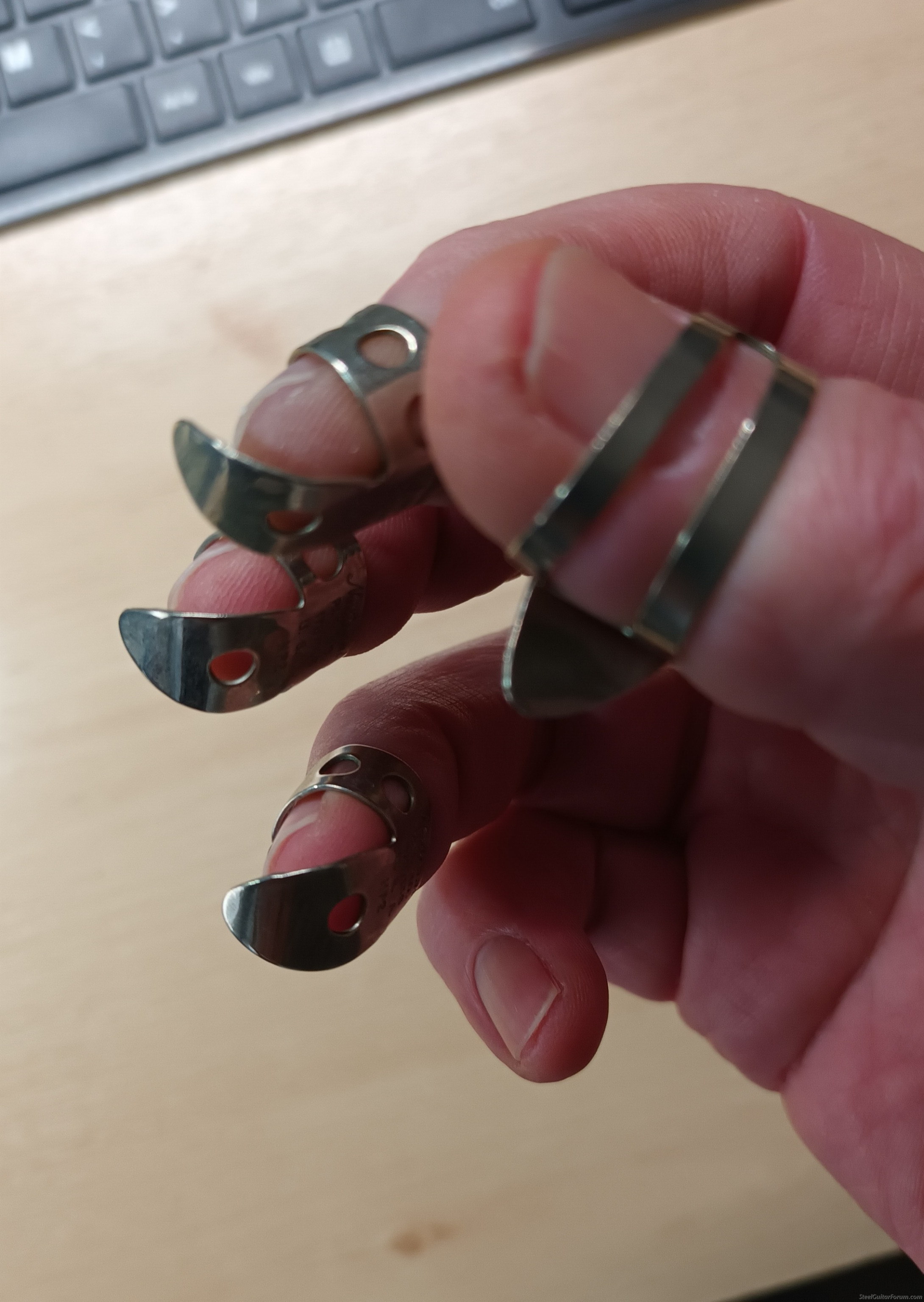
[EDIT]
BTW these are modern Nationals. I tried several brands but these stop me thinking about picks, so they're doing something right
It helps my hand to assume the shape that Jeff Newman advocates in his videos
[EDIT]
BTW these are modern Nationals. I tried several brands but these stop me thinking about picks, so they're doing something right
Last edited by Ian Rae on 28 Nov 2024 4:43 pm, edited 1 time in total.
Make sleeping dogs tell the truth!
Homebuilt keyless U12 7x5, Excel keyless U12 8x8, Williams keyless U12 7x8, Telonics rack and 15" cabs
Homebuilt keyless U12 7x5, Excel keyless U12 8x8, Williams keyless U12 7x8, Telonics rack and 15" cabs
-
Lee Baucum

- Posts: 10858
- Joined: 11 Apr 1999 12:01 am
- Location: McAllen, Texas (Extreme South) The Final Frontier
- State/Province: Texas
- Country: United States
I have 3 pairs of old National fingerpicks that I just love.
The striking surface is pretty flat on this generation of picks.
Apparently, some are more "spoon shaped" than flat.
Here is an older discussion:
viewtopic.php?t=357636
The striking surface is pretty flat on this generation of picks.
Apparently, some are more "spoon shaped" than flat.
Here is an older discussion:
viewtopic.php?t=357636
Lee, from South Texas - Down On The Rio Grande
There are only two options as I see it.
Either I'm right, or there is a sinister conspiracy to conceal the fact that I'm right.
Williams Keyless S-10, BMI S-10, Evans FET-500LV, Fender Steel King, 2 Roland Cube 80XL's,
Sarno FreeLoader, Goodrich Passive Volume Pedals, Vintage ACE Pack-A-Seat
There are only two options as I see it.
Either I'm right, or there is a sinister conspiracy to conceal the fact that I'm right.
Williams Keyless S-10, BMI S-10, Evans FET-500LV, Fender Steel King, 2 Roland Cube 80XL's,
Sarno FreeLoader, Goodrich Passive Volume Pedals, Vintage ACE Pack-A-Seat
-
Larry Dering

- Posts: 6075
- Joined: 17 May 2013 11:20 am
- Location: Missouri, USA
- State/Province: Missouri
- Country: United States
-
Dave Magram
- Posts: 776
- Joined: 10 Jan 2003 1:01 am
- Location: San Jose, California, USA
- State/Province: California
- Country: United States
Hi Melody,
Regarding brands of picks, there are many personal favorites of Forumites--which is fine: "Each to their own", I always say.
However, with all due respect to the many great and helpful players in our SGF community, I tend to pay more attention to what the full-time professional musicians use.
- I figure that they have a lot more riding on their equipment and accessory choices than part-timers like me do.
FINGERPICKS: I have watched many videos of the master players like Paul Franklin, Buddy Emmons, Joe Wright, etc--and the only brands of fingerpicks I recall seeing these top pros use are National (mostly) and Jeffran (made by Jeff Newman, and identifiable by the diamond-shaped holes in the band).
Years ago, I learned that there are 7 grades of "nickel silver" alloy, and that the old Nationals used the second softest alloy grade.
The soft alloy allows the fingerpick to grab the string more effectively, producing more tone and volume--and less pick noise.
I suspect that Jeff Newman used the same grade of alloy that were used by National, since the tone I got from these two brands was very similar.
Today, the old Nationals sell for big bucks--if you can find them.
● A good modern choice would be the National “re-issue” NP2 “nickel-silver” fingerpicks, or the Dean Hoffmeyer “nickel-silver” banjo fingerpicks (which use an alloy similar to the old Nationals).
● I have heard good things about banjo fingerpicks made by Warren Yates or Richie Dotson, both of which apparently also use a “nickel-silver” alloy similar to the old Nationals.
● I personally do not like Dunlop fingerpicks because their flared bands, while very comfortable, have a tendency to “catch” on each other (or on the strings), and the alloy used does not produce the best tone, IMHO. And FWIW, I do not recall seeing any of the top pros using them.
Whichever fingerpick brand you choose, take some time to shape the fingerpick blade-angles and bands to maximize picking effectiveness and comfort--and to minimize pick noise.
A great tip I learned years ago on the SG Forum to maximize comfort and minimize slippage, is to adhere a pair of eyeglass nose pads inside your fingerpick bands.
- You can buy a package of self-adhesive eyeglass nose pads at your local pharmacy for about $2 for ten pads. However, these wear out after a few months and must be replaced.
- Even better: About a year ago, I started using eyeglass nose pads made of silicone. These do not seem to wear out and work great. Here’s what they are called on Amazon: “TOODOO 18 Pairs Eyeglasses Nose Pads Adhesive Silicone Glasses Replacement Anti Slip Nosepads for Eyeglass Glasses Sunglasses (Transparent, 1mm)”.
- Cut each pad in half and adhere each half-pad inside each fingerpick band where the band crosses your fingernail grooves.
- If the silicone pads seem too slippery, try roughing the pad surface with a bit of sandpaper.
- Current price on Amazon for 18 pairs (surely a lifetime supply!) is only $6.99!
------------------------------------------------------------------------------------.
THUMBPICKS: I noticed that many of the top pros (especially the pick-blockers) used short-blade thumbpicks: the Blue Hercos or the red Dunlops.
I did too for many years, but noticed that both the Hercos and Dunlops would loosen up from the body heat in my thumb, and halfway through the set, I would have to switch to a "backup" thumbpick or else see the thumbpick fly off my thumb never to be seen again.
Then I heard on the SG Forum about Fred Kelly "Speed Picks'. Not only do these not loosen while playing, their clever blade "tongue" design prevents them from slippage no matter how hard you strike the string--and the material they are made of seems to never wear out!
I prefer the "heavy" white Fred Kelly Speed Picks--and they only cost about $1 each.
- Dave
Regarding brands of picks, there are many personal favorites of Forumites--which is fine: "Each to their own", I always say.
However, with all due respect to the many great and helpful players in our SGF community, I tend to pay more attention to what the full-time professional musicians use.
- I figure that they have a lot more riding on their equipment and accessory choices than part-timers like me do.
FINGERPICKS: I have watched many videos of the master players like Paul Franklin, Buddy Emmons, Joe Wright, etc--and the only brands of fingerpicks I recall seeing these top pros use are National (mostly) and Jeffran (made by Jeff Newman, and identifiable by the diamond-shaped holes in the band).
Years ago, I learned that there are 7 grades of "nickel silver" alloy, and that the old Nationals used the second softest alloy grade.
The soft alloy allows the fingerpick to grab the string more effectively, producing more tone and volume--and less pick noise.
I suspect that Jeff Newman used the same grade of alloy that were used by National, since the tone I got from these two brands was very similar.
Today, the old Nationals sell for big bucks--if you can find them.
● A good modern choice would be the National “re-issue” NP2 “nickel-silver” fingerpicks, or the Dean Hoffmeyer “nickel-silver” banjo fingerpicks (which use an alloy similar to the old Nationals).
● I have heard good things about banjo fingerpicks made by Warren Yates or Richie Dotson, both of which apparently also use a “nickel-silver” alloy similar to the old Nationals.
● I personally do not like Dunlop fingerpicks because their flared bands, while very comfortable, have a tendency to “catch” on each other (or on the strings), and the alloy used does not produce the best tone, IMHO. And FWIW, I do not recall seeing any of the top pros using them.
Whichever fingerpick brand you choose, take some time to shape the fingerpick blade-angles and bands to maximize picking effectiveness and comfort--and to minimize pick noise.
A great tip I learned years ago on the SG Forum to maximize comfort and minimize slippage, is to adhere a pair of eyeglass nose pads inside your fingerpick bands.
- You can buy a package of self-adhesive eyeglass nose pads at your local pharmacy for about $2 for ten pads. However, these wear out after a few months and must be replaced.
- Even better: About a year ago, I started using eyeglass nose pads made of silicone. These do not seem to wear out and work great. Here’s what they are called on Amazon: “TOODOO 18 Pairs Eyeglasses Nose Pads Adhesive Silicone Glasses Replacement Anti Slip Nosepads for Eyeglass Glasses Sunglasses (Transparent, 1mm)”.
- Cut each pad in half and adhere each half-pad inside each fingerpick band where the band crosses your fingernail grooves.
- If the silicone pads seem too slippery, try roughing the pad surface with a bit of sandpaper.
- Current price on Amazon for 18 pairs (surely a lifetime supply!) is only $6.99!
------------------------------------------------------------------------------------.
THUMBPICKS: I noticed that many of the top pros (especially the pick-blockers) used short-blade thumbpicks: the Blue Hercos or the red Dunlops.
I did too for many years, but noticed that both the Hercos and Dunlops would loosen up from the body heat in my thumb, and halfway through the set, I would have to switch to a "backup" thumbpick or else see the thumbpick fly off my thumb never to be seen again.
Then I heard on the SG Forum about Fred Kelly "Speed Picks'. Not only do these not loosen while playing, their clever blade "tongue" design prevents them from slippage no matter how hard you strike the string--and the material they are made of seems to never wear out!
I prefer the "heavy" white Fred Kelly Speed Picks--and they only cost about $1 each.
- Dave
-
Lee Baucum
- Posts: 10858
- Joined: 11 Apr 1999 12:01 am
- Location: McAllen, Texas (Extreme South) The Final Frontier
- State/Province: Texas
- Country: United States
Agreed. I also like the "heavy" white Fred Kelly Slick Pick made from the same material.Dave Magram wrote:Then I heard on the SG Forum about Fred Kelly "Speed Picks'. Not only do these not loosen while playing, their clever blade "tongue" design prevents them from slippage no matter how hard you strike the string--and the material they are made of seems to never wear out!
I prefer the "heavy" white Fred Kelly Speed Picks--and they only cost about $1 each.
- Dave
Lee, from South Texas - Down On The Rio Grande
There are only two options as I see it.
Either I'm right, or there is a sinister conspiracy to conceal the fact that I'm right.
Williams Keyless S-10, BMI S-10, Evans FET-500LV, Fender Steel King, 2 Roland Cube 80XL's,
Sarno FreeLoader, Goodrich Passive Volume Pedals, Vintage ACE Pack-A-Seat
There are only two options as I see it.
Either I'm right, or there is a sinister conspiracy to conceal the fact that I'm right.
Williams Keyless S-10, BMI S-10, Evans FET-500LV, Fender Steel King, 2 Roland Cube 80XL's,
Sarno FreeLoader, Goodrich Passive Volume Pedals, Vintage ACE Pack-A-Seat
-
Don R Brown

- Posts: 2965
- Joined: 27 Dec 2011 9:20 am
- Location: Rochester, New York, USA
- State/Province: New York
- Country: United States
I'm not sure exactly what kind of "noisy" you mean, Melody. But on one of Jeff Newman's videos, he discusses the need to strike the strings in a straighter manner, rather than at an angle. I don't recall specifics but he says the "wrong" way produces a "chink, chink" effect.
You might experiment with just randomly playing a few notes as you usually do, then deliberately angle your hand so you are picking 90 degrees - straight across the strings. If that seems to cure it, try to find that particular lesson - it MIGHT be "Right Hand Alpha" but I'm not sure. It's in the part where h discusses hand position and how to orient your arm, wrist, hand and fingers.
Hope this helps.
You might experiment with just randomly playing a few notes as you usually do, then deliberately angle your hand so you are picking 90 degrees - straight across the strings. If that seems to cure it, try to find that particular lesson - it MIGHT be "Right Hand Alpha" but I'm not sure. It's in the part where h discusses hand position and how to orient your arm, wrist, hand and fingers.
Hope this helps.
Many play better than I do. Nobody has more fun.
-
Melody Freeman
- Posts: 70
- Joined: 16 Jun 2024 5:13 am
- Location: Illinois, USA
- State/Province: Illinois
- Country: United States
Finger Picks
Thank you. I appreciate all of the information and advice from all of you!
Melody Freeman
-
Dave Magram
- Posts: 776
- Joined: 10 Jan 2003 1:01 am
- Location: San Jose, California, USA
- State/Province: California
- Country: United States
Hi Melody,
I just noticed that you played fiddle at a steel guitar show a couple of years ago! You really go after the most challenging instruments!
It is my understanding that the fiddle bow needs to be at a specific precise angle to the strings for the most optimal sound.
Likewise, effective palm-blocking requires a very specific angle of the fingerpick blade that is a bit different from fingertip-blocking (aka “pick-blocking”).
Years ago, when I learned to do fingertip-blocking (after palm-blocking for many years), I spent a couple of hours experimenting with re-adjusting the blade angles of my fingerpicks so I could do both.
I was surprised at how much difference changing the fingerpick blade angles just one or two degrees made in picking speed and accuracy!
● For example, I found that I needed to curl my fingerpicks around the tips of my fingers a bit more for fingertip-blocking than I did for palm-blocking. This makes sense because your hand doesn’t lift off the strings when you are fingertip-blocking.
Watch some videos of Paul Franklin to see this for yourself, such as: “Best country band ever, Mark O'Connor & New Nashville Cats - American Music Shop - Pick It Apart": https://www.youtube.com/watch?v=gJkBnt8Uww8
Paul Franklin’s incredibly fast solo begins at 1:10, with several close-ups of his right hand.
Hearing this tune (clocked at 170 bpm) caused me to decide to try to learn how do “fingertip blocking”; I couldn’t imagine how anything could be played at this tempo with palm-blocking!
Now this might ruffle a few feathers, so my apologies in advance...
With all due respect to the many well-meaning and helpful folks on the SGF, I generally prefer to learn which technical details the master steel guitar players adopt, rather than to “crowd-source” technical details like fingerpick blade-angles.
From careful examination of photos and screenshots of videos, the blade-angles used by a number of steel guitar masters appear to be within a fairly narrow range, depending on if the player mostly used palm-blocking or fingertip blocking.
All of the pro players (and I looked at many) seem to curve the pick-blade to match the curve of their fingertips to allow the string to glide off the fingerpick, as can be seen in the screenshots and videos
I posted at: viewtopic.php?t=298186.
Fingerpick blade-angles ranged between: ~26º for Paul Franklin (a “fingertip blocker”); to ~32º for Joe Wright (fingertip blocking & some palm-blocking); to ~34º for Buddy Emmons (a “hybrid” style combining fingertip blocking & palm-blocking); to ~35º for Bobby Black (mostly a palm-blocker with some fingertip blocking).
The blade-angles I personally find most effective for both fingertip-blocking and palm-blocking are right in the middle of that range: ~32º (+/- 1 degree) measured from the bands to the blade-angle at the end of the blade.
• This blade angle enables the string to glide off the fingerpick blade--instead of slamming into it, which is not optimal for picking effectiveness, and can cause pick noise.
• This exact angle may not work best for you, but may offer a good starting point to work from. I would suggest staying within the 26º to 35º range. Why reinvent the wheel?
Measuring the blade-angle: Make a gauge
I use a note-card taped to a block of wood (or the inside page at the back of a book that is at least an inch thick) on which to draw the 32º line with a protractor: the dashed line represents the bottom edge of the book (or block of wood).
I then rest the side of the blade on the block of wood (or book page), square up the band to the bottom of the book page, and bend the blade with a needle-nose pliers just above the bands until the blade tip lines up with the 32º line (without my finger in the pick, of course). The diagram shows the 32-degree blade angle to scale, so you can print it out and use it.

Be prepared to spend 20 or 30 minutes with a needle-nose pliers to shape your fingerpicks’ blade just right. You want a blade angle that allows the string to “glide” off the pick--and the fingerpick bands adjusted for maximum comfort and minimum slippage.
SHAPING THE FINGERPICK BANDS
Don’t forget to shape the fingerpick bands. I find that slightly tapering the fingerpick bands so they match the taper of my fingers makes them much more comfortable--and less likely to slip off your fingers. I shape the bands with a taper so they fit like “little gloves” on my fingers.
I also rotate my fingerpicks around my finger a bit so the flat of the blade strikes the strings instead of striking them with the edge of the blade. I like the fuller sound (and reduced pick noise) that striking the strings with the flat of the blade seems to produce—as Joe Wright and others recommend.
● To rotate your fingerpicks on your finger, after shaping the bands as described above, gently push the bands slightly off-center.
I hope you find this helpful.
-Dave
I just noticed that you played fiddle at a steel guitar show a couple of years ago! You really go after the most challenging instruments!
It is my understanding that the fiddle bow needs to be at a specific precise angle to the strings for the most optimal sound.
Likewise, effective palm-blocking requires a very specific angle of the fingerpick blade that is a bit different from fingertip-blocking (aka “pick-blocking”).
Years ago, when I learned to do fingertip-blocking (after palm-blocking for many years), I spent a couple of hours experimenting with re-adjusting the blade angles of my fingerpicks so I could do both.
I was surprised at how much difference changing the fingerpick blade angles just one or two degrees made in picking speed and accuracy!
● For example, I found that I needed to curl my fingerpicks around the tips of my fingers a bit more for fingertip-blocking than I did for palm-blocking. This makes sense because your hand doesn’t lift off the strings when you are fingertip-blocking.
Watch some videos of Paul Franklin to see this for yourself, such as: “Best country band ever, Mark O'Connor & New Nashville Cats - American Music Shop - Pick It Apart": https://www.youtube.com/watch?v=gJkBnt8Uww8
Paul Franklin’s incredibly fast solo begins at 1:10, with several close-ups of his right hand.
Hearing this tune (clocked at 170 bpm) caused me to decide to try to learn how do “fingertip blocking”; I couldn’t imagine how anything could be played at this tempo with palm-blocking!
Now this might ruffle a few feathers, so my apologies in advance...
With all due respect to the many well-meaning and helpful folks on the SGF, I generally prefer to learn which technical details the master steel guitar players adopt, rather than to “crowd-source” technical details like fingerpick blade-angles.
From careful examination of photos and screenshots of videos, the blade-angles used by a number of steel guitar masters appear to be within a fairly narrow range, depending on if the player mostly used palm-blocking or fingertip blocking.
All of the pro players (and I looked at many) seem to curve the pick-blade to match the curve of their fingertips to allow the string to glide off the fingerpick, as can be seen in the screenshots and videos
I posted at: viewtopic.php?t=298186.
Fingerpick blade-angles ranged between: ~26º for Paul Franklin (a “fingertip blocker”); to ~32º for Joe Wright (fingertip blocking & some palm-blocking); to ~34º for Buddy Emmons (a “hybrid” style combining fingertip blocking & palm-blocking); to ~35º for Bobby Black (mostly a palm-blocker with some fingertip blocking).
The blade-angles I personally find most effective for both fingertip-blocking and palm-blocking are right in the middle of that range: ~32º (+/- 1 degree) measured from the bands to the blade-angle at the end of the blade.
• This blade angle enables the string to glide off the fingerpick blade--instead of slamming into it, which is not optimal for picking effectiveness, and can cause pick noise.
• This exact angle may not work best for you, but may offer a good starting point to work from. I would suggest staying within the 26º to 35º range. Why reinvent the wheel?
Measuring the blade-angle: Make a gauge
I use a note-card taped to a block of wood (or the inside page at the back of a book that is at least an inch thick) on which to draw the 32º line with a protractor: the dashed line represents the bottom edge of the book (or block of wood).
I then rest the side of the blade on the block of wood (or book page), square up the band to the bottom of the book page, and bend the blade with a needle-nose pliers just above the bands until the blade tip lines up with the 32º line (without my finger in the pick, of course). The diagram shows the 32-degree blade angle to scale, so you can print it out and use it.
Be prepared to spend 20 or 30 minutes with a needle-nose pliers to shape your fingerpicks’ blade just right. You want a blade angle that allows the string to “glide” off the pick--and the fingerpick bands adjusted for maximum comfort and minimum slippage.
SHAPING THE FINGERPICK BANDS
Don’t forget to shape the fingerpick bands. I find that slightly tapering the fingerpick bands so they match the taper of my fingers makes them much more comfortable--and less likely to slip off your fingers. I shape the bands with a taper so they fit like “little gloves” on my fingers.
I also rotate my fingerpicks around my finger a bit so the flat of the blade strikes the strings instead of striking them with the edge of the blade. I like the fuller sound (and reduced pick noise) that striking the strings with the flat of the blade seems to produce—as Joe Wright and others recommend.
● To rotate your fingerpicks on your finger, after shaping the bands as described above, gently push the bands slightly off-center.
I hope you find this helpful.
-Dave
-
Melody Freeman
- Posts: 70
- Joined: 16 Jun 2024 5:13 am
- Location: Illinois, USA
- State/Province: Illinois
- Country: United States
Noisy Picks
Hi Dave,
Thank you for all of the information. I had recently started wearing 3 finger picks along with the thumb pick. I believe I was touching the third fingerpick on a string accidentally when playing the second finger on a string. Also, I wasn’t playing on the fat part of the pick. That’s doing pretty good now. I have ordered some Landis finger picks with the Landis hemispheric blades. I will see how that goes and I will adjust the blades like you mentioned. I appreciate all of the info, and thank you! I am a multi-instrumentalist and I have played the fiddle and also keyboard at a few Steel Guitar Shows. Thank you again!
Thank you for all of the information. I had recently started wearing 3 finger picks along with the thumb pick. I believe I was touching the third fingerpick on a string accidentally when playing the second finger on a string. Also, I wasn’t playing on the fat part of the pick. That’s doing pretty good now. I have ordered some Landis finger picks with the Landis hemispheric blades. I will see how that goes and I will adjust the blades like you mentioned. I appreciate all of the info, and thank you! I am a multi-instrumentalist and I have played the fiddle and also keyboard at a few Steel Guitar Shows. Thank you again!
Melody Freeman
-
Ron Pruter
- Posts: 1813
- Joined: 25 Feb 2011 2:47 pm
- Location: Arizona, USA
- State/Province: Arizona
- Country: United States
I don't use picks. I let my three nails grow a little long, then run a bead of 5 minute epoxy around the outer edge. Wait till the next day to shape them a little with a file. The epoxy gives the nail a very good longevity and tone. I tried super glue but it is too stiff and cracks off. It doesn't handle water very well either.
You also acquire much more blocking flesh to put to use. Works for me. Ron
You also acquire much more blocking flesh to put to use. Works for me. Ron
Emmons SKH Le Grande, Tick tack bass, Regal high strung, USA Nashville 112.
-
Melody Freeman
- Posts: 70
- Joined: 16 Jun 2024 5:13 am
- Location: Illinois, USA
- State/Province: Illinois
- Country: United States
-
Joseph Lazo
- Posts: 350
- Joined: 20 Jan 2024 8:31 am
- Location: Wisconsin, USA
- State/Province: Wisconsin
- Country: United States
Ron, can you give me the name of the 5-minute epoxy you use? And do you put it on as a thin layer...then smooth it down with something before it dries?
I'm real interested in this because I play with just fingers also. Been playing this way for years with "regular" guitar, but lately I've broken my thumbnail and two other fingernails playing steel. I've been making a half-hearted attempt to use fingerpicks, but just can't get used to them.
I'm real interested in this because I play with just fingers also. Been playing this way for years with "regular" guitar, but lately I've broken my thumbnail and two other fingernails playing steel. I've been making a half-hearted attempt to use fingerpicks, but just can't get used to them.
-
Ron Pruter
- Posts: 1813
- Joined: 25 Feb 2011 2:47 pm
- Location: Arizona, USA
- State/Province: Arizona
- Country: United States
Joseph and Mel. I use JB Weld, Clear weld.
I put it on with a tooth pick, maybe 1/16 of an inch thick. It will kind of move around at first so just keep moving your hand around and flow a little till it quits flowing. I put a little dab on a piece of plastic and keep checking that dab to see how fast it's drying rather than touching my nails. BTW, make sure you mix the epoxy well. Also, I clean my nails with Denatured alcohol, then when the alcohol evaporates, (Very Fast, BTW) I apply the glue. Good luck, keep us posted. Ron
I put it on with a tooth pick, maybe 1/16 of an inch thick. It will kind of move around at first so just keep moving your hand around and flow a little till it quits flowing. I put a little dab on a piece of plastic and keep checking that dab to see how fast it's drying rather than touching my nails. BTW, make sure you mix the epoxy well. Also, I clean my nails with Denatured alcohol, then when the alcohol evaporates, (Very Fast, BTW) I apply the glue. Good luck, keep us posted. Ron
Emmons SKH Le Grande, Tick tack bass, Regal high strung, USA Nashville 112.
-
Chris Templeton

- Posts: 3507
- Joined: 25 Sep 2012 4:20 pm
- Location: The Green Mountain State
- State/Province: -
- Country: United States
What I don't like about finger picks is the "clack" when a finger pick picks a vibrating string.
Over the years I've found two sets of no-name finger picks in old lap steel cases that were very hard and somewhat rounded/bowled.
The thing I don't like with most of the picks mentioned, is the scraping sound that comes from the side of the pick.
A slight bending Nationals, etc.on the side helps me with the unwantednoise.
Buddy recorded on a couple of my songs without picks.
Of course I had to try that and after some callus buildup, on the fingers, there was a nice tonal variety from the sound of callus to soft flesh.
Buddy stopped not using fingerpicks because it lacked attack.
Over the years I've found two sets of no-name finger picks in old lap steel cases that were very hard and somewhat rounded/bowled.
The thing I don't like with most of the picks mentioned, is the scraping sound that comes from the side of the pick.
A slight bending Nationals, etc.on the side helps me with the unwantednoise.
Buddy recorded on a couple of my songs without picks.
Of course I had to try that and after some callus buildup, on the fingers, there was a nice tonal variety from the sound of callus to soft flesh.
Buddy stopped not using fingerpicks because it lacked attack.
Excel 3/4 Pedal With An 8 String Hawaiian Neck, Sierra Tapper (10 string with a raised fretboard to fret with fingers), Single neck Fessenden 3/5
"The Tapper" : https://christophertempleton.bandcamp.c ... the-tapper
Soundcloud Playlist: https://soundcloud.com/bluespruce8:
"The Tapper" : https://christophertempleton.bandcamp.c ... the-tapper
Soundcloud Playlist: https://soundcloud.com/bluespruce8: