Tim Toberer wrote:J D Sauser wrote:
Btw. Tim. I am no expert... but did try to understand your photographed chart but fail miserably.
... J-D.
Don't do that

I am no expert either, but here is what I am trying to show. It is harder to explain than it is to utilize, part of the problem with music theory in general. Yes it is all the same intervals another way of conceptualizing this same idea. Basically it is the same 4 notes, could be any notes really, but lets say F# A C# E. Everyone who plays a 6th tuning knows that this set of notes can be thought of as an F#m7 chord or A6 chord. Then if you play these chords against different bass notes or root, you get different chords. Most players soon find the rootless major 9th position often thought of as the second home in a 6th tuning. F# A C# E as rootless DM9. A less common use of these same 4 notes would be as a B11 chord minus the Rt and the 3rd B D F# A C# E.
If you don't understand how this relates to the diminished chord I get it. For me since this is where I am starting from I use these 4 inversions to figure out where these are hidden. Of course you could play any of the other inversions with any of these chords. Same notes.. I guess this is kind of how I am using the parental forms idea. Since my tuning starts as diminished, these chords can give birth to whatever chords I need to find at the time. The further away you get from the root, the harder they are to find, but this method helps me "discover" them. Some may be more useful than others. I like pairing things down to 4 notes or less which for denser chords means usually losing the 1 and the 5 or sometimes the 3 or other notes. I could understand if you don't see the point of comparing them to diminished, it is just a tool, I suppose you could start from anywhere, but for me this idea is seeping into how I think about harmony in general.
THIS always has been my issue with the word "Substitution"... suggesting that one could play a different chord in lieu of another. And THAT is the problem with TheoriES... it's only one of many ways to look at the same thing. I long wondered HOW on earth a different chord or really, many different chord could be played over a particular chord. Well, "Common Tone" is another word which appears... and then you finally realize the all use the same notes which to each chord are different degrees, but the intervals match.
Diminished example... which play a #IVdim over to go from a IV back to a I (typical Jazz Blues twist found in buried in Jazz Standards all over)?
Well, we look at IV7th (Blues) and realize that besides the first two notes (root and Maj.3rd) they are alle minor third intervals following, from the Maj.3rd up to the 5th and from the 5th up to the b7th... a Diminished chord! The only shift is the ROOT really. One moves (raises) it to the "right" (up) just "a notch" (half step) and then they are ALL minor thirds apart... hence built yourself a #IVdim, aka. IV7b9th... really the motion and directional tension built up helping to not just do what the IV7th tends to do (going up a 4th to a cheap quick and easy resolution) but to go up a 5th from the IV back to the I... it's that root going up half that drives that motion as it get's within a half step of the target chord's 5th degree and that's the cream of resolution!
Others can jump in and bring about a whole different explanation (theory) of what just happened... then then, BB waltzes in (again him, yes!) and say "it just sounds goooooood" and who's to argue with him about that... he's made a living, and a pretty good one, one might add on that one move.
Barry Harris has a different take on it, and it helped my and now also my son better understand and use the diminished much more and in more surprising ways:
A diminished represents 4 diminishe, as each represent a Dominant with it's root raise half, that same one chord, can not only double a 4 dominants but also will lead to 4 different resolutions (aka. "Targets"), as such they could also be preceded y 4 different ii-minors!
But what if you take it a step further and allude to a particular dominant with a minor chord (which in turn suggest a Target I-chord a further 4th up, but instead, in the middle of it (the diminished) decide to take another "exit" meaning the Target I-chord a 4th up from one of the other 3 dominants that diminished chord can stand for.
Unheard of? Well... (to paraphrase Ronald Reagan)... WELL, not so fast!: look at the TriTone! TriTone means 3 whole steps (away from the normal dominant)... 3 whole steps are also 2 min.3rds stacked away!
Look at the "BackDoor" Dominant! it's right in the middle of a TriTone... 1 min.3rd above the suggested Dominant and likewiese 1 min.3rd below the TriTone!
Often in Jazz -in some standards even written out- the ii-minor is actually a 4th below the Backdoor Dominant, so now the "entry point" and he "exit point" are being switched in the "diminished Shaker"
Diminisheds RULE, man!
But that's just one way to look at it.
So, how important is it?
Well (Reagan again!), let me say this:
There are many kind of musicians (as to approaches).
But as far as the ones reaching an enviable level of proficiency, I think there are 2 main catergories:
The Buddy Emmons'ses of this world
and
The Maurice Andersons of theis world.
It would seem that like many in Jazz and Blues and Country, BE became extremely fast proficient just listening and playing. And he did that on a novelty instrument in in styles where it had not yet broken ground. He acknowledged later that only in his LA days he confronted himself intensively with theory.
Maurice almost immediately CONSCIOUSLY devised maps, systems, studied intevalic and analyzed chords and he did that to a point of a mad scientist. He could be stopped in the middle of a solo and asked to play the last lines again, and he could, even thou he was not playing rehearsed and if you asked him, "how did you come to play this over that?" he could answer and explain, like I kid you not he did once to me: "I hear the bass going this way" (played the bass line on the steel) "... and then I felt it could only go two ways, so I set myself up so I could play no matter which target it was going to". You would expect AI to do that.
We discussed that and he acknowledged "Buddy" being able to come to conventions, play here and there all day and then do a show at prime time and leave with buddies and keep jamming, while he (Maurice) after a set was "wacked".
So, how do we know which one we are, the BE or MA kind'a musician?
Simple!: If one of us was the BE kind, we weren't posting on this thread and where playing our heart and soul out somewhere.
We are left with only HOPING to be an MA kind'a player... we need to understand, we need help... THEORIES, explanations... and even with all that, most of us will never reach the level of Maurice's and similar "knowing" player's proficiency.
But it's our only way forward.
Just "Beware the theory you choose!". If it doesn't help you play better, find a better explanation.
... J-D.
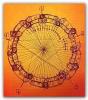
 It would be nice to get beyond that and start sharing more musical ideas, questions etc. I have lots of questions! Here is something I have been working on. Whether you think a diminished tuning is a good idea or not, using the diminished chord as a conceptual tool is very useful. One way is looking at a chord in relation to all 4 inversions of the diminished chord. I don't know a fancy way to make a graphic or anything, but this was the easiest way I could find to show what I mean.