C6 Jazz II-V-I Licks in C major/Video Tutorial
Moderator: Brad Bechtel
-
Steve Cunningham

- Posts: 872
- Joined: 30 Jul 2008 7:48 am
- Location: Atlanta, GA
C6 Jazz II-V-I Licks in C major/Video Tutorial
Zoom/Skype/Facetime lessons available http://www.atlanta-guitar-lessons.com
YouTube
http://www.youtube.com/user/SingingStri ... ature=mhee
YouTube
http://www.youtube.com/user/SingingStri ... ature=mhee
-
Tim Toberer
- Posts: 1206
- Joined: 23 Oct 2021 11:58 am
- Location: Nebraska, USA
Very nice little lesson! As a player coming from the world of folk and rock, it is really hard to start to think in terms of ii-V-I, instead of I-IV-V. An interesting extension of this thought which is new to me, is the Barry Harris approach which is thinking of ii-V as just V or more abstract thinking, Pat Martinos approach which is thinking of ii-V as just ii, which doesn't make a whole lot of sense to me honestly. I think it minorizes everything and it is just a sound that doesn't appeal to me as much, but being that C6 is essentially Am7 this approach may work well... anyway!
I have been trying to absorb little bits of jazz theory every day because it is pretty overwhelming in large chunks. This lesson shows a couple of the most basic pockets for playing through these changes in C6 , but could be applied to any 6th type tuning. A person could take this a step further and work the lick out in all 12 keys, transpose it to minor being something like iim7b5 -V7b9 - ImM7 etc. Great way to get your foot in the door. There are precious few resources for folks wanting to learn this stuff so thank you Steve!
I have been trying to absorb little bits of jazz theory every day because it is pretty overwhelming in large chunks. This lesson shows a couple of the most basic pockets for playing through these changes in C6 , but could be applied to any 6th type tuning. A person could take this a step further and work the lick out in all 12 keys, transpose it to minor being something like iim7b5 -V7b9 - ImM7 etc. Great way to get your foot in the door. There are precious few resources for folks wanting to learn this stuff so thank you Steve!
-
Dennis Belt

- Posts: 63
- Joined: 4 May 2024 7:21 am
- Location: California, USA
-
David Matzenik

- Posts: 1757
- Joined: 8 Oct 2004 12:01 am
- Location: Cairns, on the Coral Sea

-
Tim Toberer
- Posts: 1206
- Joined: 23 Oct 2021 11:58 am
- Location: Nebraska, USA
Here is a little video I found this morning relating the 2-5-1 to jazz standards. https://www.youtube.com/watch?v=r9yqSVR-Yro
I should emphasize that the first example 3-6-2-5-1 is really just an extension. It's the circle of 5ths (which is a great way to practice this stuff in all 12 keys). The 2-5 (3-6) is just unresolving. The other examples are also extensions if you think about it the 2-5 to 4, the second example, is like a modulation because the 4 chord becomes the 1 chord. And the minor 2-5 is to the relative minor, the third example, is kind of like a modulation. So the relative minor is like the 1. I think it is easier to think of them as tonal centers because it's hard to tell if they are actually modulations somtimes.
The other thing he goes into is the backdoor dominant which I think he does a good job of explaining, and even illustrates it as a backdoor 2-5. It is crazy how these common patterns are camoufloged all over in jazz! An interesting exercise I just thought of ....hmmm... Start on a 1M7 . Turn the 1 chord into a dom7 and it instantly starts to feel like a 5 chord them resolve to the new tonic then repeat. Start on a 1M7. Turn the 1 chord into a minor 7 and it starts to feel like a 2 chord pulling you towards a 5 and into new harmonic territory.... There are so many videos like this mostly for piano, but it relates the concept. Anyway these are some of the things that are helping me. The more I go through this type of stuff the more it starts to become clear, but the 2-5-1 is key.
I should emphasize that the first example 3-6-2-5-1 is really just an extension. It's the circle of 5ths (which is a great way to practice this stuff in all 12 keys). The 2-5 (3-6) is just unresolving. The other examples are also extensions if you think about it the 2-5 to 4, the second example, is like a modulation because the 4 chord becomes the 1 chord. And the minor 2-5 is to the relative minor, the third example, is kind of like a modulation. So the relative minor is like the 1. I think it is easier to think of them as tonal centers because it's hard to tell if they are actually modulations somtimes.
The other thing he goes into is the backdoor dominant which I think he does a good job of explaining, and even illustrates it as a backdoor 2-5. It is crazy how these common patterns are camoufloged all over in jazz! An interesting exercise I just thought of ....hmmm... Start on a 1M7 . Turn the 1 chord into a dom7 and it instantly starts to feel like a 5 chord them resolve to the new tonic then repeat. Start on a 1M7. Turn the 1 chord into a minor 7 and it starts to feel like a 2 chord pulling you towards a 5 and into new harmonic territory.... There are so many videos like this mostly for piano, but it relates the concept. Anyway these are some of the things that are helping me. The more I go through this type of stuff the more it starts to become clear, but the 2-5-1 is key.
-
Joe A. Roberts

- Posts: 443
- Joined: 24 Mar 2021 6:23 pm
- Location: Seoul, South Korea
-
Steve Cunningham
- Posts: 872
- Joined: 30 Jul 2008 7:48 am
- Location: Atlanta, GA
I'm glad you guys are finding this somewhat helpful. One of the things I like about this approach is that it's up to the individual how literal they want to take/use this information. Back when I was a faux jazz guitarist, I spent a fair amount of time creating/stealing II V I, I VI II V (etc) licks to use more or less verbatim over jazz tunes. Over time I found the true value to be in how the patterns assimilated into my "normal" playing, regardless of how the numbers stacked up...usually in more of a rock, R&B, funk type of setting...way more visceral than what I considered to be the "jazz" approach. Definitely the same thing with various steel tunings...I know for a fact that I'll never use these licks on a gig in the context they're presented in...but the shapes will lead me to things I probably wouldn't have otherwise come across.
Music Theory...the gift that keeps on giving
Music Theory...the gift that keeps on giving
Zoom/Skype/Facetime lessons available http://www.atlanta-guitar-lessons.com
YouTube
http://www.youtube.com/user/SingingStri ... ature=mhee
YouTube
http://www.youtube.com/user/SingingStri ... ature=mhee
-
Madeline Dietrich

- Posts: 27
- Joined: 6 Jun 2019 9:22 am
- Location: Virginia, USA
-
Madeline Dietrich
- Posts: 27
- Joined: 6 Jun 2019 9:22 am
- Location: Virginia, USA
-
Steve Cunningham
- Posts: 872
- Joined: 30 Jul 2008 7:48 am
- Location: Atlanta, GA
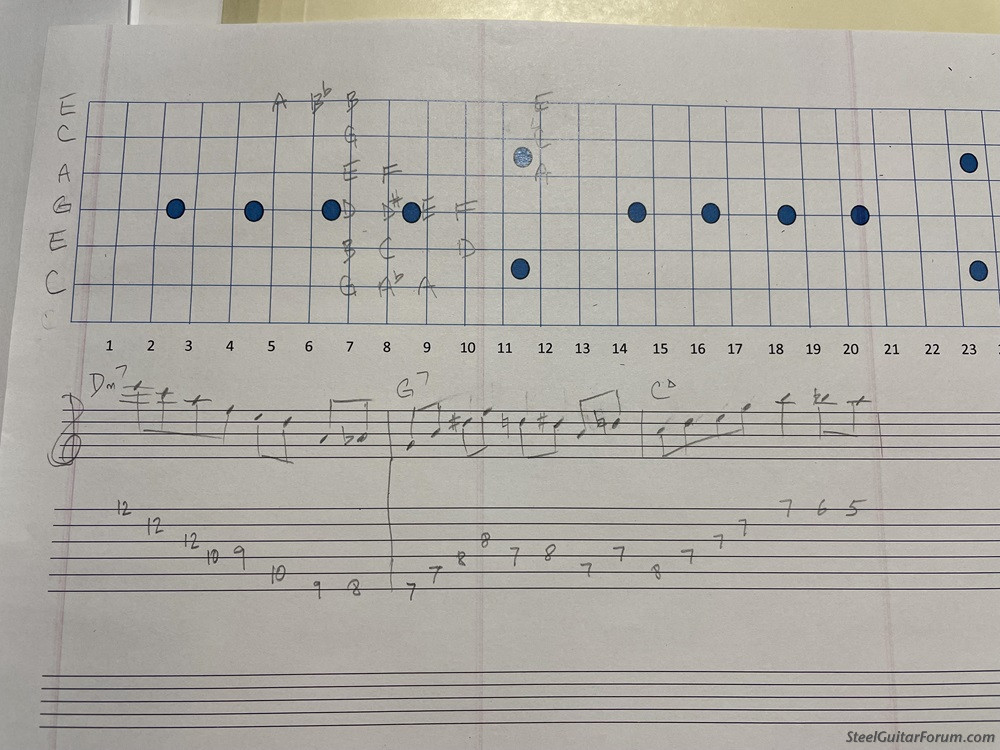
That's great Madeline! IMO, it's so much more beneficial to notate/tab music yourself...you develop more of a relationship with the music that way, makes the assimilation process much quicker/more likely.Madeline Dietrich wrote:I first learned this off the video by rote, and gradually memorized it. Later when I was away from my steel I made this grid/staff and diagramed/notated/tabbed it from memory just as an exercise. It also helps me see the lick in different ways and break it down more easily. Thanks again, Steve!
Zoom/Skype/Facetime lessons available http://www.atlanta-guitar-lessons.com
YouTube
http://www.youtube.com/user/SingingStri ... ature=mhee
YouTube
http://www.youtube.com/user/SingingStri ... ature=mhee