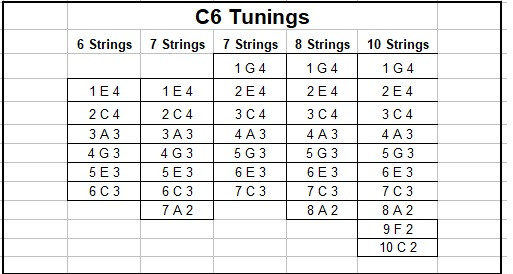
Humm. Here's how I look at it. The C based chords are:
C: C E G
C6: C E G A
C7: C E G Bb
C9: C E G Bb D
C11: C E G Bb D F
C13: C E G Bb D F A
The core C6 tuning is: C E G A C E
We are missing the 9th note - D
We are missing the 11th note - F
Without the 9th & 11th there is no 13th chord (it is a 6th chord) so I do not see how you could call it a C13 tuning. With the Bb tuned below the root of C that is a very common inverted 7th chord voicing. EDIT: As suggested the Bb would be tuned higher that the root making it a normal C7 chord.
So I come back to C6/7 name for it.
Thoughts?
Last edited by Tony Oresteen on 21 Dec 2022 8:34 am, edited 1 time in total.
Tony
Newnan, GA
Too many guitars, not enough time to play
'72 Sho-Bud 6139, '71 Marlen 210
'78 Fender Stringmaster Quad black
PedalMaster D8
Robert Murphy wrote:I tune my 7th string to D and it gives me a nice melody note plus add the G for an implied 5 chord added to the C+A for an implied 4 chord.
That's an idea, a C9 tuning. Thanks Robert!
Tony
Newnan, GA
Too many guitars, not enough time to play
'72 Sho-Bud 6139, '71 Marlen 210
'78 Fender Stringmaster Quad black
PedalMaster D8
I too would go for C13 in that regard (yes, it is missing the 11th and 9th). C13 is what it is traditionally called, though. You can easily retune it to a pure C6 by flatting the 7th string to A, and you can retune it to C6/A7 by sharping the sixth string to C# (and flatting the 7th string to A again).
That said some people really love the high G. It's a preference thing.
A classic "intro" sound on a lot of Hawaii Calls type recordings is the dominant / V chord being strummed across a tuning like this with the low b7 going up the strings to the 13th...b7 1 3 5 13/6...its a pretty sounding chord!
Waikīkī, at night when the shadows are falling
I hear the rolling surf calling
Calling and calling to me
Have you considered the 7th string as a C and the 6th string as a C#? On a six string it is an easy matter to just retune the bottom C to a C#. But you can have both with the extra string. I personally like 8 strings.
Chris Sattler wrote:Have you considered the 7th string as a C and the 6th string as a C#? On a six string it is an easy matter to just retune the bottom C to a C#. But you can have both with the extra string. I personally like 8 strings.
C C♯ E G A C E was one of Jerry Byrd’s tunings, known as A7+C6.
Hi Tony,
Go for the high G because every retired gentleman like to play around with a snappy G string now and then!
Inlaid Star Guitar 2006 by Mark Giles. SD-10 4+5 in E9th; http://luthiersupply.com/instrument-gallery.html
2017 Mullen SD-10, G2 5&5 Polished Aluminum covering. Custom Build for me. Great Steel.
Clinesmith Joaquin Murphy style Aluminum 8 String Lap Steel Short A6th.
Magnatone Jeweltone Series Lap Steel, Circa 1950? 6 String with F#minor7th Tuning.
1956 Dewey Kendrick D-8 4&3, Restoration Project.
1973 Sho~Bud Green SD-10 4&5 PSG, Restoration Project.
Plus having a 5th on the top shelf is great when you feel like getting high!
Inlaid Star Guitar 2006 by Mark Giles. SD-10 4+5 in E9th; http://luthiersupply.com/instrument-gallery.html
2017 Mullen SD-10, G2 5&5 Polished Aluminum covering. Custom Build for me. Great Steel.
Clinesmith Joaquin Murphy style Aluminum 8 String Lap Steel Short A6th.
Magnatone Jeweltone Series Lap Steel, Circa 1950? 6 String with F#minor7th Tuning.
1956 Dewey Kendrick D-8 4&3, Restoration Project.
1973 Sho~Bud Green SD-10 4&5 PSG, Restoration Project.