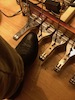
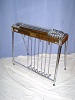
This is worrying. At last night's rehearsal I had the worst tuning problems ever and in the morning light I can see the reason - a fatigue crack in my A-pedal crank.
I thank my lucky stars it wasn't a gig. I'm not here to rubbish Mitsuo's design or execution, so I assume it's a random fault in the raw steel. I've had this instrument a little over 4 years and it's my gig/rehearsal guitar, so it only gets played once or twice a week and it had a year off for Covid. I'm not a metallurgist, but I do know that fatigue depends on the force applied and the number of repetitions. Admittedly it's a busy pedal with 4 pulls (this is a 12-string uni) but it's never felt heavy and I feel it should have lasted longer, or indeed indefinitely!
Anyway, I shall email Japan for a spare crank and I fully expect a response, but as a matter of interest does anyone in the USA carry Excel parts?
Make sleeping dogs tell the truth!
Homebuilt keyless U12 7x5, Excel keyless U12 8x8, Williams keyless U12 7x8, Telonics rack and 15" cabs
I will not obsessively examine my steels....I will not obsessively examine my steels....I will not obsessively examine my steels....I will not obsessively examine my steels....
Yeah, even if you get a new one, keep that one and fix it.
One thing about these Excels, they don't have the parts availability of something like a Bud or an Emmons.
edit: checked in safe. Of course my pullers are totally different. Just a flat piece cut to shape.
My guitar was built in mid 2018 I think. So it's about 4 years old also.
Last edited by Mike Vallandigham on 9 Apr 2022 5:07 pm, edited 1 time in total.
The endplates and leg sockets cracked on my on older model Excel and Mitsuo to care of it pronto as can be with shipping from Japan.
His assistant, Watru, is good translating English.
Mitsuio always attended Scotty's.
I guess that's one worry I've always had about stamped/formed steel parts by any maker. There is potentially a lot of fatigue introduced wherever there is a bend. In this case, there's a bend just above where the crack has formed.
The Excels are great guitars, but there's an awful lot of formed steel parts involved. Same for a lot of other makers. Machined solid metal is a costlier way to go, but I think it's less likely to fail.
Ian- have you tried reaching out to Jim Palenscar? He has (had?) some Excel parts stock & might could set you straight.
And his English is spot on.
Excel Superb D10, Sarno Black Box, Goodrich L120, various effects into a Sarno Spectrum preamp feeding a Jay Ganz Straight Ahead into pair of JBL K130 loaded cabs.
They say "thats how it goes". I say "that ain't the way it stays!"
I emailed Mitsuo and got a very quick response, promising a spare to be sent out today. Apparently the part has been redesigned (David will be glad to hear!) but he still has a couple of old ones.
I may still weld up the old one as it's likely to end up stronger than the original.
I have dealt with Jim Palenscar in the past and I have always been very impressed by his English.
Make sleeping dogs tell the truth!
Homebuilt keyless U12 7x5, Excel keyless U12 8x8, Williams keyless U12 7x8, Telonics rack and 15" cabs
From my first look at the picture something stands out to me.
To the left of the break there is a series of little dented spots. It looks like the teeth marks of a set of vice jaws. I wonder is someone along way clamped that piece in a vice and took a hammer or brute force to the lever to bend it for less travel on the stop screw out of the folded over tab.
Is that screw in the top of the tab the actual pedal stop adjustment screw?
Looks like the large hole to the left has a wear mark where the pedal rod pulls the lever up to engage the cross rod.
Once the lever is bent back to proper angle a small piece of steel could be added along the break and welded to reinforce the crack.
Yes, Bobby, I had it new 4 yrs ago. The vice marks are from the original manufacture. If you look to the right of the crack you will see further ones which would have lined up before the piece cracked and bent. (Myself, I always use copper jaw covers to avoid marking the work.)
The pedal stop adjustment works just fine, so no hammering needed! There is a little wear where the pedal rod hooks in, but then things do wear and this is the A pedal!
I shall get it welded as many have suggested - my town is full of small factories and workshops that can do that.
Mitsuo is sending some spares, but Japanese airmail to the UK is suspended as it has to fly over Russia so it could take a while.
Make sleeping dogs tell the truth!
Homebuilt keyless U12 7x5, Excel keyless U12 8x8, Williams keyless U12 7x8, Telonics rack and 15" cabs
As a temporary fix I borrowed a good crank from a pedal I can live without, so I'm up and running in the short term
It's an 8x8 uni, so it's quite crowded underneath but even so these guitars aren't bad to work on.
Make sleeping dogs tell the truth!
Homebuilt keyless U12 7x5, Excel keyless U12 8x8, Williams keyless U12 7x8, Telonics rack and 15" cabs
The problem with welding a crack like that, other than heat deformation, is that if is is allowed to cool slowly, it will be in a dead soft and fairly ductile state. It should be quenched, then annealed to a hard but not brittle phase. Cracks like that usually start at a 'stress riser', a nick or gouge. Aircraft props are regularly inspected for nicks which are filed smooth to get rid of the riser. I see other stress risers along the bottom but note that your crack started right where the stress was the highest and the metal was the thinnest. Classic crack.
By the way, you might consider brazing it. When brazing a very close gap between two pieces of steel it forms an alloy that is almost as strong as the steel and it really mitigates the heat expansion problem.
Fatigue cracks are caused by work hardening. What happens is that the stress riser concentrates the stress at a point and the steel deforms plastically at that point and hardens to where it becomes brittle and fractures on a grain boundary. That tiny fracture ends in another stress riser and the process repeats itself getting worse every time because there's less metal to support the load. Look at the wikipedia page on work hardening. Your crank didn't tear all at once, it failed over time until it gave up the ghost.
The highest strength bellcranks are forged followed by machined from a billet followed by stamped sheet followed by cast. That's not an absolute rule but generally it's true.
The whole point to annealing is that you are taking the steel from the hardest most brittle state down to the softest most ductile state. Where you stop is determined by what properties you want. Do you want your bellcrank to bend under the load? Do you want it to snap under the load? Somewhere in between maybe?
If it were my guitar I would take a little square of steel, braze it over the crack, and call it done.
That's probably what I'll do. Even though I have a package on its way from Japan which should contain a spare if Mitsuo has understood me correctly, if I double it up I should have something that's stronger than the original.
The failed component is the A pedal crank, which apart from raising 5 and 10 in the normal way also lowers the 12th string B to A, and lowers 7 slightly to compensate for my JI-style tuning scheme. So the load is fairly high and it's a busy pedal, so the combination of force and frequency is likely significant. If it were an aircraft I would be be required to inspect it for new cracks at regular intervals. Maybe I should, if only to avoid bad dreams.
Make sleeping dogs tell the truth!
Homebuilt keyless U12 7x5, Excel keyless U12 8x8, Williams keyless U12 7x8, Telonics rack and 15" cabs
The nice part about brazing is that brass melts at around 900 degrees, well below the 1335 degrees of steel's critical temperature and the 1440 melting point that welding takes you to. The properies of the base metal don't change much. Pleasant dreams.




 Larry
Larry