Why "pockets" instead of just learning SCALES?!?!

Instruments, mechanical issues, copedents, techniques, etc.

Moderator: Dave Mudgett

User avatar
Jim Fogarty
Posts: 1577
Joined: 14 Dec 1999 1:01 am
Location: Phila, Pa, USA
State/Province: -
Country: United States

Post by Jim Fogarty »

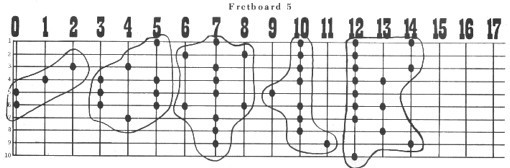
b0b wrote: Looks like C mixolydian on the high one, and the 5 notes of a C9th (C D E G Bb) on all the rest.
But only “kinda”, right?

One of the C9 ones has an A note in it, out of the blue..........some double up on one or more note on different strings, some don’t........some omit notes that others contain.... .the high one is a full C mixolydian on the upper strings, but not on the lower.......etc, etc.

Why?? Who knows!?! :wink:

Hence, my “random” comment.

I just find it weird. I crave LOGIC, dagnammit!! :lol:
User avatar
Fred Treece
Posts: 4830
Joined: 29 Dec 2015 3:15 pm
Location: California, USA
State/Province: California
Country: United States

Post by Fred Treece »

I agree with b0b. Those are mostly C9 chord tone pockets with a full C mixolydian scale in the upper register and a very limited voicing in the lower register. They are not random and they are logical in terms of timbre and playability.

That diagram clearly illustrates that pockets are not necessarily about scales, but chord tones derived from scales. So, as far as teaching the concept, maybe the notes of say, the C major scale, have to be located at frets 3-4-5 before the student can learn where the Dm7 chord tone pocket is in that area. It might not be the most useful Dm7 pocket, but I can just about guarantee its there. I am definitely not saying it’s easy to learn, or to teach.
User avatar
Dennis Detweiler
Posts: 3985
Joined: 8 Dec 1998 1:01 am
Location: Solon, Iowa, US
State/Province: Iowa
Country: United States

Post by Dennis Detweiler »

I recall somewhere, maybe his website or the Steel Guitarist Magazine, that his pockets that he charted said that he "worked within the pockets." This isn't his direct quote. I think he was saying that these notes aren't the only ones he plays in those pockets. It could be he was just using the C9 notes as a basic reference point? He also said, "you're only one fret away from correcting a mistake and creating something out of it." I assume,creativity inside the pockets? He also said, "the fun part is getting out on a limb and finding your way back."
I always assumed his pockets as more of a reference point than strict note patterns. Creating licks and riffs on the fly.
1976 Birdseye U-12 MSA with Telonics 427 pickup, 1975 Birdseye U-12 MSA with Telonics X-12 pickup, Revelation preamp, Ibanez Analog Mini Delay and Hall Of Fame Reverb, Crown XLS 1002, 2- 15" Eminence Wheelhouse speakers, ShoBud Pedal, Effects Pedals. 1949 Epiphone D-8.
User avatar
J D Sauser
Moderator
Posts: 3397
Joined: 4 Aug 1998 11:00 pm
Location: Wellington, Florida
State/Province: Florida
Country: United States

Post by J D Sauser »

Jim Fogarty wrote:
David Ellison wrote:Scales are WHAT the notes are. Pockets are WHERE the notes are.
Ok.....so what SCALE is demonstrated in these C6 POCKETS?


Image
I think the only name player I can remember insisted on scales and modes for a while and was KNOWLEDGEABLE about that approach, was Paul Franklin, and he seems (based on what I understand from his online school) to have turned more towards the chord based approach.

I am NOT trying to convince anybody that scales and modes are wrong, but when you look at the history and development of Jazz and melodic Bebop, most influential musicians concentrated demonstratively on the chords and thus the progression.

While BE's "Steel Guitar Jazz" Album which should have been named "Bebop On A Steel Guitar" has some tunes which carry some modal flavor (imposing a scale over several chord changes) BE's approach, as I understand from what he has shared in the infamous Steel Guitar Magazine and here on the forum, was mostly based around chord. Keep in mind, that BE is said to NOT have really studied musical "Theory" until his LA-days which I believe was in the 70's.... so long AFTER he recored the ground braking Jazz album aforementioned.

I am taking lessons now with another Nashville Great that has lived thru all the generations of Pedal Steel, and he too, teaches mostly ii, V runs... when I analyze what I am being taught, the degrees clearly follow the chord structures... and SOME is to use his term, quite "On The Outside".
Some is clearly structured on the Pentatonic "Blues Scale" but MODULATED as chords change... so it carries a certain "insistence" on the "Blue"-notes but the scale or scale base fragments are modulated around. So really, the thing is to for me to learn the degrees which sound "Blue" instead of "a" scale.

Django Reinhardt's playing was some times very purely based on arpeggios. Which was gave Jazz that "staggered" feel (moving "up and down" following the progression. My stepfather who denigrated quit loudly ANY music form outside of strictly Classical, said that Jazz felt like going up and down a maze of stairs! I think that while he decided to hate it, he got that right!), when compared to "classical" music which was form until it's last 80 or so years in the 19th century, mostly scale and then modal based. Thus mine alluding to even winds being played following chords instead of a key based mode or a mode against a different key.

Sure, like school like Jamie Abersold quite successfully managed the commercialize, one can look at anything which sounds good and put a "Transparency" with a certain mode over it and state "oh lookie!... 90% match".
BUT, what made the Music was the musician's thinking. Not to say that one can't make great music thinking in scales and modes.

The CHARTS which were published in, if my memory serves me well, 2 or 3 installments in The Steel Guitar Magazine, lacked explanation.
Many understood only so much that BE was trying to SAY something. But even though BE had the good sense of using Charts over TAB to show how HE SAW the fretboard, the image of patterns he projected on it while playing, it lacked guidance.

I approached BE in the late 90's and asked about one-on-one lessons. He however seemed declaredly uncomfortable with my proposal, stating he he did not really know how to verbalize his thinking (which was what I was after).

To bring this to a point, I don't believe that SCALES was what BE tried to show. But playable "Pockets" that allow for quick access to practical or meaningful degrees and also to slide-ins and slide-outs which sound good as well as iim, V movements which are the building blocks of so much of Western music.
Every instrument able to produce all 12 semi tones, can in theory play EVERY thing... but playability and playing in ways to accentuate the instrument's particular advantages (like in our instrument's case, the "Gliss") in an effective manner is in most instruments scattered around some more easily accessible or executable positions. You can play Floyd Cramer style on a piano doing his half-note thrills very easily sliding your fingers down from a black key to an adjacent white key with one and the same finger. The same sound requires a much different and in my opinion more difficult technique going from a white key up to the adjacent black key or even only to on of the two semi-tone adjacent white key. So, different keys, different chords, in other words, different POSITIONS = different playability.
Like any multi stringed instrument, the steel guitar has the particularity that the same notes, scales and even harmonies and chords appear at the same pitch repeatedly all over the neck. The timbre changes (string gauges vs. vibrating lengths) and accessibility and surrounding notes or degrees (in between) change too. And particular to our instrument, pedal and lever changes will affect different degrees in each different position. The later may be seen as an incumbrance (one has to learn each pedal & lever pitch change again and again for each positions. But really it's a HUGE advantage as it allows for a more surprising and less predictable sound. Compare most typical A&B-mashing E9th players to somebody like Bobbe Seymore who would often play out of very uncommon positions and thus surprise the "knowing" audience with what seemed to be pedal & lever changes out of this world, just using A&B against totally different degrees (Paul Franklin's online course demonstrates by the way a lot of these positions).

I think that you will find these charts BE published in the late 70's I believe, more absorbable and useful if you layer transparencies with the typical IM, iim (and II7), iiim (and III7), IVM, V7, vim (and VI7) positions. If you print or draw these charts with equal fret spacing (so not getting smaller to the right) and transparencies that you can move to the left and right, you will suddenly have that "AHA"-moment. And of course, IF you are very knowledgeable on scales and modes and can make transparencies of their layout to overlay, I am pretty sure you may come up with some "close"-matches too.

... J-D.
__________________________________________________________

Was it JFK who said: Ask Not What TAB Can Do For You - Rather Ask Yourself "What Would B.B. King Do?"

A Little Mental Health Warning:

Tablature KILLS SKILLS.
The uses of Tablature is addictive and has been linked to reduced musical fertility.
Those who produce Tablature did never use it.

I say it humorously, but I mean it.
User avatar
b0b
Posts: 29079
Joined: 4 Aug 1998 11:00 pm
Location: Cloverdale, CA, USA
State/Province: -
Country: United States

Post by b0b »

I think that if you visualize a position of the current current chord along with the octaves of its 5-note extension, you can call that a "pocket". That's what BE's chart demonstrates on a C9th. When the chord changes, adjust the notes accordingly.

It's sort of obvious to me that BE's pockets will work against Gm-C7-F (ii V7 I) but need to change a bit over the iii chord (Am) and the vi (Dm). When you encounter chords with out-of-key notes, you may have to move the entire pocket up or down the neck.
Last edited by b0b on 23 Mar 2021 8:36 pm, edited 2 times in total.
-𝕓𝕆𝕓- (admin) - Robert P. Lee - Recordings - Breathe - D6th - Video
User avatar
J D Sauser
Moderator
Posts: 3397
Joined: 4 Aug 1998 11:00 pm
Location: Wellington, Florida
State/Province: Florida
Country: United States

Post by J D Sauser »

b0b wrote:I think that if you visualize a position of the current current chord along with the octaves of its 5-note extension, you can call that a "pocket". That's what BE's chart demonstrates on a C9th. When the chord changes, adjust the notes accordingly.

It's sort of obvious to me that BE's pockets will work against Am-C7-G (ii V7 I) but need to change a bit over the iii chord (Bm) and the vi (Em). When you encounter chords with out-of-key notes, you may have to move the entire pocket up or down the neck.

(I know that Bb isn't in a G chord, but it's a blue note so don't roast me on that point, okay?)
Exactly! At the end of the day, that chart isn't etched on a fretboard, but moves (can slide to the left or right), depending on keys or chord movements. Like what works on a iim-V7 will have the same musical message ("say the same thing", to use BB Kings words) going iiim-VI7 or bviim (b7m7)-III7, etc (although the last example often starts on a half diminished (m7b5)...
To a BE this is self evident... to the student... erm... uh...


I would like to clarify something before any "stuff" hits some fan somewhere next to a computer! I may seem as I have a "beef" or have "highjacked" this thread.
I just am very interested in this subject and only after several decades "steelin' " have set my tush down to seriously study single note playing. I was so far behind on that, even my right had is sweathin' hard.
I have long given up on convincing people on the internet.
I just don't seem to have b0b's ability to make my case in 4 lines.


... J-D.
__________________________________________________________

Was it JFK who said: Ask Not What TAB Can Do For You - Rather Ask Yourself "What Would B.B. King Do?"

A Little Mental Health Warning:

Tablature KILLS SKILLS.
The uses of Tablature is addictive and has been linked to reduced musical fertility.
Those who produce Tablature did never use it.

I say it humorously, but I mean it.
User avatar
Fred Treece
Posts: 4830
Joined: 29 Dec 2015 3:15 pm
Location: California, USA
State/Province: California
Country: United States

Post by Fred Treece »

Dennis Detweiler wrote:I recall somewhere, maybe his website or the Steel Guitarist Magazine, that his pockets that he charted said that he "worked within the pockets." This isn't his direct quote. I think he was saying that these notes aren't the only ones he plays in those pockets. It could be he was just using the C9 notes as a basic reference point? He also said, "you're only one fret away from correcting a mistake and creating something out of it." I assume,creativity inside the pockets? He also said, "the fun part is getting out on a limb and finding your way back."
I always assumed his pockets as more of a reference point than strict note patterns. Creating licks and riffs on the fly.
Yes. I would agree with that assumption. Knowing the pocket well enough to disregard it on a whim. JD’s mention of Django’s arpeggio approach to soloing is pertinent too. It's something of a trademark for him, but served mostly as a framework for the million other tricks in his magic bag.

I think Jim F is a more concerned about the learning (and teaching) process than the notion of pocket playing itself. I think its something either a player dives into on his own (me, following loosely the same method learned on guitar because NO teachers were available at my income level), or the serious student tries to learn from one of the wellsprings of knowledge, such as the Paul Franklin course.
User avatar
J D Sauser
Moderator
Posts: 3397
Joined: 4 Aug 1998 11:00 pm
Location: Wellington, Florida
State/Province: Florida
Country: United States

Post by J D Sauser »

Fred Treece wrote:
Dennis Detweiler wrote:I recall somewhere, maybe his website or the Steel Guitarist Magazine, that his pockets that he charted said that he "worked within the pockets." This isn't his direct quote. I think he was saying that these notes aren't the only ones he plays in those pockets. It could be he was just using the C9 notes as a basic reference point? He also said, "you're only one fret away from correcting a mistake and creating something out of it." I assume,creativity inside the pockets? He also said, "the fun part is getting out on a limb and finding your way back."
I always assumed his pockets as more of a reference point than strict note patterns. Creating licks and riffs on the fly.
Yes. I would agree with that assumption. Knowing the pocket well enough to disregard it on a whim. JD’s mention of Django’s arpeggio approach to soloing is pertinent too. It's something of a trademark for him, but served mostly as a framework for the million other tricks in his magic bag.

I think Jim F is a more concerned about the learning (and teaching) process than the notion of pocket playing itself. I think its something either a player dives into on his own (me, following loosely the same method learned on guitar because NO teachers were available at my income level), or the serious student tries to learn from one of the wellsprings of knowledge, such as the Paul Franklin course.
Somebody just sent me this: https://youtu.be/GTowUMBmvew

Django. Me being from Europe, I was lucky to grow up along with even direct decedents of Django. I am friends with his grand son David, go to the yearly Samois Sur Seine (South of Paris) as often as I can. Played with many of the greats and heirs of the style. People outside the "community" may have various approaches to the style. I can tell you how I was taught to play and have observed fathers, uncles hand down the style to kids:
1- play rhythm in the style (today, THAT is different than what Django's brother did... which was BASIC chords with no much tension. Today, all play the classical Jazz chords and some even interject "modern" chords).
2- once they know the chord shapes they are drilled to play the arpeggios, day and night and then typical transitions. Evidently, many of Django's own tunes are true minor key centers to the point where even the IV chord can often be minor. There is AFTER Django... when the style became "Gypsy"-Swing or Jazz-Manouche, a lot of influence from the older Eastern and Central European styles, a lot of "Rhapsodian" influence, and thus in the arpeggios and solos one will wind up recognizing a certain emphasis on the 2nd and 6th degree in minor chords.
3- enclosures... "grace", or "slide in/slide out" notes, hammer on and offs... mapping it all out, it becomes like most any approach pretty much chromatic "every thing goes"... but the red thread of the style is the "Jazz"-chords and their notes (Arpeggios).

It's most of them who once someone blew the whistle on me having played steel in the past that encouraged me to pick up the steel again after pretty much a 20 year hiatus. I am going at it from what I learned on the guitar. I never gained the left hand technique to become a guitar soloist, but I have my reputation as "Pompe" (French for "pump") Rhythm player and can play with anybody.
I dropped my E9th completely and expanded my C6th setup.
I apply what I remember Maurice Anderson teaching me, because I can relate to it.
Maurice had an amazing understanding of Chords and always came up with wilder ways to apply them. He also stressed intervalic for EVERY aspect of playing; Keys, progressions, Chords internal structure and single note soloing (which is my greatest deficit, but now I am working on it METHODICALLY and it's coming.
My left hand is still better with a bar in it than I could ever get on the standard guitar... my right hand is "sweating it", I added a 3rd finger pick (T + 3) and I went to pick blocking and after studying PF's and Joe White's, I developed my own technique and it's starting to impress me.

I look for REPETITION in everything. I don't dabble much in "Theories", I prefer Physics. To me, music is physics and physics can be understood best thru repeatability and math. Number come in handy with math... name calling not so much.


'nuff said... I should go practice and so should most of us. Then BE practice all his life.


Thanks!... J-D.
__________________________________________________________

Was it JFK who said: Ask Not What TAB Can Do For You - Rather Ask Yourself "What Would B.B. King Do?"

A Little Mental Health Warning:

Tablature KILLS SKILLS.
The uses of Tablature is addictive and has been linked to reduced musical fertility.
Those who produce Tablature did never use it.

I say it humorously, but I mean it.
Tom Keller
Posts: 680
Joined: 13 Nov 2001 1:01 am
Location: Greeneville, TN, USA
State/Province: Tennessee
Country: United States

Post by Tom Keller »

One thing that prompted Django's style was the fact that he only had two usable fingers on his left hand.
User avatar
J D Sauser
Moderator
Posts: 3397
Joined: 4 Aug 1998 11:00 pm
Location: Wellington, Florida
State/Province: Florida
Country: United States

Post by J D Sauser »

Tom Keller wrote:One thing that prompted Django's style was the fact that he only had two usable fingers on his left hand.
I wouldn't say that. He was still faster than many who play in his style with an undamaged hand. :)
I know a few who made it a point to play with index and middle finger "only" (Django actually did use his burned stiff ring and pinky too, quite often).
One needs to go back further into history.
Django played a Banjo very early on... but as a "novelty" instrument. Mostly playing "Musette" which was a waltz style often played in Bistros (street cafes), for tips.
Then, he is quoted of having heard Luis Armstrong and having exclaimed "c'est mon frere!" (he's my brother!). Satchmo was one of his influences and he actually met him while briefly in the US.

But that's a different subject.
... J-D.
__________________________________________________________

Was it JFK who said: Ask Not What TAB Can Do For You - Rather Ask Yourself "What Would B.B. King Do?"

A Little Mental Health Warning:

Tablature KILLS SKILLS.
The uses of Tablature is addictive and has been linked to reduced musical fertility.
Those who produce Tablature did never use it.

I say it humorously, but I mean it.
User avatar
b0b
Posts: 29079
Joined: 4 Aug 1998 11:00 pm
Location: Cloverdale, CA, USA
State/Province: -
Country: United States

Post by b0b »

Let's stick to pedal steel, please.

While I sort of understand Buddy's pockets, I found Jeff's inscrutable as he explained them. Odd, because most of his lessons make perfect sense to me.
-𝕓𝕆𝕓- (admin) - Robert P. Lee - Recordings - Breathe - D6th - Video
User avatar
John Spaulding
Posts: 330
Joined: 27 Sep 2017 3:53 pm
Location: Wisconsin, USA
State/Province: Wisconsin
Country: United States

Post by John Spaulding »

Jim Fogarty wrote:
b0b wrote: Looks like C mixolydian on the high one, and the 5 notes of a C9th (C D E G Bb) on all the rest.
But only “kinda”, right?

One of the C9 ones has an A note in it, out of the blue..........some double up on one or more note on different strings, some don’t........some omit notes that others contain.... .the high one is a full C mixolydian on the upper strings, but not on the lower.......etc, etc.

Why?? Who knows!?! :wink:

Hence, my “random” comment.

I just find it weird. I crave LOGIC, dagnammit!! :lol:
As b0b mentioned, scale is Mixolydian, a Major scale with a flatted 7th tone: R, 2 (9), 3, 4(11), 5, 6 (13), b7.

Here's a way to look at it:

All of these pocket notes are chord tones taken from that scale, spread out over the entire neck, that sound good over Cdom7 harmony: C7, C9, C11, C13.

Super Simplified Theory Idea: For a bluesy sound, approach all the 3rds one fret below. The b3 is a "blue" note. For a jazzier sound, approach the 5ths and 9ths one fret above or below. This is the "altered" sound of Jazz chords: b5, #5, b9, #9.

Intervals in relation to C triad, top to bottom:

Pocket #1: C9 chord tones (R,3,5, b7, 9)
Open Strings: 5, 3
Fret 1: b7
Fret 2: 9

Pocket #2: C13 chord tones (R, 3, 5, b7, 9, 11, 13)
Fret 3: R,b7,5
Fret 4: 3,3
Fret 5: 5, 9, R, 13

Pocket #3: C13 chord tones (R, 3, 5, b7, 9, 11, 13)
Fret 6: b7, b7
Fret 7: 13, 5, 3, 9, 5, 3, R
Fret 8: R, R

Pocket #4: C9 chord tones (R,3,5, b7, 9)
Fret 9: 3
Fret 10: R, 9, b7, 5, 9, b7, 5
Fret 11: 3

Pocket #5: C13 chord tones (R, 3, 5, b7, 9, 11, 13)
Fret 12: 9,3,R,13,5,3,R,R
Fret 13: b7, 4 (11), b7
Fret 14: 3, 9, 5


Image
Last edited by John Spaulding on 19 Mar 2021 1:54 pm, edited 1 time in total.
User avatar
Jim Sliff
Posts: 7060
Joined: 22 Jun 2005 12:01 am
Location: Lawndale California, USA
State/Province: California
Country: United States

Post by Jim Sliff »

Wow, I guess I'm hallucinating about having played 45 years of gigs on multiple instruments. Heck, ask me to play a MAJOR scale on 6-string and I'll probably blow it - because I don't *think* that way.

I'm an ear player. And 90% of the blues, rock and country players around LA are as well. The other 10% mostly went to musicians' Institute, learned their theory, think in terms of which scale they need to base their plying on and which notes need to be flatted or sharped and when...

...and are generally mechanical-sounding, lifeless players.

There ARE those who learned mainly by ear first and studies theory later - but they ere vry careful not to "overthink" to the point that they lost all emotion and dynamics in their playing.

I was using the "CAGE" system before it WAS a "system" - just hearing where the pentatonics connected - and THEN plying around with which notes sounded "blue". OTOH, if one sounded greenish-purple it was wrong.

....errr, I mean, it was jazz! :lol:

On pedal steel the only thing that made/makes any sense to me is is learning where major chord "grips" are; figuring out how the pedals & levers audibly get you 1) a IV chord and whatever minors you can find without moving the bar; logically moving the bar 2 frets up for a V chord with pedals engaged and discovering what other chord sounds are in that position..

...and playing the dozens of arpeggios in those two positions (and a couple frets down in short order) by varying pedal and lever combinations.

Basically playing bvanjp rolls over mechanical changes. There are enough licks, fills and solo chunks in those spots that you can actually play with other humans who think you know how to play pedal steel AFTERWARDS.

Is it "cheating?" Well, not if pedal steel will be a secondary (or further down the line) instrument for you AND other musicians you play with and audience members are happy with it.

Are you "faking it"? Define "faking it" AND the context to which the term applies.

If everyone (except theory-heavy pedal steel players in the audience) is haappy - does it matter?

Nobody has ever required...or even asked me...to play a single scale since saxophone lessons in the 4th grade.

So my question to the OP is - has someone required you to play/know/comprehend everything about scales in order to play blues - or is it a personal need YOU have to play and understand them in order to "properly" play the blues?

I'd love to hear you discuss the subject with Robert Johnson, Elmore James, or Albert King.
No chops, but great tone
1930's/40's Rickenbacher/Rickenbacker 6&8 string lap steels
1921 Weissenborn Style 2; Hilo&Schireson hollownecks
Appalachian, Regal & Dobro squarenecks
1959 Fender 400 9+2 B6;1960's Fender 800 3+3+2; 1948 Fender Dual-8 Professional
User avatar
Jim Fogarty
Posts: 1577
Joined: 14 Dec 1999 1:01 am
Location: Phila, Pa, USA
State/Province: -
Country: United States

Post by Jim Fogarty »

Jim Sliff wrote:Wow, I guess I'm hallucinating about having played 45 years of gigs on multiple instruments. Heck, ask me to play a MAJOR scale on 6-string and I'll probably blow it - because I don't *think* that way.

I'm an ear player. And 90% of the blues, rock and country players around LA are as well. The other 10% mostly went to musicians' Institute, learned their theory, think in terms of which scale they need to base their plying on and which notes need to be flatted or sharped and when...

...and are generally mechanical-sounding, lifeless players.

There ARE those who learned mainly by ear first and studies theory later - but they ere vry careful not to "overthink" to the point that they lost all emotion and dynamics in their playing.

I was using the "CAGE" system before it WAS a "system" - just hearing where the pentatonics connected - and THEN plying around with which notes sounded "blue". OTOH, if one sounded greenish-purple it was wrong.

....errr, I mean, it was jazz! :lol:

On pedal steel the only thing that made/makes any sense to me is is learning where major chord "grips" are; figuring out how the pedals & levers audibly get you 1) a IV chord and whatever minors you can find without moving the bar; logically moving the bar 2 frets up for a V chord with pedals engaged and discovering what other chord sounds are in that position..

...and playing the dozens of arpeggios in those two positions (and a couple frets down in short order) by varying pedal and lever combinations.

Basically playing bvanjp rolls over mechanical changes. There are enough licks, fills and solo chunks in those spots that you can actually play with other humans who think you know how to play pedal steel AFTERWARDS.

Is it "cheating?" Well, not if pedal steel will be a secondary (or further down the line) instrument for you AND other musicians you play with and audience members are happy with it.

Are you "faking it"? Define "faking it" AND the context to which the term applies.

If everyone (except theory-heavy pedal steel players in the audience) is haappy - does it matter?

Nobody has ever required...or even asked me...to play a single scale since saxophone lessons in the 4th grade.

So my question to the OP is - has someone required you to play/know/comprehend everything about scales in order to play blues - or is it a personal need YOU have to play and understand them in order to "properly" play the blues?

I'd love to hear you discuss the subject with Robert Johnson, Elmore James, or Albert King.
Ah, the old "more knowledge = less soul" trope. It's provably false nonsense, of course, but whatever works for you.

But, you make a LOT of assumptions about what a working musician may or may not need, just because your personal experience is different.

I've also been a working/touring/recording musician on multiple instruments for 30+ years. What you describe absolutely would have limited the amount and quality of work I've gotten over the years, in a major way.

Aside from that, I think having basic knowledge about the instruments I love is important and necessary. YMMV.

Plus, I teach. That adds another element of needing to know what you're doing, in an organized way.

I KNOW my experience and goals are not always the same as everyone else's. Don't assume yours are, either (that is the general "you", not just you, Jim).
Dale Rivard
Posts: 416
Joined: 22 Jan 2006 1:01 am
Location: Ontario, Canada
State/Province: -
Country: United States

Post by Dale Rivard »

Hi Jim, Just recently, I dissected a fairly fast C6th solo that Buddy Emmons played live. Here's my take on it: Certain scales played on the C6th, in their entirety, are difficult to play at fast tempos. Even the major scale requires a fair bit of bar movement, where on the E9th, it can be played on 1 fret using pedals. Also, I believe most players play things in the heat of battle(on a gig) that they're comfortable with and have practiced repeatedly(muscle memory). Personally, when I hear a musician that is scale based, sometimes(but not always) I find their playing boring and predictable. By choosing groups of notes found in pockets, it can allow a certain freedom to the player, especially when adlibbing(altering the phrasing and feel of the notes). Of course, you still need to understand how common(same) notes fit over different chords. Plus, training your ear and having musical knowledge helps no matter what direction you choose. Scales are definitely another piece of the puzzle. Emmons knew scales. He just chose to approach his playing using pockets.
Last edited by Dale Rivard on 22 Mar 2021 6:41 am, edited 1 time in total.
User avatar
J D Sauser
Moderator
Posts: 3397
Joined: 4 Aug 1998 11:00 pm
Location: Wellington, Florida
State/Province: Florida
Country: United States

have yer flam throwers ready?

Post by J D Sauser »

I love this thread, even thou, it's scattered with "opinions"... including mine.

However, I start to get under the impression that we are avoiding to look at the elephant in the room... to the point I feel we are trying to tell each other "there is no elephant, just stop bumping into it!"

The reason we debate "systems" like scales/modes, arpeggios, pockets/shapes etc "PATTERNS", is that we CAN't play like BE, JB, JD, PF, LG, CC etc. and we are in a constant search or a "system" which will give you what "they" seem to have... the freedom to play.

PF insist on learning your "intervals" (he actually means "degrees")... this from a man who promoted the modal approach decades ago and mentions that the reason LG played like he did was because he knew his degrees (the root, the 9th, the minor or major 3rds, the fourth, the 5th and thus the flat 5th and aug. 5th, the 6th and the flat and major 7ths. This makes sense, because it's the DEGREE in a chord that "colors" the musical message. Whereas a note NAME can have any degree as chords move and thus it's musical message will vary. An "A" can be beautiful played against a B-chord and point to what's coming.. a 4th up. But an "A" can sound awful against another chord.

While I follow what I believe to understand, in my case chords, intervals and degrees and thus map after roots and chords and construct my or analyze other people's "pockets" or "shapes" based on that system. PF did GREAT playing modes in the 70's! I believe Jo Wright was at a time studying and applying modes too and I feel that many "name"/professional players which had great technique played some kind of "steel guitar jazz" using mostly and quite indiscriminately the one or two most prominent modes which were touted to make one sound "Jazzy". I just can't stand listening to that very long. I'd rather listen to BB playing 2 notes which are 3 seconds apart but are pushing the right receptors on my fat-cells.

So, every system works. BUT you have to MAKE it work.
I had a somewhat tense discussion with Jeff Newman during a break at one of his traveling boot camp events. Jeff was a great teacher and I miss him, his teaching, his wit and showmanship and music DAILY. But I disagreed on the concept of pitching the Pentatonic as "OBAIL" (Oh Boy Am I Lost)-scale. The concept that EVERY note works is not true, and the concept that you can play without knowing what chords are played (especially in a 3-chord environment) seemed to me an odd thing to "teach".

It is JEFF who correctly said what another great musician said before him:
Only play what you hear, if you hear nothing, play nothing.

I see youtube-"teachers" starting to explain licks and run like a TAB sheet... out "cold" without playing it thru once first and encouraging to LEARN it in your HEAD, gain the ability to hum or whistle it or run the "melody" thru in your head.
Usually NO mention of the underlining chords.
Instead, just like TAB they go something like "place yer bar on the 3rd fret and pick string, uh 8... sorry 7 and then....
IF self-proclaimed teachers show you things like that on a LIVELY format like a VIDEO and don't explain why, where, because of... it's because they themselves wouldn't know.
That's not a problem, but it becomes one when students learn to learn that way.
You not only learn to play a like, but by repetition you accidentally LEARN-to-LEARN in a totally wrong manner.

I find that when I learn to hum a lick, phrase, or line... I can play it much faster, better, more musically. It takes some self discipline to do it. A great many Jazz icons have been know to use that method... George Benson made it a trade mark of his style and even live appearances. I had the opportunity to briefly discuss that with him after an appearance in France (and he loves "Gypsy"-Jazz and hang around with Bireli Lagrene and Stochelo Rosenberg) and he told me very quickly "DO IT and you will see!".

What I am trying to say is:
I remember well that BE's "Pocket"-article created some chatter for decades that followed and many just ended up agreeing that BE tried to "say something".
Yes, the articles lacked instruction, lacked connection to the chords being played, movements (iim-V etc) and too many just set them up on their note-stands and proceeded to "noodle" (to use one of JN's terms) the hell out of them without THINKING MUSIC... like it was supposed to do it for us... make us sound like BE on the spot.

Jeff Newman stressed joining a band EARLY on... and also was one of the first to sell rhythm tracks and and "Ear Training" course. Today, you can download rhythm tracks from youtube for FREE for virtually ANY song in ANY style, tracks to practice iim-V's and other common changes in all "Keys" until the cows come home and scream "Oh cut it out now!" (like cows "scream"! Ha!).
Fist mistake most do, they click play and proceed to noodle on the instrument.
Maybe a more productive way to learn would be to sit back and listen to iim-V's for a while to get into the "feeling" and start coming up with crap in you head, whistle or hum in all "Keys". And THEN only try to lay it out on the neck.
Chances are, after not too long BE's pocket's or the scale or modal patterns or arpeggios you practiced will start blinking at you from under the strings!

Music doesn't start at the loud speaker or the fiddle, it starts in your head/heart.

Patterns (to use a term for ALL the pockets, scales/modes and/or arpeggios) are just a tool to find home bases to start off from and find back home too. They are anchors, parking spots, express lanes "WHAT EVER"... but the music is not within, it's in YOU.

And don't come on here "oh maybe I am not so musical"! BULL SHIT! You don't choose STEEL GUITAR over all the other instruments, over let's say DRUMS because you are "not musical". Don't tell us you bought a strung up table with Ford truck clutch pedals attached to it, because you thought the chicks would find you sexy while bent over it like you'd be filling the bands tax declaration while the guitar players wiggle their tails!

... J-D.

b0b feel free to make that work in 4 lines. Please! :D
(oh boy, I know he's going to do it!)
__________________________________________________________

Was it JFK who said: Ask Not What TAB Can Do For You - Rather Ask Yourself "What Would B.B. King Do?"

A Little Mental Health Warning:

Tablature KILLS SKILLS.
The uses of Tablature is addictive and has been linked to reduced musical fertility.
Those who produce Tablature did never use it.

I say it humorously, but I mean it.
User avatar
Fred Treece
Posts: 4830
Joined: 29 Dec 2015 3:15 pm
Location: California, USA
State/Province: California
Country: United States

Post by Fred Treece »

I have been enjoying this thread too.

I confess, JD, that usually I just skim through your longer posts in an effort to find the point you are trying to make. But that one there? That was a mindful mouthful and I don't think there is a way to condense most of it.
Very well said.
User avatar
b0b
Posts: 29079
Joined: 4 Aug 1998 11:00 pm
Location: Cloverdale, CA, USA
State/Province: -
Country: United States

Re: have yer flam throwers ready?

Post by b0b »

J D Sauser wrote:I love this thread, even thou, it's scattered with "opinions"... including mine.
[...]
b0b feel free to make that work in 4 lines. Please! :D
(oh boy, I know he's going to do it!)
TLDR; sorry.
-𝕓𝕆𝕓- (admin) - Robert P. Lee - Recordings - Breathe - D6th - Video
User avatar
Tony Prior
Posts: 14718
Joined: 17 Oct 2001 12:01 am
Location: Charlotte NC
State/Province: -
Country: United States

Post by Tony Prior »

in·​scru·​ta·​ble | \ in-ˈskrü-tə-bəl \

Definition of inscrutable
: not readily investigated, interpreted, or understood :

MYSTERIOUS

an inscrutable smile
inscrutable motives
Emmons L-II , Fender Telecasters, B-Benders , Eastman Mandolin ,
Pro Tools 12 on WIN 7 !
jobless- but not homeless- now retired 9 years

CURRENT MUSIC TRACKS AT > https://tprior2241.wixsite.com/website
User avatar
Dale Rottacker
Posts: 4139
Joined: 3 Aug 2010 6:49 pm
Location: Walla Walla
State/Province: Washington
Country: United States

Post by Dale Rottacker »

Knowledge is good, BUT, for some of us too much information is paralyzing. I think I tend to reside in that camp.

I understand how chords are constructed, and the numbers make sense, but my brain NEVER gets to that gear while I'm playing. What I do think in and SEE are patterns or shapes.

I can dissect the chord name and number after the playing is over. So by extension, I guess knowing the scales only starts being relevant to me once I can visually see it as a pattern, position or the pockets that it lives in.

Probably just me :wink:
User avatar
Jim Sliff
Posts: 7060
Joined: 22 Jun 2005 12:01 am
Location: Lawndale California, USA
State/Province: California
Country: United States

Post by Jim Sliff »

Jim F:
Ah, the old "more knowledge = less soul" trope. It's provably false nonsense, of course, but whatever works for you.
"False nonsense"? Even with your "whatever works for you" it's rather insulting analysis.

Your original post was based primarily on your playing/teaching experience of blues on "armpit guitar".

My comments were based on not just my personal experience playing blues-style on both "armpit" and pedal steel guitar, but my personal observation from countless gigs, jams and sessions of "scale analyzers". And most sound cold, clinical and don't "draw in" the listener.

There seems to be an over-analytical concern over playing "wrong" notes - a "math-like" accuracy lacking much willingness to paint oneself into a corner and play "outside" established norms.

There's absolutely nothing wrong with ANY approach. But some methods - in my experience - draw players into a style more concerned with mathematical "correctness" rather than musical "art".

And regarding playing out of "pockets" - this may have already been posted (I didn't read every detail of every post) this was material I found helpful paying both B6 and E9 because it is stylistically "neutral" - i.e. not another collection of material that focused only on results applicable to "country music" .

It's just a way of visualizing a fretboard that can be ported to any tuning, copedent - or instrument, really.

http://www.buddyemmons.com/pockets.htm

This kind of material - "visual based" - can be helpful to theory-deficient, non-reading ear players like me who just don't have the time...or patience...to learn music theory and pedal steel concurrently. :\ Thinking "pockets" alllowed me to play me way through songs and improvise, while observing others spenda month or more learning to play and understand all the right notes in one song.
But if they made one small mistake they were lost and hd no ability to improvise their way back into the tune.
No chops, but great tone
1930's/40's Rickenbacher/Rickenbacker 6&8 string lap steels
1921 Weissenborn Style 2; Hilo&Schireson hollownecks
Appalachian, Regal & Dobro squarenecks
1959 Fender 400 9+2 B6;1960's Fender 800 3+3+2; 1948 Fender Dual-8 Professional
User avatar
Fred Treece
Posts: 4830
Joined: 29 Dec 2015 3:15 pm
Location: California, USA
State/Province: California
Country: United States

Post by Fred Treece »

Excellent link, Jim. Thanks for posting.

The great thing about the article is that it reveals Buddy’s process for determining what a pocket is and how the locations can be learned.

Here is the link to the discussion on minor pockets:
http://www.buddyemmons.com/MinorPockets.htm

And guess what? If you learn your maj9 and dom9 pockets, you’re already most of the way there.
User avatar
b0b
Posts: 29079
Joined: 4 Aug 1998 11:00 pm
Location: Cloverdale, CA, USA
State/Province: -
Country: United States

Post by b0b »

Here's the blues scale pocket I use the most on C6th (shown in key of F):
[tab]
D -----------6---
E -----------6---
C ---------5-----
A ---------5-6---
G -----3-4-5-----
E -------4-------
C ---------5-----
A ---------5-6---
F -------------7-
C ---------------
[/tab]
Also there's the very obvious one 3 frets up:
[tab]
D ---------8-----
E -------7-8-----
C ---------8-----
A ---------8-----
G ---------8-----
E -----6-7-8-----
C ---------8-----
A ---------8-----
F ---------------
C ---------------
[/tab]
Last edited by b0b on 24 Mar 2021 12:08 pm, edited 2 times in total.
-𝕓𝕆𝕓- (admin) - Robert P. Lee - Recordings - Breathe - D6th - Video
User avatar
Jim Fogarty
Posts: 1577
Joined: 14 Dec 1999 1:01 am
Location: Phila, Pa, USA
State/Province: -
Country: United States

Post by Jim Fogarty »

Jim Sliff wrote:Jim F:
Ah, the old "more knowledge = less soul" trope. It's provably false nonsense, of course, but whatever works for you.
"False nonsense"? Even with your "whatever works for you" it's rather insulting analysis.
Yes.....sorry it came off that way. My annoyance is at that false premise, not at you. I also find insulting the myth that gaining knowledge will somehow impede a player's "soul".

I'm more of a self-taught "street" player than anything, having gigged long before I studied, but I've played with some Berklee/GIT/other music school MONSTERS, with more "soul" in their playing than all of us combined, who also have otherworldly "ears". One doesn't preclude the other.

So, while I would never denigrate someone who plays totally by feel, I equally think it's not cool when someone rips players because they're studied. It also only tends to be a guitar thing. You never hear horn players or pianists tear down someone because they went to school.

YMMV,

Jim F
User avatar
Ian Worley
Posts: 2431
Joined: 14 Jan 2012 12:02 pm
Location: Sacramento, CA
State/Province: California
Country: United States

Post by Ian Worley »

Jim Fogarty wrote:...One doesn't preclude the other...
yes. this.
All lies and jest, still a man hears what he wants to hear and disregards the rest - Paul Simon