I'm a total newbie and I cant really make sense of any of the descriptions of what a compressor does.
Thank you
What exactly does a compressor pedal do to your sound
Moderator: Dave Mudgett
-
Steven Schwartz
- Posts: 46
- Joined: 19 Sep 2020 5:37 pm
- Location: Longview Washington, USA
- State/Province: Washington
- Country: United States
-
Gary Watkins

- Posts: 1768
- Joined: 14 May 2004 12:01 am
- Location: Bristol, VA
- State/Province: -
- Country: United States
Re: What exactly does a compressor pedal do to your sound
Check out this link: https://www.youtube.com/watch?v=6LwSJmdxjiISteven Schwartz wrote:I'm a total newbie and I cant really make sense of any of the descriptions of what a compressor does.
Thank you
If you succeed in cheating someone, don't think that the person is a fool. It's just that the person trusted you far more than you deserved.
-
Noah Miller

- Posts: 1592
- Joined: 19 Oct 2009 1:34 pm
- Location: Rocky Hill, CT
- State/Province: -
- Country: United States
-
Richard Sinkler
- Posts: 17879
- Joined: 15 Aug 1998 12:01 am
- Location: Missoula
- State/Province: Montana
- Country: United States
-
Steven Schwartz
- Posts: 46
- Joined: 19 Sep 2020 5:37 pm
- Location: Longview Washington, USA
- State/Province: Washington
- Country: United States
-
George Redmon
- Posts: 3547
- Joined: 8 Apr 2005 12:01 am
- Location: Muskegon & Detroit Michigan.
- State/Province: Michigan
- Country: United States
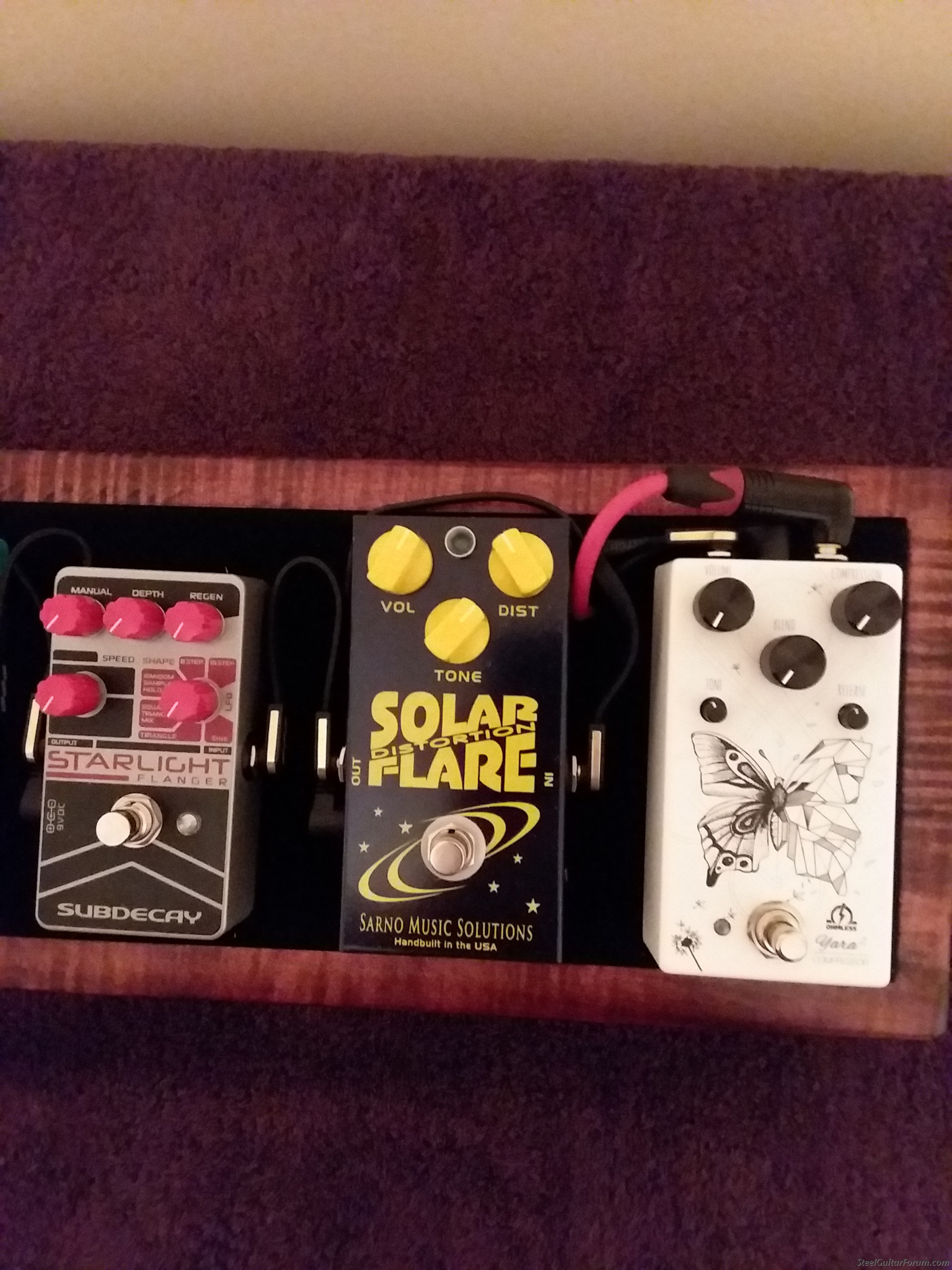
I love my Compressor. Either on my Tele, or any steel i'm playing. It's an "always-on" "must-have" if you play anything besides country. I am currently using the Ohmless Yara v2 Optical Compressor.
https://ohmless-pedals.reverbsites.com/ ... 2/13847570
Part of my board.

https://ohmless-pedals.reverbsites.com/ ... 2/13847570
Part of my board.
-
Chris Brooks
- Posts: 1470
- Joined: 28 Feb 2000 1:01 am
- Location: Providence, Rhode Island
- State/Province: Rhode Island
- Country: United States
-
Per Berner

- Posts: 1993
- Joined: 10 Aug 2004 12:01 am
- Location: Skovde, Sweden
- State/Province: -
- Country: United States
For pedal steel (with its near infinite sustain compared to a regular guitar), I have never felt the need for a compressor. But my Telecaster needs to be tamed by a little bit of compresion – I won't play a single note without it. Used a Boss for decades, it was really good, but my new Keeley is even better. With a Les Paul-type guitar, which I very rarely play, compression is not really necessary – the humbuckers and the body construction provides longer sustain and less spikiness compared to the Tele.
Last edited by Per Berner on 5 Mar 2021 10:56 am, edited 1 time in total.
-
Anthony Campbell

- Posts: 101
- Joined: 7 Jan 2020 3:30 pm
- Location: Northwest Indiana, USA
- State/Province: Indiana
- Country: United States
I leave my Cali76 on for either guitar or steel guitar.
I leave the dry blend set at a decent level so unprocessed signal can go through uncompressed.
There's pros to not using them, and pros to using them.
Try it out - if you like it - use it!
I leave the dry blend set at a decent level so unprocessed signal can go through uncompressed.
There's pros to not using them, and pros to using them.
Try it out - if you like it - use it!
Williams Keyless D10
Goodrich Volume
Quilter 101R and Quilter IB45
Goodrich Volume
Quilter 101R and Quilter IB45
-
Fred Treece

- Posts: 4827
- Joined: 29 Dec 2015 3:15 pm
- Location: California, USA
- State/Province: California
- Country: United States
Keep in mind, if you put a compressor after the volume pedal in your signal chain, you probably won’t notice the effect unless the volume pedal is full on and left there. The video linked in Gary W’s post is very good, but I would bet that it was done with the guitar volume knob all the way up. I think compressors like to get a full blast of output signal, no matter what purpose you intend for them.
-
Pete Burak
- Posts: 6560
- Joined: 2 Oct 1998 12:01 am
- Location: Portland, OR USA
- State/Province: -
- Country: United States
-
George Biner

- Posts: 362
- Joined: 11 Apr 2018 2:29 pm
- Location: Los Angeles, CA
- State/Province: California
- Country: United States
The basic function of a compressor is to "punch up" the sound -- make the whole thing uniformly louder by reducing the peaks -- whole armies of metal guitarists use them to create massive sustain where the notes never die off -- in the last twenty years, most pop records use extreme compression to the point that they have no dynamics at all -- but, when used by sane people, they can even out your sound and make it louder and easier to hear in a mix -- they will reduce the effect of the volume pedal by the way -- and if you ever need to do a screaming, saturated, really loud lead solo to piss off your band, you'll have it handy!
Guacamole Mafia - acoustic harmony duo
Electrical engineer / amp tech in West Los Angeles -- I fix Peaveys
"Now there is a snappy sounding instrument. That f****r really sings." - Jerry Garcia
Electrical engineer / amp tech in West Los Angeles -- I fix Peaveys
"Now there is a snappy sounding instrument. That f****r really sings." - Jerry Garcia
-
Tony Prior
- Posts: 14718
- Joined: 17 Oct 2001 12:01 am
- Location: Charlotte NC
- State/Province: -
- Country: United States
the thing about a compressor is, 1st, its not an effect, 2nd , it can be !
Compressors are used to tame mild peaks, which folds them back into the sound envelope. We shouldn't even know it's on. Typically if we can hear it, it's too much.
BUT, because we can BOOST the gain on a compressor, we can now HEAR the signal being folded back, SQUASHED somewhat OR squashed A LOT !
In the recording world we can see the peaks being tamed on meters but can't hear it, thats ideal, its a tool . In the Guitar/Steel world , we boost the signal so we can hear it, now its an audio effect.
Compressors are used to tame mild peaks, which folds them back into the sound envelope. We shouldn't even know it's on. Typically if we can hear it, it's too much.
BUT, because we can BOOST the gain on a compressor, we can now HEAR the signal being folded back, SQUASHED somewhat OR squashed A LOT !
In the recording world we can see the peaks being tamed on meters but can't hear it, thats ideal, its a tool . In the Guitar/Steel world , we boost the signal so we can hear it, now its an audio effect.
Emmons L-II , Fender Telecasters, B-Benders , Eastman Mandolin ,
Pro Tools 12 on WIN 7 !
jobless- but not homeless- now retired 9 years
CURRENT MUSIC TRACKS AT > https://tprior2241.wixsite.com/website
Pro Tools 12 on WIN 7 !
jobless- but not homeless- now retired 9 years
CURRENT MUSIC TRACKS AT > https://tprior2241.wixsite.com/website
-
K Maul
- Posts: 2247
- Joined: 14 Feb 2000 1:01 am
- Location: Hadley, NY/Hobe Sound, FL
- State/Province: -
- Country: United States
Like any effect it can be overused. On steel it would go probably first in the chain, and on only slightly so it only has minimal effect on just the highest peaks. Xotic makes the SP, with which you can blend the dry signal in so sustain increases but the squashing effect is not as noticeable.
KEVIN MAUL: Airline, Beard, Clinesmith, Danelectro, Evans, Fender, Gibson, Hilton, Ibanez, Justice, K+K, Live Strings, MOYO, National, Oahu, Peterson, Quilter, Rickenbacher, Sho~Bud, Supro, TC, Ultimate, VHT, Williams, Xotic, Yamaha, ZKing.
-
Bob Hoffnar

- Posts: 9502
- Joined: 4 Aug 1998 11:00 pm
- Location: Austin, Tx
- State/Province: Texas
- Country: United States
Be careful not to conflate studio compressors with pedal compressors. They have different functions within very different contexts. Stomp box compressors are getting really good though. My little rule is to use them for enhancement and not for correction. I don’t use a stomp box compressor but it seems like there is always some sort of high end comp in the signal chain when I’m being recorded.
Don’t worry about not understanding what compressors really do. They remain mystery to some of the best pro engineers. I’ll often ask the engineer what that big blue box with the knobs and VU meters on it does and the answers is usually something like turn the knobs like this and it’s like magic.
Don’t worry about not understanding what compressors really do. They remain mystery to some of the best pro engineers. I’ll often ask the engineer what that big blue box with the knobs and VU meters on it does and the answers is usually something like turn the knobs like this and it’s like magic.
Bob
-
Bill Terry

- Posts: 2812
- Joined: 29 Apr 1999 12:01 am
- Location: Bastrop, TX
- State/Province: Texas
- Country: United States
Agreed, the magic 'all buttons in' (crush?) mode on an 1176, LOL.. The various ways compressor circuits are designed can have a huge impact on what actually happens to the signal, and the kinds of control you have. This article has some fairly interesting details on common compressor types with intrinsic characteristics. Even though slanted toward the studio recording applications, these explanations apply, as most of these circuit types find their way into 'pedals' as well. An FET comp is going to work like and FET comp, no matter where it is..Bob wrote:Don’t worry about not understanding what compressors really do. They remain mystery to some of the best pro engineers. I’ll often ask the engineer what that big blue box with the knobs and VU meters on it does and the answers is usually something like turn the knobs like this and it’s like magic.
https://audiohertz.com/2017/08/07/what- ... mpressors/
Lost Pines Studio
"I'm nuts about bolts"
"I'm nuts about bolts"
-
Bill Hatcher
- Posts: 7306
- Joined: 6 Nov 1998 1:01 am
- Location: Atlanta Ga. USA
- State/Province: -
- Country: United States
-
Georg Sørtun

- Posts: 3854
- Joined: 2 Jun 2009 9:12 am
- Location: Mandal, Agder, Norway
- State/Province: -
- Country: United States
I use a stomp-box type compressor as "permanently-ON" buffer-amp w/tone control for PSG – before VP and all else, and prefer one with a little slow attack and decay so as not to squash the pick-attack sound but rather make it more distinct without peaking so high that it causes clipping in following amp-stages in my sound-chains.
As few if any stomp-box size compressors have adjustable attack and decay settings, they are either designed/built with suitable characteristics, or they make the PSG sound like "something else". I want a naturally/traditionally sounding PSG regardless of type of music, so finding a suitable compressor took time. All units for 6-strings I have tested over the years have fallen through as unsuited, but the Boss LNB-3 primarily built as "expression pedal" for bass-guitar fits right in there with a very playable effect.
As few if any stomp-box size compressors have adjustable attack and decay settings, they are either designed/built with suitable characteristics, or they make the PSG sound like "something else". I want a naturally/traditionally sounding PSG regardless of type of music, so finding a suitable compressor took time. All units for 6-strings I have tested over the years have fallen through as unsuited, but the Boss LNB-3 primarily built as "expression pedal" for bass-guitar fits right in there with a very playable effect.
-
Lee Baucum

- Posts: 10859
- Joined: 11 Apr 1999 12:01 am
- Location: McAllen, Texas (Extreme South) The Final Frontier
- State/Province: Texas
- Country: United States
-
Georg Sørtun
- Posts: 3854
- Joined: 2 Jun 2009 9:12 am
- Location: Mandal, Agder, Norway
- State/Province: -
- Country: United States
Only in name: "Limiter/Enhancer"Lee Baucum wrote:I believe the Boss LMB 3 that Georg uses is actually a limiter.

http://www.ovnilab.com/reviews/bosslmb3.shtml
It has the characteristics of a somewhat slow compressor, with a limiter to shape the top-peak. Makes it well suited to "stretch the attack" (make it sound strong even if it isn't) instead of squashing it – behaves more like a driven tube pre-amp.
FWIW: I have built lots of compressors in my time, for broadcasting etc., and know how I want them to work for various uses. I have never tried to cramp one into a stomp-box though, which is why I went on the market for one. The LNB-3 is the only one I have tried that I find it a joy to play through, and with the (typical for a Boss) high input impedance and very low output impedance it has also replaced all the various buffer amps I have tested. Only drawback with it is that batteries don't last as long as I would have liked – need am external supply if I want more than 8-10 hours playtime without interruptions.
-
Dave Hopping

- Posts: 2370
- Joined: 28 Jul 2008 4:18 pm
- Location: Aurora, Colorado
- State/Province: Colorado
- Country: United States

-
Gene Tani
- Posts: 1165
- Joined: 14 Mar 2019 8:07 pm
- Location: Pac NW
- State/Province: -
- Country: United States
there's a few different kinds and there's also this website with hundreds of reviews, which I'm sure don't help at all
I bought the LMB3 based on recommendations and am a believer, it gives notes "sparkle" and "bloom" and words like that. The Presonus studio channel is also a nice unit (maybe not real durable) I would like to try a joemeek and dbx 676 sometime
https://www.izotope.com/en/blog/mixing/ ... world.html
http://www.ovnilab.com/
I bought the LMB3 based on recommendations and am a believer, it gives notes "sparkle" and "bloom" and words like that. The Presonus studio channel is also a nice unit (maybe not real durable) I would like to try a joemeek and dbx 676 sometime
https://www.izotope.com/en/blog/mixing/ ... world.html
http://www.ovnilab.com/
- keyless Sonny Jenkins laps stay in tune forever!; Carter PSG
- The secret sauce: polyester sweatpants to buff your picks, cheapo Presonus channel strip for preamp/EQ/compress/limiter, Diet Mountain Dew
- The secret sauce: polyester sweatpants to buff your picks, cheapo Presonus channel strip for preamp/EQ/compress/limiter, Diet Mountain Dew
-
Richard Sinkler
- Posts: 17879
- Joined: 15 Aug 1998 12:01 am
- Location: Missoula
- State/Province: Montana
- Country: United States
The squish was exactly the reason I used an MXR Dynacomp in the 70's & 80's. Loved that popping sound that is kind of an imitation of the Tele sound. Only on a few songs was it ever used. Most of the night it was off.Dave Hopping wrote:If you put the compressor/limiter BEFORE the volume pedal you get micro-precise control over your levels.I just got a Keeley Compressor-Plus, and the only drawback(for me) is the temptation to squish the steel sound to the point it sounds like a Tele with 12 benders!
Carter D10 8p/7k, Dekley S10 3p/4k C6 setup, Regal RD40 Dobro (D tuning), Recording King Professional Dobro (G tuning), NV400, NV112, Ibanez Gio guitar, Epiphone SG Special (open G slide and regular G tuning guitar) .
Playing for 56 years and still counting.
Playing for 56 years and still counting.
-
K Maul
- Posts: 2247
- Joined: 14 Feb 2000 1:01 am
- Location: Hadley, NY/Hobe Sound, FL
- State/Province: -
- Country: United States
Yes it’s cool full on for special cases. I use it to add an extra stage to fuzz pedals, too. It seems that Buddy Emmons used a DynaComp quite a lot in the 70s if you check his work on Flying Fish records. So if can’t be ALL bad....right?
KEVIN MAUL: Airline, Beard, Clinesmith, Danelectro, Evans, Fender, Gibson, Hilton, Ibanez, Justice, K+K, Live Strings, MOYO, National, Oahu, Peterson, Quilter, Rickenbacher, Sho~Bud, Supro, TC, Ultimate, VHT, Williams, Xotic, Yamaha, ZKing.
-
Charley Paul

- Posts: 264
- Joined: 8 Jul 2015 2:49 pm
- Location: California, USA
- State/Province: California
- Country: United States
I’ve recently begun experimenting with a compressor on psg. I quite like the results. The sound is more polished and feels more controlled and even. It makes the psg punch through a bit more, as well.
I think the two important takeaways when using compression with psg are to have a 50/50 blend of the dry and compressed signals, and to not over-compress.
I like a dry blend because it preserves the attack of the note, as well as the subtleties of the volume pedal.
I think, as pointed out before, if you can hear the compressor squashing the sound, then you need to dial it back. On psg, I like it best when I don’t know it’s there...
I think the two important takeaways when using compression with psg are to have a 50/50 blend of the dry and compressed signals, and to not over-compress.
I like a dry blend because it preserves the attack of the note, as well as the subtleties of the volume pedal.
I think, as pointed out before, if you can hear the compressor squashing the sound, then you need to dial it back. On psg, I like it best when I don’t know it’s there...