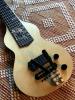
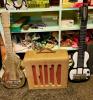
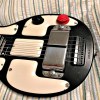
A friend of mine has a Ric Frypan 7 stringer with vol knob, no tone knob. It appears to be an all original one from the 30's. It does not have a serial number at the end of the neck where I've seen it on other frypan's. Is this unusual? Are there other ways to date this guitar? Any info is appreciated.
It's not for sale
Here are some pictures:
Last edited by Tom Dillon on 5 Aug 2019 5:48 pm, edited 1 time in total.
My 7-string is serial number 048, has a single original octagon knob, & has no "Pat Pending" stamp on it. I'm pretty sure that makes it 1934, maybe '35. Mine looks just like this one, with the polished aluminum top; back & sides finished with a metallic platinum color paint. The knob on this one is a Ric knob from later 1930's; most likely a replacement of the small original octagon knob. Mine has a putty plug in the end of the head-stock.
Hi Steve,
The putty plug in the head-stock looks kind of like plastic wood, but it's obviously not. It was probably installed by the guy who took a perfectly good parlor guitar, amputated the neck, cut a big hole in the top and screwed it onto my frypan when it was virtually new. My pan has very few scratches, and absolutely none on the back of the body, because it was buried in the parlor guitar until shortly before I bought it from Gryphon in 2015. I think maybe the original owner did this to mimic Alvino Rey, who had an early frypan mounted inside a parlor guitar. Interestingly, the part of my pan that was inside the parlor guitar is metallic gold while the neck paint is platinum color. I think it's all the same original paint; the question is "why the color difference?" I've seen other frypans with black crinkle, gold or platinum paint; but not both gold & platinum color on one instrument.
Except for the black crinkle ones, these weren't painted. The gold color comes from clear lacquer that was applied over the aluminum; the lacquer yellows over time, producing a gold tint. The lacquer doesn't adhere very well to bare aluminum, which is why they tend to have a mottled appearance. Different color greys result from the presence or absence of lacquer, and varying states of oxidation of the aluminum.
Where is this plug in the headstock? I'm not seeing it.
I think that's right about the gold color and the aging/oxidation, Noah. Although the selective aging is odd. I also had a frypan that had a cream colored crinkle finish.
Jerry, I recall seeing that guitar for sale when it was built into the acoustic guitar. Very interesting. Good to know that those circumstances helped to preserve the back in a way hardly heard of.
Noah, they are talking about a different guitar. The one pictured above doesn't have a hole/plug in the headstock. I heard it played live last night. It sounds great.
If I were to get a different frypan, it would be a long scale 6 string. Short scale doesn't quite get the sound of a long scale......at least to my ears !