Would someone give me some insight about split tun
ing on E 9, and what it is supposed to do?
And as always many thanks
Tommy Shown.
Split Tuning
Moderator: Dave Mudgett
-
Tommy Shown
- Posts: 2679
- Joined: 9 Oct 2008 4:10 pm
- Location: Denham Springs, La.
- State/Province: -
- Country: United States
-
Richard Sinkler

- Posts: 17878
- Joined: 15 Aug 1998 12:01 am
- Location: Missoula
- State/Province: Montana
- Country: United States
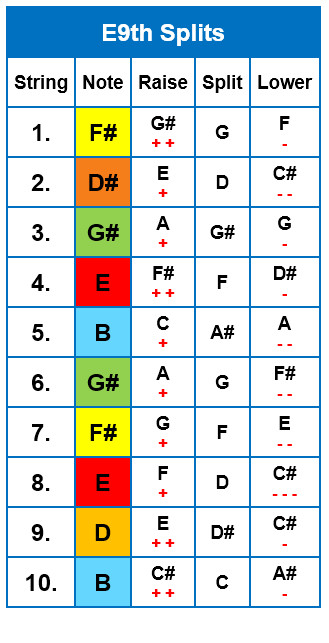
It allows you to raise and lower a string at the same time to get a note that isn't there naturally.
Example: Lower string 6 from G# to F#. Engage pedal B at the same time. The lower to F# on string 6 raises to G when you press the B pedal. This only works EASILY on an all-pull guitar. You need a split tuner to accomplish these changes accurately (barring any super luck without them). The reason being, when you tunes all these notes, the F# on string 6 will be flat. The tuning procedure is:
Using the "extra rod" method.
1. Tune string 6 open to G#.
2. Press the B pedal and tune it to A.
3. While still pressing the B pedal, activate the knee lever lowering string 6. You should now use the lowering nylon tuner to tune a G note.
4. Activate the lever that lowers string 6 only. You will probably notice that the F# note is flat. The extra rod is a raise rod. Use the nylon tuner on that rod to raise the pitch of the F# note so that it is in tune.
Example: Lower string 6 from G# to F#. Engage pedal B at the same time. The lower to F# on string 6 raises to G when you press the B pedal. This only works EASILY on an all-pull guitar. You need a split tuner to accomplish these changes accurately (barring any super luck without them). The reason being, when you tunes all these notes, the F# on string 6 will be flat. The tuning procedure is:
Using the "extra rod" method.
1. Tune string 6 open to G#.
2. Press the B pedal and tune it to A.
3. While still pressing the B pedal, activate the knee lever lowering string 6. You should now use the lowering nylon tuner to tune a G note.
4. Activate the lever that lowers string 6 only. You will probably notice that the F# note is flat. The extra rod is a raise rod. Use the nylon tuner on that rod to raise the pitch of the F# note so that it is in tune.
Carter D10 8p/7k, Dekley S10 3p/4k C6 setup, Regal RD40 Dobro (D tuning), Recording King Professional Dobro (G tuning), NV400, NV112, Ibanez Gio guitar, Epiphone SG Special (open G slide and regular G tuning guitar) .
Playing for 55 years and still counting.
Playing for 55 years and still counting.
-
Jack Stoner

- Posts: 22147
- Joined: 3 Dec 1999 1:01 am
- Location: Kansas City, MO
- State/Province: Kansas
- Country: United States
Along with the 6th string split mentioned, I have a split on the 5th string. My lower will lower the B string to Bb. The A pedal raises the B string to C# and with the split it lowers the 5th string to C.
An example of the 5th string B split, is with Pedals A and B mashed and the 5th string lower, pick strings 4,5,6 and that gives you a minor - open that would give you an A minor.
An example of the 5th string B split, is with Pedals A and B mashed and the 5th string lower, pick strings 4,5,6 and that gives you a minor - open that would give you an A minor.
-
Ian Rae

- Posts: 6182
- Joined: 10 Oct 2013 11:49 am
- Location: Redditch, England
- State/Province: -
- Country: United Kingdom
-
Jack Stoner
- Posts: 22147
- Joined: 3 Dec 1999 1:01 am
- Location: Kansas City, MO
- State/Province: Kansas
- Country: United States
-
Ian Rae
- Posts: 6182
- Joined: 10 Oct 2013 11:49 am
- Location: Redditch, England
- State/Province: -
- Country: United Kingdom
-
Charles Kurck

- Posts: 154
- Joined: 15 Mar 2010 1:14 pm
- Location: Living in Arkansas but Heaven is home
- State/Province: Kansas
- Country: United States
-
Richard Sinkler
- Posts: 17878
- Joined: 15 Aug 1998 12:01 am
- Location: Missoula
- State/Province: Montana
- Country: United States
I think because most of the time, you only hear of players splitting the 5th and 6th strings. But I agree, why not do all the strings.Ian Rae wrote:I have noticed that some guitars have maybe one or two screws, but while you're building, why not drill and tap the lot? You never know.
I have never owned a guitar with the split screws. My Carter and Mullen have the extra rods, and they work really good. But, I have not tried the screws.
Carter D10 8p/7k, Dekley S10 3p/4k C6 setup, Regal RD40 Dobro (D tuning), Recording King Professional Dobro (G tuning), NV400, NV112, Ibanez Gio guitar, Epiphone SG Special (open G slide and regular G tuning guitar) .
Playing for 55 years and still counting.
Playing for 55 years and still counting.
-
Georg Sørtun

- Posts: 3854
- Joined: 2 Jun 2009 9:12 am
- Location: Mandal, Agder, Norway
- State/Province: -
- Country: United States
"Max-lower stop screws" work fine, but they are kind of like a "one-trick pony" in that they can only limit max lower by holding back the finger, and thereby facilitate a split with a raise.
I prefer "split rods" – providing there is room for those I need in any given A-P PSG, as "split rods" do not limit our options to one max-lower adjustment pr string, rods can limit raises as well as lowers, and "split rods" can (if necessary) be set up to adjust the travel-curves for syncronised raises / lowers while defining the actual max raise/lower.
As having "max-lower stop screws" does not exclude "split rods" or other compensator rods, having it all is ideal
I prefer "split rods" – providing there is room for those I need in any given A-P PSG, as "split rods" do not limit our options to one max-lower adjustment pr string, rods can limit raises as well as lowers, and "split rods" can (if necessary) be set up to adjust the travel-curves for syncronised raises / lowers while defining the actual max raise/lower.
As having "max-lower stop screws" does not exclude "split rods" or other compensator rods, having it all is ideal
-
Pete Burak
- Posts: 6560
- Joined: 2 Oct 1998 12:01 am
- Location: Portland, OR USA
- State/Province: -
- Country: United States
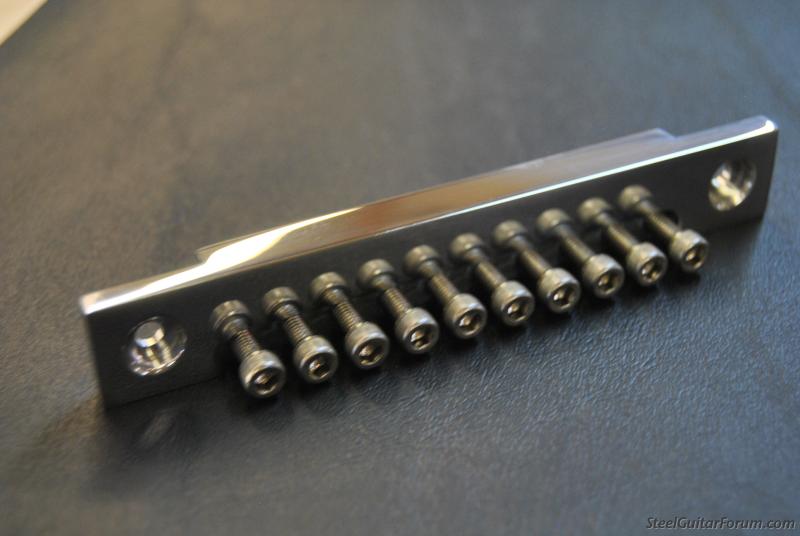
Sierra used to make an add-on thingee that instantly added a split-screw for a every string (I will add a pic tonight).
I saw some other after-market add-on split-screw units at the Dallas show, one I recall is made by Mullen.
Just an FYI if you have no split-screws and want split-screws.
Here is the Mullen one:
I saw some other after-market add-on split-screw units at the Dallas show, one I recall is made by Mullen.
Just an FYI if you have no split-screws and want split-screws.
Here is the Mullen one:
-
Ian Rae
- Posts: 6182
- Joined: 10 Oct 2013 11:49 am
- Location: Redditch, England
- State/Province: -
- Country: United Kingdom
Georg, what you say is very illuminating. I shall learn about extra rods as they would solve the problem on the uni where a string such as the middle G# has to perform two roles with two "max lowers".
Make sleeping dogs tell the truth!
Homebuilt keyless U12 7x5, Excel keyless U12 8x8, Williams keyless U12 7x8, Telonics rack and 15" cabs
Homebuilt keyless U12 7x5, Excel keyless U12 8x8, Williams keyless U12 7x8, Telonics rack and 15" cabs
-
Ken Byng

- Posts: 4329
- Joined: 19 Feb 2001 1:01 am
- Location: Southampton, England
- State/Province: -
- Country: United States
-
Ian Rae
- Posts: 6182
- Joined: 10 Oct 2013 11:49 am
- Location: Redditch, England
- State/Province: -
- Country: United Kingdom
Split screws have another disadvantage. The only practical place to put them is closer to the axle than the nearest raise, which makes the adjustment very sensitive. I have to readjust them more often than any of the pulls.
Make sleeping dogs tell the truth!
Homebuilt keyless U12 7x5, Excel keyless U12 8x8, Williams keyless U12 7x8, Telonics rack and 15" cabs
Homebuilt keyless U12 7x5, Excel keyless U12 8x8, Williams keyless U12 7x8, Telonics rack and 15" cabs
-
Dustin Rigsby

- Posts: 1470
- Joined: 20 Mar 2004 1:01 am
- Location: Parts Unknown, Ohio
- State/Province: Ohio
- Country: United States
-
Ian Rae
- Posts: 6182
- Joined: 10 Oct 2013 11:49 am
- Location: Redditch, England
- State/Province: -
- Country: United Kingdom
-
Mike Perlowin RIP
- Posts: 15171
- Joined: 4 Aug 1998 11:00 pm
- Location: Los Angeles CA
- State/Province: -
- Country: United States
I played without them for 25 years, but once I got them, it was like a whole new world of possibilities opened up.
I have 3, on my 4th, 5th, and 8th strings.
I have 3, on my 4th, 5th, and 8th strings.
Please visit my web site and Soundcloud page and listen to the music posted there.
http://www.mikeperlowin.com http://soundcloud.com/mike-perlowin
http://www.mikeperlowin.com http://soundcloud.com/mike-perlowin
-
Devon Breshears
- Posts: 3
- Joined: 15 Jul 2019 8:59 am
- Location: Idaho, USA
- State/Province: Idaho
- Country: United States
-
Ian Worley

- Posts: 2426
- Joined: 14 Jan 2012 12:02 pm
- Location: Sacramento, CA
- State/Province: California
- Country: United States
I think you're talking about a half-stop Devon, which is different than a split.
A half-stop is "feel" stop point at an intermediate note on a single knee lever, the D note in the case you mentioned.
A "split" refers to an intermediate note that is achieved by applying a separate raise and a lower simultaneously on the same string with two different knees or pedals. In most case the resulting intermediate note will end up a little flat. The split tuning methods discussed above correct/compensate for that.
A half-stop is "feel" stop point at an intermediate note on a single knee lever, the D note in the case you mentioned.
A "split" refers to an intermediate note that is achieved by applying a separate raise and a lower simultaneously on the same string with two different knees or pedals. In most case the resulting intermediate note will end up a little flat. The split tuning methods discussed above correct/compensate for that.
-
Richard Sinkler
- Posts: 17878
- Joined: 15 Aug 1998 12:01 am
- Location: Missoula
- State/Province: Montana
- Country: United States
Does your RKR also lower string 9 from D to C#? That nylon nut on string 9 is where you tune the the D note on the 2nd string. You adjust the nut on the 9th string to start pulling when the 2nd string is at the D note. Adding the resistance from the 9th string pull gives the "feel stop" at D.Devon Breshears wrote:I'm a newbie, I have a GFI UltraD10 that does not have a split screw mechanism. So, the extra rod would connect to which pedal/lever on the 2nd string for instance? The factory copedant list the RKR change as D/C#, is that where the extra rod should be placed?
Carter D10 8p/7k, Dekley S10 3p/4k C6 setup, Regal RD40 Dobro (D tuning), Recording King Professional Dobro (G tuning), NV400, NV112, Ibanez Gio guitar, Epiphone SG Special (open G slide and regular G tuning guitar) .
Playing for 55 years and still counting.
Playing for 55 years and still counting.
-
Devon Breshears
- Posts: 3
- Joined: 15 Jul 2019 8:59 am
- Location: Idaho, USA
- State/Province: Idaho
- Country: United States
YES! That makes so much sense the way you and Ian explained it. Thanks so much for help a new guy out!Richard Sinkler wrote: Does your RKR also lower string 9 from D to C#? That nylon nut on string 9 is where you tune the the D note on the 2nd string. You adjust the nut on the 9th string to start pulling when the 2nd string is at the D note. Adding the resistance from the 9th string pull gives the "feel stop" at D.
-
Gabriel Edell

- Posts: 144
- Joined: 9 Aug 2006 12:01 am
- Location: Hamilton, Ontario
- State/Province: -
- Country: United States
At the advice of the very helpful people here I added a split rod on the 6th string (G#) of my GFI Ultra S-10 a few months back. I ordered the part from Al Brisco and it wasn't too expensive. It took about 10 minutes to install and another 5 minutes to get it properly adjusted. I am definitely going to install some more.Devon Breshears wrote:I'm a newbie, I have a GFI UltraD10 that does not have a split screw mechanism. So, the extra rod would connect to which pedal/lever on the 2nd string for instance? The factory copedant list the RKR change as D/C#, is that where the extra rod should be placed?
GFI S-10 P U, Moyo Volume, Fender Steel King, Fender 5F4 Super-Amp
-
Ken Byng
- Posts: 4329
- Joined: 19 Feb 2001 1:01 am
- Location: Southampton, England
- State/Province: -
- Country: United States
Re: E9 splits
Bobbe Seymour reckoned that it was achievable although he never clarified how. At least on this forum.Kelcey ONeil wrote:Any one ever put splits on a push pull?
Show Pro D10 - amber (8+6), MSA D10 Legend XL Signature - redburst (9+6), Sho-Bud Pro 111 Custom (8+6), Emmons black Push-Pull D10 (8+5), Zum D10 (8x8), Hudson pedal resonator. Telonics TCA-500, Webb 614-E,
-
Kelcey ONeil

- Posts: 374
- Joined: 1 May 2018 11:42 am
- Location: Sevierville, TN
- State/Province: Tennessee
- Country: United States