On pages 50-51 are two musical exercises for right hand technique. The preceding lesson focuses on palm blocking, so that is where I went with the exercises initially. My questions are:
—Has anyone ever mapped out picking patterns for the exercises? The first one in particular is pretty straightforward at first, but then gets a little more complicated.
—Has anyone ever tried pick blocking them? The 2nd one, on page 51, seems custom made for it, as does the first part of page 50. Also, again, anyone tabbed it with picking patterns?
Winnie Book, Right Hand Technique - questions.
Moderator: Dave Mudgett
-
Fred Treece

- Posts: 4827
- Joined: 29 Dec 2015 3:15 pm
- Location: California, USA
- State/Province: California
- Country: United States
-
Fred Treece
- Posts: 4827
- Joined: 29 Dec 2015 3:15 pm
- Location: California, USA
- State/Province: California
- Country: United States
-
Jerry Jones

- Posts: 852
- Joined: 6 Sep 2007 4:26 pm
- Location: Franklin, Tenn.
- State/Province: -
- Country: United States
-
Joachim Kettner

- Posts: 7690
- Joined: 14 Apr 2009 1:57 pm
- Location: Germany
- State/Province: -
- Country: United States

-
Fred Treece
- Posts: 4827
- Joined: 29 Dec 2015 3:15 pm
- Location: California, USA
- State/Province: California
- Country: United States
Thanks, Joachim!
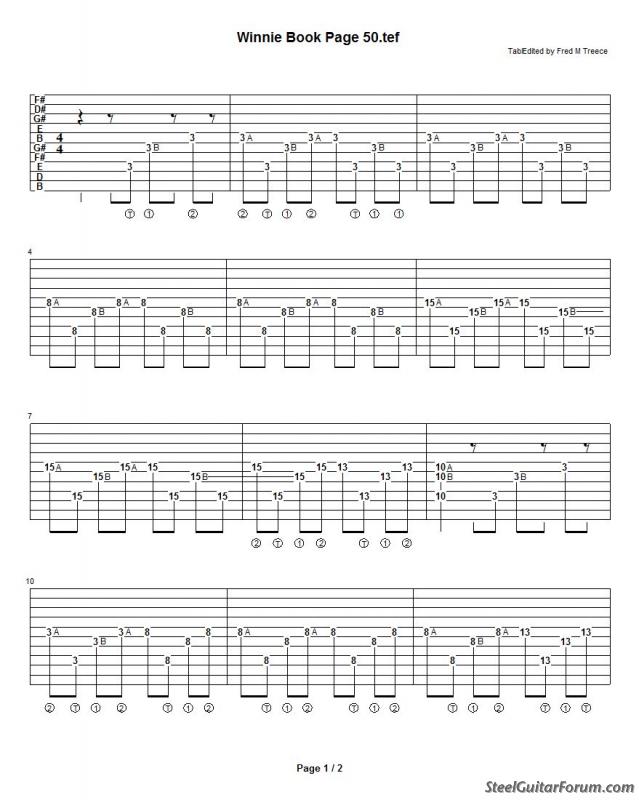
Here is my page 50 in TablEdit with RH fingering, which pretty much repeats the preceding pattern where I have not entered markings.
I couldn't figure out how to mark pedal releases and slides without mucking up the whole thing, so where there are no finger markings it is either a slide or pedal release. For example, in measure 2, the 3A -- 3 would be a pedal release.
Yep the markings are pretty dinky. Oh well. I hope it is fairly obvious where pick blocking would end and palm blocking would start. Any comments and suggestions would be appreciated.
 [/img]
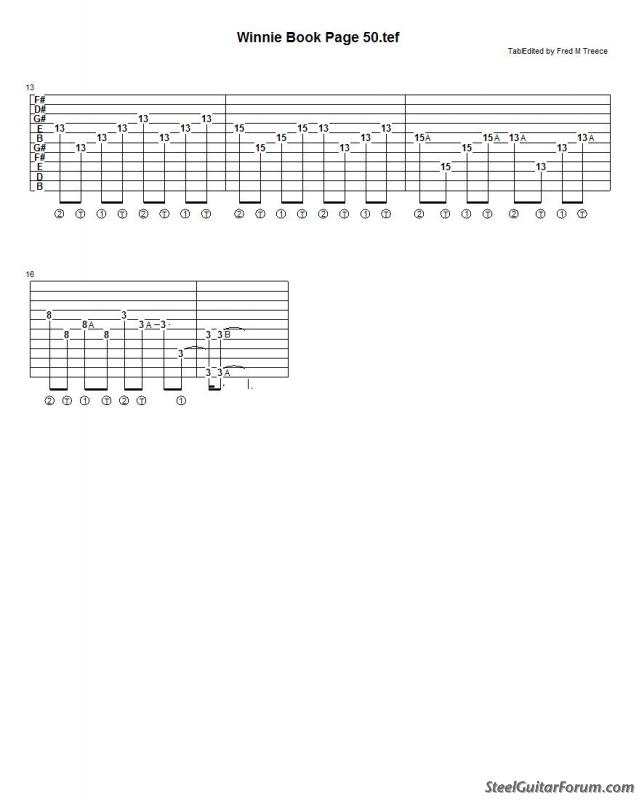
Here is my page 50 in TablEdit with RH fingering, which pretty much repeats the preceding pattern where I have not entered markings.
I couldn't figure out how to mark pedal releases and slides without mucking up the whole thing, so where there are no finger markings it is either a slide or pedal release. For example, in measure 2, the 3A -- 3 would be a pedal release.
Yep the markings are pretty dinky. Oh well. I hope it is fairly obvious where pick blocking would end and palm blocking would start. Any comments and suggestions would be appreciated.
[/img]-
Ian Rae

- Posts: 6182
- Joined: 10 Oct 2013 11:49 am
- Location: Redditch, England
- State/Province: -
- Country: United Kingdom
The chapter (which begins on p47) is about palm blocking and that is what the exercises are for. Finger blocking is not mentioned.
Incidently, as the book is still in print I'm not sure that it's legal to post images of it, regardless of whether other members have a copy or not. Get one! Much has been written since but it's still a classic. The thing to bear in mind is that it is a compendium of contemporary knowledge, not a systematic course of instruction. Many of the early examples are too hard for a beginner and need to be skipped and returned to later.
Incidently, as the book is still in print I'm not sure that it's legal to post images of it, regardless of whether other members have a copy or not. Get one! Much has been written since but it's still a classic. The thing to bear in mind is that it is a compendium of contemporary knowledge, not a systematic course of instruction. Many of the early examples are too hard for a beginner and need to be skipped and returned to later.
Make sleeping dogs tell the truth!
Homebuilt keyless U12 7x5, Excel keyless U12 8x8, Williams keyless U12 7x8, Telonics rack and 15" cabs
Homebuilt keyless U12 7x5, Excel keyless U12 8x8, Williams keyless U12 7x8, Telonics rack and 15" cabs
-
Fred Treece
- Posts: 4827
- Joined: 29 Dec 2015 3:15 pm
- Location: California, USA
- State/Province: California
- Country: United States
Thanks, Ian. I sure wish the compendium of contemporary knowledge would have included some fingerpicking markings! I believe I indicated an awareness of the lesson’s focus on palm blocking. The question was regarding whether anyone has attempted to finger block the exercises and which fingers to use to attack which strings.
-
Larry Bressington
- Posts: 2818
- Joined: 6 Jul 2006 12:01 am
- Location: Nebraska
- State/Province: Nebraska
- Country: United States
Most of those licks I believe would be played thumb middle thumb middle. Where 2 strings are picked at the same time, that would be thumb and middle together especially more so where there’s a string skip ( missing string 4) such as strings 3 and 5. I’m a nobody so I could be wrong but that seems the way I would go.
A.K.A Chappy.
-
Fred Treece
- Posts: 4827
- Joined: 29 Dec 2015 3:15 pm
- Location: California, USA
- State/Province: California
- Country: United States
Everybody here is somebody...A few of the somebodies have been here a long time and been playing since before Here existed. I did a search and found this:
https://steelguitarforum.com/Forum5/HTML/006587.html
Mr. Winston himself commented on that one.
Apparently there is no law against being able to do whatever kind of blocking gets the job done. I don’t believe it is a random thing though, and the circumstances of the music being played determine which right hand technique is more effective.
Picking styles seem to conform to one type of blocking or the other. Thumb + 1 finger for palm blocking and thumb + 2 fingers (or more) for finger blocking. With exceptions, no doubt - when playing chords, for example.
These two exercises in the book are so valuable! I knew that from the moment I started fumbling around with them. Yeah, they are basically a string of cliche licks. But both picking styles and a variety of blocking techniques can be applied effectively. And it feels good to have some cliches in my fingers.
Sorry for answering my own question. Sometimes you just gotta write it out and bounce it off other people’s heads. Thanks to all who have responded on this thread and to those who addressed it long before I ever thought about it.
https://steelguitarforum.com/Forum5/HTML/006587.html
Mr. Winston himself commented on that one.
Apparently there is no law against being able to do whatever kind of blocking gets the job done. I don’t believe it is a random thing though, and the circumstances of the music being played determine which right hand technique is more effective.
Picking styles seem to conform to one type of blocking or the other. Thumb + 1 finger for palm blocking and thumb + 2 fingers (or more) for finger blocking. With exceptions, no doubt - when playing chords, for example.
These two exercises in the book are so valuable! I knew that from the moment I started fumbling around with them. Yeah, they are basically a string of cliche licks. But both picking styles and a variety of blocking techniques can be applied effectively. And it feels good to have some cliches in my fingers.
Sorry for answering my own question. Sometimes you just gotta write it out and bounce it off other people’s heads. Thanks to all who have responded on this thread and to those who addressed it long before I ever thought about it.
-
Ian Rae
- Posts: 6182
- Joined: 10 Oct 2013 11:49 am
- Location: Redditch, England
- State/Province: -
- Country: United Kingdom
-
Ken Boi
- Posts: 279
- Joined: 6 Jul 2016 8:20 am
- Location: Arizona, USA
- State/Province: Arizona
- Country: United States
Not a lawyer here, but this posting may be acceptable under Copyright Fair Use:Ian Rae wrote:Incidently, as the book is still in print I'm not sure that it's legal to post images of it, regardless of whether other members have a copy or not.
https://citl.indiana.edu/teaching-resou ... -fair-use/
It may actually be a benefit to the book publisher as it can give some insight into the book's contents, which may in turn create a new buyer.
Just my $.02.
-
Joachim Kettner
- Posts: 7690
- Joined: 14 Apr 2009 1:57 pm
- Location: Germany
- State/Province: -
- Country: United States
I went through these two exercises and at first it was thumb, first and then second finger, just flat handed. I was glad that I was at the same tempo, but I hadn't blocked anything.
Then I alternated between thumb and second finger and I noticed that's the only way the edge of the right hand falls back on the string I just picked.
But if a few strings still ring? What the heck!
Then I alternated between thumb and second finger and I noticed that's the only way the edge of the right hand falls back on the string I just picked.
But if a few strings still ring? What the heck!
Fender Kingman, Sierra Crown D-10, Evans Amplifier, Soup Cube.
-
Fred Treece
- Posts: 4827
- Joined: 29 Dec 2015 3:15 pm
- Location: California, USA
- State/Province: California
- Country: United States
Joachim, when picking uptempo single note passages involving crossing over several strings, I have given myself an allowance to let one string ring while another is picked, at least until I get better at blocking. But, if more than one string is left ringing, the phrase starts sounding like minestrone soup. Sometimes I like the sound of several strings being picked consecutively and then left to ring together, but I want that to be intentional and not because I can’t block them.
Ken, yeah I think fair use applies here. It doesn’t hurt to be reminded of how to treat copyrighted material once in a while.
Ken, yeah I think fair use applies here. It doesn’t hurt to be reminded of how to treat copyrighted material once in a while.
-
Ian Rae
- Posts: 6182
- Joined: 10 Oct 2013 11:49 am
- Location: Redditch, England
- State/Province: -
- Country: United Kingdom
Ken, I'm not a lawyer either, nor an American! Your laws are probably different so I shall keep quiet. I agree that excerpts may well benefit sales and in this case I hope they do.
Make sleeping dogs tell the truth!
Homebuilt keyless U12 7x5, Excel keyless U12 8x8, Williams keyless U12 7x8, Telonics rack and 15" cabs
Homebuilt keyless U12 7x5, Excel keyless U12 8x8, Williams keyless U12 7x8, Telonics rack and 15" cabs
-
James Quillian

- Posts: 520
- Joined: 22 Nov 2011 7:39 pm
- Location: San Antonio, Texas, USA
- State/Province: Texas
- Country: United States
Most attorneys don't understand copyright law.Ken Boi wrote:Not a lawyer here, but this posting may be acceptable under Copyright Fair Use:Ian Rae wrote:Incidently, as the book is still in print I'm not sure that it's legal to post images of it, regardless of whether other members have a copy or not.
https://citl.indiana.edu/teaching-resou ... -fair-use/
It may actually be a benefit to the book publisher as it can give some insight into the book's contents, which may in turn create a new buyer.
Just my $.02.
Most importantly, to benefit from copyright law one must have a lot of money at stake. Even then it can take a lot of political clout.
When the copyright question comes up, just say this.
"Oh, I see, please cite the statute and section I am violating and tell me what case law applies. That will end the discussion close to 100% of the time."
Respecting copyrights is good manners.
I am not an attorney either but for the right price, I would be willing to play one in TV.
Curbside Jimmy's New Act
https://www.youtube.com/watch?v=XlzieFLE5no
https://www.youtube.com/watch?v=XlzieFLE5no
-
Fred Treece
- Posts: 4827
- Joined: 29 Dec 2015 3:15 pm
- Location: California, USA
- State/Province: California
- Country: United States

-
Daniel Morris

- Posts: 1335
- Joined: 30 Jun 2008 10:13 am
- Location: Westlake
- State/Province: Ohio
- Country: United States
Fred, I learned from Winnie Winston and Jeff Newman material, both of whom - at least back in the day - taught palm blocking. I used to think my occasional pick blocking (didn't know it was called that) might be incorrect, but I knew it worked.
I think perhaps it's best to learn both styles. There are some subtle distinctions, and it's possible that one doesn't always translate well to the other.
I believe a lot depends on what works best for you, as far as picking patterns go. There's the alternating finger and thumb, there's the all 3 - or 4 - finger approach. There's undoubtedly more thoughts on this than I'm aware of, but it seems you came up with a workable solution.
I think perhaps it's best to learn both styles. There are some subtle distinctions, and it's possible that one doesn't always translate well to the other.
I believe a lot depends on what works best for you, as far as picking patterns go. There's the alternating finger and thumb, there's the all 3 - or 4 - finger approach. There's undoubtedly more thoughts on this than I'm aware of, but it seems you came up with a workable solution.
1979 MSA U12 Pedal Steel
1982 Kline U12 Pedal steel
2019 Sierra U12 Pedal Steel
2011 Bear Creek MK Weissenborn
Milkman 40W Mini amp w/Telonics 15" speaker.
Dr. Z Surgical Steel w/TT 15" speaker.
Frenzel MB-50 head.
Effectrode, Empress, Eventide, Pigtronix.
1982 Kline U12 Pedal steel
2019 Sierra U12 Pedal Steel
2011 Bear Creek MK Weissenborn
Milkman 40W Mini amp w/Telonics 15" speaker.
Dr. Z Surgical Steel w/TT 15" speaker.
Frenzel MB-50 head.
Effectrode, Empress, Eventide, Pigtronix.
-
James Quillian
- Posts: 520
- Joined: 22 Nov 2011 7:39 pm
- Location: San Antonio, Texas, USA
- State/Province: Texas
- Country: United States
I am going to throw something out there about palm blocking.
There are somethings on an instrument that some struggle with but others do naturally.
As a person uses the right hand to pick with, the position of it slowly changes and the picking becomes more efficient. In a little time your palm may sit closer to the strings and you might start blocking naturally.
If this is like the first part of your practicing, my suggestion is to learn a few easy songs before learning something that might come along naturally.
When I started playing the steel, I discovered that I couldn't move my two first fingers without also moving my little finger. That is the kind of thing that happens when learning any instrument. Most people have a few imperfections. After that was corrected, I had no trouble palm blocking. It just happened without having to work on it. If something isn't working it is important to focus on the exact cause of the issue.
There are somethings on an instrument that some struggle with but others do naturally.
As a person uses the right hand to pick with, the position of it slowly changes and the picking becomes more efficient. In a little time your palm may sit closer to the strings and you might start blocking naturally.
If this is like the first part of your practicing, my suggestion is to learn a few easy songs before learning something that might come along naturally.
When I started playing the steel, I discovered that I couldn't move my two first fingers without also moving my little finger. That is the kind of thing that happens when learning any instrument. Most people have a few imperfections. After that was corrected, I had no trouble palm blocking. It just happened without having to work on it. If something isn't working it is important to focus on the exact cause of the issue.
Curbside Jimmy's New Act
https://www.youtube.com/watch?v=XlzieFLE5no
https://www.youtube.com/watch?v=XlzieFLE5no
-
Fred Treece
- Posts: 4827
- Joined: 29 Dec 2015 3:15 pm
- Location: California, USA
- State/Province: California
- Country: United States
Thank you James and Daniel. I have indeed noticed a difference in the way my hand positions itself for palm blocking over the last year and a half. Pick (or fingertip) blocking permits a position that feels much more natural to me and will probably become my default technique. But rather than assuming it can cover everything, I am becoming more familiar with the purpose of palm blocking. I learned about economy of movement in 45 years of playing guitar, and whatever gets the job done most efficiently for tone and accuracy is the right way.