How to use Nashville Notation for this minor song

Musical topics not directly related to steel guitar

Moderator: Dave Mudgett

Wolfgang Mrazek
Posts: 34
Joined: 20 Jan 2012 8:07 am
Location: Sweden

How to use Nashville Notation for this minor song

Post by Wolfgang Mrazek »

First of all ... I wish y'all A Happy New Year!

I started working with Nashville Notation about a year ago and still learning. So far, all songs have been in Major key but this one now is in Minor key...

It's "Boat on the river" by Styx. It has rather nice chord changes.

https://www.youtube.com/watch?v=K9Qs8-BkiLw


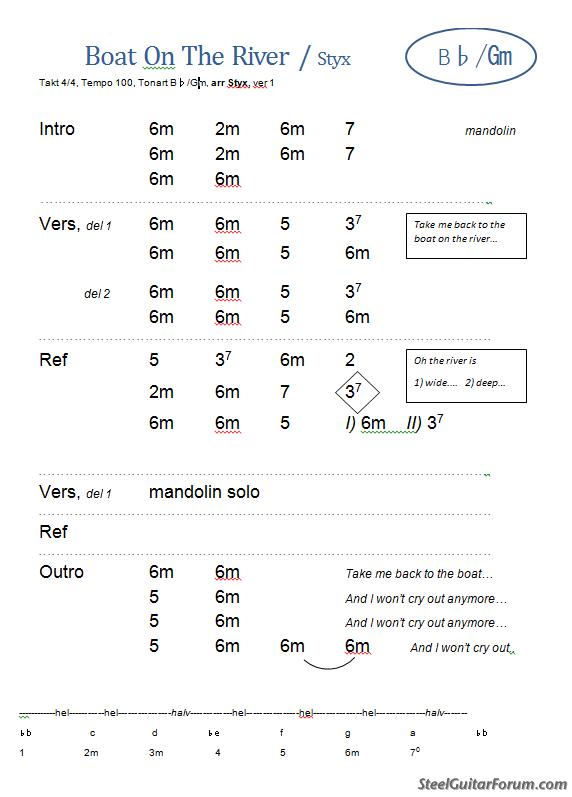
So I'm asking, does this make sense what I have written using Nashville Notation? Or would you rather go for the chords on songs like this? See below. The song is in Gm that has the relative key Bb. So I used Bb.


Here is the song with chords:

Image


Here is the song with my Nashville Notation:

Image


Regards,
Wolfgang
WBS 10 lefty
Bill C. Buntin
Posts: 1414
Joined: 14 Nov 2000 1:01 am
Location: Cleburne TX

Post by Bill C. Buntin »

In this case (Gm) is now the one chord. For which you apply the rules for that mode.

So it would be Gm = 1-, Cm = 4-, A = 2, F = 7b etc etc.
Skip Edwards
Posts: 3089
Joined: 1 Dec 1998 1:01 am
Location: LA,CA

Post by Skip Edwards »

Certain tunes are better written out in letters...this may be one of them.
It doesn't really go into a major section where the tonal relationship between the 1 and the 6m is apparent.
In this instance the minor sounds as the tonic, so my advice would be to just keep this one charted in letters.
User avatar
Herb Steiner
Posts: 12617
Joined: 4 Aug 1998 11:00 pm
Location: Briarcliff TX 78669, pop. 2,064

Post by Herb Steiner »

Skip Edwards wrote:Certain tunes are better written out in letters...this may be one of them.
It doesn't really go into a major section where the tonal relationship between the 1 and the 6m is apparent.
In this instance the minor sounds as the tonic, so my advice would be to just keep this one charted in letters.
What Skip said...

I asked Roy Rosetta which he preferred when getting charts for steel shows, and he generally preferred number charts, but when I brought up "All the Things You Are," which modulates keys about every 4 measures or so, he said "letters, definitely."
My rig: Infinity and Telonics.

Son, we live in a world with walls, and those walls have to be guarded by men with steel guitars. Who's gonna do it? You? You, Lt. Weinberg?
ajm
Posts: 1748
Joined: 13 Nov 1999 1:01 am
Location: Los Angeles

Post by ajm »

So maybe an unintended lesson from this topic is: If you get called to do a session, make sure you have a pen/pencil/Sharpie with you.

If you are given a chart written in one format, and you prefer it in the other format, you can quickly mark it up.

However, if they give you the chart written in "letter" format, and they decide to change keys, it could get messy. In that case, you'd be better off with the "number" format. That way you wouldn't need to mark it up.
Skip Edwards
Posts: 3089
Joined: 1 Dec 1998 1:01 am
Location: LA,CA

Post by Skip Edwards »

make sure you have a pen/pencil/Sharpie with you.
Reminds me of a story...
One time Tommy Tedesco - uber famous Wrecking Crew session guitarist for those who don't know - was asked for advice by a newbie player, hoping to break into the session scene.

His pearl of wisdom advice was... "bring a pencil"
User avatar
Herb Steiner
Posts: 12617
Joined: 4 Aug 1998 11:00 pm
Location: Briarcliff TX 78669, pop. 2,064

Post by Herb Steiner »

Skip Edwards wrote:
make sure you have a pen/pencil/Sharpie with you.
Reminds me of a story...
One time Tommy Tedesco - uber famous Wrecking Crew session guitarist for those who don't know - was asked for advice by a newbie player, hoping to break into the session scene.

His pearl of wisdom advice was... "bring a pencil"
The Tedesco story is legendary, and though TT probably meant as a joke I'll bet it was only partially tongue-in-cheek.

Dig it: If you were showing up for a construction project and didn't bring a hammer and tool belt and had to borrow one from the foreman, it would be very obvious to the contractor that you didn't completely have your sh!t together as a carpenter.

So yes, not having a pencil and embarrassingly have to borrow one can be a serious faux pas sometimes, especially if the contractor and/or session leader see it. Don't ask me how I know? When I was in my early 20's around 68-69 and trying to get session work in LA, through music biz friendships I got on two or three "real" sessions with guys like Tedesco, Dennis Budimir, Jim Gordon, Larry Knechtel, Earl Palmer, Max Bennett... that ilk. I was totally green and made some serious session mistakes that ended my playing with guys of that caliber, because I frankly was not ready at all to be working in that level of professionalism. Not bringing a notebook and pencil was actually one of my goofs, though not at a date that Tedesco was on.
My rig: Infinity and Telonics.

Son, we live in a world with walls, and those walls have to be guarded by men with steel guitars. Who's gonna do it? You? You, Lt. Weinberg?
Wolfgang Mrazek
Posts: 34
Joined: 20 Jan 2012 8:07 am
Location: Sweden

Post by Wolfgang Mrazek »

Tried it out today at rehearsal with the band. I preferred the "letters" although I am more used to "numbers". But now the singer wanted to change the key to Em...
WBS 10 lefty
User avatar
Charlie McDonald
Posts: 11065
Joined: 17 Feb 2005 1:01 am
Location: out of the blue

Post by Charlie McDonald »

That's the beauty of numbers.
I think it translates better if the song is noted in 1m, rather than as a relative minor
User avatar
Bryan Daste
Posts: 1403
Joined: 11 Jul 2005 12:01 am
Location: Portland, Oregon, USA

Post by Bryan Daste »

I would write this in numbers as you did, with the Gm as the 6-. But since the chords aren't necessarily super intuitive, I might pencil in a couple of clues along the way - for instance, the fourth chord is the 7 major, which is not very common, so I might just pencil a little "A" right over that. There are a few more candidates. Then if the key does get changed, you only have to change your little clues rather than rewrite everything.
User avatar
Michael Maddex
Posts: 1140
Joined: 18 Apr 2007 5:02 pm
Location: Northern New Mexico, USA

Post by Michael Maddex »

If I were to use the numbers, I would notate it in Gm, that is 'Gm = 1m' and so on as noted above. To notate a song in a Minor Key with numbers from a Major Scale (Gm = 6m) just doesn't make sense to me.
"For every expert, there is an equal and opposite expert." -- Arthur C. Clarke
Brint Hannay
Posts: 3957
Joined: 23 Dec 2005 1:01 am
Location: Maryland, USA

Post by Brint Hannay »

Personally, I have a hard time thinking of a song as "in Bb" when there is not a single Bb chord in it. It strikes me as counter-intuitive. The underlying assumption seems to be that there is no such thing as a minor key, which my ears tell me isn't so.

For my own purposes, I would assign numbers in this song relative to Gm being 1m, the tonic.
Last edited by Brint Hannay on 3 Jan 2018 10:06 am, edited 1 time in total.
Tucker Jackson
Posts: 1893
Joined: 8 Apr 2004 12:01 am
Location: Portland, Oregon, USA

Post by Tucker Jackson »

I've done it all three of the ways mentioned depending on which system 'fits' the song best: assuming the key is the relative major and then writing the tone center as 6m, writing it as a 1m, and just skipping numbers altogether. If the song is unusual, I'll write chords and numbers over them.

Check out this prior thread on this topic:

viewtopic.php?t=212215
Franklin wrote:Charting using the NNS......All numbers are major chords unless notated different, no exceptions.........

If the song is in E minor, most chart riders will use G major as the tonal center for the chart......Making the root chord a 6 minor......

Paul
Butch Gardner wrote:Chas Williams in his book The Nashville Number System states on page 12
"However, in Nashville, most of the time, for a song in a minor key, the chord chart will be written as if in the relative major key"...

Butch
If you're writing charts that only you see, I think you should use whatever is easiest for you to understand.
User avatar
Roger Rettig
Posts: 11162
Joined: 4 Aug 2000 12:01 am
Location: Naples, FL

Post by Roger Rettig »

I certainly see the value of the number system and it works best with simple chord structures. I still prefer the actual chord-symbols, though, even if it's a basic tune.

A easy a tune as, say, 'Back Home in Indiana' can be challenging if it's written in 'numbers' - there's that split-second where you're momentarily counting up or down the scale in your head! There's no room for doubt with the proper chord-symbol.
Roger Rettig: Emmons D10, B-bender Teles, Martins, and a Gibson Super 400!
----------------------------------
User avatar
Fred Treece
Posts: 4782
Joined: 29 Dec 2015 3:15 pm
Location: California, USA

Post by Fred Treece »

Yes it makes sense. I agree with others who have suggested Gm as the key and the tonic chord.

I worked with a singer who changed keys depending on the weather. Letter charts would have been useless for somebody who was subbing. Made doing background vocals interesting too. :?
Brint Hannay
Posts: 3957
Joined: 23 Dec 2005 1:01 am
Location: Maryland, USA

Post by Brint Hannay »

Herb Steiner wrote:I asked Roy Rosetta which he preferred when getting charts for steel shows, and he generally preferred number charts, but when I brought up "All the Things You Are," which modulates keys about every 4 measures or so, he said "letters, definitely."
I once amused myself by writing a chart for "All the Things You Are" using Nashville-type numbers, with each new key written above the staff, and chords for the short time in that key numbered for that key. My hat would be off to anyone who could sight-read off that chart.
Tucker Jackson
Posts: 1893
Joined: 8 Apr 2004 12:01 am
Location: Portland, Oregon, USA

Post by Tucker Jackson »

Right. Some songs don't lay as easily in a number system. The right tool for the job, and all that... I use numbers up until it doesn't make sense. I play with too many people who regularly change the key of a song, real-time, 5 seconds before downbeat, so... numbers are my first choice if the structure of the song will allow writing it that way. If not, no big deal. Chords work too.
Last edited by Tucker Jackson on 3 Jan 2018 10:13 am, edited 1 time in total.
User avatar
Roger Rettig
Posts: 11162
Joined: 4 Aug 2000 12:01 am
Location: Naples, FL

Post by Roger Rettig »

Exactly, Brint - that's where the method falls down. It works in theory but.....

:whoa:
Roger Rettig: Emmons D10, B-bender Teles, Martins, and a Gibson Super 400!
----------------------------------
Skip Edwards
Posts: 3089
Joined: 1 Dec 1998 1:01 am
Location: LA,CA

Post by Skip Edwards »

The convenience of using numbers for the sake of the chart is really only a perk of the number system. The real benefit is hearing the changes. There's no need to count up or down scale tones if your ears are trained to hear the numbers.

You could number the Styx song as a 1m, etc, but it's not going to be "ear-intuitive" throughout the body of the tune.
Franklin
Posts: 2172
Joined: 6 Feb 2000 1:01 am

Post by Franklin »

Wolfgang,
In numbers that song is an easier read as 6m.....You can omit the Gm at the top and just say Bb because the 6m in the chart to a musician seeing the chart for the first time is a Gm... Having two key signatures at the top is an indicater of a modulation.....
Paul Franklin
User avatar
Fred Treece
Posts: 4782
Joined: 29 Dec 2015 3:15 pm
Location: California, USA

Post by Fred Treece »

The End.
Franklin
Posts: 2172
Joined: 6 Feb 2000 1:01 am

Post by Franklin »

All The Things You Are
Key Ab
6m 2m 5 1

4 7dom 3 3

Key Eb
6m 2m 5 1

4 7dom 3 3

Key G
2m 5 1 1

7m 3 6 6

Key Ab
6m 2m 5 1

4 7b 1 3m/3bm

2m 5 1 3

Wolfgang,

I don't remember seeing anyone raise modulating Key Centers when charting with the number system....Thanks to Brint for raising a good point..Number charts written in single keys when songs are composed in multiple key signatures can be a nightmare to read....

I believe I serve myself best by staying with one system for simplicity of learning....I was never good at switching back and forth between numbers and letters. I see music as intervals (numbers) and since letters require transposing when singers change keys I chose numbers as the easier way for me.

A lot of shortcuts with the number system have evolved over decades....Often on more complicated songs the chordal centers change to keep it simple and easy to read. As I study music writing complicated songs in numbers using modulations helps me see where all the common 2/5/1's are found.
Numbers are the same as letters in this respect...To know the system I had to memorize where all the flats and sharps are located.

Paul
Wolfgang Mrazek
Posts: 34
Joined: 20 Jan 2012 8:07 am
Location: Sweden

Post by Wolfgang Mrazek »

Thanks for all your replies, it is a great help for me! As I said, the Nashville number system is new to me and I'm still learning by doing. And reading the posts here, and a good book: "The Nashville Number System" by Chas Williams.

It is such a powerful system. The numbers tell what function the chord have in the song. Arrangements, form, stops, etc. can be written in only one sheet of paper that gives a good overview.

I still haven't convinced the others in my band though, I'm trying...
WBS 10 lefty
Doug Hall
Posts: 97
Joined: 16 Aug 2015 6:32 am
Location: Alabama, USA

Which is better...

Post by Doug Hall »

Which is Better requires answering, For Whom? Best to ask them.
Mullen G2 SD10, Excel S10; Peavey 400s (LTD, Vegas, Session, and Renown); Nashville 112; etc...
User avatar
Fred Treece
Posts: 4782
Joined: 29 Dec 2015 3:15 pm
Location: California, USA

Re: Which is better...

Post by Fred Treece »

Doug Hall wrote:Which is Better requires answering, For Whom? Best to ask them.
It is for players who find it easier to think and sight read in terms of intervals rather than letters of the alphabet. Another off-topic tangential question might be for what song.

Obviously it works great for any tune with diatonic chord changes from start to finish. Things get a little more complicated in a tune like All The Things You Are, or name-your-favorite-harmonic-minor-Brazilian-standard with mile-long chord extensions. Once you have the basic understanding of the system though, it can be extrapolated pretty far out there.