Quickest and proper way to restring a pedal steel
Moderator: Dave Mudgett
-
Scott McRee
- Posts: 422
- Joined: 10 Apr 2013 12:26 pm
- Location: Georgia, USA
- State/Province: Georgia
- Country: United States
Quickest and proper way to restring a pedal steel
Can someone post a video on they're technique of restringing they're steel? Thanks
-
Jack Stoner

- Posts: 22147
- Joined: 3 Dec 1999 1:01 am
- Location: Kansas City, MO
- State/Province: Kansas
- Country: United States
-
Tucker Jackson
- Posts: 1939
- Joined: 8 Apr 2004 12:01 am
- Location: Portland, Oregon, USA
- State/Province: Oregon
- Country: United States
There's a link on the old Carter resource guide that had a slideshow on how to do a string change. Poke around on this site:
https://www.steelguitar.com/strings.html
Good luck.
https://www.steelguitar.com/strings.html
Good luck.
-
John Sluszny
- Posts: 2308
- Joined: 9 Apr 2001 12:01 am
- Location: Brussels, Belgium
- State/Province: -
- Country: Belgium
Yes,good luck !!!Tucker Jackson wrote:There's a link on the old Carter resource guide that had a slideshow on how to do a string change. Poke around on this site:
https://www.steelguitar.com/strings.html
Good luck.
-
Bo Borland

- Posts: 4023
- Joined: 20 Dec 1999 1:01 am
- Location: South Jersey -
- State/Province: -
- Country: United States
Tuckers' link above is great .. the only thing I didn't agree with was overlapping to line up the strings
Photo 11 is how they should look on the post , not the overlapped photo # 14
Depending on how YOUR machines line up with the roller nuts.. you may have to wrap to the outside instead of the inside
Photo 11 is how they should look on the post , not the overlapped photo # 14
Depending on how YOUR machines line up with the roller nuts.. you may have to wrap to the outside instead of the inside
-
Scott McRee
- Posts: 422
- Joined: 10 Apr 2013 12:26 pm
- Location: Georgia, USA
- State/Province: Georgia
- Country: United States
Video
Anyone have any techniques that make it quicker? Also, anyone want to make a video and put it on YouTube? There is only one video. It's pathetic that we only have one video of restringing a stee. There is a million for other instruments
-
Allan Kelly

- Posts: 37
- Joined: 21 Jun 2005 12:01 am
- Location: Watford, United Kingdom
- State/Province: -
- Country: United States
-
Patrick Laffrat

- Posts: 186
- Joined: 3 Jan 2006 1:01 am
- Location: Gemenos, France
- State/Province: -
- Country: United States
you can try this way, but it is not absolutely necessary to sing during the operation. 
https://www.youtube.com/watch?v=jbYxmzJkrLE
https://www.youtube.com/watch?v=jbYxmzJkrLE
-
David Nugent
- Posts: 4905
- Joined: 2 Nov 2001 1:01 am
- Location: Gum Spring, Va.
- State/Province: -
- Country: United States
Scott...In the video, he is shown restringing a Magnum which features the slotted fingers. This method does not work as well if your guitar has the pins for holding the ball as it has a tendency to pop off the pin if constant pressure is not exerted. I normally measure and precut the string prior to beginning the process using the two tuner rule illustrated (for wound strings, 1 1/2 should be sufficient, otherwise there may not be ample space on the post). I first attach the string to the tuner post, make one turn to hold it in place, then gently bend the ball end around the tip of my finger to facillitate attaching the ball to the pin (or slot). FWIW: I find it easier when changing the entire set to install strings one through five, and then ten through six in that order. Working the final five strings toward me while leaving the space open between seems to leave more room for my rather large fingers to work.
-
John McClung

- Posts: 5165
- Joined: 4 Aug 1998 11:00 pm
- Location: Olympia WA, USA
- State/Province: -
- Country: United States
Scott, that Carter video by John Fabian is poor in image quality, and that method of how to measure and cut the string to the proper length was a bit murky to me, but it's something I'll try to master someday.
And to protect the tuning keys cavity lacquer, get some thin vinyl or plexiglass (clear or any color you like), measure and cut to shape and put it in there to protect your Williams' finish.
And to protect the tuning keys cavity lacquer, get some thin vinyl or plexiglass (clear or any color you like), measure and cut to shape and put it in there to protect your Williams' finish.
E9 INSTRUCTION
 If you want to have an ongoing discussion, please email me, don't use the Forum messaging which I detest! steelguitarlessons@earthlink.net
 If you want to have an ongoing discussion, please email me, don't use the Forum messaging which I detest! steelguitarlessons@earthlink.net
-
John Sluszny
- Posts: 2308
- Joined: 9 Apr 2001 12:01 am
- Location: Brussels, Belgium
- State/Province: -
- Country: Belgium
-
Ian Rae

- Posts: 6182
- Joined: 10 Oct 2013 11:49 am
- Location: Redditch, England
- State/Province: -
- Country: United Kingdom
-
Ian Worley

- Posts: 2426
- Joined: 14 Jan 2012 12:02 pm
- Location: Sacramento, CA
- State/Province: California
- Country: United States
-
Tom Quinn

- Posts: 2755
- Joined: 4 Aug 1998 11:00 pm
- State/Province: -
- Country: United States
-
Bill Moore (RIP)
- Posts: 2116
- Joined: 5 Jun 2000 12:01 am
- Location: Manchester, Michigan
- State/Province: Michigan
- Country: United States
Changing strings is something that gets easier the more you do it. I think it's best to take your time at first, you don't need to change all 10 strings at once, just do a couple at a time. Make sure the plain strings have a good number or wraps on the tuner, and try to wind them so they are well aligned with the roller. Don't wind a full length string, cut it to the right length before winding. And bend the end with pliers, make it short so it won't scratch up the finish as it turns. Just take your time and pay attention to what you are doing, it will get easier.
-
Bob Hoffnar

- Posts: 9502
- Joined: 4 Aug 1998 11:00 pm
- Location: Austin, Tx
- State/Province: Texas
- Country: United States
Re: Video
I use a string winder that connects to a power drill. Speeds it up quite a bit. Also I see no reason to add plastic to the head stock. All you need to do is not push the string to far through the tuning key.Scott McRee wrote:Anyone have any techniques that make it quicker? Also, anyone want to make a video and put it on YouTube? There is only one video. It's pathetic that we only have one video of restringing a stee. There is a million for other instruments
I take all the strings off so I can clean up my steel easily. Although if you change one at a time you will have a handy visual reference of what direction the string goes.
If your steel has pins holding the string instead of a slot in the bridge stick something handy in there to hold the string on while you tighten it.
After doing it a couple times you will see how simple it is and why there is no need for a video. If you are into videos you could make an in depth study of the million videos of guitar players changing there strings then apply those principals to your steel. After you have mastered string changing you could make the ultimate video for us.
Bob
-
Jim Pitman
- Posts: 2049
- Joined: 29 Aug 1998 12:01 am
- Location: Waterbury Ctr. VT 05677 USA
- State/Province: -
- Country: United States
I like to use a wooden wedge cut from 3/8" thick hardwood flat stock to trap the ball end of the string at the changer. My wedge is made from oak. It's about 2" long and pointy at one end while the other end is about 3/8" across. (square in cross section at this end). I could envision one made from hard rubber.
I push it in, pointy end down, behind the current finger and the neck end piece, in that cavity that always exist in every PSG. Trapping that end means you can use both hands on the key head end of the string without worring about the changer end coming off.
I use one of my manual (cordless/battery-less) string winders to speed up the key head end. It's fast, never fails, and never runs out of juice.
I push it in, pointy end down, behind the current finger and the neck end piece, in that cavity that always exist in every PSG. Trapping that end means you can use both hands on the key head end of the string without worring about the changer end coming off.
I use one of my manual (cordless/battery-less) string winders to speed up the key head end. It's fast, never fails, and never runs out of juice.
-
Jeff Mead

- Posts: 1712
- Joined: 15 Jun 2006 12:01 am
- Location: London, England
- State/Province: -
- Country: United States
I use a rubber wedge like this. They are sold as a tool that piano tuners use. They are called Piano Tuning Mutes or Mute Keys.Jim Pitman wrote:I like to use a wooden wedge cut from 3/8" thick hardwood flat stock to trap the ball end of the string at the changer. My wedge is made from oak. It's about 2" long and pointy at one end while the other end is about 3/8" across. (square in cross section at this end). I could envision one made from hard rubber.
-
Steve Vroman
- Posts: 42
- Joined: 31 Jul 2015 8:15 am
- Location: Albany, NY
- State/Province: New York
- Country: United States
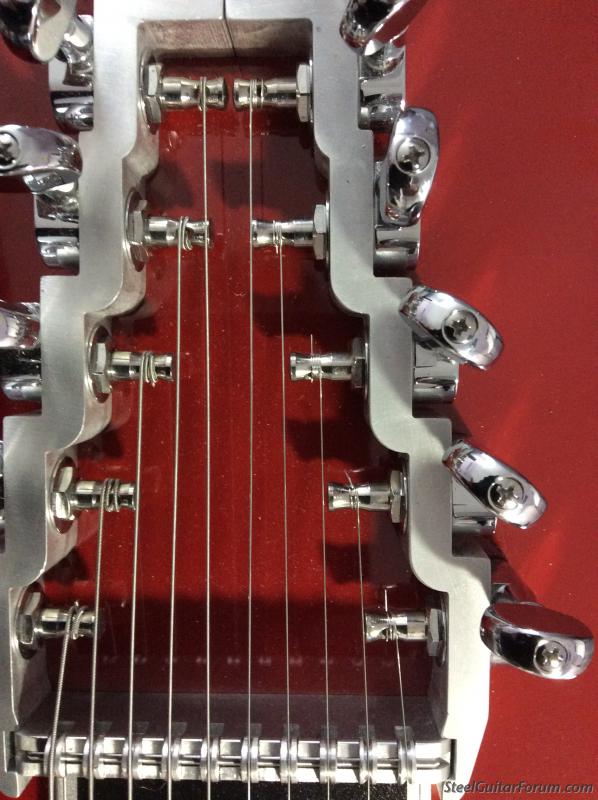
Just completed my first string change on my Stage 1. I was kind of nervous but I just worked slowly and changed one string at a time. Could be a little straighter off the roller but I'm pleased overall. I went with LiveSteel strings and pretty much stuck with the same gauges as Doug set it up. I did bump up the third string to a .0115 and that seems to work for me. My initial impression of these strings is great, maybe a little more girth than the GHS. I really like how the sound decays too, if that's the right word for it
Much thanks to Doug for building me such a nice guitar and to the forum for all the good info. I've only been playing about six months but it's been great fun
Much thanks to Doug for building me such a nice guitar and to the forum for all the good info. I've only been playing about six months but it's been great fun
-
Ian Rae
- Posts: 6182
- Joined: 10 Oct 2013 11:49 am
- Location: Redditch, England
- State/Province: -
- Country: United Kingdom
Steve, that's a tidy job but I wonder how many folk would prefer to see more turns round the posts, especially on the plain strings. I put at least half a dozen. I may be paranoid, but I've never had one break that end.
Make sleeping dogs tell the truth!
Homebuilt keyless U12 7x5, Excel keyless U12 8x8, Williams keyless U12 7x8, Telonics rack and 15" cabs
Homebuilt keyless U12 7x5, Excel keyless U12 8x8, Williams keyless U12 7x8, Telonics rack and 15" cabs
-
Tucker Jackson
- Posts: 1939
- Joined: 8 Apr 2004 12:01 am
- Location: Portland, Oregon, USA
- State/Province: Oregon
- Country: United States
Ian, you just beat me to it.
Steve, you did a nice clean job. You might want to cut those strings just slightly longer before installing next time. What you have should work OK for now, but that sixth string is over the hole -- meaning it might take some unnecessary wear if there is a burr around the lip of the hole. On thinner strings especially, this can sometimes be the cause of breakage at the keyhead end.
Also, as Ian pointed out, the thinner strings want more turns than the thicker ones. The first string is probably OK, but you might have slippage if you use the raise lever a lot. Probably not, but a couple more wraps next time will remove all doubt. You're good for now -- nice and straight over the roller nut...now go play that awesome guitar!
Steve, you did a nice clean job. You might want to cut those strings just slightly longer before installing next time. What you have should work OK for now, but that sixth string is over the hole -- meaning it might take some unnecessary wear if there is a burr around the lip of the hole. On thinner strings especially, this can sometimes be the cause of breakage at the keyhead end.
Also, as Ian pointed out, the thinner strings want more turns than the thicker ones. The first string is probably OK, but you might have slippage if you use the raise lever a lot. Probably not, but a couple more wraps next time will remove all doubt. You're good for now -- nice and straight over the roller nut...now go play that awesome guitar!
Last edited by Tucker Jackson on 15 Jan 2016 12:15 pm, edited 1 time in total.
-
Steve Vroman
- Posts: 42
- Joined: 31 Jul 2015 8:15 am
- Location: Albany, NY
- State/Province: New York
- Country: United States