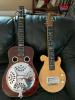
A guy dropped this off to me to make it playable. I think I can do that, but I just wonder how old it is, or if anyone can tell me anything about the cone? I think the cone is in wrong...and nailed in...wow!
Here it is:
RICK ABBOTT
Sho~Bud D-10 Professional #7962
Remington T-8, Sehy #112
1975 Peavey Pacer 1963 Gibson Falcon
The lug cone and spider is pre-war Regal made Dobro, to me. The cones were indeed tacked in with two nails, at least mine was - and I was the first person to take the cone out from new, I know that for a fact. Solid headstock puts it late 1930's (1937 on) for me, Chicago made, as does the cover plate. The positioning of the spider on the lug cone is correct, the spider legs do not sit on the lugs. There were some "licensed" guitars made in the later 1930's that got the height of the cone rim wrong, hence the normal #14 spider (which is what you have) would not fit, so they made the lug cone and a short spider were the legs did fit on the lugs, and so the whole affair sat lower in the guitar, solved the problem.
It would be nice to see the soundwell and the neck bracing, if any. My 1936 Model 25 has the same spider and cone, same coverplate, but a dovetail neck and no soundwell.
Edit; Lack of serial number is very common in the mid-late 1930's Regal made Dobro's. I think I see four tail piece mounting screws and a fade mark on the top where the tail piece bars would have been, that means it had what I call a "bar" tailpiece and not the more typical stamped and arched fan tailpiece. Also it looks to be a deep body - Regal made bodies were 3 1/4" near the neck and 3 1/2" deep near the tail. California made bodies were 2 7/8" and 3 1/4".
Brian
Last edited by Brian Evans on 30 Jul 2015 5:49 am, edited 1 time in total.
this is cut and paste from the excellent Randy Getz article on the history of the pre-war Dobro. I only have it as a word document, I lost the link.
PEGHEADS
All pegheads on California-built guitars were slotted. On early models (until about 1934), the slots were cut with a special saw, which produced a squared-end in the slot. Upon merger with National and the subsequent move to a single building, this saw became misplaced (or discarded) and from that time all California-built guitars had routed slots which penetrated the peghead at an angle and had rounded ends. Regal-produced guitars also had routed slots. These slots, however, were slightly wider than those on California-built guitars and went straight through the peghead. They are, therefore, easily identifiable. The solid peghead did not appear until late in 1937, by which time all final production had been shifted to Chicago. Solid pegheads appear to have only been used on Chicago-built, Model 37 and Model 45 guitars. Many solid pegheads had sleeves where the tuning post penetrated the peghead, while others were produced without these sleeves
Another bit on the tail piece confirms that only Regal made instruments had the bar, or trapeze tail piece.
Another bit confirms that the three little round holes were beveled on the CA made guitars, and have square edges on the Regal made instruments.
So you most likely have a Model 37 or a Model 45. If the binding is single ply, it is a model 37, if the binding is three ply it's a model 45, per Getz. It may have been refinished, but the Model 45 had a natural finish three ply top, with the top ply spruce, and I would say yours looks exactly like that. Model 45 with solid peghead were built in Chicago from late 1937 to end of production in 1941.
Fun to explore this stuff, I enjoyed the hunt!
Edit: I see in the first picture that the top binding is three ply, I think we have a winner!
Brian
Last edited by Brian Evans on 30 Jul 2015 6:18 am, edited 3 times in total.
Howard, when I got my pre-war dobro I totally went to town trying to learn what it was and when it was made. It turns out to be a Chicago made by Regal Dobro Model 25 or 27 made from 1935 to around 1937, round neck. I find this stuff far too fascinating.
Location: Sonoma County in The Great State Of Northern California
State/Province: California
Country: United States
Postby Mark Eaton »
This guitar appears to be an early Regal built Model 45 from around 1933-1935. But - there were some square shoulder Regal built 45s in the late '30s, but by then it seems many of the guitars had spun cones as opposed to lug cone.
- The "square shoulders" are typically a transition from the Calif. built Dobros to the Chicago built Regals.
- the lack of a serial number is typically a "Regal thing" as is the solid headstock.
- the lug cone doesn't automatically make it a Regal, I have an early '30s Calif. built Dobro with a lug cone.
Kudos to Randy Getz for his fine article which has been of great use over the years, but I obtained some of my information beginning on page 120 of Steve Toth's excellent Dobro Roots: A Photo Tour of Prewar Wood Body Dobros which was published in 2014. Anyone with an interest in old Dobros will enjoy this book.
First time I've been able to use this phrase in awhile: another example of the convoluted history of the Dobro.
But Steve's book has made things less convoluted than they used to be.
Last edited by Mark Eaton on 30 Jul 2015 9:11 am, edited 6 times in total.
All pegheads on California-built guitars were slotted. On early models (until about 1934)...... The solid peghead did not appear until late in 1937, by which time all final production had been shifted to Chicago. Solid pegheads appear to have only been used on Chicago-built, Model 37 and Model 45 guitars. Many solid pegheads had sleeves where the tuning post penetrated the peghead, while others were produced without these sleeves
This sounds pretty definitive.
I'm looking forward to getting it back together. Any advice about string gauges? I will put GBDGBD on it.
RICK ABBOTT
Sho~Bud D-10 Professional #7962
Remington T-8, Sehy #112
1975 Peavey Pacer 1963 Gibson Falcon