Adjustable Roller Nut
Moderator: Dave Mudgett
-
David Doggett

- Posts: 8088
- Joined: 20 Aug 2002 12:01 am
- Location: Bawl'mer, MD (formerly of MS, Nawluns, Gnashville, Knocksville, Lost Angeles, Bahsten. and Philly)
- State/Province: -
- Country: United States
Well, yes, adjustable nut rollers would solve the problem, if they don't adversely affect tone. But it seems like overkill to me. I agree many manufacturers are not responsive on this problem. But it would be way easier for them to make or buy rollers in a variety of gauges in large quantities. I agree it is not a trivial problem for an individual player. But for a manufacturer to put in a stock of a variety of sizes would seem to be a lot easier for them than designing and making adjustable rollers.
-
C Dixon
- Posts: 7348
- Joined: 4 Aug 1998 11:00 pm
- Location: Duluth, GA USA
- State/Province: -
- Country: United States
Over the past 20 yrs, I have had a number of "gauged" nut rollers sent to me by Emmons, Sierra and Excel.
I am sad to say that NOT one; I repeat not one; resulted in the absence of string rattle at the lower frets. In fact, in EVERY case some strings were low enough at the first fret, that it took considerable bar pressure for the bar to meet the string.
Requesting 2nd, 3rd and even a 4th set, resulted in the SAME scenario, only the low strings were never the same one. And I used the exact same gauge strings in all examples.
Lamenting over this on the forum many years ago, 3 different forumites and a 4th individual who I was referred to offered at NO cost to me to make me a set of gauged nut rollers that would result in 100% co-planar strings.
One of these persons worked with me for over a year. And continued to send me ever slightly plus or minus individually gauged nut rollers. Same problem
The last individual designed what I thought would be THE answer. It was one of the cleverest machining adaptors I had ever seen for getting the problem solved.
Sadly this too was unable to stop the scenario mentioned above.
So for whatever it is worth, and at least in my case, "gauged nut rollers" are NOT the answer. The reason I am not sure. But I have had enough experience with it now, that it is just not the answer from where I sit.
All of these gentleman were, gracious, kind and tried desperately to make me a set that would solve the problem. But it didn't I am sorry to say.
NOTHING will ever make me believe that anything other than adjustable nut rollers is the answer. With one caveat:
If the adjustment must be done from the bottom of the guitar, I feel that is still not the answer ultimately.
My dream and my prayer is that before I die, I will live to see the day that ALL PSG manufactures solve this inimatable problem once and for all. I go on record stating again and again, that they SHOULD have tackled this problem head-on, years ago and solved the problem, once and for all. I stand on that.
carl
I am sad to say that NOT one; I repeat not one; resulted in the absence of string rattle at the lower frets. In fact, in EVERY case some strings were low enough at the first fret, that it took considerable bar pressure for the bar to meet the string.
Requesting 2nd, 3rd and even a 4th set, resulted in the SAME scenario, only the low strings were never the same one. And I used the exact same gauge strings in all examples.
Lamenting over this on the forum many years ago, 3 different forumites and a 4th individual who I was referred to offered at NO cost to me to make me a set of gauged nut rollers that would result in 100% co-planar strings.
One of these persons worked with me for over a year. And continued to send me ever slightly plus or minus individually gauged nut rollers. Same problem
The last individual designed what I thought would be THE answer. It was one of the cleverest machining adaptors I had ever seen for getting the problem solved.
Sadly this too was unable to stop the scenario mentioned above.
So for whatever it is worth, and at least in my case, "gauged nut rollers" are NOT the answer. The reason I am not sure. But I have had enough experience with it now, that it is just not the answer from where I sit.
All of these gentleman were, gracious, kind and tried desperately to make me a set that would solve the problem. But it didn't I am sorry to say.
NOTHING will ever make me believe that anything other than adjustable nut rollers is the answer. With one caveat:
If the adjustment must be done from the bottom of the guitar, I feel that is still not the answer ultimately.
My dream and my prayer is that before I die, I will live to see the day that ALL PSG manufactures solve this inimatable problem once and for all. I go on record stating again and again, that they SHOULD have tackled this problem head-on, years ago and solved the problem, once and for all. I stand on that.
carl
A broken heart + † = a new heart.
-
Danny James
- Posts: 694
- Joined: 3 May 2004 12:01 am
- Location: Summerfield Florida USA
- State/Province: Florida
- Country: United States
Carl my friend,
First I want to say it's nice to see you back on the Forum. We have missed you. I respect your experience and knowledge on steel guitars and really enjoy reading your posts.
However I gotta tell you on my own lapsteel that I designed & built with a 4 tuning changer in it, I needed roller nuts so I successfully made gauged rollers that work fine. It is not all that hard to make them with the technique I used. Anyone with a small lathe and a set of micrometers and a little machining knowledge should have no trouble making them. Just my two cents worth and MHO.
There are only two reasons I can think of why in certain instances that they might not work on someones guitar. That would be the roller shaft not being straight or the strings varying in diameter from one set to the next from the factory. Neither one seems logical to me.
I will be glad to explain how I do it if anyone is interested. It's really quite simple. Actually I think back when we discussed this some time ago, I did explain it. Can't remember when that was exactly. --- Maybe someone else will.
God bless,
Danny
First I want to say it's nice to see you back on the Forum. We have missed you. I respect your experience and knowledge on steel guitars and really enjoy reading your posts.
However I gotta tell you on my own lapsteel that I designed & built with a 4 tuning changer in it, I needed roller nuts so I successfully made gauged rollers that work fine. It is not all that hard to make them with the technique I used. Anyone with a small lathe and a set of micrometers and a little machining knowledge should have no trouble making them. Just my two cents worth and MHO.
There are only two reasons I can think of why in certain instances that they might not work on someones guitar. That would be the roller shaft not being straight or the strings varying in diameter from one set to the next from the factory. Neither one seems logical to me.
I will be glad to explain how I do it if anyone is interested. It's really quite simple. Actually I think back when we discussed this some time ago, I did explain it. Can't remember when that was exactly.
--- Maybe someone else will. God bless,
Danny
-
Jim Palenscar
- Posts: 6031
- Joined: 4 Aug 1998 11:00 pm
- Location: Oceanside, Calif, USA
- State/Province: -
- Country: United States
-
C Dixon
- Posts: 7348
- Joined: 4 Aug 1998 11:00 pm
- Location: Duluth, GA USA
- State/Province: -
- Country: United States
HI Danny,
Forgive me, but of late I have difficulty sometimes with short term memory. But it seems that you sent me one (or more) sets of "gauged nut rollers". But maybe it was not you. I know that 4 different people did over a 3 yr period.
And what you say, is very similar to what they all said. "It is is very easy to do it........" Or words to that affect.
NO disrespect whatsoever dear person, but the fact that neither Emmons, Sierra, nor Excel was able to send me a single set out of many, that was even close to 100%; coupled with the repeated threads on this subject since the day the SGF began; tells me that it is not that easy.
For IF it was, how come sooooooo many players complain about it? How come not one single set from any of the above builders OR a single set of any one of those who said, "I will send you a set that will be perfectly flat, was able to deliver.
In other words, I want strings that allow the bar to make contact with EVERY string at the first fret with only a moderate amount of bar pressure.
All 3 of the builders above NEW my string gauges. All 4 of the individuals I worked with NEW my string gauges. And ALL sent me new roller axle rods with the sets.
After this, I realized something. EVERY string manufacturer works with "tolerances". This means that if a given string is even 1/10,000's of inch + or - from its stated gauge, the bar will NOT contact that string, assuming all the other strings are dead on. Which they won't be.
So what you have is this. EVERY string set made will NOT be dead on to their respective gauges. This means; that IF per chance you ended up with a given set of "gauged nut rollers" that DID provide 100% co-planar strings at the nut on a given set of strings; the VERY next set of strings would CAUSE the aforementioned problem. The only remedy I see for this malady; when it comes to "gauged rollers; is for EVERY set of strings to include a set of rollers WITH axle rod; machined to THAT set.
Which would be impractical.
This is why, I maintain now, the ONLY true remedy for the problem is adjustable nut rollers. Further, if they cannot be adjusted from the top, little will be achieved.
Again, please friend, I am not trying to be argumentative or disrespectful, etc. It is simply that too much water has gone over the dam. I spent untold hours changing these rollers. On a keyless guitar this is NOT easy, since once the strings are cut off, you have restricted slackening ability, unlike when the strings are attached with keys.
But thanks for posting and thanks for the kind words.
May Jesus bless you dear friend,
c.
Forgive me, but of late I have difficulty sometimes with short term memory. But it seems that you sent me one (or more) sets of "gauged nut rollers". But maybe it was not you. I know that 4 different people did over a 3 yr period.
And what you say, is very similar to what they all said. "It is is very easy to do it........" Or words to that affect.
NO disrespect whatsoever dear person, but the fact that neither Emmons, Sierra, nor Excel was able to send me a single set out of many, that was even close to 100%; coupled with the repeated threads on this subject since the day the SGF began; tells me that it is not that easy.
For IF it was, how come sooooooo many players complain about it? How come not one single set from any of the above builders OR a single set of any one of those who said, "I will send you a set that will be perfectly flat, was able to deliver.
In other words, I want strings that allow the bar to make contact with EVERY string at the first fret with only a moderate amount of bar pressure.
All 3 of the builders above NEW my string gauges. All 4 of the individuals I worked with NEW my string gauges. And ALL sent me new roller axle rods with the sets.
After this, I realized something. EVERY string manufacturer works with "tolerances". This means that if a given string is even 1/10,000's of inch + or - from its stated gauge, the bar will NOT contact that string, assuming all the other strings are dead on. Which they won't be.
So what you have is this. EVERY string set made will NOT be dead on to their respective gauges. This means; that IF per chance you ended up with a given set of "gauged nut rollers" that DID provide 100% co-planar strings at the nut on a given set of strings; the VERY next set of strings would CAUSE the aforementioned problem. The only remedy I see for this malady; when it comes to "gauged rollers; is for EVERY set of strings to include a set of rollers WITH axle rod; machined to THAT set.
Which would be impractical.
This is why, I maintain now, the ONLY true remedy for the problem is adjustable nut rollers. Further, if they cannot be adjusted from the top, little will be achieved.
Again, please friend, I am not trying to be argumentative or disrespectful, etc. It is simply that too much water has gone over the dam. I spent untold hours changing these rollers. On a keyless guitar this is NOT easy, since once the strings are cut off, you have restricted slackening ability, unlike when the strings are attached with keys.
But thanks for posting and thanks for the kind words.
May Jesus bless you dear friend,
c.
A broken heart + † = a new heart.
-
C Dixon
- Posts: 7348
- Joined: 4 Aug 1998 11:00 pm
- Location: Duluth, GA USA
- State/Province: -
- Country: United States
Hi Jim,
My 1969 Emmons' P/P' came with offset drilled holes in their nut rollers. I did not know this, and years later at a "Namm" show, Buddy was in the Emmons' booth. During a break, I told him about my "string rattle" problem.
It was then he showed me this feature, on his guitar.
I went home, and solved the problem. But it was NOT easy. Because EACH string had to be adjusted. Some were too high, some were too low. Worse was; every time I changed strings, EACH one had to be adjusted again on BOTH necks, after the guitar was tuned. Remember on a keyed guitar as you tighten new strings, the rollers move considerably.
This required slackening the key; slipping the string off the roller; adjusting the roller; slipping the string back on the roller; retuning that string; then trial and error, etc; then repeating the scenario on all the other strings.
I said "phooey on this. 'Tis better to have the holes in the center! and put up with the rattle!"
Thanks for posting. It seemed like a terrific idea. Only problem was, it made matters worse in practice. Which is not atypical of most "new" ideas and creations by man.
ONLY Jesus is immune to this saga. Praise His holy name.
Luv ya dear friend,
carl
My 1969 Emmons' P/P' came with offset drilled holes in their nut rollers. I did not know this, and years later at a "Namm" show, Buddy was in the Emmons' booth. During a break, I told him about my "string rattle" problem.
It was then he showed me this feature, on his guitar.
I went home, and solved the problem. But it was NOT easy. Because EACH string had to be adjusted. Some were too high, some were too low. Worse was; every time I changed strings, EACH one had to be adjusted again on BOTH necks, after the guitar was tuned. Remember on a keyed guitar as you tighten new strings, the rollers move considerably.
This required slackening the key; slipping the string off the roller; adjusting the roller; slipping the string back on the roller; retuning that string; then trial and error, etc; then repeating the scenario on all the other strings.
I said "phooey on this. 'Tis better to have the holes in the center! and put up with the rattle!"
Thanks for posting. It seemed like a terrific idea. Only problem was, it made matters worse in practice. Which is not atypical of most "new" ideas and creations by man.
ONLY Jesus is immune to this saga. Praise His holy name.
Luv ya dear friend,
carl
A broken heart + † = a new heart.
-
Bill Hatcher
- Posts: 7306
- Joined: 6 Nov 1998 1:01 am
- Location: Atlanta Ga. USA
- State/Province: -
- Country: United States
Carl. May I ask you why you could not live with the adjustment being on the bottom of the guitar. If you think about it, this adjustment would not be an everyday type of thing. You would basically only need to change the roller height whenever you changed a string guage. If you put a set on and adjusted the roller from the bottom, as long as you stayed with the same strings, you would not need to even touch it. I personally don't see an issue from the top or from the bottom. On the underside, the keyhead is usually in an area where there is very little "plumbing" in the way. Getting to the adjusments should not be a problem.C Dixon wrote:
If the adjustment must be done from the bottom of the guitar, I feel that is still not the answer ultimately.
-
Danny James
- Posts: 694
- Joined: 3 May 2004 12:01 am
- Location: Summerfield Florida USA
- State/Province: Florida
- Country: United States
Hi Carl,
I wasn't one of the people who sent you gauged roller nuts to try, although I think I offered to.
Sometimes friends just need to agree to disagree. That is a feature of this Forum that I like and respect and is a good tool for learning.
I can say that the gauged roller nuts I made and used on the lapsteel with the changer that I designed and built, do in fact work to my satisfaction. And it wasn't something that took a mathematical genius to figure out.
I must compliment Martin Weenick on his adjustable roller nut assemblies. Personally I would not hesitate to incorporate something like them in a guitar of mine. I would think a similar design could be utilized that could be adjusted from the top, although I agree adjusting from the bottom, as seldom as I think it would be necessary, would not bother me all that much.
This is a good thread, and should stimulate some thinking for those of us who like a challenge.
God Bless,
Danny
I wasn't one of the people who sent you gauged roller nuts to try, although I think I offered to.
Sometimes friends just need to agree to disagree. That is a feature of this Forum that I like and respect and is a good tool for learning.
I can say that the gauged roller nuts I made and used on the lapsteel with the changer that I designed and built, do in fact work to my satisfaction. And it wasn't something that took a mathematical genius to figure out.
I must compliment Martin Weenick on his adjustable roller nut assemblies.
Personally I would not hesitate to incorporate something like them in a guitar of mine. I would think a similar design could be utilized that could be adjusted from the top, although I agree adjusting from the bottom, as seldom as I think it would be necessary, would not bother me all that much.This is a good thread, and should stimulate some thinking for those of us who like a challenge.
God Bless,
Danny
-
C Dixon
- Posts: 7348
- Joined: 4 Aug 1998 11:00 pm
- Location: Duluth, GA USA
- State/Province: -
- Country: United States
Thanks for your objective comments Bill.
Here is why I would not care for adjusting the nut rollers from the bottom of the guitar.
When I think of what I would have to do, in order to adjust them even once, to me it would just not fit into the way I believe would be most beneficial. Note the following:
1. On my keyless Excel Superb, the area just under the rollers is packed.
2. Sitting behind the guitar with my bar on top the strings at fret one, how would I be able to find a particular adjustment screw easily AND pick the string while holding the bar at the above location.
The more I think about it, the more it seems to be a step in the wrong direction. I of course could be wrong, and if that is the only way it can be done, then of course I would take that over any other remedy.
But I feel in my heart, that with good engineering and dedicated desire, one could have the best of both worlds, IF the adjustment could be done from the top.
IN fact, it has been done on a lap steel:
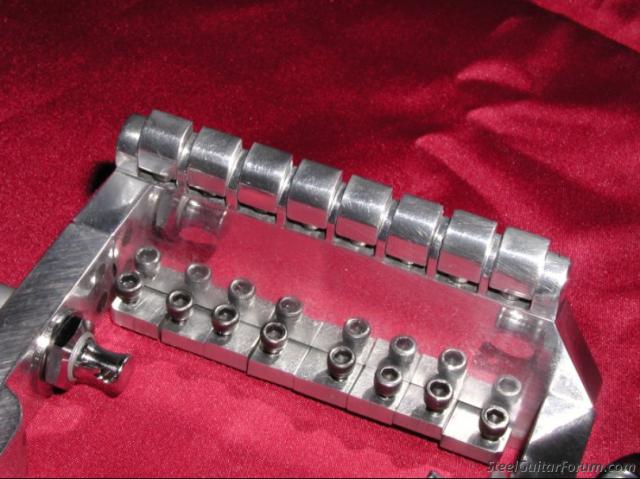

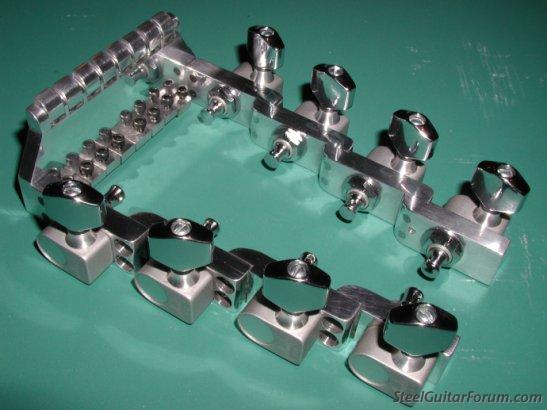
Note: There are NOT two rows of allen cap screws. The second row is reflection in the highly polished alluminum housing.
Secondly, this solves the "underneath the guitar" problem, but not using "V" Grooved nut rollers is unnaceptable to me.
The following may be a better idea. Not sure.

Thanks again dear brother, for your thoughts.
c.
Here is why I would not care for adjusting the nut rollers from the bottom of the guitar.
When I think of what I would have to do, in order to adjust them even once, to me it would just not fit into the way I believe would be most beneficial. Note the following:
1. On my keyless Excel Superb, the area just under the rollers is packed.
2. Sitting behind the guitar with my bar on top the strings at fret one, how would I be able to find a particular adjustment screw easily AND pick the string while holding the bar at the above location.
The more I think about it, the more it seems to be a step in the wrong direction. I of course could be wrong, and if that is the only way it can be done, then of course I would take that over any other remedy.
But I feel in my heart, that with good engineering and dedicated desire, one could have the best of both worlds, IF the adjustment could be done from the top.
IN fact, it has been done on a lap steel:
Note: There are NOT two rows of allen cap screws. The second row is reflection in the highly polished alluminum housing.
Secondly, this solves the "underneath the guitar" problem, but not using "V" Grooved nut rollers is unnaceptable to me.
The following may be a better idea. Not sure.
Thanks again dear brother, for your thoughts.
c.
A broken heart + † = a new heart.
-
C Dixon
- Posts: 7348
- Joined: 4 Aug 1998 11:00 pm
- Location: Duluth, GA USA
- State/Province: -
- Country: United States
-
Ron !
- Posts: 3860
- Joined: 11 Aug 2004 12:01 am
- State/Province: -
- Country: United States
Carl the picture posted by you might work if you would not have any strings on your guitar.From the looks of that one there would not be any space to move the allan wrench.C Dixon wrote:The following may be a better idea. Not sure.
I think that Martin's idea is probably the best one I have seen.It might take some effort to adjust the roller nuts but there is enough space for leverage underneath the guitar to do so.
The last picture posted by you does not have the space needed.The keyhead for the lapsteel does though.
Ron
-
Bill Hatcher
- Posts: 7306
- Joined: 6 Nov 1998 1:01 am
- Location: Atlanta Ga. USA
- State/Province: -
- Country: United States
No problem. All you have to do is loosen up the string a couple of turns and move the string over and then adjust the allen head screw and retension the string. I do this all the time with underarm guitars when I am adjusting the height of the strings at the nut.Ron ! wrote:Carl the picture posted by you might work if you would not have any strings on your guitar.From the looks of that one there would not be any space to move the allan wrench.C Dixon wrote:The following may be a better idea. Not sure.
Ron
This would actually be the best method rather than adjusting under string pressure. You would "unload"
the weight of the string on the adjustment mechanism and eliminate any undue stress on the parts.
I sure like the pics of your prototypes there Carl.
Have you ever thought of just having the ability to adjust the height on the lower wound strings. That seems to be the big culprit especially on a C6 neck. If a manufacturer did not want to go to the expense of making the key head with ALL height adjusters, then say the lower 4 or 5 strings being adjustable would certainly add a good feature to any steel.
-
Danny James
- Posts: 694
- Joined: 3 May 2004 12:01 am
- Location: Summerfield Florida USA
- State/Province: Florida
- Country: United States
Ron, Carl,& Bill,
I would think the diagram Carl is showing could be easily adjusted with what they call a ball end allen wrench. They work very well from an angle, which would be neccessary because of the strings being directly above the adjusting screws. I have a set of them.
I presume the nut shown is for a lapsteel. Now if it was slotted to accept rollers we would possibly have the best of both worlds.
Even though my gauged rollers work very well for me, I do agree I like the idea of adjustable rollers better, especially for those experimenters who change string diameters every so often.
Now if these could be incorporated into a commercially built pedal steel guitar, and not be cost prohibitive, there just might be a demand for them. Maybe Martin Weenick or someone will come out with an aftermarket product and make it available.
I would think the diagram Carl is showing could be easily adjusted with what they call a ball end allen wrench. They work very well from an angle, which would be neccessary because of the strings being directly above the adjusting screws. I have a set of them.
I presume the nut shown is for a lapsteel. Now if it was slotted to accept rollers we would possibly have the best of both worlds.
Even though my gauged rollers work very well for me, I do agree I like the idea of adjustable rollers better, especially for those experimenters who change string diameters every so often.
Now if these could be incorporated into a commercially built pedal steel guitar, and not be cost prohibitive, there just might be a demand for them. Maybe Martin Weenick or someone will come out with an aftermarket product and make it available.
-
C Dixon
- Posts: 7348
- Joined: 4 Aug 1998 11:00 pm
- Location: Duluth, GA USA
- State/Province: -
- Country: United States
I really DO appreciate all the great comments pro AND con. I like this.
A few points:
1. Notice the offset allen cap screws in the first and 3rd pictures. They were offset purposely so they would not be right under the strings; to facilitate getting an allen wrench into their heads easily.
2. This, of course, is NOT necessary if you do as Danny said concerning "Ball-end" allen wrenches. I have used them for years and they are really great; because they afford a plus or minus 15 degree shift from straight in.
This gives a total possible angle of 30 degrees in any direction. Without this, there would be NO way to remove Excel bellcranks and crossrod cranks (the part the pedal rod hooks into).
3. With both methods (shown in the above pictures), you can adjust the rollers up and down, with OUT slackening the keys. The torque provided by case-hardened allen cap (and set) screws, is more than sufficient to overcome the downward pressure of a given string tuned to correct pitch.
4. Aside from the first prototype not having V grooved rollers, I do not like the fact that the adjusting screws are located to the left of the roller part of the keyhead.
I would rather the adjusting screws be hidden UNDERNEATH holes that were drilled into the right side of the block that supports the rollers.
This could be made esthetically appealing (if done right). And....it would be easier on the player to insert the "ball end" of the allen wrench, because the holes would be clearly visible; plus the allen screws would be hidden.
Thanks again for all the interest and excellent comments.
c.
A few points:
1. Notice the offset allen cap screws in the first and 3rd pictures. They were offset purposely so they would not be right under the strings; to facilitate getting an allen wrench into their heads easily.
2. This, of course, is NOT necessary if you do as Danny said concerning "Ball-end" allen wrenches. I have used them for years and they are really great; because they afford a plus or minus 15 degree shift from straight in.
This gives a total possible angle of 30 degrees in any direction. Without this, there would be NO way to remove Excel bellcranks and crossrod cranks (the part the pedal rod hooks into).
3. With both methods (shown in the above pictures), you can adjust the rollers up and down, with OUT slackening the keys. The torque provided by case-hardened allen cap (and set) screws, is more than sufficient to overcome the downward pressure of a given string tuned to correct pitch.
4. Aside from the first prototype not having V grooved rollers, I do not like the fact that the adjusting screws are located to the left of the roller part of the keyhead.
I would rather the adjusting screws be hidden UNDERNEATH holes that were drilled into the right side of the block that supports the rollers.
This could be made esthetically appealing (if done right). And....it would be easier on the player to insert the "ball end" of the allen wrench, because the holes would be clearly visible; plus the allen screws would be hidden.
Thanks again for all the interest and excellent comments.
c.
A broken heart + † = a new heart.
-
richard burton

- Posts: 3856
- Joined: 23 Jan 2001 1:01 am
- Location: Britain
- State/Province: -
- Country: United States
-
Eugene Cole
- Posts: 514
- Joined: 1 Feb 2002 1:01 am
- Location: near Washington Grove, MD, USA
- State/Province: Washington
- Country: United States
Martin; having done this. What are your current thoughts regarding the ideal T.P.I. and screw size for your nut adjuster screws?
Regards
-- Eugene <sup>at</sup> FJ45.com
PixEnBar.com
Cole-Luthierie.com
FJ45.com
Sierra U14 8+5 my copedent, 1972 MSA D10 8+4, and nothing in the Bank. 8^)
-- Eugene <sup>at</sup> FJ45.com
PixEnBar.com
Cole-Luthierie.com
FJ45.com
Sierra U14 8+5 my copedent, 1972 MSA D10 8+4, and nothing in the Bank. 8^)
-
Martin Weenick

- Posts: 999
- Joined: 23 Jul 2001 12:01 am
- Location: Lecanto, FL, USA
- State/Province: -
- Country: United States
Eugene C. This is really an old post. The best I can remember I used 10-32 socket head machine screws for the adjustment screws. They worked very well. If I had it to do over I think I would use # 8-40 screws for a little finer adjustment but it is not really necessary. The 10-32 screws worked just fine, also 8-40 screws are hard to find in the longer length's. 8-40 is a common gun sight screw. Martin.
Several custom steels. NV-112 Boss DD-7
-
John McClung

- Posts: 5165
- Joined: 4 Aug 1998 11:00 pm
- Location: Olympia WA, USA
- State/Province: -
- Country: United States
Tom Bradshaw outfitted an MSA D-12 he was revamping for me with custom-built (by someone else, I don't recall the name) adjustable height roller nuts, very similar design to yours, Martin. Worked great, and did solve bar chatter problems on the extended E9 quite nicely, but I always wondered if tone and sustain were diminished since the rollers were no longer transferring sound energy to the cabinet, as Bill Hatcher on page 1 of this thread also wonders. Here are pix of the gizmo:


E9 INSTRUCTION
 If you want to have an ongoing discussion, please email me, don't use the Forum messaging which I detest! steelguitarlessons@earthlink.net
 If you want to have an ongoing discussion, please email me, don't use the Forum messaging which I detest! steelguitarlessons@earthlink.net
-
Martin Weenick
- Posts: 999
- Joined: 23 Jul 2001 12:01 am
- Location: Lecanto, FL, USA
- State/Province: -
- Country: United States
John M. John you are right. I did have some tone loss with just the spring steel strips holding the roller posts firm and I had to go back and drill and tap 8-32 holes on the inside of the key head and lock the posts down solid after I had adjusted them for height. That cured the tone loss problem. Martin.
Several custom steels. NV-112 Boss DD-7
-
Eugene Cole
- Posts: 514
- Joined: 1 Feb 2002 1:01 am
- Location: near Washington Grove, MD, USA
- State/Province: Washington
- Country: United States
Thanks. I was very curious what your hind-sight aumented choice would be.Martin Weenick wrote:Eugene C. This is really an old post. The best I can remember I used 10-32 socket head machine screws for the adjustment screws. They worked very well. If I had it to do over I think I would use # 8-40 screws for a little finer adjustment but it is not really necessary. The 10-32 screws worked just fine, also 8-40 screws are hard to find in the longer length's. 8-40 is a common gun sight screw. Martin.
I was very impressed with your design. I seldom recall specific Posts from this far back. I actually looked up this post today after recalling it. And then posted a link to it in a thread about roller nuts.
Regards
-- Eugene <sup>at</sup> FJ45.com
PixEnBar.com
Cole-Luthierie.com
FJ45.com
Sierra U14 8+5 my copedent, 1972 MSA D10 8+4, and nothing in the Bank. 8^)
-- Eugene <sup>at</sup> FJ45.com
PixEnBar.com
Cole-Luthierie.com
FJ45.com
Sierra U14 8+5 my copedent, 1972 MSA D10 8+4, and nothing in the Bank. 8^)
-
Martin Weenick
- Posts: 999
- Joined: 23 Jul 2001 12:01 am
- Location: Lecanto, FL, USA
- State/Province: -
- Country: United States
-
Lee Dassow

- Posts: 847
- Joined: 17 Mar 2010 8:01 am
- Location: Jefferson, Georgia USA
- State/Province: Georgia
- Country: United States
Real nice work Martin. Tennessee Lee
2015 Mullen D-10 Royal Precision 9x8,-1990 BMI S-10 5x5-1972 Silver face Fender pro Reverb amp,-1965 Fender Super Reverb Amp,- 1966 Fender Showman Amp Two 15" JBL speakers,- 2006 65 Fender Twin Reverb reissue Amp,- 1982 Peavey Session 500 amp,-1978 Peavey Session 400,Goodrich Volume Pedals,John Pearse Steel Bars,
-
Ron Pruter
- Posts: 1813
- Joined: 25 Feb 2011 2:47 pm
- Location: Arizona, USA
- State/Province: Arizona
- Country: United States