There has been much discussion lately regarding some pot pedals sounding different than other pot pedals. This seems strange since most pedals use a 500K pot. How can they possibly sound different? This week, I asked my Chief Engineer to measure a few pots using a capacitance bridge, and see if there could possibly be some capacity between the resistive element and the metal case. In theory I knew there had to be some capacitance, but such a low value, I thought it would not be a factor.
The results are in: the pots he measured ranged between 8 and 22 pf. 22pf is certainly enough capacity to cause high frequency loss at high impedance. This might explain why various pot pedals not only do sound different, but none of them sound as good as a pedal using the new generation of non-metal pots, similar to the ones Tom Bradshaw offers.
But Wait, There's More!
Beyond volume pedal troubles, consider the guitars with built-in volume or tone controls. Add to that the fact that some pick up manufacturers use mini-coax such as RG-174 to carry the audio once it leaves the pickup. This coax is rated right at 30pf per foot. When you add all of this together, is there any wonder that we are always chasing a better tone.
Something to think about.
Sincerely,
Craig Baker 706-485-8792
cmbakerelectronics@gmail.com
C.M. Baker Electronics
P.O. Box 3965
Eatonton, GA 31024
Why Volume Pedals Sound Different
Moderator: Dave Mudgett
-
Craig Baker

- Posts: 1330
- Joined: 19 Apr 2013 7:17 pm
- Location: Eatonton, Georgia, USA - R.I.P.
- State/Province: Georgia
- Country: United States
-
Greg Cutshaw

- Posts: 6821
- Joined: 17 Nov 1998 1:01 am
- Location: Corry, PA, USA
- State/Province: -
- Country: United States
More capacitance is not always bad! You need the "right" amount of capacitance to get the "right" tone! I actually added about 5' of cable to my George L's setup a few years back to roll off the highs with my then new amp, a Steel King. I just couldn't get the same effect by adjusting the amp controls. By doing so I was able to get a tone very close to the Webb amp I was using previously. I couldn't tell the difference in tone between my new Dunlop Hotpotz and the old NOS AB I took off of my Goodrich pedal. I don't doubt that there was a difference but not enough that I could notice it.
It's just not necessarily true that reducing the signal chain capacitance to zero will result in the best tone. Overcoming that capacitance by using a low impedance driver may or may not sound better. Tuning the level of capacitance to the right amount in the right places can result in a pleasing tone matched to one's guitar, pickup, amp, cord, effects system.
I've tried using active pickups and buffers to eliminate the admittedly high capacitance that most steel manufacturers use from the pickup to the guitar jack. It always ended up sounding a lot better with the extra capacitance in there. The capacitance not only rolls off the highs, it also produces a slight phase shift of the signal as a function of frequency. This can slightly alter the characteristic sound of an amplified guitar.
It's just not necessarily true that reducing the signal chain capacitance to zero will result in the best tone. Overcoming that capacitance by using a low impedance driver may or may not sound better. Tuning the level of capacitance to the right amount in the right places can result in a pleasing tone matched to one's guitar, pickup, amp, cord, effects system.
I've tried using active pickups and buffers to eliminate the admittedly high capacitance that most steel manufacturers use from the pickup to the guitar jack. It always ended up sounding a lot better with the extra capacitance in there. The capacitance not only rolls off the highs, it also produces a slight phase shift of the signal as a function of frequency. This can slightly alter the characteristic sound of an amplified guitar.
-
Craig Baker
- Posts: 1330
- Joined: 19 Apr 2013 7:17 pm
- Location: Eatonton, Georgia, USA - R.I.P.
- State/Province: Georgia
- Country: United States
Greg,
The reason I had the measurements taken was not to say that "this tone" is better than "that tone". It was just a mystery to me why similar volume pedals sound different. When it comes to the tone we prefer, we're all experts.
Rain is a good thing. . . if you're a farmer. Rain is the last thing you want. . . if you're in charge of the Easter parade.
If one observes the recording, broadcast, or film industry, There is a scientific reason why you won't find high impedance microphones. Engineers learned decades ago that high impedance circuits are vulnerable to a variety of variables. Similar to a Low impedance microphone, a low impedance guitar pickup offers the operator much more control over the sound and takes unexpected variables out of the game.
Les Paul had remarkable success in his experiments with low impedance pickups. It eliminates the surprising change in tone if you happen to use a 20' cord rather than a 6' cord, or replace a metal pot with a non-metal pot, or go with "this" volume pedal instead of "that" volume pedal. Using low impedance circuits, you can always add a tone control if you need to roll off some highs. It simply requires a higher capacitance in the tone circuit.
Sincerely,
Craig Baker 706-485-8792
cmbakerelectronics@gmail.com
C.M. Baker Electronics
P.O. Box 3965
Eatonton, GA 31024
The reason I had the measurements taken was not to say that "this tone" is better than "that tone". It was just a mystery to me why similar volume pedals sound different. When it comes to the tone we prefer, we're all experts.
Rain is a good thing. . . if you're a farmer. Rain is the last thing you want. . . if you're in charge of the Easter parade.
If one observes the recording, broadcast, or film industry, There is a scientific reason why you won't find high impedance microphones. Engineers learned decades ago that high impedance circuits are vulnerable to a variety of variables. Similar to a Low impedance microphone, a low impedance guitar pickup offers the operator much more control over the sound and takes unexpected variables out of the game.
Les Paul had remarkable success in his experiments with low impedance pickups. It eliminates the surprising change in tone if you happen to use a 20' cord rather than a 6' cord, or replace a metal pot with a non-metal pot, or go with "this" volume pedal instead of "that" volume pedal. Using low impedance circuits, you can always add a tone control if you need to roll off some highs. It simply requires a higher capacitance in the tone circuit.
Sincerely,
Craig Baker 706-485-8792
cmbakerelectronics@gmail.com
C.M. Baker Electronics
P.O. Box 3965
Eatonton, GA 31024
-
David Mason

- Posts: 6079
- Joined: 6 Oct 2001 12:01 am
- Location: Cambridge, MD, USA
- State/Province: -
- Country: United States
I find the discussions about this, starring many "seat-of-the-pants" guitar players to be almost mystifying. Your guitar cord is a tone control. The wiring in a guitar is a tone control. One unhappy-yet fruitful experiment I did building up a seven-string guitar was to leave out the tone pot on the neck humbucker. I grew up on a four-knob/two-pickup arrangement, and I like the weird interactions from fiddling with the two volume knobs... but I never used the neck tone, always on ten, so leave it out, right? Uh-uh. Even though many of my available ex-spurts say a knob on ten is like no knob at all; wide-open is not wide-open.
Every Strathead I know or read about always carries a high-capacitance (cheap) cord in their kit and uses them specifically for the tone - guitar hero flying in, at the mercy of the backline rentals... here's what the pickup master Bill Lawrence had to say about (including the math):
(this be a GOOD read)->->->
http://www.billlawrence.com/Pages/All_A ... dSound.htm
The reason Jimi Hendrix used the "awful" coiled cords was because a Strat into "good" cables into a wah into a fuzztone into a Marshall into Celestion speakers would shatter teeth, otherwise. And speakers are the last, great, even biggest tone controls you can buy. "Guitar speakers" are morphed from P.A. speakers that were designed to be used with tweeters and/or horns.
Look at the frequency curves of speakers, they just DIE above 2400 or so, thank goodness.
http://www.usspeaker.com/
If you really, really want a "full" and "natural" sound, plug into a line booster, then straight into the PA with its tweeters and horns. Yikes!
P.S.(A whole lot of those "seat'o'pants" guitar heroes think that "mid-range" is somewhere in between the 5th fret and the 15th fret or so )
)
Every Strathead I know or read about always carries a high-capacitance (cheap) cord in their kit and uses them specifically for the tone - guitar hero flying in, at the mercy of the backline rentals... here's what the pickup master Bill Lawrence had to say about (including the math):
(this be a GOOD read)->->->
http://www.billlawrence.com/Pages/All_A ... dSound.htm
The reason Jimi Hendrix used the "awful" coiled cords was because a Strat into "good" cables into a wah into a fuzztone into a Marshall into Celestion speakers would shatter teeth, otherwise. And speakers are the last, great, even biggest tone controls you can buy. "Guitar speakers" are morphed from P.A. speakers that were designed to be used with tweeters and/or horns.
Look at the frequency curves of speakers, they just DIE above 2400 or so, thank goodness.
http://www.usspeaker.com/
If you really, really want a "full" and "natural" sound, plug into a line booster, then straight into the PA with its tweeters and horns. Yikes!
P.S.(A whole lot of those "seat'o'pants" guitar heroes think that "mid-range" is somewhere in between the 5th fret and the 15th fret or so
)-
Craig Baker
- Posts: 1330
- Joined: 19 Apr 2013 7:17 pm
- Location: Eatonton, Georgia, USA - R.I.P.
- State/Province: Georgia
- Country: United States
Fred,
The industry standard for low impedance microphones is 150 Ohms. For other devices operating at a higher level, such as broadcast and recording equipment as well as landline telephones, the industry standard output impedance is 600 Ohms.
Dave,
You're very observant. Many guitar speakers do indeed die before they ever get to 3,000 Hz. Still, a pedal steel player asks a single 15" speaker to produce complex chords on the bass strings of the C6th neck and in the next song, brilliant high harmonics on the E9th neck. While on a home stereo system, we demand full range speakers with three-way crossovers in order to faithfully reproduce Gary Carter's beautiful tone.
You might ask: "Why do we keep using high impedance pickups and speakers with very restricted frequency response?" Probably the same reason we continue to use 1/4" connectors and unbalanced audio lines.
Very simple, it's because of those six deadly words. . .
"We've always done it this way"
Sincerely,
Craig Baker 706-485-8792
cmbakerelectronics@gmail.com
C.M. Baker Electronics
P.O. Box 3965
Eatonton, GA 31024
The industry standard for low impedance microphones is 150 Ohms. For other devices operating at a higher level, such as broadcast and recording equipment as well as landline telephones, the industry standard output impedance is 600 Ohms.
Dave,
You're very observant. Many guitar speakers do indeed die before they ever get to 3,000 Hz. Still, a pedal steel player asks a single 15" speaker to produce complex chords on the bass strings of the C6th neck and in the next song, brilliant high harmonics on the E9th neck. While on a home stereo system, we demand full range speakers with three-way crossovers in order to faithfully reproduce Gary Carter's beautiful tone.
You might ask: "Why do we keep using high impedance pickups and speakers with very restricted frequency response?" Probably the same reason we continue to use 1/4" connectors and unbalanced audio lines.
Very simple, it's because of those six deadly words. . .
"We've always done it this way"
Sincerely,
Craig Baker 706-485-8792
cmbakerelectronics@gmail.com
C.M. Baker Electronics
P.O. Box 3965
Eatonton, GA 31024
-
Scott Duckworth

- Posts: 3464
- Joined: 6 Apr 2013 8:41 am
- Location: Etowah, TN Western Foothills of the Smokies
- State/Province: -
- Country: United States
As with all electronic theory, audio, radio, etc., capacitance, inductance, resistance, and impedance all come in to play to produce a "transparent" chain from what ever (in our case) is producing the sound, to whatever lets the sound out.
Example, in ham radio, we work with the antenna and feed line to try to make the transfer of RF power be as efficient from the back of the radio to the antenna. Sometimes, there have to be "acceptable" losses, sometimes you can get close to a theoretical no loss situation.
To get pedal steel audio right, everyone who makes the parts, pickups, volume pedals, amps, and other devices has to come together to make that happen. Some kind of "industry standard" if you will, such as in ham radio that pretty much all transceivers operate with a 50 ohm antenna impedance.
Good points here from everyone.
Example, in ham radio, we work with the antenna and feed line to try to make the transfer of RF power be as efficient from the back of the radio to the antenna. Sometimes, there have to be "acceptable" losses, sometimes you can get close to a theoretical no loss situation.
To get pedal steel audio right, everyone who makes the parts, pickups, volume pedals, amps, and other devices has to come together to make that happen. Some kind of "industry standard" if you will, such as in ham radio that pretty much all transceivers operate with a 50 ohm antenna impedance.
Good points here from everyone.
Amateur Radio Operator NA4IT (Extra)
http://www.qsl.net/na4it
I may, in fact, be nuts. However, I am screwed onto the right bolt... Jesus!
http://www.qsl.net/na4it
I may, in fact, be nuts. However, I am screwed onto the right bolt... Jesus!
-
Jack Stoner
- Posts: 22147
- Joined: 3 Dec 1999 1:01 am
- Location: Kansas City, MO
- State/Province: Kansas
- Country: United States
There is a difference between an RF transmission line and an audio frequency "cable". Standing waves, etc are not applicable to audio frequency lines. e.g. in Audio the cable does not have to be a certain length or multiple/sub multiple like it does with an RF transmission line.
The Impedance that an audio line is terminated in is not as critical as an RF link.
Can't really compare RF to Audio frequency devices.
Agreed that capacitive reactance, impedance, resistance, etc play a role but different than RF.
(ex W5DVO/ZD8JES, and 2nd Class FCC Radiotelephone licensee).
The Impedance that an audio line is terminated in is not as critical as an RF link.
Can't really compare RF to Audio frequency devices.
Agreed that capacitive reactance, impedance, resistance, etc play a role but different than RF.
(ex W5DVO/ZD8JES, and 2nd Class FCC Radiotelephone licensee).
-
Craig Baker
- Posts: 1330
- Joined: 19 Apr 2013 7:17 pm
- Location: Eatonton, Georgia, USA - R.I.P.
- State/Province: Georgia
- Country: United States
Industry Standards
Scott,
Your example of the necessity of a standard is well founded. My appliances will plug into your outlets and your light bulbs will fit in my sockets. Liberace could play any piano, but could Doug Jernigan or Tommy White sit down and tear it up on Jimmy Day's setup? What you suggest would require a true convention, rather than merely a three-day concert. While the two-way radio industry thrives on 50 Ohm transmission lines with matching antennae and PL-259 connectors, and the television industry long ago settled on 75 Ohm video feed lines with BNC connectors, somebody forgot to tell the audio industry to convene. Shall we use high, medium or low impedance lines, 1/4 inch connectors, RCA plugs or XLRs, balanced or unbalanced?
Jack,
I'm sure you'll remember; when using inductive devices such as a high quality audio transformer, it now becomes necessary to match the impedance with the proper load. What appears as standing waves on RF transmission lines is known as "ringing" at audio frequencies.
Getting good tone shouldn't be an amazing feat, but we're guitar players and. . .
"We've Always Done It This Way."
Best regards,
Craig Baker 706-485-8792
cmbakerelectronics@gmail.com
C.M. Baker Electronics
P.O. Box 3965
Eatonton, GA 31024
Your example of the necessity of a standard is well founded. My appliances will plug into your outlets and your light bulbs will fit in my sockets. Liberace could play any piano, but could Doug Jernigan or Tommy White sit down and tear it up on Jimmy Day's setup? What you suggest would require a true convention, rather than merely a three-day concert. While the two-way radio industry thrives on 50 Ohm transmission lines with matching antennae and PL-259 connectors, and the television industry long ago settled on 75 Ohm video feed lines with BNC connectors, somebody forgot to tell the audio industry to convene. Shall we use high, medium or low impedance lines, 1/4 inch connectors, RCA plugs or XLRs, balanced or unbalanced?
Jack,
I'm sure you'll remember; when using inductive devices such as a high quality audio transformer, it now becomes necessary to match the impedance with the proper load. What appears as standing waves on RF transmission lines is known as "ringing" at audio frequencies.
Getting good tone shouldn't be an amazing feat, but we're guitar players and. . .
"We've Always Done It This Way."
Best regards,
Craig Baker 706-485-8792
cmbakerelectronics@gmail.com
C.M. Baker Electronics
P.O. Box 3965
Eatonton, GA 31024
Last edited by Craig Baker on 17 Feb 2014 5:09 am, edited 2 times in total.
-
Greg Cutshaw
- Posts: 6821
- Joined: 17 Nov 1998 1:01 am
- Location: Corry, PA, USA
- State/Province: -
- Country: United States
I keep using the existing high impedance pickups because they sound awesome! All of the active pickups I've tried sound screechy and stale. Having a flatter frequency response or more even high frequency response is not always desirable to achieve the best tone. That's what tone controls and tuning your system cords, pedals, amps etc is for.
For RF antennas 50 ohms was selected for the best power transfer. For the least voltage loss 93 ohms is best. Many cable systems chose 75 ohms as a good trade-off between 50 and 93. For power transfer in general and transmission lines, max power is transferred when the load and source impedances are matched. Any mismatch, high or low, and power transferred is reduced and transmission line reflections are introduced. All of this does not matter with our audio systems. If it sounds good use it! I do use a stomp box reverb with most of my steel setups so actually I do have some buffering but it's after the foot volume and overcomes some of the loss in the cord and amp system.
The ear's response peaks are around 2Khz so it does not favor having a flat frequency response at all!
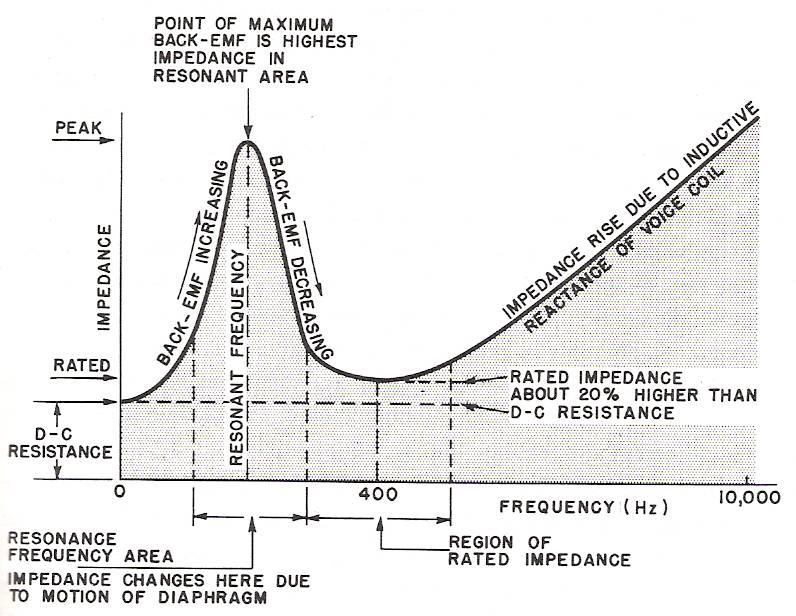
The chart below shows a typical speaker's impedance vs. frequency. It's a complex interaction between the speaker's mechanical and electrical components!
For RF antennas 50 ohms was selected for the best power transfer. For the least voltage loss 93 ohms is best. Many cable systems chose 75 ohms as a good trade-off between 50 and 93. For power transfer in general and transmission lines, max power is transferred when the load and source impedances are matched. Any mismatch, high or low, and power transferred is reduced and transmission line reflections are introduced. All of this does not matter with our audio systems. If it sounds good use it! I do use a stomp box reverb with most of my steel setups so actually I do have some buffering but it's after the foot volume and overcomes some of the loss in the cord and amp system.
The ear's response peaks are around 2Khz so it does not favor having a flat frequency response at all!
The chart below shows a typical speaker's impedance vs. frequency. It's a complex interaction between the speaker's mechanical and electrical components!
-
Dickie Whitley
- Posts: 1090
- Joined: 10 Feb 2004 1:01 am
- State/Province: -
- Country: United States
Feel free to beat me with a wet noodle if I'm not seeing this correctly, but we seem to be talking about two different things here.
On one hand we're talking matching components for maximized performance or signal transfer, then on the other, we're talking about tone. To me the first one is something that is totally quantifiable, it can be measured and analyzed, and adjusted to meet "maximized" performance.
The second, tone, is something to me that is purely subjective, and not quantifiable, because everybody and their brother/sister has a different opinion of what "tone" is, and what is good and what's not.
Some folks (like me) prefer tube preamps and the "warmth" it gives the tone, others prefer solid state all the way and wouldn't be caught near a tube device. Some like more bass, some more treble, some more mids, some less of varying degrees. The discussion of pot pedals verses electronic and what's best continues.
I'm not sure whether this discussion between such opposites can ever find a happy medium. I stand to be corrected.
On one hand we're talking matching components for maximized performance or signal transfer, then on the other, we're talking about tone. To me the first one is something that is totally quantifiable, it can be measured and analyzed, and adjusted to meet "maximized" performance.
The second, tone, is something to me that is purely subjective, and not quantifiable, because everybody and their brother/sister has a different opinion of what "tone" is, and what is good and what's not.
Some folks (like me) prefer tube preamps and the "warmth" it gives the tone, others prefer solid state all the way and wouldn't be caught near a tube device. Some like more bass, some more treble, some more mids, some less of varying degrees. The discussion of pot pedals verses electronic and what's best continues.
I'm not sure whether this discussion between such opposites can ever find a happy medium. I stand to be corrected.
-
Georg Sørtun

- Posts: 3854
- Joined: 2 Jun 2009 9:12 am
- Location: Mandal, Agder, Norway
- State/Province: -
- Country: United States
-
Jim Pitman
- Posts: 2049
- Joined: 29 Aug 1998 12:01 am
- Location: Waterbury Ctr. VT 05677 USA
- State/Province: -
- Country: United States
-
Donny Hinson
- Posts: 21830
- Joined: 16 Feb 1999 1:01 am
- Location: Glen Burnie, Md. U.S.A.
- State/Province: -
- Country: United States
Re: Why Volume Pedals Sound Different
Well, since 22pf is about the same capacitance as a foot of regular coax, I really wouldn't be too concerned about it, especially since most pedal steelers use at least eleven feet of coax! To me, worrying about this small a load is kinda like worrying about whether your next new car gets 31 mpg, or 31.5 mpg.Craig Baker wrote: The results are in: the pots he measured ranged between 8 and 22 pf. 22pf is certainly enough capacity to cause high frequency loss at high impedance. This might explain why various pot pedals not only do sound different, but none of them sound as good as a pedal using the new generation of non-metal pots...
Of course, I'm weird anyway, and I have a hard time understanding why a player who runs his treble at 3 or 4 would then gripe about not having enough highs?
-
Lane Gray

- Posts: 13684
- Joined: 4 Aug 1998 11:00 pm
- Location: Topeka, KS
- State/Province: -
- Country: United States
Re: Why Volume Pedals Sound Different
There you go again, Hinson. Using that common sense and logical thinking...Donny Hinson wrote:
Of course, I'm weird anyway, and I have a hard time understanding why a player who runs his treble at 3 or 4 would then gripe about not having enough highs?
2 pedal steels, a lapStrat, and an 8-string Dobro (and 3 ukes)
More amps than guitars, and not many effects
More amps than guitars, and not many effects
-
Joshua Gibson
- Posts: 287
- Joined: 21 Oct 2011 7:57 am
- Location: Arizona, USA
- State/Province: Arizona
- Country: United States
Hoo-Boy!!!... , this is a good one!,
No, Seriously thanks for the info Craig I "TRY" to consider Myself a tone junkie, I'm constantly trying different variations of cords, caps, speakers, amps, Etc. Etc. So I honestly DO appreciate it,
Josh.
, this is a good one!,No, Seriously thanks for the info Craig I "TRY" to consider Myself a tone junkie, I'm constantly trying different variations of cords, caps, speakers, amps, Etc. Etc. So I honestly DO appreciate it,
Josh.
'83 Mullen custom D-10 8x5.
'03 Carter Experimental D-10 9x8
Mesa Lonestar classic 112 custom cab.
Session 400 Ltd, Nashville 1000,
Telonics, Zoom, BJS,
Goldtone BS, LITM, OS Dobros.
Fender, G&L, Gibson, Ibanez guitars.
'03 Carter Experimental D-10 9x8
Mesa Lonestar classic 112 custom cab.
Session 400 Ltd, Nashville 1000,
Telonics, Zoom, BJS,
Goldtone BS, LITM, OS Dobros.
Fender, G&L, Gibson, Ibanez guitars.
-
Craig Baker
- Posts: 1330
- Joined: 19 Apr 2013 7:17 pm
- Location: Eatonton, Georgia, USA - R.I.P.
- State/Province: Georgia
- Country: United States
Hi Joshua,
A friend once told me:
"You spend so much time working in your business that you don't spend enough time working on your business"
I too have always had a great interest in tone. Perhaps spending more time learning to play well would be a good idea. LOL
Sincerely,
Craig Baker 706-485-8792
cmbakerelectronics@gmail.com
C.M. Baker Electronics
P.O. Box 3965
Eatonton, GA 31024
A friend once told me:
"You spend so much time working in your business that you don't spend enough time working on your business"
I too have always had a great interest in tone. Perhaps spending more time learning to play well would be a good idea. LOL
Sincerely,
Craig Baker 706-485-8792
cmbakerelectronics@gmail.com
C.M. Baker Electronics
P.O. Box 3965
Eatonton, GA 31024
-
Jim Bates
- Posts: 1316
- Joined: 27 Mar 2002 1:01 am
- Location: Alvin, Texas, USA
- State/Province: Texas
- Country: United States
Yes, there is a difference in the amount of tone 'suck' volume pedals have. Craig at least has done experiments and measurements on some pedals, pots and cords to quantify the effects.
From my experience on dealing with: Sho-Bud, DeArmond, Dekley, Fender, Goodrich, Ernie Ball and some others I have owned, I have used small capacitors - 100pf,220pf and 330pf to get the treble back in my sound. Sho-Bud needed a 330 pf hi-pass,220pf on Fender, Dekley, and Goodrich pot pedals. The DeArmond used the 100pf. Also, I used the 100pf caps on my late 60's Hi-Fi (High Definition!)do I could hear the rosion biting the strings in Classical music.
I make my own cords from the Belden blue cable 9272 that still has one of the lowest mfd/ft.
Bottom line to this discussion is 'different tones for different folks'.
Of course another BIG thing is that when your ears get older you WILL hear things differently.
Enjoy the sound you have at the moment, no matter how you achieved it!
Thanx,
Jim
From my experience on dealing with: Sho-Bud, DeArmond, Dekley, Fender, Goodrich, Ernie Ball and some others I have owned, I have used small capacitors - 100pf,220pf and 330pf to get the treble back in my sound. Sho-Bud needed a 330 pf hi-pass,220pf on Fender, Dekley, and Goodrich pot pedals. The DeArmond used the 100pf. Also, I used the 100pf caps on my late 60's Hi-Fi (High Definition!)do I could hear the rosion biting the strings in Classical music.
I make my own cords from the Belden blue cable 9272 that still has one of the lowest mfd/ft.
Bottom line to this discussion is 'different tones for different folks'.
Of course another BIG thing is that when your ears get older you WILL hear things differently.
Enjoy the sound you have at the moment, no matter how you achieved it!
Thanx,
Jim
-
Pete Nicholls

- Posts: 575
- Joined: 6 Jun 2012 2:59 pm
- Location: Macon, Georgia, USA
- State/Province: Georgia
- Country: United States
So do these caps go from the pedal input to ground?Jim Bates wrote:From my experience on dealing with: Sho-Bud, DeArmond, Dekley, Fender, Goodrich, Ernie Ball and some others I have owned, I have used small capacitors - 100pf,220pf and 330pf to get the treble back in my sound. Sho-Bud needed a 330 pf hi-pass,220pf on Fender, Dekley, and Goodrich pot pedals. The DeArmond used the 100pf.
Justice The Judge SD-10, 2007
Justice Pro Lite SD-10, 2011
Quilter Steelaire
Quilter Labs Tone Block 202 Head
Roland Cube 80-XL
American Stratocaster - Yamaha Bass Guitar
1 Fender Telecaster Nashville Edition
Ham Call: N4BHB
Justice Pro Lite SD-10, 2011
Quilter Steelaire
Quilter Labs Tone Block 202 Head
Roland Cube 80-XL
American Stratocaster - Yamaha Bass Guitar
1 Fender Telecaster Nashville Edition
Ham Call: N4BHB
-
Jim Bates
- Posts: 1316
- Joined: 27 Mar 2002 1:01 am
- Location: Alvin, Texas, USA
- State/Province: Texas
- Country: United States
On the pot, hook one end on the input, other to the output (center). Or, you hook cap from input jack (tip) to output jack (tip) - sometimes this is handier.
If you have too much treble in your signal and want to trim the treble some, THE you hook the cap to the input and the other end to ground.
Thanx,
Jim
PS - be sure you use these very small caps.
If you have too much treble in your signal and want to trim the treble some, THE you hook the cap to the input and the other end to ground.
Thanx,
Jim
PS - be sure you use these very small caps.