You could ruin a otherwise nice guitar very quickly.

Well... I didn't have any other place to try it...
I’m adding in this timeline of events just for clarification; Some time around the early 90’s, I bought
a Fender 2000. I played it for a while, then switched out the cables for rods, thereby giving it a more
direct feel, and then added knee levers. Some where along the way I noticed it had this certain “extraâ€
tone when I played the fourth and fifth string. I tried every thing I could to figure out what was causing
this. I experimented with different string gauges and even changed the pickups to GL 10-1’s. In 2006
I posted on here http://bb.steelguitarforum.com/viewtopi ... highlight= to see if any one
knew the answer to this problem. I got some very good replies from all who responded on that thread,
all of which were very helpful, very solid advice. One of the items mentioned was the contact point
where the string meets the finger. One thing I did not know to try then was what Donny mentioned in
this thread, which was forming the string at the finger. This may have been all I needed to do. Jerry
also mentioned this and posted a picture, on this thread, which explains this perfectly.
After finding the problem, I fixed it (not the easy way, mind you) and have been happily playing it
for 3 or 4 years since. Here's what the problem was. It is a phenomenon which probably happens in most
all strings, but is only manifested audibly in the largest of the solid strings. What happens is this; The
larger the diameter of the vibrating string is, the more prone it is to come up off the finger at the point
where the string and the finger meet. It then slaps back down onto the finger introducing a new random
vibration into the strings otherwise "perfect" oscillation. This is sometimes referred to as the “sitar†effect,
but might be more properly known as string sizzle. This happens to a lesser degree as string size
decreases because;
#1 the "new random" vibrations are increasingly higher in frequency with this decrease in string size,
being coupled with,
#2 they are significantly quieter because the increasingly smaller string slaps the finger with less force.
There are other things like string tension which could have some affect, but the best fix is to keep the
string in constant contact with the top of the finger at this critical point. A way to keep the string to finger
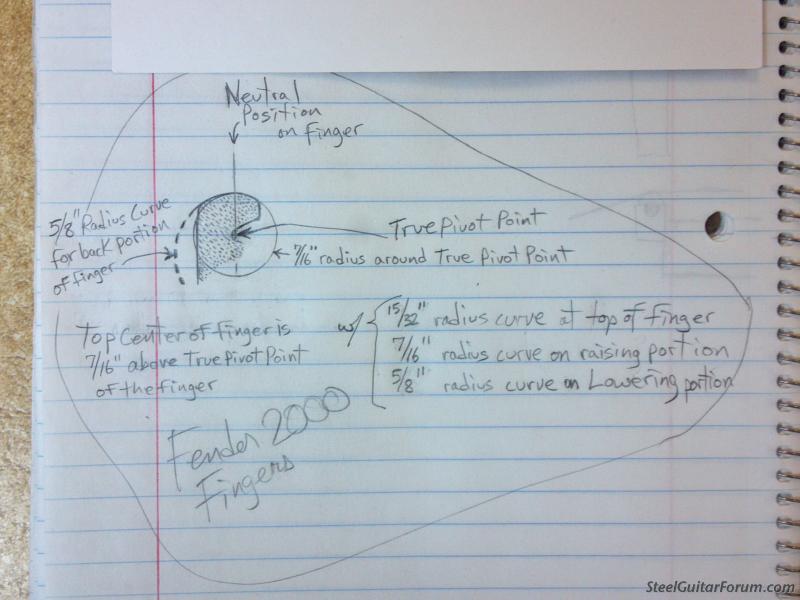
contact is to increase the down bearing pressure of the string by decreasing the radius of the finger. This
would maybe not need to be as drastic for the number 4 finger as for the number 5 finger, but I made my
number 4 and 5 finger radii the same. Then again, the tension on the number 5 string might be such that
it had less of a problem than the number 4 string had, therefore requiring finger 4 to be in need of more
modification. Some guitars which have sizzle may be the effect of being worked on to remove a burr
or groove, and in reality the top of the finger was flattened, thereby increasing the radius of the contact
point. What I am posting here is just by way of information for some one who has a machine shop and/or
the right equipment, and would want to make an entirely new finger for their guitar and is in no way
meant to encourage any one to haphazardly experiment on, or otherwise ruin their guitar. Since I didn’t
have the tools to make an entirely new finger, this is what I did;
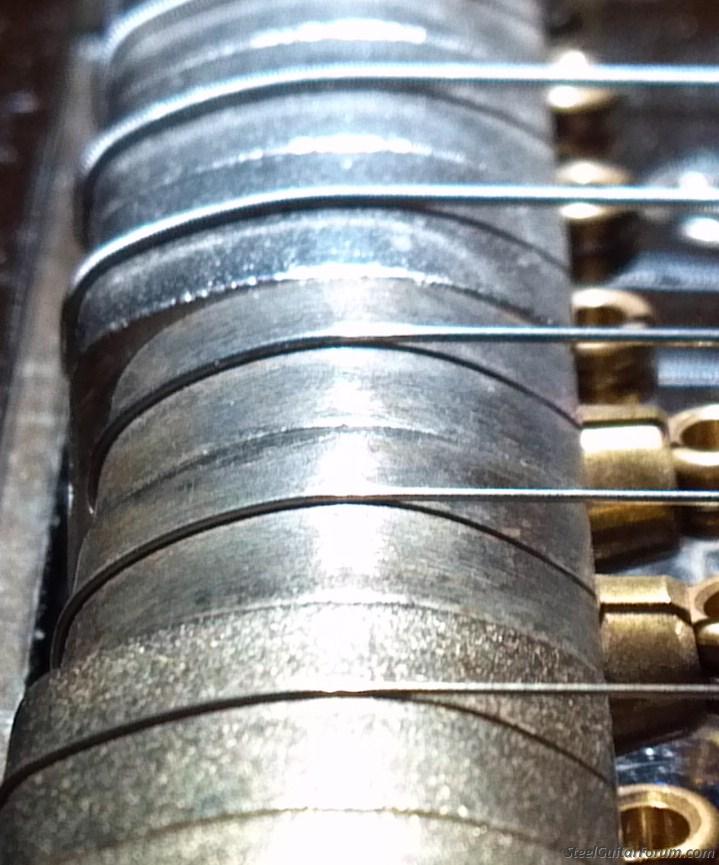
I removed the chrome by grinding toward the center of the top of the finger. I then made the back
and front radii less, always cutting toward the inside of the finger so as to not chip the chrome. I left
the top (at the string contact point) where it was(minus the chrome). I did most the work with a 4"
grinder and finished it with a honing stone and then a dremel to polish them. It took a while, and
then I had to make a cone for the front so the wrap on the string would not have to bend coming
out the back. I did this using a cut off from a brass barbed connector and a piece of small stainless
tubing to join this to the finger and keep them centered. The steeper radius on the back the finger
made for too sharp of a string bend, so I had to take off about 1/16" of the back so as to have an
easier curve for the string. It took a long time and I thought that if some one wanted they could use
this information to make one of these modified fingers. It works great, no more sizzle, still goes
3 or 4 years without breaking a string.
This is a great guitar, has great tone, and at this point I don't think I'll ever need to change to
anything else.

Hopefully, some day I can post a sound clip/video, but that will take some R&D.