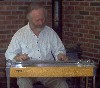
I have just finished refurbing this Bigsby for Rich Sullivan, a fellow formulite.
Rich has the original bill of sale, from Paul Bigsby, stating that it was the first 10 string with pedals that Paul Bigsby made. I have posted before and after pictures of it. The body was refinished by Thomas Gardner of Hampton, N.H. Tom was able to refinish the body and keep the original owners name and the Bigsby name on the guitar.Thanks Tom, for a a fine job.
These are the pictures before. .jpg[/img]
Last edited by Tommy Cass on 19 Apr 2013 5:29 am, edited 5 times in total.
Looks great, Tom! I saw this guitar a few weeks ago at Tom's place "before" ...and later I saw it "after", and I was blown away! Beautiful work, Tom. I did a little pickin' on it when I was there, but now I wish I had played it more!
This is another example of the exquisite work that Tom does. I can't say enough. The before photos really don't show what poor condition the guitar was in when I received it. But it is gorgeous now. I got to play it for awhile this morning, and that's the most fun I've had in a long time. Thanks again, Tom.
Some historical notes on the guitar. It was owned by Coy Martin until he passed away, and his estate auctioned it at Christie's late last year. I also received the original bill of sale and a letter from P.A. The serial number is 7151 (born on July 1, 1951), and the bill of sale is dated 7-9-51. In the letter, P.A. states that it is the first ten string guitar that he built. We are speculating on whether this might be the first ten string pedal steel ever made by anyone(?) The ten string neck was built with two of the original keyhead plunger style changers, and they are still present on the guitar. The inside neck is non-pedal. The outside neck has two pedals, which were added some time after the guitar was first built, and this neck has the bridge end style changer that he switched to on later guitars. Many of the parts in the changer looked to be homemade, certainly not consistent with P.A.'s normally meticulous workmanship. We decided to machine some replacement parts for these and Tom polished them up nicely.
This will undoubtedly become my number one guitar. On a personal note, it resonates with me that the guitar was born on 7-1-51, two days before I was born.
Congrats Rich, you're a lucky man! I can't quite read the total on the bill of sale, but I think it's about $825? That would be over $7300 in today's dollars!
Rich Sullivan wrote: We decided to machine some replacement parts for these and Tom polished them up nicely.]
He even polished parts that are not supposed to be polished.
I would suggest casting a replacement for the broken pedal four crank rather than machining one. Sure it is easier machine a replacement, but wouldn't you rather have a replacement that does not stand out as a replacement. This is a Bigsby.
Also, just as an aside, the legs with wheels go on the back, not the pedal rack side.
It is interesting Paul Bigsby did not note the tunings on the invoice. My 1951 came with E6, E13 and A6 tunings, but it has no 10 string necks.
As cheesy as it sounds, the cast plunger parts under the keyhead should be painted silver to look as though they are unpolished cast aluminum and the plunge rods should be painted silver too.
Chris Lucker
Red Bellies, Bigsbys and a lot of other guitars.
Doug - The total on the invoice was $700 for the guitar, and $8 for a full set of strings.
Chris - Tom didn't post photos of the underside after the work was completed, but we were able to have the original broken pedal crank welded, and it is on the guitar now. We replaced the fingers in the changer. Most of these were not cast and were poorly machined.
Rich
Glad you sorted it out. I had the spare parts, though:
(Ignore the Wright pickup and Magnatone pickup cover(?) and some other odd cover.
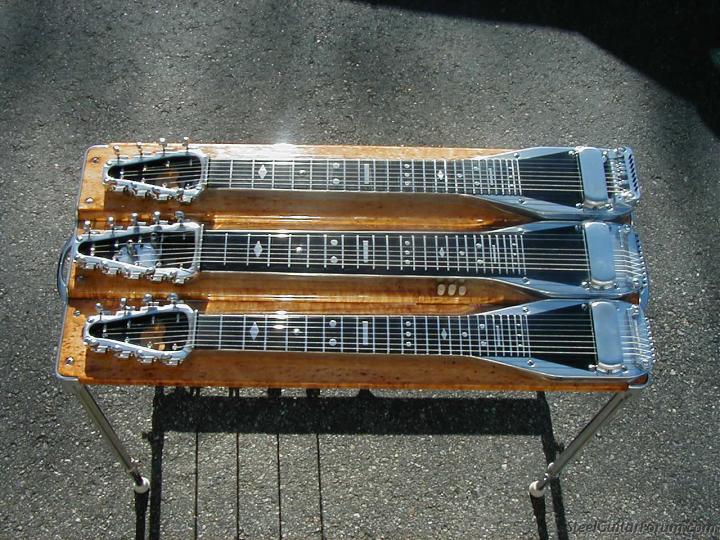
Also, regarding saving the lettering on the front apron, the truth is, it is hard to remove the letters. They are heavy pickguard material inlaid into the maple. When the name Marv Erickson needed to be removed after being in the apron of the Joaquin Murphey triple Bigsby for fifty years, substantial material needed to be planed off the surface of the apron. It was a lot of work to change that guitar back from being Marv Erickson to Joaquin Murphey and relic the refinish and new apron plaque.
Chris Lucker
Red Bellies, Bigsbys and a lot of other guitars.
I love this thread, thanks for all the information and photos. Won't b0b be tickled when he finds out that these remarkable guitars were strung up using a 5th string from a banjo...
Sorry to add to such an old post but for the history books sake: I'm not sure which was the last Bigsby with screws in the apron, but it was from 1949. There are 1949s without screws as well. A more important feature is the change in scale length that occurred in early 1951. I've seen it in March but I've also seen long scales from June-Somebody must have paid the $100 expediting fee.


 .jpg[/img]






 such beautfull guitars