DG; With my changer/tuner on the players left, I looked at adding the Fender like string saddles to the bridge end...not for the string length adjustment, but to add the Piezo sensors to the instrument as an option.
Google up "GHOST" pickups and you will find a Co in BC that makes/sells them, but they are too wide for the 11/32" string centers of the PSG.
JD; All ears do not hear alike, and all tonal preferences are not the same. Instrumentation does not add "tone" words to the soup, just repeatable data.
Integrated changer/tuner...opinions = ?
Moderator: Dave Mudgett
-
ed packard
- Posts: 2162
- Joined: 4 Aug 1998 11:00 pm
- Location: Show Low AZ
- State/Province: -
- Country: United States
-
Bent Romnes
- Posts: 5985
- Joined: 28 Feb 2007 2:35 pm
- Location: London,Ontario, Canada
- State/Province: -
- Country: United States
Re: Thanks for fueling the fire!
J-D and everybody. There is a builders forum already in action. It would be great to have you all carry on this same discussion there!J D Sauser wrote:Richard and Ed:
It seems we are about to sway away from the original subject of LCT to ALL aspects of PSG building. Interesting, but potentially bound to become an over amount of information and ideas to handle in ONE thread. Maybe, we can win b0b over to give us a PSG BUILDER Forum?
... J-D.
http://steelguitarbuilder.com/forum/index.php
See y'all there!!
Bent
BenRom Pedal Steel Guitars
https://www.facebook.com/groups/212050572323614/
https://www.facebook.com/groups/212050572323614/
-
Mike Perlowin RIP
- Posts: 15171
- Joined: 4 Aug 1998 11:00 pm
- Location: Los Angeles CA
- State/Province: -
- Country: United States
Re: Ears and taste
I have experimented extensively with Peizos, and found that they pick up and amplify all the noise generated by the pedals. These experiments included placing the Peizo at the first fret, as far from the changer as possible. But no matter what I did, I was unable to eliminate the extraneous noise.ed packard wrote:...to add the Piezo sensors to the instrument as an option.
It is my opinion that unless or until a way to solve this problem is found, Peizos are not practical for a pedal steel guitar.
I hope somebody finds a solution.
Please visit my web site and Soundcloud page and listen to the music posted there.
http://www.mikeperlowin.com http://soundcloud.com/mike-perlowin
http://www.mikeperlowin.com http://soundcloud.com/mike-perlowin
-
Richard Damron

- Posts: 1251
- Joined: 23 Jul 2007 2:51 pm
- Location: Gallatin, Tennessee, USA (deceased)
- State/Province: Tennessee
- Country: United States
-
J D Sauser

- Moderator
- Posts: 3389
- Joined: 4 Aug 1998 11:00 pm
- Location: Wellington, Florida
- State/Province: Florida
- Country: United States
Naw Richard, DON'T apologize. Since I suggested that LCT was ALL about tone first... the obvious was to take it to the next level.Richard Damron wrote:J.D. -
I must apologize, young man. I let my interest and excitement over the notion of someone doing something radically different with the PSG get the best of me. My posts were, indeed, asides from the LCT concept.
My bad.
Keep us posted.
Respectfully,
Richard
And YOU have been interested by the same issues I have: Sound board energy containment.
John Billings: I too wondered how the "chopped" first fretboard interval would feel. I must say, I did not notice. You actually do see the string take off at the center of the changer fingers.
All others who did play the guitar, never minded.
Actually, the cool thing was, that one could slide off the zero-fret and not get entangled in the keys or anything sticking out.
Obviously a keyheaded LCT would not look any different at the nut than your everyday PSG.
Ed, you are correct. But I think that noise is noise, rattles are rattles and buzzes are... well, buzzes (and NOT overtones) and even the best ear can't hear more sustain once the sustain is gone (well, maybe my downstairs neighbor could when his chandeliers were still rattling after my floor had sucked off all the sustain from my old PSG
 ).
).Not all ears are the same, but I've never heard anybody complain about Jerry Byrd's or Buddy Emmons' "bad" tone.

But yes, just like this board certainly is divided by Sho~Bud vs. Emmons, PP vs. AP, keyed vs. keyless, Rickenbacher vs. Fender "tone". There will be those which will stick to their right changer "tone" and drag LCT tone thru the dirt. At least, until "so'n'so/big shot player" surprised everybody and "goes" LCT. God help us if that player then some day picks up an endorsement for a right changer guit'tar
 .
.I however still think that there is a definition for good (or lets say "quality") tone and many for bad tone. Muffled, zingy, deadened, unbalanced etc is can't be good. It can have it's uses but it comes and goes (and Rock'n'Roll stays... as Chuck Berry would say).
But yes, it is subjective.
Bottom line, the goal is not to set up something and holler "see, it's BETTER and everything else is BAD", but to present something which is an evolution and ask "how'd ya like that?" with a big smile.
It's difficult to explain why a guitar seem to tickle player and listeners... out of many similarly well made guitars. But then, when you are just after perfecting things, you CAN analyze the existing, see problems and culprits and try to address them. If one can explain what he's doing, they just may be something to it.
... J-D.
-
Rob Segal
- Posts: 490
- Joined: 4 Aug 1998 11:00 pm
- Location: New York NY
- State/Province: New York
- Country: United States
-
J D Sauser
- Moderator
- Posts: 3389
- Joined: 4 Aug 1998 11:00 pm
- Location: Wellington, Florida
- State/Province: Florida
- Country: United States
I was hoping you would push me a little with a new "well, why don't JUST..." idea, like in the middle of the night ("why don't you just add a couple of knee levers too?")!Rob Segal wrote:Hey J-D I'm a little late in chiming in here, but I want to say that J.D. is full of compelling ideas about how a steel guitar acts and should be constructed. It was and remains a great pleasure to think steel with him. He has said it all and more, so I'll just lay back as I usually do--Rob
I still remember the first time I met Rob. We ran into each other at the ISG-convention in St. Louis, MO. Somehow we hit it off well immediately and talked "shop". I remember telling him something to the like of "... them guitars are all built backwards!". Instead of taking it as a joke as most would have, Rob started to pick my brain.
Weeks later, he called me "so, hav'ya built it?". I wasn't even planing to build anything... I had just been bitching!... The phone calls would not stop. So, we talked ideas over the phone, I thought THAT would get him off my back over time. WRONG! He finally offered -well "offered"? NO, INFORMED me- he was coming down to Florida from NYC for a couple of days to put heads on the nails.
So we did. Half a year later we had ourselves an ugly little guitar. I received the last parts the day BEFORE the Dallas show. We wanted to take it there (I was going there anyway) to have pro players play it in my room and give us some feed back. Quite courageous endeavour, when you haven't even heard your idea play before. Anyways, I worked the whole day and night. For a moment, when I was going to put the first sting on, I had doubts! For a moment, I thought I was not working, that the fingers were not pulling but only bending the strings... I was tired. Anyways, by midnight I had A&B pedals on and 10 strings and a pickup. I HAD to try it! Dragged it into the music room and hooked it. I WENT "WHOAW". I called up Rob. I had a mike fitted onto the phone system, so I could play AND talk thru a second mike on my head phone. He seemed pleased. I said "OK, I pack'er up! We are all GO!". WRONG again "why don't you just add a third pedal, a couple of knee lever and something like a neck?"... why don't you just... it's ONE in the morning and JD is trashed!
Anyways, I constructed a "neck", added C and a couple of levers. My wife got up, met me in the garage, helped me put everything, including me in the car and off to PBI airport!
I had not slept and my flight that went West Palm-Chicago-where I bumped into Rob coming from NYC-to Dallas. I must have looked like an cold pizza by then... but "why don't you just set it up and go hit the bed then?". Sometimes, it best suits you to do what you gotta do! The last thing I remember as I passed out, was hearing Rob strum that thing and go "WHOAW!".
We had NO amp with us. Finally it was Bobby Bowman who graciously said "sure my Brother, take one of mine, I'll call you if I sell it!".
Sadly, when Maurice Anderson worked an hour out of his busy schedule early the next morning, Bobby had not been around yet - no amp! Maurice likes to try guitars with an amp, imagine!
. So, the one man I was really looking forward to kick the tires on that thing and give us a sincere opinion, could not really hear it like he wanted to.We got to know John Hughey like I never imagined he was. I think Rob had talked to him before. I thought Mr. Hughey would be a "dry" somewhat "authoritarian" person. Was I ever wrong. He dedicated us over an hour, playing our little ugly guit'tar and talking.
I had talked to Tom Brumley before. He surprised me by "hey, I remember you! You are that Swiss guy with the "ideas""! I told him, that "idea" was set up in my room, to which he asked "can I see it?". Well, we were hoping he would like to. Again, a very generous person spending over an hour with us.
On the way back from Dallas, we took the guitar to NYC, to Rob's office. First time in NYC for me. I walked into Little Italy while Rob kept on strumming, I locked a waiter out of his restaurant (an idiot, you know...
 ), and Rob was glad he had staid at home, strumming.
We discussed ideas on body/sound board, knee levers, etc and even did some comparative recordings, somewhat empirical!
We visited pickup builder Bill Lawrence at his factory. My theory was that PSG pickups had over the time being designed to somewhat hide the typical tonal issues of traditional PSG's. Mr. Lawrence confirmed that. We got a funny lesson on "elasticity", big man Bill Lawrence shocking us by stepping one one of his guitar's neck! And he strummed out thing and said "you got it"... yes, you will need a different, an "open" pickup now".
Later that year, Rob came down again and we fooled around with the ugly thing and experimented with some of our weird theories:
I had just gotten a Rickenbacher B10. So I fit the 10 string 1 1/2 horseshoe pickup on the LCT PSG. We went "WHOAW!" again... it opened the guitar up so much. With a guitar which did not generate "zing"-sounds and buzzes, you could use that pickup. BL was right and so were we!
Then, we loosened the plank board from the frame (our theory of separating frame from sound board). I had already moved the bottoming of the changer scissors from the end plate to a support directly mounted on the wood board. Obviously, the tuning went "South" as the plank lost the tension support of the frame, but after a good meal, it had settled and we found the guitar had yet again taken a "deep breath" (less vibration loss into the floor).
Finally, Rob asked if we could knock off the front apron (MSA's only had an apron on the front)... we knew that this would be the irreversible "end" of the ugly one, but it could be worth it to satisfy our curiosity. The tuning went way, way South obviously... we were playing only on 1/2" of wood now, with the strings a full inch above (leverage). While it never got "stable", we got it up there somewhat, so we could "play" it... It was now a lap steel with a changer... and sounded GRAND, free and full.
This was shortly before I had to leave to Spain, I took everything apart, and boxed it. The butchered wood plank was disposed of.
I got the LCT changer in Florida now... so why don't I just, huh?
So Richard Damron, you see, I am used to a little fuel onto the fire!
Had it not been for Robert believing in me and kicking me around with "why don't you just..." and later INSISTING on not only moving the changer to the left but incorporating the tuning into it (my initial idea was similar to what I later discovered the Fender 210 to be -changer on the left/keyless tuning on the right), I'd probably still only be here and say "yeah, I've been thinking about something like that too."
Anyways, every project has it's story behind it. This is only one.
... J-D.
-
ed packard
- Posts: 2162
- Joined: 4 Aug 1998 11:00 pm
- Location: Show Low AZ
- State/Province: -
- Country: United States
The finished unit(s)
The referenced PHOTOBUCKET photo collection has been mobbed with viewers. Because of the interest, I will save folk the trouble of going there for the basics of the design...more info still there.
Here is the overview of the BEAST with the tuner/changer on the players left, 30" scale, 2 switchable phaseable pickups, no neck block, 14 strings, interchangeable bridge material, 10 pedals, 7 levers, and the B6(G6)LOK, and the 13 series tuning included.

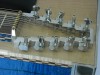
A closeup of the tuner/changer end.

A closeup of the bridge end.

A closeup of the tuner/changer mounted on the players right, with finger tuning knobs.

The tuner arm.

And for those that may not know about the 30+ PSGs analyzed at Jim Palenscars shop (mentioned by RD above), here is the link to the photos and the sustain charts.
http://s75.photobucket.com/albums/i287/ ... ?start=120
Here is the overview of the BEAST with the tuner/changer on the players left, 30" scale, 2 switchable phaseable pickups, no neck block, 14 strings, interchangeable bridge material, 10 pedals, 7 levers, and the B6(G6)LOK, and the 13 series tuning included.
A closeup of the tuner/changer end.
A closeup of the bridge end.
A closeup of the tuner/changer mounted on the players right, with finger tuning knobs.
The tuner arm.
And for those that may not know about the 30+ PSGs analyzed at Jim Palenscars shop (mentioned by RD above), here is the link to the photos and the sustain charts.
http://s75.photobucket.com/albums/i287/ ... ?start=120
-
Bent Romnes
- Posts: 5985
- Joined: 28 Feb 2007 2:35 pm
- Location: London,Ontario, Canada
- State/Province: -
- Country: United States
Ed, how do you allow for different string height regarding the different thickness of the strings? I can't see for sure but are those fingers grooved accordingly?
BenRom Pedal Steel Guitars
https://www.facebook.com/groups/212050572323614/
https://www.facebook.com/groups/212050572323614/
-
ed packard
- Posts: 2162
- Joined: 4 Aug 1998 11:00 pm
- Location: Show Low AZ
- State/Province: -
- Country: United States
allowing some slop
Hi Bent;
Re the tuner/changer on the left unit:
Flatness of the tops of the strings has never been much of a hangup with me so I did not do much about it...except give it a bit of thought.
My 14 strings are C#,G#,F#,E,B,G#,F#,E,B,G#,E,C#,B,E.
Their Gauges are
15,11.5,12,14,18,22,24,28,36,44,56,64,72,112.
When the bottoms of the strings are on a planar surface:
The differences between adjacent strings are 3.5,.5,2,2,4,4,2,4,10,10,12,8,40.
This means that the tops of strings 2,3,4,5,6,7,8,9 are nearly in plane to begin with (+/- string tolerance, finger machining and mounting tolerance, and any overshoot due to string stiffness).
The tops of strings 9,10,11,12,13 would be in plane with each other IF 11,12 were tweaked a bit in gauge BUT i prefer to keep the same noted strings an octave apart 2X each other.
The real monster is 14 which is 0.040" above 13! A groove for this would not hurt, but my thumb helps out when I am not using it and am using the strings near it.
Considering that overshoot has been addressed to a degree by way of shallow angles, I would settle for dropping string 1 a bit, and dropping 14 a bunch.
Re tuner/changer on the players right:
The drop in rod can be grooved to taste, but another way would be to make the rod planar for the high strings, then planar for the lower strings but at an angle to the upper part of the rod...groove for string 14.
On my roller nut units the rollers were depth compensated.
With the above units, I find no need for rollers.
Hope I did not mess the arith up as I am writing off the top of my bald head.
Some fun this PSG thing!!
Edp
Re the tuner/changer on the left unit:
Flatness of the tops of the strings has never been much of a hangup with me so I did not do much about it...except give it a bit of thought.
My 14 strings are C#,G#,F#,E,B,G#,F#,E,B,G#,E,C#,B,E.
Their Gauges are
15,11.5,12,14,18,22,24,28,36,44,56,64,72,112.
When the bottoms of the strings are on a planar surface:
The differences between adjacent strings are 3.5,.5,2,2,4,4,2,4,10,10,12,8,40.
This means that the tops of strings 2,3,4,5,6,7,8,9 are nearly in plane to begin with (+/- string tolerance, finger machining and mounting tolerance, and any overshoot due to string stiffness).
The tops of strings 9,10,11,12,13 would be in plane with each other IF 11,12 were tweaked a bit in gauge BUT i prefer to keep the same noted strings an octave apart 2X each other.
The real monster is 14 which is 0.040" above 13! A groove for this would not hurt, but my thumb helps out when I am not using it and am using the strings near it.
Considering that overshoot has been addressed to a degree by way of shallow angles, I would settle for dropping string 1 a bit, and dropping 14 a bunch.
Re tuner/changer on the players right:
The drop in rod can be grooved to taste, but another way would be to make the rod planar for the high strings, then planar for the lower strings but at an angle to the upper part of the rod...groove for string 14.
On my roller nut units the rollers were depth compensated.
With the above units, I find no need for rollers.
Hope I did not mess the arith up as I am writing off the top of my bald head.
Some fun this PSG thing!!
Edp
-
Bent Romnes
- Posts: 5985
- Joined: 28 Feb 2007 2:35 pm
- Location: London,Ontario, Canada
- State/Province: -
- Country: United States
Hi again Ed,
Thanks for the numbers, which speak for themselves. I do respectfully submit that even the 3.5, 10,2, 4 thou and so on is of a real concern when dealing with a perfectly straight bar laying across the strings on the first fret. Less of a concern of course as you move up the fretboard. I feel that I proved this to myself during my second project where I thought I'd take a somewhat easy way out and turn the same groove in 2 or three rollers where the strings were close in gauge. I did get string buzz at the first fret for sure. I had new rollers turned, each one gauged to its own string, and the buzzing stopped. These gauged rollers were good for this one thing, but not for another issue, namely the fact that some strings end up down too deep in the groove and I'm afraid that this takes some sustain away from the string.
This is why I have started to believe in what Martin Weenick does: Each roller has the same size groove, but each of these rollers are mounted on a separate "pedestal" if you will, that is adjustable from underneath, thereby eliminating all doubt as to aligning the strings on the same plane.
Another issue I would like to address since it is related. An engineer that I know, showed me the way to cut the groove in the roller to get maximum sustain. He says it is important that the string contacts the roller on both sides of the groove and not in the bottom. According to him, maximum sustain is achieved , not by one contact point, like in no groove at all,not by 3 contact points (bottom and sides) but by 2 contact points (each side).
Does this make sense?
Thanks for the numbers, which speak for themselves. I do respectfully submit that even the 3.5, 10,2, 4 thou and so on is of a real concern when dealing with a perfectly straight bar laying across the strings on the first fret. Less of a concern of course as you move up the fretboard. I feel that I proved this to myself during my second project where I thought I'd take a somewhat easy way out and turn the same groove in 2 or three rollers where the strings were close in gauge. I did get string buzz at the first fret for sure. I had new rollers turned, each one gauged to its own string, and the buzzing stopped. These gauged rollers were good for this one thing, but not for another issue, namely the fact that some strings end up down too deep in the groove and I'm afraid that this takes some sustain away from the string.
This is why I have started to believe in what Martin Weenick does: Each roller has the same size groove, but each of these rollers are mounted on a separate "pedestal" if you will, that is adjustable from underneath, thereby eliminating all doubt as to aligning the strings on the same plane.
Another issue I would like to address since it is related. An engineer that I know, showed me the way to cut the groove in the roller to get maximum sustain. He says it is important that the string contacts the roller on both sides of the groove and not in the bottom. According to him, maximum sustain is achieved , not by one contact point, like in no groove at all,not by 3 contact points (bottom and sides) but by 2 contact points (each side).
Does this make sense?
BenRom Pedal Steel Guitars
https://www.facebook.com/groups/212050572323614/
https://www.facebook.com/groups/212050572323614/
-
ed packard
- Posts: 2162
- Joined: 4 Aug 1998 11:00 pm
- Location: Show Low AZ
- State/Province: -
- Country: United States
Bent;
That kind of issue is why we did the 30+ PSG analysis at Jim P's shop a couple of years back. We took lots of physical measurements, photos, and FSA data. In the group of PSGs, there were all sizes and shapes of nut. I found no correlation between nut shape and sustain.
Sustain within the same brand of PSG was also all over the place.
Those photos, charts, and measurements are available to all at the PHOTOBUCKET site listed above.
That kind of issue is why we did the 30+ PSG analysis at Jim P's shop a couple of years back. We took lots of physical measurements, photos, and FSA data. In the group of PSGs, there were all sizes and shapes of nut. I found no correlation between nut shape and sustain.
Sustain within the same brand of PSG was also all over the place.
Those photos, charts, and measurements are available to all at the PHOTOBUCKET site listed above.
-
J D Sauser
- Moderator
- Posts: 3389
- Joined: 4 Aug 1998 11:00 pm
- Location: Wellington, Florida
- State/Province: Florida
- Country: United States
If I may, the way I see it, Ed's LCT could easily be fitted with a gauged free wheel (roller) laid into the original changer finger, just like we had on ours.
His LCT and ours only differ in two things:
I too, am utterly picky about leveling strings at the nut end (and so is my friend Carl Dixon, I know).
But as I said, a gauged roller could be fitted into Ed's design as easy as on ours, which I think could also prove beneficial at the time of fine tuning.
... J-D.
His LCT and ours only differ in two things:
- His was fitted ON a Sierra changer (double hung instead of the now more common single shaft scissor systems), while ours on an old MSA 3R/2L Classic changer.
- Ed's LCT has a pull lever for tuning, similar to the Kline keyless tuner, whereas ours had a pull sleigh.
I too, am utterly picky about leveling strings at the nut end (and so is my friend Carl Dixon, I know
).But as I said, a gauged roller could be fitted into Ed's design as easy as on ours, which I think could also prove beneficial at the time of fine tuning.
... J-D.
-
ed packard
- Posts: 2162
- Joined: 4 Aug 1998 11:00 pm
- Location: Show Low AZ
- State/Province: -
- Country: United States
It would seem apparent that the changer fingers could be grooved to the appropriate depth to compensate for the "nominal" diameters of the strings; not part of what was being studied. Personally, I would like the fingers to be made of zirconium dioxide.
The breadboard for the changes shown in/on the BEAST was also a bit on the crude side = made with $100 each drill press, band saw, and sander plus a $40 XY table.
The hopes for the thread was to get reaction to the idea of integrated tuner/changer PSGs from the players of other style PSGs.
There are those that would not play a keyless, and I expect that there are those that would not want the integrated tuner/changer, regardless of which end it is on.
I would still like to hear from them.
The breadboard for the changes shown in/on the BEAST was also a bit on the crude side = made with $100 each drill press, band saw, and sander plus a $40 XY table.
The hopes for the thread was to get reaction to the idea of integrated tuner/changer PSGs from the players of other style PSGs.
There are those that would not play a keyless, and I expect that there are those that would not want the integrated tuner/changer, regardless of which end it is on.
I would still like to hear from them.
-
J D Sauser
- Moderator
- Posts: 3389
- Joined: 4 Aug 1998 11:00 pm
- Location: Wellington, Florida
- State/Province: Florida
- Country: United States
Until the "others" comment, may I pick your brain a little further, Ed?
From the third (bottom) picture above, I've come to realize, that at one point you had your integrated tuner/changer installed on the right (pickup/bridge end). What is the tone/sound difference YOU noted when you moved it to the left and replaced it with that edge bridge?
Btw. we thought about grooving the fingers to gauge them. The tool shop we used felt it was going to be cheaper and easier to insert a gauged roller. It's not easy to precision v-groove a partial radius. Additionally, the roller version gave us what we think may be easier tuning as the string won't have to drag over the finger.
... J-D.
From the third (bottom) picture above, I've come to realize, that at one point you had your integrated tuner/changer installed on the right (pickup/bridge end). What is the tone/sound difference YOU noted when you moved it to the left and replaced it with that edge bridge?
Btw. we thought about grooving the fingers to gauge them. The tool shop we used felt it was going to be cheaper and easier to insert a gauged roller. It's not easy to precision v-groove a partial radius. Additionally, the roller version gave us what we think may be easier tuning as the string won't have to drag over the finger.
... J-D.
-
Rob Segal
- Posts: 490
- Joined: 4 Aug 1998 11:00 pm
- Location: New York NY
- State/Province: New York
- Country: United States
Finger with Gauged Rollers
Here is a picture of the actual finger, but without the gauged roller in place (J-D has them), and my drawing of the set of rollers. A roller fits into the slot in the finger
The gauged rollers were machined with a 90 degree v-shaped cut, to a calculated depth, each different, so that all the tops of the strings were tangent to a single plane.
This made bar-to-string contact perfect.
It also, I believe, made return to pitch more accurate (overcame the so-called 'hysteresis' problem) by minimizing the dragging of the strings across the roller surface.
It further allowed the strings an 'immaculate' departure from the changer finger, which greatly reduced the 'zizzing' problem. (What zizzing remained would have to have been due to the string's departure from the rounded surface of the bar, an arguably imperfect detail in the whole system that we've not talked about yet.)
The gauged rollers was an idea with which I was quite taken at the time, but in retrospect I don't know objectively how it changed the sustain performance (sound) of the guitar compared to a standard finger.


The gauged rollers were machined with a 90 degree v-shaped cut, to a calculated depth, each different, so that all the tops of the strings were tangent to a single plane.
This made bar-to-string contact perfect.
It also, I believe, made return to pitch more accurate (overcame the so-called 'hysteresis' problem) by minimizing the dragging of the strings across the roller surface.
It further allowed the strings an 'immaculate' departure from the changer finger, which greatly reduced the 'zizzing' problem. (What zizzing remained would have to have been due to the string's departure from the rounded surface of the bar, an arguably imperfect detail in the whole system that we've not talked about yet.)
The gauged rollers was an idea with which I was quite taken at the time, but in retrospect I don't know objectively how it changed the sustain performance (sound) of the guitar compared to a standard finger.
-
ed packard
- Posts: 2162
- Joined: 4 Aug 1998 11:00 pm
- Location: Show Low AZ
- State/Province: -
- Country: United States
tone/sound difference
JD;
The results of some the tests are shown in the set from Jim Palenscars shop (and after) in chart form, for the freq range of 20 to 10KHz or so, as a function of time = 1,2,4,8 seconds for a single condition = open strings strummed at the 12th fret.
In general, for all PSGs, the sound usually referred to as sustain is in the frequency band related to the resonance of that PSG. This is mostly in the several hundred Hz area.
The part of the spectrum that contains the higher frequencies (1kHz to 6KHz) falls off rapidly with time, so the "sustain" in this band is pretty low as compared.
Were these properties different...yes...see the charts.
There are several instruments that were modified with the ITC ideas. They, with the exception of the BEAST, were all Sierra Session Series, 14 string, 25" scale. The BEAST was the result of seeing/hearing the performance of those units/mods.
The Thread "Them Good Vibrations" and its predecessor, touched on the performance differences. The units involved are all here for further tests when I get back to it. They are 25" scale with ITC on the players right and a non roller nut on the left; 25" scale with original hardware; The beast with 30" scale, ITC on the players left, and the changeable rod bridge.
This group, all built at the same time with the same hardware, and by the same person(s) allow comparing a number of performance variables including the effect of string length on the sound/sustain et al.
Because the beast has no neck block, other differences may be examined. All pickups are interchangeable with each other also.
Much to be done when I get back to it. Are there differences...yes...to spell them out in words is beyond this poor cowboy....to show the instrumentation data from the experiments is a can do...and the data is repeatable.
The results of some the tests are shown in the set from Jim Palenscars shop (and after) in chart form, for the freq range of 20 to 10KHz or so, as a function of time = 1,2,4,8 seconds for a single condition = open strings strummed at the 12th fret.
In general, for all PSGs, the sound usually referred to as sustain is in the frequency band related to the resonance of that PSG. This is mostly in the several hundred Hz area.
The part of the spectrum that contains the higher frequencies (1kHz to 6KHz) falls off rapidly with time, so the "sustain" in this band is pretty low as compared.
Were these properties different...yes...see the charts.
There are several instruments that were modified with the ITC ideas. They, with the exception of the BEAST, were all Sierra Session Series, 14 string, 25" scale. The BEAST was the result of seeing/hearing the performance of those units/mods.
The Thread "Them Good Vibrations" and its predecessor, touched on the performance differences. The units involved are all here for further tests when I get back to it. They are 25" scale with ITC on the players right and a non roller nut on the left; 25" scale with original hardware; The beast with 30" scale, ITC on the players left, and the changeable rod bridge.
This group, all built at the same time with the same hardware, and by the same person(s) allow comparing a number of performance variables including the effect of string length on the sound/sustain et al.
Because the beast has no neck block, other differences may be examined. All pickups are interchangeable with each other also.
Much to be done when I get back to it. Are there differences...yes...to spell them out in words is beyond this poor cowboy....to show the instrumentation data from the experiments is a can do...and the data is repeatable.