The gauges are 13, 15, 11, 14, 17, 20p, 26w, 30w, 34w, and 38w.
Who and how are recommended string gauge sets determined? In general, are they for a specified scale-length lap steel? The reason I ask is that I have a Morrell lap steel that I would have returned except for the fact that I replaced the factory strings the day I received it. As an honest man, I didn't "feel right" about returning something after I had changed the strings. The scale length is about 20-5/8".
My 6 string Rondo, which has a screwed up bridge, and needs a nut filing adjustment is a 22.5" scale length. My Variax 300 electric has a scale length of 25.5".
Ok, I know that a shorter scale length can utlize strings that can be tuned higher than instruments with longer scale lengths, right?
My question is:
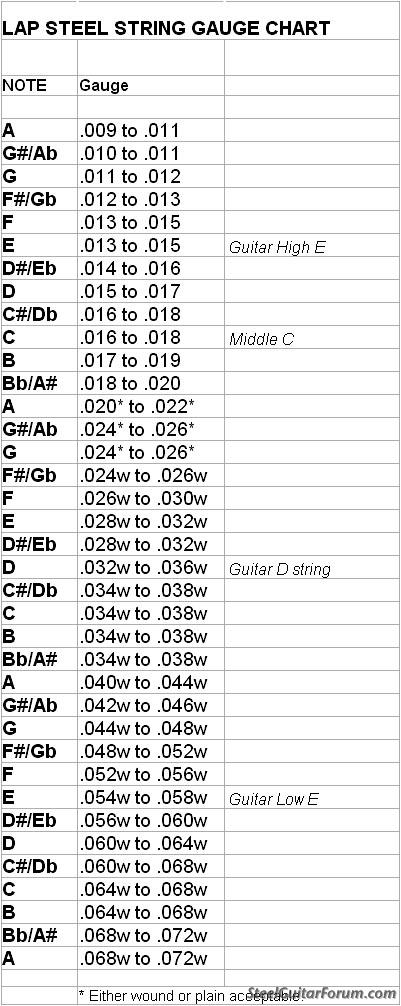
Assuming that I correctly (or incorrectly) feel that fatter strings equals better tone, AND I am tuning within the parameters of the C6 family, would this work for my short scale Morrell: 17, 20, 26, 30, 34, 38 (in C6 tuning)?
===========
If so, would the above gauges also work on the 22.5" Rondo? Or, should I go with 15, 17, 20, 26, 30, and 34 (or 38)? Keep in mind that the lowest string will sometimes be C and sometimes will be C#.
===========
The long-scale Variax is a different story. I would like to install the fattest strings possible, while still remaining in the "C6 family". In other words, I don't mind tuning this one down to A6 (A-C#-E-F#-A-C#) or even G6, since this beast has the capability of using a "virtual capo" allowing me to instantly switch between any tuning within the C6 family. Keep in mind that with this feature, the ACTUAL strings on the guitar will remain in the original tuning. In other words, if I use fat strings and tune to A6, the acoustic sound will still be A6. The string tension will remain EXACTLY the same no matter which tuning I select with the knobs and switches on the guitar. The sound coming from the amp (or into recording software) can be A6, C6, E6, or any other "6th" tuning within the family. It is kinda like a magic trick.

Bottom Line Question: Is it correct to assume that fatter strings equals better tone on a lap steel? Or, is there some other reason that C6 stringsets use smaller gauge strings, other than the risk of breakage? I play with bare thumb and fingers. It is true that fatter strings are harder on the flesh. I know that some here prefer floppier strings for various reasons.



 ...
...