Could someone point me to, or present here, a lick or two and an explanation of the use of the 2nd string single and double lower.
It is eluding me...and the literature is sparse.
Thanks a bunch.
2nd string lower...
Moderator: Dave Mudgett
-
Ray Minich
- Posts: 6431
- Joined: 22 Jul 2003 12:01 am
- Location: Bradford, Pa. Frozen Tundra
- State/Province: -
- Country: United States
-
Kevin Hatton
- Posts: 8233
- Joined: 3 Jan 2002 1:01 am
- Location: Buffalo, N.Y.
- State/Province: -
- Country: United States
-
Steve Feldman

- Posts: 3345
- Joined: 5 Dec 1999 1:01 am
- Location: Central MA USA
- State/Province: -
- Country: United States
Short ending in Bb with a counterpoint move.
L = whole tone lower.
~~ = slide into note, or sustain,
-- = pedal engage (or disengage)

Hope this works!
L = whole tone lower.
~~ = slide into note, or sustain,
-- = pedal engage (or disengage)
Hope this works!
Last edited by Steve Feldman on 2 Jul 2008 11:30 am, edited 1 time in total.
"...An admission of interest in protracted commentary is certainly no reason to capitalize on surmised aberations that do not exist." - BH
-
Dick Wood

- Posts: 3078
- Joined: 2 May 2005 12:01 am
- Location: Springtown Texas, USA
- State/Province: Texas
- Country: United States
Ray,
Ricky and Rebels site has a wealth of popular steel intro's and turn arounds etc. that also include tab.
Touch My Heart uses a full 2nd string lower in conjunction with the 6th string.
Here's Touch My Heart.
http://users.interlinks.net/rebel/steel/touch2.mp3
Another use of the 2nd string 1/2 lower can be heard in George Straits Adalida which is on Buddy Emmons website.
Those two Websites should keep you busy for some time.
Ricky and Rebels site has a wealth of popular steel intro's and turn arounds etc. that also include tab.
Touch My Heart uses a full 2nd string lower in conjunction with the 6th string.
Here's Touch My Heart.
http://users.interlinks.net/rebel/steel/touch2.mp3
Another use of the 2nd string 1/2 lower can be heard in George Straits Adalida which is on Buddy Emmons website.
Those two Websites should keep you busy for some time.
-
James Collett
- Posts: 397
- Joined: 29 Dec 2007 11:23 pm
- Location: Hacienda Heights, CA
- State/Province: California
- Country: United States
-
Dick Sexton
- Posts: 3554
- Joined: 2 Oct 2006 12:01 am
- Location: Greenville, Ohio
- State/Province: Ohio
- Country: United States
Second string 1/2 tone lower..
Key of “C” Intro
------1st Part------------------------------------2nd Part----------------------------
1___1~~2~~~6____________|__________________________________
2___1~~2D~~6______________________________________________
3__________________________________________________________
4_____________________________________________10~___8~~____
5_______________10~~10A___10A~10______10~10A~~~___________
6_______________10B~10B___________10B~~~~~~~~~~___8~~____
Time 1----2----3---------4--------------1-------2-------3------&------4
------1st Part------------------------------------2nd Part----------------------------
1___1~~2~~~6____________|__________________________________
2___1~~2D~~6______________________________________________
3__________________________________________________________
4_____________________________________________10~___8~~____
5_______________10~~10A___10A~10______10~10A~~~___________
6_______________10B~10B___________10B~~~~~~~~~~___8~~____
Time 1----2----3---------4--------------1-------2-------3------&------4
-
Twayn Williams
- Posts: 1471
- Joined: 12 Jun 1999 12:01 am
- Location: Portland, OR
- State/Province: Oregon
- Country: United States
The main use I have for the 2nd string lower D# - D is for minor chords. ex:
B(5) - D#(2) - F#(1) = B major
B(5) - D(2) - F#(1) = B minor
Using this string grouping:
fret 1 = C
fret 3 = Dm /with lever
fret 5 = Em /with lever
fret 6 = F
fret 8 = G
fret 10 = Am /with lever
fret 12 = Bm /with lever
Also, it's useful for Dom7 chords with strings 6-5-(4)-3-2
The full lower D# - C# makes a nice suspension with strings 5-2-1
B(5) - D#(2) - F#(1) = B major
B(5) - D(2) - F#(1) = B minor
Using this string grouping:
fret 1 = C
fret 3 = Dm /with lever
fret 5 = Em /with lever
fret 6 = F
fret 8 = G
fret 10 = Am /with lever
fret 12 = Bm /with lever
Also, it's useful for Dom7 chords with strings 6-5-(4)-3-2
The full lower D# - C# makes a nice suspension with strings 5-2-1
Primitive Utility Steel
-
Jonathan Shacklock

- Posts: 681
- Joined: 11 Jan 2006 1:01 am
- Location: London, UK
- State/Province: -
- Country: United States
Kevin there is an old course called "Trappin' Squirrels" by Catfish John Geer which is all about the 2nd string lower. It's still listed on Frenchy's page at $9.99. At that price nobody's getting rich but it looks to be a very well written book (I haven't been through my copy yet). It's quite advanced stuff I think.Kevin Hatton wrote:If anyone comes out with a course on second string lower they are going to make themselves alot of money. It is sorely needed.
-
George Crowder
- Posts: 440
- Joined: 11 Jan 2001 1:01 am
- Location: Richmond, VA, USA
- State/Province: -
- Country: United States
Hi Ray. Jonathan beat me to it. I was going to suggest you consider the "Trappin' Squirrels" course by Catfish John Geer. On the cover of the booklet, he refers to it as "A guide toward a more complete understanding of the 2nd string's full potential on the E9th Neck." I bought mine from Frenchy's (Belen, NM) at the convention in St Louis in 2000.
-
Greg Cutshaw

- Posts: 6821
- Joined: 17 Nov 1998 1:01 am
- Location: Corry, PA, USA
- State/Province: -
- Country: United States
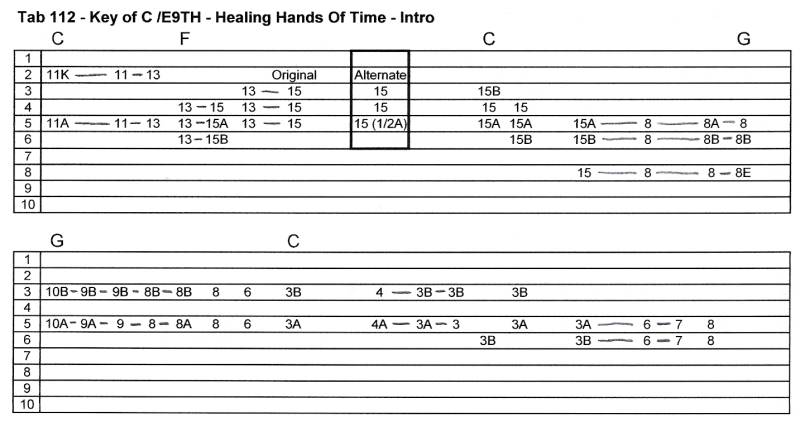
Here's 8 or 9 examples from my tab pages with sound files (one of these might have the 2nd string raising). There's many more if you went through all the songs there!
Intro to healing hands of time:
Audio
Tab
Fast Lick:
Audio
Tab
Practical Use:
Audio
Tab
Unique Sound:
Audio
Tab
3 uses (Raise):
Audio
Tab
1 uses (Raise):
Audio
Tab
An Eye For An Eye:
Audio
Tab
With Pedal 3:
Audio
Tab
Weldon Myrick Sound:
Audio
Tab
Greg
Intro to healing hands of time:
Audio
Tab
Fast Lick:
Audio
Tab
Practical Use:
Audio
Tab
Unique Sound:
Audio
Tab
3 uses (Raise):
Audio
Tab
1 uses (Raise):
Audio
Tab
An Eye For An Eye:
Audio
Tab
With Pedal 3:
Audio
Tab
Weldon Myrick Sound:
Audio
Tab
Greg
-
Tony Prior
- Posts: 14718
- Joined: 17 Oct 2001 12:01 am
- Location: Charlotte NC
- State/Province: -
- Country: United States
-
C Dixon
- Posts: 7348
- Joined: 4 Aug 1998 11:00 pm
- Location: Duluth, GA USA
- State/Province: -
- Country: United States
Quick and easy I to IV resolve.................
You are holding a I chord (say strings 3, 4 and 5, letting them sustain, waiting to go to a IV chord.
Simply pick strings 2 and 3, and as they sustain, half-stop the second string. Gives a I to IIIM to I7 chord's tension. It is easy and leads you right to the IV chord.
This works like a charm on a hymn like "In the Garden".
Key of Bb (6th fret) Play ALL the notes below at this fret.
"I come to the garden alone".......now do it right here. It is a great transition like an alto or a tenor in a choir would do as the soprano sustains the melody. Leads the soprano right into the IV chord.
Then a little later on in the song at the same fret,
Where the song goes "......walks with me (again at the 6th fret strings 4, 5 and 6) as these strings sustain, reach up and pick the 2nd string and lower it a whole tone, then immediately release the knee lever and as you do, engage the knee lever that lowers the 4th string a half a tone. This says, "As He talks with me....." ALL at the 6th fret.
It is awesomely beautiful. I would tab it, but I don't know how to make tab work on the forum.
When this is practiced and you learn to give it feeling, it will bring chills down the spine of most who hear it, as well as yours. This is never more true than when your audience has a number of Christians in it.
It is awesomely beautiful I think.
And as you do this, may Jesus bless you AND your audience,
carl
c.
You are holding a I chord (say strings 3, 4 and 5, letting them sustain, waiting to go to a IV chord.
Simply pick strings 2 and 3, and as they sustain, half-stop the second string. Gives a I to IIIM to I7 chord's tension. It is easy and leads you right to the IV chord.
This works like a charm on a hymn like "In the Garden".
Key of Bb (6th fret) Play ALL the notes below at this fret.
"I come to the garden alone".......now do it right here. It is a great transition like an alto or a tenor in a choir would do as the soprano sustains the melody. Leads the soprano right into the IV chord.
Then a little later on in the song at the same fret,
Where the song goes "......walks with me (again at the 6th fret strings 4, 5 and 6) as these strings sustain, reach up and pick the 2nd string and lower it a whole tone, then immediately release the knee lever and as you do, engage the knee lever that lowers the 4th string a half a tone. This says, "As He talks with me....." ALL at the 6th fret.
It is awesomely beautiful. I would tab it, but I don't know how to make tab work on the forum.
When this is practiced and you learn to give it feeling, it will bring chills down the spine of most who hear it, as well as yours. This is never more true than when your audience has a number of Christians in it.
It is awesomely beautiful I think.
And as you do this, may Jesus bless you AND your audience,
carl
c.
A broken heart + † = a new heart.
-
Dennis Olearchik
- Posts: 391
- Joined: 24 Jul 2001 12:01 am
- Location: Newtown, PA
- State/Province: Pennsylvania
- Country: United States
Pleae help me name the chords...
Hi Carl,
So if you played the same strings and levers "open"
(no bar), would you be playing an E Major, C# Minor 7th and E Major 7th, then an A Major (the IV chord)?
Thanks for your help.
Dennis
So if you played the same strings and levers "open"
(no bar), would you be playing an E Major, C# Minor 7th and E Major 7th, then an A Major (the IV chord)?
Thanks for your help.
Dennis
-
C Dixon
- Posts: 7348
- Joined: 4 Aug 1998 11:00 pm
- Location: Duluth, GA USA
- State/Province: -
- Country: United States
Hi Dennis,
More like this:
Emajor-G#minor-E7th-Amajor.
A very common musical resolve, often used in orchestral music, and particularly in gospel music.
Nevertheless, listeners can equate easily with it, and NO instrument on earth, in my opinion, can embellish it as well. This is due to the "overtones" that are uniquely specific to the PSG.
carl
More like this:
Emajor-G#minor-E7th-Amajor.
A very common musical resolve, often used in orchestral music, and particularly in gospel music.
Nevertheless, listeners can equate easily with it, and NO instrument on earth, in my opinion, can embellish it as well. This is due to the "overtones" that are uniquely specific to the PSG.
carl
A broken heart + † = a new heart.
-
Dennis Olearchik
- Posts: 391
- Joined: 24 Jul 2001 12:01 am
- Location: Newtown, PA
- State/Province: Pennsylvania
- Country: United States
-
Ray Minich
- Posts: 6431
- Joined: 22 Jul 2003 12:01 am
- Location: Bradford, Pa. Frozen Tundra
- State/Province: -
- Country: United States
-
mtulbert

- Posts: 1593
- Joined: 14 Apr 2000 12:01 am
- Location: Plano, Texas 75023
- State/Province: Texas
- Country: United States
-
C Dixon
- Posts: 7348
- Joined: 4 Aug 1998 11:00 pm
- Location: Duluth, GA USA
- State/Province: -
- Country: United States
-
Jerry Hayes R.I.P.
- Posts: 7489
- Joined: 3 Mar 1999 1:01 am
- Location: Virginia Beach, Va.
- State/Province: West Virginia
- Country: United States
Ray, here's some simple "chromatic" style runs to try out. In each one of them just play the strings in this order: 5 2 4 1 3 1 4 2 5......using your thumb and middle fingers.......
Try it with no pedals or levers, then play it with the 2nd string lowered to D, then play it with the second string lowered to C# and listen to the scales you're playing and the difference in each.
Next play the same string sequence with the E strings, 4 and 8, lowered to D# and have the second string lowered to C#.
Another move is to play the same strings in the same sequence but have the A & B pedals depressed and the 2nd string lowered to D........
Have fun with the steel as it's a fun instrument...JH in Va.
Try it with no pedals or levers, then play it with the 2nd string lowered to D, then play it with the second string lowered to C# and listen to the scales you're playing and the difference in each.
Next play the same string sequence with the E strings, 4 and 8, lowered to D# and have the second string lowered to C#.
Another move is to play the same strings in the same sequence but have the A & B pedals depressed and the 2nd string lowered to D........
Have fun with the steel as it's a fun instrument...JH in Va.
Don't matter who's in Austin (or anywhere else) Ralph Mooney is still the king!!!
-
Tony Prior
- Posts: 14718
- Joined: 17 Oct 2001 12:01 am
- Location: Charlotte NC
- State/Province: -
- Country: United States
-
C Dixon
- Posts: 7348
- Joined: 4 Aug 1998 11:00 pm
- Location: Duluth, GA USA
- State/Province: -
- Country: United States
Jerry,
That is a VERY good suggestion.
Tony, I agree. There is a ton of material out there. But author's of such books rarely make much money. Human nature causes us to want to just "play" and psychologically we tend to assume we can get it without the work of reading and/or studying.
Practice! Practice! Practice! IS indeed a worthy saying, but practicing helps nothing if it is bad practice. And bad habits that develop early on, are very hard to remove.
Plus, there are many who simply cannot learn from reading. They have to do it.
Understanding the printed word, is not the forte' of most PSG players, sadly. I mean NO disrespect. Just my observations over many years.
I ran into this when I tried to train technicians for RCA, when I taught electronics. In MOST cases the training was for naught. We had the material and it was good stuff. But only a few really benefited from it.
Proving the old adage, "When all else fails, read the instructions".
This was driven home to us very painfully when the company decided that us instructors should ride with the techs at random (and at unannounced) times during the year, AFTER they had attended the training centers, to see just how much they had learned.
And every instructor reported the same sad statistics. MOST of what had been taught was either not absorbed, or it was cast aside. Sorta like this, "nah, ya don' need that theory stuff. Who cares how a capacitor works anyway?"
As the company stayed in dismay over why our "call-back" ratio in reality was 60%; even though the managers fudged the stats and reported less than 6%. LOL
oh well "For the wisdom of man is folly unto the Lord."
carl
That is a VERY good suggestion.
Tony, I agree. There is a ton of material out there. But author's of such books rarely make much money. Human nature causes us to want to just "play" and psychologically we tend to assume we can get it without the work of reading and/or studying.
Practice! Practice! Practice! IS indeed a worthy saying, but practicing helps nothing if it is bad practice. And bad habits that develop early on, are very hard to remove.
Plus, there are many who simply cannot learn from reading. They have to do it.
Understanding the printed word, is not the forte' of most PSG players, sadly. I mean NO disrespect. Just my observations over many years.
I ran into this when I tried to train technicians for RCA, when I taught electronics. In MOST cases the training was for naught. We had the material and it was good stuff. But only a few really benefited from it.
Proving the old adage, "When all else fails, read the instructions".
This was driven home to us very painfully when the company decided that us instructors should ride with the techs at random (and at unannounced) times during the year, AFTER they had attended the training centers, to see just how much they had learned.
And every instructor reported the same sad statistics. MOST of what had been taught was either not absorbed, or it was cast aside. Sorta like this, "nah, ya don' need that theory stuff. Who cares how a capacitor works anyway?"
As the company stayed in dismay over why our "call-back" ratio in reality was 60%; even though the managers fudged the stats and reported less than 6%. LOL
oh well
"For the wisdom of man is folly unto the Lord."carl
A broken heart + † = a new heart.
-
CrowBear Schmitt
- Posts: 11624
- Joined: 8 Apr 2000 12:01 am
- Location: Ariege, - PairO'knees, - France
- State/Province: -
- Country: United States
Carl, it's great to see you back w; us 
1--------------------------------2--------------------------------3
1
2 ---------4--------------6--------------8D--------------9---------------11
3
4 ------4F-------------6--------------8---------------9F-------------11F
5 --4A ------4A__6A ------6A__8A--------8A__9A------9A__11A
6
---------------------------------4------------------------------
1
2 --------------------13-------------------15D
3
4 ----------------13-------------------15
5 ---11A__13A-----------13A__15A------------15A__16A
6
1--------------------------------2--------------------------------3
1
2 ---------4--------------6--------------8D--------------9---------------11
3
4 ------4F-------------6--------------8---------------9F-------------11F
5 --4A ------4A__6A ------6A__8A--------8A__9A------9A__11A
6
---------------------------------4------------------------------
1
2 --------------------13-------------------15D
3
4 ----------------13-------------------15
5 ---11A__13A-----------13A__15A------------15A__16A
6
-
Greg Cutshaw
- Posts: 6821
- Joined: 17 Nov 1998 1:01 am
- Location: Corry, PA, USA
- State/Province: -
- Country: United States
I've got about 20 good examples of the 2nd string lower handy. I could tab them out and publish them. But I have to agree with Carl that most people would just consider it a chore to pour through them. Also many would prefer them on YouTube or video which I can now do, but then there wouldn't be any tab. It's just too much work to do the tab and the video and even more work if I was to put them in a hardcover book with a CD. Print my PDF tabs and burn a CD using Windows so it will play in any CD player, and PRESTO! you've got a book/CD course.
Greg
Greg
-
Ben Jones

- Posts: 3356
- Joined: 12 Dec 2005 1:01 am
- Location: Seattle, Washington, USA
- State/Province: Washington
- Country: United States
-
C Dixon
- Posts: 7348
- Joined: 4 Aug 1998 11:00 pm
- Location: Duluth, GA USA
- State/Province: -
- Country: United States