I can't agree with that. According to the voltage divider rule, the output voltage of the pickup will be the same, regardless of wht, or what kind, of components, are placed in parallel---Meaning, of course, that a variable resistor wouldnt even be seen in the circuit. This is DEFINITELY not standard on any of my guitars.Donny Hinson wrote:No. Though putting the resistance in series will also lower signal, it's simply not as effective as the standard parallel (voltage divider) method.Actually, the volume pedal pot would have to be in series with the pickup, wouldn't it? That way, when you backed off the pedal, you'd be adding MORE DC resistance in line.
I want to see if my suspicions are true.
Moderator: Dave Mudgett
-
Stephen Gambrell
- Posts: 6870
- Joined: 20 Apr 2002 12:01 am
- Location: Over there
- State/Province: -
- Country: United States
-
David L. Donald

- Posts: 13700
- Joined: 17 Feb 2003 1:01 am
- Location: Koh Samui Island, Thailand
- State/Province: -
- Country: United States
Chicken Shawarma Recipe
Some may know it in it's variation as the Doner Kebab.
Not related culinarilly to the Donner Party.

Shawarma is like the ultimate on the go meal. Thinly sliced meat, wrapped in a pita with veggies and sauce is a delicious quick meal. Before attempting a shawarma recipe, please read "Shawarma 101: Tips for Making Authentic Shawarma". You won't be disappointed!
INGREDIENTS:
* 1 1/2 lbs boneless, skinless chicken thighs or breasts (thinly cut)
* 1 cup plain yogurt
* 1/4 cup vinegar
* 2 cloves garlic, crushed
* 1 teaspoon pepper
* 1/2 teaspoon salt
* 2 cardamom pods
* 1 teaspoon allspice
* juice from 1 lemon
* ___________________________
* FOR THE SAUCE:
* 1 cup tahini
* 2 cloves garlic, crushed
* 1/4 cup lemon juice
* 2 tablespoons yogurt
* ___________________________
* PITA FILLINGS:
* 8 loaves of pita bread or 4 large
* thinly slice cucumbers
* thinly sliced onions
* 1/2 teaspoon sumac
* thinly sliced tomatoes
* 1/2 cup fresh parsley, finely chopped
* pickle slices (optional)
PREPARATION:
Combine all ingredients except for chicken, fillings, and sauce ingredients to make marinade. If it seems a little dry, add a little olive oil (a tablespoon at a time). Here is an excellent tahini recipe, if you do not have some handy.
Add chicken, cover and refrigerate at least 8 hours, preferable overnight.
In a stockpot or large saucepan, cook chicken over medium heat for 45 minutes or until done. Be sure not to overcook! If chicken becomes a little dry, add a few tablespoons of water throughout cooking duration.
While chicken is cooking, prepare the sauce. Combine sauce ingredients and mix well. Set aside.
Take the onions, tomatoes, cucumbers and sprinkle with sumac. Add other filling ingredients in a large bowl and combine well.
When the chicken is done, you can shred it, slice it, or leave into large pieces. As long as it it thinly cut, there is not much difference. I prefer to cut mine into wide strips.
Prepare the Pita
Place enough chicken on pita that cover 1/4 of the loaf. Add veggies and pour sauce. Roll like a soft taco or burrito and you have shawarma! You can also stuff the pocket of the pita if you like. I prefer to roll large pitas (this is where making your own pita comes in handy), but it is hard to find large loaves of pita at the supermarket.
Serving Shawarma
You can serve shawarma with fries, falafel, hummus, or with a salad like tabouleh.
Some may know it in it's variation as the Doner Kebab.
Not related culinarilly to the Donner Party.
Shawarma is like the ultimate on the go meal. Thinly sliced meat, wrapped in a pita with veggies and sauce is a delicious quick meal. Before attempting a shawarma recipe, please read "Shawarma 101: Tips for Making Authentic Shawarma". You won't be disappointed!
INGREDIENTS:
* 1 1/2 lbs boneless, skinless chicken thighs or breasts (thinly cut)
* 1 cup plain yogurt
* 1/4 cup vinegar
* 2 cloves garlic, crushed
* 1 teaspoon pepper
* 1/2 teaspoon salt
* 2 cardamom pods
* 1 teaspoon allspice
* juice from 1 lemon
* ___________________________
* FOR THE SAUCE:
* 1 cup tahini
* 2 cloves garlic, crushed
* 1/4 cup lemon juice
* 2 tablespoons yogurt
* ___________________________
* PITA FILLINGS:
* 8 loaves of pita bread or 4 large
* thinly slice cucumbers
* thinly sliced onions
* 1/2 teaspoon sumac
* thinly sliced tomatoes
* 1/2 cup fresh parsley, finely chopped
* pickle slices (optional)
PREPARATION:
Combine all ingredients except for chicken, fillings, and sauce ingredients to make marinade. If it seems a little dry, add a little olive oil (a tablespoon at a time). Here is an excellent tahini recipe, if you do not have some handy.
Add chicken, cover and refrigerate at least 8 hours, preferable overnight.
In a stockpot or large saucepan, cook chicken over medium heat for 45 minutes or until done. Be sure not to overcook! If chicken becomes a little dry, add a few tablespoons of water throughout cooking duration.
While chicken is cooking, prepare the sauce. Combine sauce ingredients and mix well. Set aside.
Take the onions, tomatoes, cucumbers and sprinkle with sumac. Add other filling ingredients in a large bowl and combine well.
When the chicken is done, you can shred it, slice it, or leave into large pieces. As long as it it thinly cut, there is not much difference. I prefer to cut mine into wide strips.
Prepare the Pita
Place enough chicken on pita that cover 1/4 of the loaf. Add veggies and pour sauce. Roll like a soft taco or burrito and you have shawarma! You can also stuff the pocket of the pita if you like. I prefer to roll large pitas (this is where making your own pita comes in handy), but it is hard to find large loaves of pita at the supermarket.
Serving Shawarma
You can serve shawarma with fries, falafel, hummus, or with a salad like tabouleh.
DLD, Chili farmer. Plus bananas and papaya too.
Real happiness has no strings attached.
But pedal steels have many!
Real happiness has no strings attached.
But pedal steels have many!
-
Keith Hilton
- Posts: 3788
- Joined: 1 May 1999 12:01 am
- Location: 248 Laurel Road Ozark, Missouri 65721
- State/Province: Missouri
- Country: United States
-
Jim Cohen

- Posts: 21849
- Joined: 18 Nov 1999 1:01 am
- Location: Philadelphia, PA
- State/Province: Pennsylvania
- Country: United States
-
David L. Donald
- Posts: 13700
- Joined: 17 Feb 2003 1:01 am
- Location: Koh Samui Island, Thailand
- State/Province: -
- Country: United States
-
Donny Hinson
- Posts: 21830
- Joined: 16 Feb 1999 1:01 am
- Location: Glen Burnie, Md. U.S.A.
- State/Province: -
- Country: United States
I suggest you read up on voltage dividers, loading, shunt circuits, and then take a look at the volume controls in guitar pickup wiring diagrams, and finally, in your own guitars. If any of the pot terminals are grounded, it's a voltage divider circuit, plain and simple.Stephen Gambrell wrote: I can't agree with that. According to the voltage divider rule, the output voltage of the pickup will be the same, regardless of wht, or what kind, of components, are placed in parallel---Meaning, of course, that a variable resistor wouldnt even be seen in the circuit. This is DEFINITELY not standard on any of my guitars.
-
David L. Donald
- Posts: 13700
- Joined: 17 Feb 2003 1:01 am
- Location: Koh Samui Island, Thailand
- State/Province: -
- Country: United States
Donny is right as I understand it.

If you use two resistors in series,
and use the voltage appearing across one of them.
This configuration is known as a voltage divider
because it divides the source voltage into two parts.
The basic circuit is shown to the above.
In this circuit, the output voltage, VOUT,
can be set accurately as a fraction of the source voltage, E.
Using our example above, we want to select R1 and R2
such that we will drop 4 volts across R1,
leaving 5 volts across R2.
Since VOUT is the voltage across R2,
this will give us the voltage we want.
But how do we find the correct values of resistance to do this?
The first step is to note that, with no external connection to VOUT, this is simply a series connection and the same current must flow through both resistors.
Therefore, in accordance with Ohm's Law,
the ratio of voltage across these resistors will be equal to the ratio of the resistance values themselves.
--------------
For volume pot pedals.
If the pot is in series one side to pickup
and the other on the wiper to input of amp,
it gives higher resistance as the pedal passes less signal.
This is a non fixed LR network Inductance / Resistance.
Your pickup is the L the pot is the R
.
it ALSO really changes the impedance of the pickup to input circuit
as an R/ C circuit
and that will change the tubes Miller capacitances reactions to your signal
and cause even greater tone changes.
Miller capacitances are small, but still there,
and things like Grid Stopper resisters are there to deal with it.
There is a a global effect on the circuit.
All changes in topology change both before and after circuit reactions.
----------
While a 1 meg pot across ground to signal will be about the same as the typical 1meg or 1meg+ 27k
or 68k resisters at the front end of the preamp section.
So you are leaving the impedance relatively unchanged,
but changing the amount of signal passed across this relatively fixed resistance impedance.
Here is a classic Fender champ preamp dirt simple.
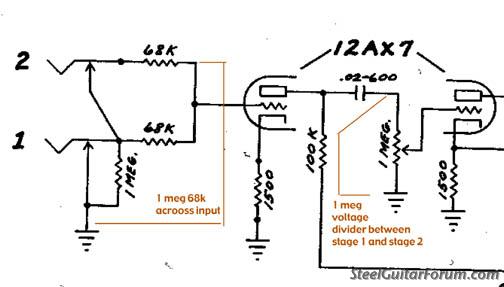
As you can see there is 1 meg to ground in BOTH inputs to stages.
Not in series.
Also the .02 capaciter before the 1Meg pot is seeing ALWAYS 1 meg, not a changing R/C network.
The stage two tube grid DOES see a change in impedance.
But to a hotter signal.
And this is an old, old, low rung in the
cost of production, amp. Late 50's entry level.
Keith Hilton is building his pedals to minimize
any changes the circuits see before and after
other than AC signal level.
And yet even then, Brad Sarno's BB and Rev are taking that change and putting it later in the chain,
so that the L/R of your pick up to tube is as direct as possible before the tube.
Then changing that optimal signal AFTER the tube
like in the Champ above.
If you use two resistors in series,
and use the voltage appearing across one of them.
This configuration is known as a voltage divider
because it divides the source voltage into two parts.
The basic circuit is shown to the above.
In this circuit, the output voltage, VOUT,
can be set accurately as a fraction of the source voltage, E.
Using our example above, we want to select R1 and R2
such that we will drop 4 volts across R1,
leaving 5 volts across R2.
Since VOUT is the voltage across R2,
this will give us the voltage we want.
But how do we find the correct values of resistance to do this?
The first step is to note that, with no external connection to VOUT, this is simply a series connection and the same current must flow through both resistors.
Therefore, in accordance with Ohm's Law,
the ratio of voltage across these resistors will be equal to the ratio of the resistance values themselves.
--------------
For volume pot pedals.
If the pot is in series one side to pickup
and the other on the wiper to input of amp,
it gives higher resistance as the pedal passes less signal.
This is a non fixed LR network Inductance / Resistance.
Your pickup is the L the pot is the R
.
it ALSO really changes the impedance of the pickup to input circuit
as an R/ C circuit
and that will change the tubes Miller capacitances reactions to your signal
and cause even greater tone changes.
Miller capacitances are small, but still there,
and things like Grid Stopper resisters are there to deal with it.
There is a a global effect on the circuit.
All changes in topology change both before and after circuit reactions.
----------
While a 1 meg pot across ground to signal will be about the same as the typical 1meg or 1meg+ 27k
or 68k resisters at the front end of the preamp section.
So you are leaving the impedance relatively unchanged,
but changing the amount of signal passed across this relatively fixed resistance impedance.
Here is a classic Fender champ preamp dirt simple.
As you can see there is 1 meg to ground in BOTH inputs to stages.
Not in series.
Also the .02 capaciter before the 1Meg pot is seeing ALWAYS 1 meg, not a changing R/C network.
The stage two tube grid DOES see a change in impedance.
But to a hotter signal.
And this is an old, old, low rung in the
cost of production, amp. Late 50's entry level.
Keith Hilton is building his pedals to minimize
any changes the circuits see before and after
other than AC signal level.
And yet even then, Brad Sarno's BB and Rev are taking that change and putting it later in the chain,
so that the L/R of your pick up to tube is as direct as possible before the tube.
Then changing that optimal signal AFTER the tube
like in the Champ above.
DLD, Chili farmer. Plus bananas and papaya too.
Real happiness has no strings attached.
But pedal steels have many!
Real happiness has no strings attached.
But pedal steels have many!
-
Stephen Gambrell
- Posts: 6870
- Joined: 20 Apr 2002 12:01 am
- Location: Over there
- State/Province: -
- Country: United States
First, build a fire with a good, fragrant hardwood like hickory. When the fire burns to coals, THEN, and only then, are you ready to cook a pig, or a few green hams. Place the coals off to one side, and make sure the meat is covered, but vented, so there's plenty of smoke. The only time you want to uncover the meat, is to add more coals. Take your time, relax, and DO NOT ADD SAUCE while the meat is actually cooking. Wait till it's nearly done (it'll pull apart easily when done), THEN add a little sauce, if you want to. A lot of folks like to serve the pig with beans, potato salad, cole slaw, and plenty of beverages to wash it down. I enjoy a vinegar-based sauce, but tastes vary accordig to region, and, well, to taste. And, to quote the late David Blackwell, one of the best friends a man could have, "You ain't enjoyin' barbecue ifit ain't drippin' off both elbows."
-
David Doggett

- Posts: 8088
- Joined: 20 Aug 2002 12:01 am
- Location: Bawl'mer, MD (formerly of MS, Nawluns, Gnashville, Knocksville, Lost Angeles, Bahsten. and Philly)
- State/Province: -
- Country: United States
-
David L. Donald
- Posts: 13700
- Joined: 17 Feb 2003 1:01 am
- Location: Koh Samui Island, Thailand
- State/Province: -
- Country: United States
Chacha's friend Lee na, who sang in our wedding, is married to an Israeli fellow.
They have a nice little restaraunt in Chaingmai,
and make great Shawarma, falafal and tabouli etc.
We always eat there a few times during visits.
Now if I could get a good bagle and lox.....
Nah just a meshugana idea here!
They have a nice little restaraunt in Chaingmai,
and make great Shawarma, falafal and tabouli etc.
We always eat there a few times during visits.
Now if I could get a good bagle and lox.....
Nah just a meshugana idea here!
DLD, Chili farmer. Plus bananas and papaya too.
Real happiness has no strings attached.
But pedal steels have many!
Real happiness has no strings attached.
But pedal steels have many!
-
Dave Mudgett

- Moderator
- Posts: 10556
- Joined: 16 Jul 2004 12:01 am
- Location: Central Pennsylvania and Gallatin, Tennessee
- State/Province: Pennsylvania
- Country: United States
Now, if I could just get these barbecue joints up here to listen to that, Steve. A lot of them just DROWN everything in sweet sauce.Take your time, relax, and DO NOT ADD SAUCE while the meat is actually cooking. Wait till it's nearly done (it'll pull apart easily when done), THEN add a little sauce, if you want to. ... I enjoy a vinegar-based sauce, but tastes vary accordig to region, and, well, to taste. ... "You ain't enjoyin' barbecue ifit ain't drippin' off both elbows."
I agree on that most guitar volume controls I have seen are voltage dividers.
On that stock Fender tube amp input circuit - yes there's a 1 Meg resistor to ground. But it's not effective on both inputs. The input impedance (to ground) of Input 1 is about 1 MegOhm, and the input impedance of Input 2 is about 136 KOhm.
Each jack, without a plug in it, is shorted to the top of that 1 Meg resistor, which is shorted to ground when Input 1 has nothing plugged into it. When plugged into Input 1, the Input 1 short is opened up and the effective resistance/impedance to ground is about 1 Meg, since the effective impedance of the tube grid side is a very large parallel impedance to ground. But when plugged into Input 2 only, the Input 1 short remains, the Input 2 short opens up, and the effective resistance/impedance to ground is now 68K + 68K or about 136K. In fact, if you plug a jack into Input 1 and 2 respectively and measure with a decent ohmmeter, that is what you will observe - provided the shorting jack is working properly. Input 2 is set up as a 50/50 voltage divider, so the gain of that input is roughly half - but with a much lower input impedance.
In fact, I had occasion to measure this the other day, because the shorting jack on Vibrato channel Input 1 of my Deluxe Reverb was acting funky.
This input impedance difference is why I prefer not to use Input 2 on most guitar amps, unless I'm trying to tame the high end. It does tend to dull the sound, especially with higher impedance pickups.
-
Dave Mudgett
- Moderator
- Posts: 10556
- Joined: 16 Jul 2004 12:01 am
- Location: Central Pennsylvania and Gallatin, Tennessee
- State/Province: Pennsylvania
- Country: United States
-
David L. Donald
- Posts: 13700
- Joined: 17 Feb 2003 1:01 am
- Location: Koh Samui Island, Thailand
- State/Province: -
- Country: United States
Ok we have a few things happening.
In empty top plug (2) we have
1 meg + ( 68k parallel to 68K )from the grid to ground
BUT also parallel to the 1 meg a direct path to ground
through jack (1) and 68K resister, the other one above allowing a voltage division.
ground • 68k • grid • 68k • source
So effectively with no guitars it's 32k to ground from grid.
Enough to not let it freewheel so to speak.
In bottom we have the same thing with no plug inserted.
Just a slightly different routing around the barn.
__________________________
Add plug in top jack.
It lifts the ground going to jack (1)lower.
leaving 1 meg and parallel jack to ground link.
So the 68k below to ground and 68k above divide the voltage passing through 68k above and this goes to grid.
This is the quiet low level input, where you put the high level signals.
------------------------
Now insert in the lower jack (1) with (2) empty
You lift the ground leaving
1 meg to ground PLUS
(68k parallel to 68k)through BOTH jacks
So you get 1 meg 32k relative to ground
and tube stage ones grid.
68k parallel to 68K means they divide each other 32k.
Add a SECOND guitar,
and there is now an inductance / resitance filter
of the 68k resister and pickup (coil and magnet)
laid on top of guitar ones signal.
I have a Harmony open at the moment
2 inputs both go right to a.02 cap placed like the 68k's
and tops off on a 1 meg resister and into the tube grid.
And the cathode is DIRECTLY grounded, no 1,500 ohm resister.
Quite odd when I first saw it.
DLD, Chili farmer. Plus bananas and papaya too.
Real happiness has no strings attached.
But pedal steels have many!
Real happiness has no strings attached.
But pedal steels have many!
-
Dave Mudgett
- Moderator
- Posts: 10556
- Joined: 16 Jul 2004 12:01 am
- Location: Central Pennsylvania and Gallatin, Tennessee
- State/Province: Pennsylvania
- Country: United States
Absolutely. My point was that the input impedance from guitar input to ground - looking from the guitar input side - is now about 68K + 68K, or about 136K. This is a big change from the 1M seen using Input 1. But perfect for a jazz archtop type tone. Cleans it up and smooths it out - I normally roll the guitar tone down some anyway. But I don't care for it for E9 PSG, especially with a humbucking pickup, which is usually a little darker anyway. Personal taste dictates, of course.Add plug in top jack.
It lifts the ground going to jack (1)lower.
leaving 1 meg and parallel jack to ground link.
So the 68k below to ground and 68k above divide the voltage passing through 68k above and this goes to grid.
This is the quiet low level input, where you put the high level signals.
Oh, yeah - there are a bunch of things going on - Leo was very clever guy.
-
David L. Donald
- Posts: 13700
- Joined: 17 Feb 2003 1:01 am
- Location: Koh Samui Island, Thailand
- State/Province: -
- Country: United States
Dave the top one is actual 2nd input or low level.
But it is 32Kr not 136kr.
Two resisters in SERIES add them or 136K
And yes nice for a clean warm signal
or a hotter pickup like a steel pickup.
But for input 1,
in this case the two 68Kr are in parallel
and so divide by the number of resisters,
or two, so = 32Kr.
It is relatively easy since both are the same value.
Well with Leo cost and such played a big part.
The basic circuits were in the radio books
30 years before Leo built amp one.
But Leo looked at the Post War new tubes and updated.
He bought war surplus parts and built circuits that
fit the parts he got in big lots. Of course he had
an idea WHAT to buy first.
Eventually he started working from musician feedback
about what worked and looked to job parts that fit to those new ideas.
He also just experimented; had groups of all different
types and sizes of parts in small lots and tried all sorts of ideas.
He was a designer that listened for sure.
But it is 32Kr not 136kr.
Two resisters in SERIES add them or 136K
And yes nice for a clean warm signal
or a hotter pickup like a steel pickup.
But for input 1,
in this case the two 68Kr are in parallel
and so divide by the number of resisters,
or two, so = 32Kr.
It is relatively easy since both are the same value.
Well with Leo cost and such played a big part.
The basic circuits were in the radio books
30 years before Leo built amp one.
But Leo looked at the Post War new tubes and updated.
He bought war surplus parts and built circuits that
fit the parts he got in big lots. Of course he had
an idea WHAT to buy first.
Eventually he started working from musician feedback
about what worked and looked to job parts that fit to those new ideas.
He also just experimented; had groups of all different
types and sizes of parts in small lots and tried all sorts of ideas.
He was a designer that listened for sure.
DLD, Chili farmer. Plus bananas and papaya too.
Real happiness has no strings attached.
But pedal steels have many!
Real happiness has no strings attached.
But pedal steels have many!
-
Dave Mudgett
- Moderator
- Posts: 10556
- Joined: 16 Jul 2004 12:01 am
- Location: Central Pennsylvania and Gallatin, Tennessee
- State/Province: Pennsylvania
- Country: United States
David, I'm talking about the impedance looking in from the guitar input to ground, not from the grid to ground. The main path to ground plugged into Input 2 is two 68K resistors in series, and the 1M resistor is shunted to ground by the shorting jack on Input 1. There is, of course, the parallel path to ground from the tube grid onward, which is generally considered infinite. Again, I'm talking about the impedance that the guitar output sees "looking into" the amp, which is different than the impedance you're talking about.But it is 32Kr not 136kr.
Two resisters in SERIES add them or 136K
Similarly, the input impedance through Input 1 is 1M.
You can easily verify this with an ohmmeter - just plug a cable into each jack separately, and measure the DC resistance across the other end of the cable. There are no coupling capacitors, so the impedance to ground in the front-end is strictly resistive.
-
David L. Donald
- Posts: 13700
- Joined: 17 Feb 2003 1:01 am
- Location: Koh Samui Island, Thailand
- State/Province: -
- Country: United States
Gotcha.
Of course getting the amp to sound is
BOTH sides of this impedance reference point.
Yes dragging the signal 136K to ground
will give a much lower level.
It will also alter the L/R reactance
of the pickup/coil and resister value.
Sorry, I have been thinking in terms of
what the amp sees to do it's job.
And the guitar as just an AC source.
Of course getting the amp to sound is
BOTH sides of this impedance reference point.
Yes dragging the signal 136K to ground
will give a much lower level.
It will also alter the L/R reactance
of the pickup/coil and resister value.
Sorry, I have been thinking in terms of
what the amp sees to do it's job.
And the guitar as just an AC source.
DLD, Chili farmer. Plus bananas and papaya too.
Real happiness has no strings attached.
But pedal steels have many!
Real happiness has no strings attached.
But pedal steels have many!
-
Dave Mudgett
- Moderator
- Posts: 10556
- Joined: 16 Jul 2004 12:01 am
- Location: Central Pennsylvania and Gallatin, Tennessee
- State/Province: Pennsylvania
- Country: United States
Ah, yes - but they load each other.And the guitar as just an AC source.
My concern with low input impedance is twofold. First, voltage transfer depends on the ratio of the receiver's input impedance to the source's output impedance. Low input impedance and high output impedance gives poor results.
Second, it has been my experience that with many overwound pickups, the actual AC output impedance of the pickup is often much higher at high frequencies due to high inductive impedance, hence the poor voltage transfer is exaagerated at high frequencies. To me, such pickups tend to sound relatively dull and lifeless into a low-impedance input.
This is probably why I like Lawrence humbuckers so much. Bill specifically winds his pickups to have much lower inductance than typical humbuckers. My experience is that they don't lose their high-frequency edge the same way as, let's say, a typical Gibson-humbucker style pickup.
My opinions, all personal taste, YMMV, and all that.

-
Don Drummer
- Posts: 917
- Joined: 1 May 2007 2:15 pm
- Location: West Virginia, USA
- State/Province: West Virginia
- Country: United States
hot pups first hle secong hole
Samidges, pick-ups, what's going on here?
-
Dave Mudgett
- Moderator
- Posts: 10556
- Joined: 16 Jul 2004 12:01 am
- Location: Central Pennsylvania and Gallatin, Tennessee
- State/Province: Pennsylvania
- Country: United States
Don, the questions that opened up this thread were:
Why is it important? Because there has been a trend for some time for many PSG pickup winders to use more and more windings to make pickups "hotter" - have a higher output, in terms of the voltage level of the signal put out. These pickups add new technical requirements for things like Keith's active volume pedal, effects, and amplifier input stages, and also affect the frequency response (tonality) of the pickup. Since it's a technical topic, some of the responses have gotten a little technical.
We've been discussing the whats, whys, and wherefores of those two questions - first about the hotter pickups, and then the advantages and disadvantages of "High" sensitivity versus "Low" sensitivity amplifier inputs.How many of you think the hotter a pickup is the better it is? How many of you think plugging into the input marked "High" on an amplifier is better than plugging into the input marked "Low" Just curious.
Why is it important? Because there has been a trend for some time for many PSG pickup winders to use more and more windings to make pickups "hotter" - have a higher output, in terms of the voltage level of the signal put out. These pickups add new technical requirements for things like Keith's active volume pedal, effects, and amplifier input stages, and also affect the frequency response (tonality) of the pickup. Since it's a technical topic, some of the responses have gotten a little technical.
-
David L. Donald
- Posts: 13700
- Joined: 17 Feb 2003 1:01 am
- Location: Koh Samui Island, Thailand
- State/Province: -
- Country: United States
What I have so far NEVER seen is:
A pickup that charts its frequency response.
And does it in relation to 2-3
more or less standard benchmark input circuit impedances.
Or at least a relevant spectrum of typical impedances.
Not just it's resistance in ohms when
measured with a DC ohm meter.
Oh, this one is 17Kr or 18.5Kr or 14Kr.
Compared to the amps impedance it is negligable,
but when COUPLED to that amps impedance it
absolutely has changes in audio bandwith responses.
What does this pick up do at
50hz 200hz 500hz 1K 2.5K 4K 6K 7K
into 1 meg ohm load, 100k ohm load, 500k ohm load.
Or at least a spectrum from an S-14 low string to
the harmonics of the top string before it breaks.
What does this do from C6 bottom to Hughey country on E9.
Use an Ebow and get the same relative excitation of strings.
Easier than building a mechanical plucking machine.
That's gonna tell me what the pickup actually does.
And where is the pickups resonance points in the spectrum?
Is it peaking at the same place my amp's 1st stage peaks at?
Or worse the resonant point of the SPEAKER!
Or is it at an inverse to the amps faults: auto canceling faults.
If I knew exactly what it does versus a load,
I could specify a inductance value that matches
my amp.
Well, you use a Steel king at XXXX impedance,
try the 3,400 turn winding with 32g wire etc.
Ah, but you use a JBL inside it, a slightly lower resonance,
raise yours away from it. Try 3,600 windings. Etc.
Not the relatively irrelevant resistance of the winding at DC.
I think many people go through many amps
and pickups trying to MATCH the faults in
the best manner. And this may be why.
Dave that making any sense? Iit's late here.
A pickup that charts its frequency response.
And does it in relation to 2-3
more or less standard benchmark input circuit impedances.
Or at least a relevant spectrum of typical impedances.
Not just it's resistance in ohms when
measured with a DC ohm meter.
Oh, this one is 17Kr or 18.5Kr or 14Kr.
Compared to the amps impedance it is negligable,
but when COUPLED to that amps impedance it
absolutely has changes in audio bandwith responses.
What does this pick up do at
50hz 200hz 500hz 1K 2.5K 4K 6K 7K
into 1 meg ohm load, 100k ohm load, 500k ohm load.
Or at least a spectrum from an S-14 low string to
the harmonics of the top string before it breaks.
What does this do from C6 bottom to Hughey country on E9.
Use an Ebow and get the same relative excitation of strings.
Easier than building a mechanical plucking machine.
That's gonna tell me what the pickup actually does.
And where is the pickups resonance points in the spectrum?
Is it peaking at the same place my amp's 1st stage peaks at?
Or worse the resonant point of the SPEAKER!
Or is it at an inverse to the amps faults: auto canceling faults.
If I knew exactly what it does versus a load,
I could specify a inductance value that matches
my amp.
Well, you use a Steel king at XXXX impedance,
try the 3,400 turn winding with 32g wire etc.
Ah, but you use a JBL inside it, a slightly lower resonance,
raise yours away from it. Try 3,600 windings. Etc.
Not the relatively irrelevant resistance of the winding at DC.
I think many people go through many amps
and pickups trying to MATCH the faults in
the best manner. And this may be why.
Dave that making any sense? Iit's late here.
Last edited by David L. Donald on 16 May 2008 4:54 pm, edited 1 time in total.
DLD, Chili farmer. Plus bananas and papaya too.
Real happiness has no strings attached.
But pedal steels have many!
Real happiness has no strings attached.
But pedal steels have many!
-
Dave Mudgett
- Moderator
- Posts: 10556
- Joined: 16 Jul 2004 12:01 am
- Location: Central Pennsylvania and Gallatin, Tennessee
- State/Province: Pennsylvania
- Country: United States
I have actually seen pickup frequency responses. But you're right - most manufacturers don't make that information public. I can imagine they rightly view that as somewhat propietary - why give the competition the info to easily cop what they're doing?
Once one has that frequency response, one could model the frequency response as it goes through a chain of linear circuits. But the problem, especially with tube amps, is the nonlinearities. So I think comparative frequency response curves would give a good qualitative feel to compare pickups, but I'm not sure I would take it any further than that.
Yup - I have to match guitars, pickups, amps, speakers, and tubes if applicable, to each other. Technical information is good up to a point. But to me - at a certain point, my ears are the final judge of what I think is "good" or "not good". Or sometimes I let other people make that determination - when I'm a willing subject on their dime.
Once one has that frequency response, one could model the frequency response as it goes through a chain of linear circuits. But the problem, especially with tube amps, is the nonlinearities. So I think comparative frequency response curves would give a good qualitative feel to compare pickups, but I'm not sure I would take it any further than that.
Yup - I have to match guitars, pickups, amps, speakers, and tubes if applicable, to each other. Technical information is good up to a point. But to me - at a certain point, my ears are the final judge of what I think is "good" or "not good". Or sometimes I let other people make that determination - when I'm a willing subject on their dime.
-
Don Drummer
- Posts: 917
- Joined: 1 May 2007 2:15 pm
- Location: West Virginia, USA
- State/Province: West Virginia
- Country: United States
pick ups and such
thanks for the reply Dave M. This thread is good. I use single coil pups on my Lashly Legrande and a GEO. L on my Emmons push pull on the "E" neck. The minutia about all of this is somthing I'm not familiar with. Maby I'll learn some \thing from this discussion. It' the samidge stuff I didn't get. Don
-
Jim Pitman
- Posts: 2049
- Joined: 29 Aug 1998 12:01 am
- Location: Waterbury Ctr. VT 05677 USA
- State/Province: -
- Country: United States
David D and Dave M. You are right on the money. I think I'm qualified to say that as I manufactured pickups for a while. I had the same E-bow idea but never did find one.
There are four components to pickup tone:
Resistance, Inductance, and Q. Really the third, Q describes the ratio of the first two. The fourth is magnet strength. The capacitance is a fifth that is negligible typically unless its unusually high due to some defect.
Actually, there is another fifth - temperature! The resistance of a pickup will change about 200ohms per degree F. This always presented a problem for me living in cold VT. A customer would order a pickup at specific R and be dissapointed when they measured it in ther home in CA where the temperature was 85. I eventually specified R at 72degF.
A highly inuctive pickup will accentuate the bass. One with a high Q will be peakey at a frequency determined by the inductance for the most part. You can play around with this in the following manner. Each turn of wire contributes to both the R and the L. Changing the guage of wire causes the resistance per turn to go up or down. Changing the core (pole pieces) to be more massive increses the L only. I farted around with these three and using an LCR bridge and my ear until I got the tone me and my compadres were looking for. I used to write the R,L, and Q imbedded in the SN on the pickup. If these three were consitent you got a consistent sounding pickup.
A small peak in the resonance around 1.5K is what most people are looking for in a steel guitar tone.
The inductance has the biggest bearing on the tone of the four. I found that most modern players will say the pickup is thin and lacking bass if the inuctance falls below 11mh.
However, I like the tone of the old Fender steel guitars for some apps. These pickups were lighlty wound - low inductance. On the other hand, if you put one of these in an Emmons PP guitar you'd wreck the holey grail tone I'm sure.
So there is a place for highly wound pickups. I think it has been arrived at by modern manufactures. Modern pedal steels benefit from a more highly inductive pickup because acoustically they have alot of high end.
Yes amp input impedance has a big bearing on pickup tone. Let's face it though everybody is going to plug a PSG into a volume pedal with a 500Kohm pot which represents a parallel load to the amps input Z. (unless they use effects loops - see Keithe
's other post)
Unfortunately, It takes quite a few turns to get that inductance without it being peakey hence that's why a steel guitar pickup puts out so much more signal than a standard pickup. - Each turn increase the signal amplitude.
Possible solution - Use a weaker magnet.
There are four components to pickup tone:
Resistance, Inductance, and Q. Really the third, Q describes the ratio of the first two. The fourth is magnet strength. The capacitance is a fifth that is negligible typically unless its unusually high due to some defect.
Actually, there is another fifth - temperature! The resistance of a pickup will change about 200ohms per degree F. This always presented a problem for me living in cold VT. A customer would order a pickup at specific R and be dissapointed when they measured it in ther home in CA where the temperature was 85. I eventually specified R at 72degF.
A highly inuctive pickup will accentuate the bass. One with a high Q will be peakey at a frequency determined by the inductance for the most part. You can play around with this in the following manner. Each turn of wire contributes to both the R and the L. Changing the guage of wire causes the resistance per turn to go up or down. Changing the core (pole pieces) to be more massive increses the L only. I farted around with these three and using an LCR bridge and my ear until I got the tone me and my compadres were looking for. I used to write the R,L, and Q imbedded in the SN on the pickup. If these three were consitent you got a consistent sounding pickup.
A small peak in the resonance around 1.5K is what most people are looking for in a steel guitar tone.
The inductance has the biggest bearing on the tone of the four. I found that most modern players will say the pickup is thin and lacking bass if the inuctance falls below 11mh.
However, I like the tone of the old Fender steel guitars for some apps. These pickups were lighlty wound - low inductance. On the other hand, if you put one of these in an Emmons PP guitar you'd wreck the holey grail tone I'm sure.
So there is a place for highly wound pickups. I think it has been arrived at by modern manufactures. Modern pedal steels benefit from a more highly inductive pickup because acoustically they have alot of high end.
Yes amp input impedance has a big bearing on pickup tone. Let's face it though everybody is going to plug a PSG into a volume pedal with a 500Kohm pot which represents a parallel load to the amps input Z. (unless they use effects loops - see Keithe
's other post)
Unfortunately, It takes quite a few turns to get that inductance without it being peakey hence that's why a steel guitar pickup puts out so much more signal than a standard pickup. - Each turn increase the signal amplitude.
Possible solution - Use a weaker magnet.
-
Brad Sarno

- Posts: 4958
- Joined: 18 Dec 2000 1:01 am
- Location: St. Louis, MO USA
- State/Province: -
- Country: United States