Are there any modern steels as easily changeable...
Moderator: Dave Mudgett
-
Mike Neer

- Posts: 11523
- Joined: 9 Dec 2002 1:01 am
- Location: NJ
- State/Province: -
- Country: United States
Are there any modern steels as easily changeable...
as a Fender? I would really like to look at steels which are adaptable to different copedants/tunings. In the few days that I've owned a Fender I've been impressed by how easily this can be done, although there are some definite limitations. I'm a bit of an experimenter in this way.
Links to streaming music, websites, YouTube: Links
-
Jon Light (deceased)
- Posts: 14336
- Joined: 4 Aug 1998 11:00 pm
- Location: Saugerties, NY
- State/Province: -
- Country: United States
I fully expect that someone will show me that I am wrong but.....to the best of my knowledge, no. All modern steels are derived/evolved from a similar engineering concept of bellcranks with an assortment of holes for varying radii mounted on cross shafts and rods from the cranks (pullers) to changer fingers with a selction of holes of varying radii.
However, I do not know how linear changers (Excel, Anapeg) are engineered and I also don't know anything about Jacksons other than that they have some distinctly innovative stuff going on.
Some of the modern guitars are easier than others but they all require moving rods and pullers. Far easier than a push/pull but still more than a 5 minute task.
Question for historians----is the cross shaft>bellcrank>rod>changer a Bud Carter thing?
However, I do not know how linear changers (Excel, Anapeg) are engineered and I also don't know anything about Jacksons other than that they have some distinctly innovative stuff going on.
Some of the modern guitars are easier than others but they all require moving rods and pullers. Far easier than a push/pull but still more than a 5 minute task.
Question for historians----is the cross shaft>bellcrank>rod>changer a Bud Carter thing?
-
Bill Ford

- Posts: 3862
- Joined: 13 Dec 1999 1:01 am
- Location: Graniteville SC Aiken
- State/Province: -
- Country: United States
-
Jim Sliff

- Posts: 7060
- Joined: 22 Jun 2005 12:01 am
- Location: Lawndale California, USA
- State/Province: California
- Country: United States
I can change the whole copedent on a cable-pull Fender...or two copedents on a 1000...in about 5-10 minutes if I don't need to change string gages.
I've done copedent changes on an MSA Classic, a few Shobuds, and a GFI Ultra plus the Fenders. The GFI was very easy, and with a quite complicated, odd copedent. The Shobuds varied; the MSA was really tough. With the GFI I still needed a couple screwdrivers, blue low-tack tape to hold stuff in place temporarily, and Allen wrenches (I HATE Allen wrenches...I wish guitar companies would figure out a better way....), and an entire change took a few evenings of work.
With the Fenders I need my fingers and a commercial while we're watching TV....
I've done copedent changes on an MSA Classic, a few Shobuds, and a GFI Ultra plus the Fenders. The GFI was very easy, and with a quite complicated, odd copedent. The Shobuds varied; the MSA was really tough. With the GFI I still needed a couple screwdrivers, blue low-tack tape to hold stuff in place temporarily, and Allen wrenches (I HATE Allen wrenches...I wish guitar companies would figure out a better way....), and an entire change took a few evenings of work.
With the Fenders I need my fingers and a commercial while we're watching TV....
No chops, but great tone
1930's/40's Rickenbacher/Rickenbacker 6&8 string lap steels
1921 Weissenborn Style 2; Hilo&Schireson hollownecks
Appalachian, Regal & Dobro squarenecks
1959 Fender 400 9+2 B6;1960's Fender 800 3+3+2; 1948 Fender Dual-8 Professional
1930's/40's Rickenbacher/Rickenbacker 6&8 string lap steels
1921 Weissenborn Style 2; Hilo&Schireson hollownecks
Appalachian, Regal & Dobro squarenecks
1959 Fender 400 9+2 B6;1960's Fender 800 3+3+2; 1948 Fender Dual-8 Professional
-
Bent Romnes
- Posts: 5985
- Joined: 28 Feb 2007 2:35 pm
- Location: London,Ontario, Canada
- State/Province: -
- Country: United States
Jim,
quote: and Allen wrenches (I HATE Allen wrenches...I wish guitar companies would figure out a better way.
end quote
What about the Canadian square drive screw/driver?
It is called the Robertson and is a Hamilton, Ontario invention.
It is near to impossible to over-torque and strip a Robertson compared to a Phillips or Allen.
I have been cursing the tiny set screws I am using for the pull rods. I keep stripping either the hex hole or the Allen key. All this wouldn't have happened if the set screws were made for a Robertson driver.
quote: and Allen wrenches (I HATE Allen wrenches...I wish guitar companies would figure out a better way.
end quote
What about the Canadian square drive screw/driver?
It is called the Robertson and is a Hamilton, Ontario invention.
It is near to impossible to over-torque and strip a Robertson compared to a Phillips or Allen.
I have been cursing the tiny set screws I am using for the pull rods. I keep stripping either the hex hole or the Allen key. All this wouldn't have happened if the set screws were made for a Robertson driver.
-
ebb

- Posts: 1480
- Joined: 4 Aug 1998 11:00 pm
- Location: nj
- State/Province: -
- Country: United States
-
Russ Tkac
- Posts: 2486
- Joined: 28 Feb 2005 1:01 am
- State/Province: -
- Country: United States
-
Dave Mudgett

- Moderator
- Posts: 10556
- Joined: 16 Jul 2004 12:01 am
- Location: Central Pennsylvania and Gallatin, Tennessee
- State/Province: Pennsylvania
- Country: United States
My old BMI is easily the easiest steel I've had to set up, and I have an old Rack and Barrel Sho Bud, which I agree is also pretty simple. When I got the BMI, I had never really worked on a PSG. I figured out what I needed to and made the changes in a morning. I'd have probably been at it for days on most steels.
With the BMI, one can quickly unscrew the bellcrank, take the nylons off, remove the pullrod and put it where you want it, screw the bellcrank back in, and screw the nylon back on. Bang - a half an hour or an hour to change the whole setup if you have it mapped out in advance. The nylons require a hex wrench. The only thing you have to worry about is that there is a metal spacer on the changer end of the nylon that has to be put back in place.
To just move the the changer hole without making a pull change, one can remove the cotter pin holding the pull rod onto the bellcrank, yank out the pull rod from the changer end, put it back in the hole you want, and reconnect the cotter pin.
There was a thread a couple of years ago about this: http://steelguitarforum.com/Forum5/HTML/010993.html
I also think these guitars play and sound great, and used examples can generally be found reasonably.
With the BMI, one can quickly unscrew the bellcrank, take the nylons off, remove the pullrod and put it where you want it, screw the bellcrank back in, and screw the nylon back on. Bang - a half an hour or an hour to change the whole setup if you have it mapped out in advance. The nylons require a hex wrench. The only thing you have to worry about is that there is a metal spacer on the changer end of the nylon that has to be put back in place.
To just move the the changer hole without making a pull change, one can remove the cotter pin holding the pull rod onto the bellcrank, yank out the pull rod from the changer end, put it back in the hole you want, and reconnect the cotter pin.
There was a thread a couple of years ago about this: http://steelguitarforum.com/Forum5/HTML/010993.html
I also think these guitars play and sound great, and used examples can generally be found reasonably.
-
John Roche

- Posts: 2212
- Joined: 2 Feb 2006 1:01 am
- Location: England
- State/Province: -
- Country: United States
I can change the rod settings on my Sierra session uni 12 while sitting in the playing position, i can reach under the steel and locate the rod by moving the pedal or lever then unscrew the rod and move it up or down the bellcrank it takes only the time to unscrew and rescrew the rod. I even done on a gig in between songs if i'm not happy with the feel of the pedals as the guitar is new to me i'm still trying to find the right feel on the pedals.
-
b0b

- Posts: 29079
- Joined: 4 Aug 1998 11:00 pm
- Location: Cloverdale, CA, USA
- State/Province: -
- Country: United States
None are as easy as a Fender, no.
-𝕓𝕆𝕓- (admin) - Robert P. Lee - Recordings - Breathe - D6th - Video
-
Danny James
- Posts: 694
- Joined: 3 May 2004 12:01 am
- Location: Summerfield Florida USA
- State/Province: Florida
- Country: United States
I've just got to ask it one more time---- 
Why with the modern technology and machinery available today,---- do not the modern manufacturers make their changers as easy to quickly change as the old Multi-Kords were ----
---- 
I do believe the ones made today are beautiful pieces of art and workmanship, that function very well once they are set up. They are very strong, stay in tune, and hold up well. No doubt about that.
Why with the modern technology and machinery available today,---- do not the modern manufacturers make their changers as easy to quickly change as the old Multi-Kords were
---- I do believe the ones made today are beautiful pieces of art and workmanship, that function very well once they are set up. They are very strong, stay in tune, and hold up well. No doubt about that.
-
Al Marcus

- Posts: 9440
- Joined: 12 May 1999 12:01 am
- Location: Cedar Springs,MI USA (deceased)
- State/Province: -
- Country: United States
Danny-I dont know why they dont, but Fender tried it in about 1974 with a multi-Kord type changer, but a very good one. I played one, very nice, crossover switch so pedals and knee levers worked either neck.Gene Fields designed it when he was with Fender and underneath was all stamped parts so it could be easily put on production line for fast inexpensive constrution. The body of birdseye maple probably was the most expensive part of the guitar. They only made a few and quit as they were selling Telecasters, etc like mad, so who needed to bother with a few steels.? Probably their thinking.
There was NO Need for the factory to set up the tunings as it was so easy for the player to do. I heard that too many guys wanted custom tunings and they didn't care to go into that. The players had a miss understanding of how easy it was to customize your own tungs. They could have put a booklet showing where the scres went to a new inexperienced player and that would have solve their Problem.
I wonder if the builders today have more labor in their guitars setting them up, than actually building them? No setup labor, no matter what the tunings, with the Fender PS210, Multikord or old Gibsons......al. :)
:)
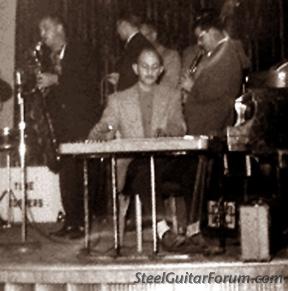
My Gibson Electra-Harp built in 1942 had that, I could take a screw out of on hole and put it in another and cahnge in less than 30 Seconds. I could do a whoe new setup on 6 pedasl in 10 minutes , all from the top sitting at the guitar.
Here I am playing it at a Jam session, I took the cabinet off and put it on a pipe stand. If I had to tune a pedal, I turned the screw up or down right between songs. Quick. This picture was about 1952...al:)
There was NO Need for the factory to set up the tunings as it was so easy for the player to do. I heard that too many guys wanted custom tunings and they didn't care to go into that. The players had a miss understanding of how easy it was to customize your own tungs. They could have put a booklet showing where the scres went to a new inexperienced player and that would have solve their Problem.
I wonder if the builders today have more labor in their guitars setting them up, than actually building them? No setup labor, no matter what the tunings, with the Fender PS210, Multikord or old Gibsons......al.
:)My Gibson Electra-Harp built in 1942 had that, I could take a screw out of on hole and put it in another and cahnge in less than 30 Seconds. I could do a whoe new setup on 6 pedasl in 10 minutes , all from the top sitting at the guitar.
Here I am playing it at a Jam session, I took the cabinet off and put it on a pipe stand. If I had to tune a pedal, I turned the screw up or down right between songs. Quick. This picture was about 1952...al:)
Michigan (MSGC)Christmas Dinner and Jam on my 80th Birthday.
My Email.. almarcus@cmedic.net
My Website..... www.cmedic.net/~almarcus
My Email.. almarcus@cmedic.net
My Website..... www.cmedic.net/~almarcus
-
Danny James
- Posts: 694
- Joined: 3 May 2004 12:01 am
- Location: Summerfield Florida USA
- State/Province: Florida
- Country: United States
Yes Al, that's what I'm getting at. My Multi-Kords have the same type of system. You take a screw out of one hole and put it into the one next to it, to change from raise to lower on that string and that pedal.
Multi-Kords I admit leave a lot to be desired, however the principal of their changer I believe is quite desirable. You could raise or lower any or all strings with each pedal in any combination. I know of no pedal steel guitar being made today that has a changer with those capabilities and I'm sure that could still be done.
It seems to me that most if not all the pedal steels that I have seen work off the same basic design with their changers. To do what I am suggesting, I believe will take some experimenting with completely different changer designs.
I really believe such a guitar could be made sturdy and yet lighter than most steels today and more cost effective as well. It could also be designed to be much more efficient to change to different tunings. Those who like to experiment with different tunings could do that to their hearts content in a matter of minutes instead of hours.
Multi-Kords I admit leave a lot to be desired, however the principal of their changer I believe is quite desirable. You could raise or lower any or all strings with each pedal in any combination. I know of no pedal steel guitar being made today that has a changer with those capabilities and I'm sure that could still be done.
It seems to me that most if not all the pedal steels that I have seen work off the same basic design with their changers. To do what I am suggesting, I believe will take some experimenting with completely different changer designs.
I really believe such a guitar could be made sturdy and yet lighter than most steels today and more cost effective as well. It could also be designed to be much more efficient to change to different tunings. Those who like to experiment with different tunings could do that to their hearts content in a matter of minutes instead of hours.
-
Al Marcus
- Posts: 9440
- Joined: 12 May 1999 12:01 am
- Location: Cedar Springs,MI USA (deceased)
- State/Province: -
- Country: United States
Danny-They were sure easy to change a tuning back then, and I did that a lot as it was so easy. I didn't need to send it back to the factory to "Adjust" it.
The easiest guitar I ever had next to that was my old Sho-Bud Professional with the Rack and Barrel undercarrige. no Bellcranks to move aroun. The rod pullers had ten holes in them for raise and ten holes for lower. All you had to do was loosen the set screw on the Barrel and pull the rod out, put it in another hole, put the barrel on the rod , tighten the set screw , took about 3 minutes if your fast enough. All the holes lined up right from the factory. But they were heavy in those days.
Hal Rugg used one for years on the GOO and Wilburn Bros Shows. I wish I still had it, But I still got a Pro1 with barrel tuners, but with bell cranks, 6 pedals and 5 knee levers.
Then again, most players use a standard E9th and C6 setup so not so important to change for them....al.
The easiest guitar I ever had next to that was my old Sho-Bud Professional with the Rack and Barrel undercarrige. no Bellcranks to move aroun. The rod pullers had ten holes in them for raise and ten holes for lower. All you had to do was loosen the set screw on the Barrel and pull the rod out, put it in another hole, put the barrel on the rod , tighten the set screw , took about 3 minutes if your fast enough. All the holes lined up right from the factory. But they were heavy in those days.
Hal Rugg used one for years on the GOO and Wilburn Bros Shows. I wish I still had it, But I still got a Pro1 with barrel tuners, but with bell cranks, 6 pedals and 5 knee levers.
Then again, most players use a standard E9th and C6 setup so not so important to change for them....al.
Michigan (MSGC)Christmas Dinner and Jam on my 80th Birthday.
My Email.. almarcus@cmedic.net
My Website..... www.cmedic.net/~almarcus
My Email.. almarcus@cmedic.net
My Website..... www.cmedic.net/~almarcus
-
b0b
- Posts: 29079
- Joined: 4 Aug 1998 11:00 pm
- Location: Cloverdale, CA, USA
- State/Province: -
- Country: United States
The modern pull rod method isn't as easy to modify as the older guitars, that's true. But it works much better. The pedals stay in tune and the changes can be adjusted to work in perfect synchronization. Also, the modern designs include wonderful features like tunable splits and compensators.
I have a Rickenbacker (changer similar to Multi-Kord) and a Fender 1000. Both are very easy to change. Neither has the tuning stability or easy pedal action of a modern guitar.
Players today have less interest in changing what their pedals do. There was a lot of experimentation in the early days of the instrument. Today, almost everyone plays E9 with standard pedals and nearly standard knee levers.
I have a Rickenbacker (changer similar to Multi-Kord) and a Fender 1000. Both are very easy to change. Neither has the tuning stability or easy pedal action of a modern guitar.
Players today have less interest in changing what their pedals do. There was a lot of experimentation in the early days of the instrument. Today, almost everyone plays E9 with standard pedals and nearly standard knee levers.
-𝕓𝕆𝕓- (admin) - Robert P. Lee - Recordings - Breathe - D6th - Video
-
Danny James
- Posts: 694
- Joined: 3 May 2004 12:01 am
- Location: Summerfield Florida USA
- State/Province: Florida
- Country: United States
Bob, yes I understand and agree, however, my point is with modern technology I believe a guitar can be built today with a changer that has the best of both worlds.
There should be no need to sacrifice anything to accomplish what I'm suggesting.
Working smoother, staying in tune,synchronization, as well as quick tuning changes, it seems to me should be within the reach of the builders of today.
Sometimes we just have to dream a little outside of the box.
I think there are at least a few of us such as Mike Neer, Al, & myself who would like to see this.
It would be interesting to see how many pedal steel players would like to do some experimenting with tuning changes if they could only do it easily and quickly.
I guess I'm one of those guys who's never satisfied with things as they are. Always thinking how to improve something. Once in a while I come up with something that actually works,--- like my lapsteel changer that I designed and built.
There should be no need to sacrifice anything to accomplish what I'm suggesting.
Working smoother, staying in tune,synchronization, as well as quick tuning changes, it seems to me should be within the reach of the builders of today.
Sometimes we just have to dream a little outside of the box.
I think there are at least a few of us such as Mike Neer, Al, & myself who would like to see this.
It would be interesting to see how many pedal steel players would like to do some experimenting with tuning changes if they could only do it easily and quickly.
I guess I'm one of those guys who's never satisfied with things as they are. Always thinking how to improve something. Once in a while I come up with something that actually works,
--- like my lapsteel changer that I designed and built. -
b0b
- Posts: 29079
- Joined: 4 Aug 1998 11:00 pm
- Location: Cloverdale, CA, USA
- State/Province: -
- Country: United States
I have designed a user interface for an electronic changer controller. The pedals would send signals to a computer which would operate the changer mechanism. This gives you the ultimate tuning flexibility, but it removes the direct mechanical feel of pulling the strings with your foot.
If anyone with a background in robotics wants to prototype such a beast, I'd be happy to strike up a partnership deal. I can do the programming...
If anyone with a background in robotics wants to prototype such a beast, I'd be happy to strike up a partnership deal. I can do the programming...
-𝕓𝕆𝕓- (admin) - Robert P. Lee - Recordings - Breathe - D6th - Video
-
Willis Vanderberg

- Posts: 2446
- Joined: 13 Mar 2002 1:01 am
- Location: Petoskey Mi
- State/Province: -
- Country: United States
-
basilh

- Posts: 7710
- Joined: 26 May 1999 12:01 am
- Location: United Kingdom
- State/Province: -
- Country: United States
-
Duane Reese
- Posts: 2039
- Joined: 13 Oct 2005 12:01 am
- State/Province: -
- Country: United States
-
Mike Neer
- Posts: 11523
- Joined: 9 Dec 2002 1:01 am
- Location: NJ
- State/Province: -
- Country: United States
b0b, would you mind explaining "tunable splits and compensators" to me?
I, for one, really like the idea of a guitar that's very "user-friendly". It's not that I don't like E9 and all that, but I can't wrap my head around it (the chromatic strings, even though on my E13 tuning I use an F# followed by a G#) and I don't really have the time to lock myself away to learn. I'm just doing what comes easy to a fool.
I've enjoyed playing in Ralph Mooney's 10 string tuning (well, I don't have all the pedals and knees) and will build on my own from there.
Thanks for all the input.
I, for one, really like the idea of a guitar that's very "user-friendly". It's not that I don't like E9 and all that, but I can't wrap my head around it (the chromatic strings, even though on my E13 tuning I use an F# followed by a G#) and I don't really have the time to lock myself away to learn. I'm just doing what comes easy to a fool.
I've enjoyed playing in Ralph Mooney's 10 string tuning (well, I don't have all the pedals and knees) and will build on my own from there.
Thanks for all the input.
Links to streaming music, websites, YouTube: Links
-
b0b
- Posts: 29079
- Joined: 4 Aug 1998 11:00 pm
- Location: Cloverdale, CA, USA
- State/Province: -
- Country: United States
When you raise a string with one pedal and lower it with another at the same time, the note that results is out of tune. Tunable splits allow you to tune that note. Many E9th players use them on the 5th and/or 6th strings.
Compensators are small, microtonal changes that make the guitar play more in tune.
The first two strings are probably the most difficult aspect of the E9th. I know a lot of people who just use them for scale runs and nothing else.
Compensators are small, microtonal changes that make the guitar play more in tune.
The first two strings are probably the most difficult aspect of the E9th. I know a lot of people who just use them for scale runs and nothing else.
-𝕓𝕆𝕓- (admin) - Robert P. Lee - Recordings - Breathe - D6th - Video
-
Al Marcus
- Posts: 9440
- Joined: 12 May 1999 12:01 am
- Location: Cedar Springs,MI USA (deceased)
- State/Province: -
- Country: United States
b0b-That is a good idea for a completely electronic tuning changer. Any tuning available. sounds good to me. Build it. ....al.:)
:)Michigan (MSGC)Christmas Dinner and Jam on my 80th Birthday.
My Email.. almarcus@cmedic.net
My Website..... www.cmedic.net/~almarcus
My Email.. almarcus@cmedic.net
My Website..... www.cmedic.net/~almarcus
-
Danny James
- Posts: 694
- Joined: 3 May 2004 12:01 am
- Location: Summerfield Florida USA
- State/Province: Florida
- Country: United States
-
Donny Hinson
- Posts: 21830
- Joined: 16 Feb 1999 1:01 am
- Location: Glen Burnie, Md. U.S.A.
- State/Province: -
- Country: United States
Mike, you don't have to lock yourself away, you just have to watch a few players in person to realize how useful the chromatic strings really are. Believe it or not, I did the same thing as you. When I first got my old (well-used) Fender 1000 from Stu Basore, I couldn't comprehend the first two strings. I'd come from a straight guitar background, and they didn't make any sense. Stu came over my house once (when he was playing for Ray Price), and showed me what my straight major tuning lacked. I put the chromatic strings back on, but kept 2 octaves of a straight "D" tuning. That let me play many straight guitar things (Our lead players in my first band were pretty... unreliable.) I played that way for over 7 years, and when I finally got a 10 string guitar, I also finally "learned" the logic behind the added 7th and 9th. Many players try to come up with something new, but the two tunings we use today (C6th and E9th) have a LOT of possibilities, and there's a lot of logic behind them.Mike Neer wrote:I, for one, really like the idea of a guitar that's very "user-friendly". It's not that I don't like E9 and all that, but I can't wrap my head around it (the chromatic strings, even though on my E13 tuning I use an F# followed by a G#) and I don't really have the time to lock myself away to learn.
While it's true that some people find new directions when they "venture off the beaten path", I feel the vast majority just wind up getting lost.