I guess that Jerry Byrd’s innovation of an alternate C# bass note was the start of the dual tunings but I am sure Forumites will correct me if I am wrong. Murphey’s tuning abandons the C natural bass note and substitutes an (unwound) B on the bottom which sits in pitch between the 3rd and fourth strings. It is difficult getting used to this configuration because of the physical placement of the B (out of ascending pitch order) and the fact that you don’t have a fat root note to anchor your 6th chords. But it is a very worthwhile exercise.
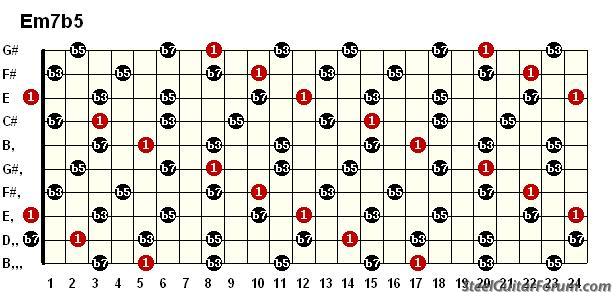
The bottom four strings give you a half diminished or minor 7 flat 5 chord. (m7b5) This chord is crucial for handling minor keys as it is the ii (2) chord when harmonising a minor scale (natural or harmonic) in seventh chords. It consists of a diminished triad with a minor seventh on top. This chord appears in many styles but is critical for jazz. A diminished triad which appears in a number of tunings is useful for the ii chord in minor keys but the m7b5 is much more satisfying. I have looked at tunings on Brad’s Page of Steel and in Andy Volk’s “Slide Rules” and I haven’t been able to find another dual tuning that offers the m7b5 as well as Murphey’s does.
Another reason for making sure a m7b5 chord is available is the other chords that it can stand for in the phenomenon that I know as “plurality”. This really makes a difference when there are many chords and modulations.

“Yesterdays” written in 1933 by Jerome Kern is a jazz standard. Its form is 32 bars made up of two almost identical 16 bar sections. It is a challenging tune in minor with a number of modulations, a cyclical section of dominant chords, a melody which has a broad range and a quirky contrapuntal section where the melody ascends as the bass descends. My starting point for this arrangement was a Real Book chart. The chords are for accompaniment but the chart works with bass only (IMO).
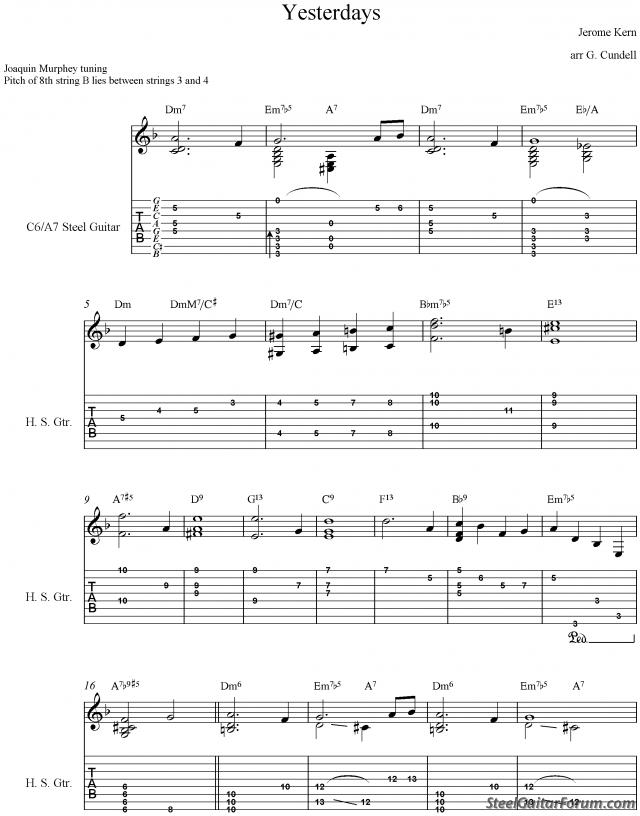

PDF link

I can’t help wondering if Murphey’s tuning played a role in Buddy Emmon’s subsequent innovations for the PSG. I have seen a video posted here on the forum of Mr E reeling of a perfect Murphey style solo. I look in wonder at his subsequent remarkable chordal approach to jazz on the PSG and question whether Murphey’s tuning played some part in its genesis..