


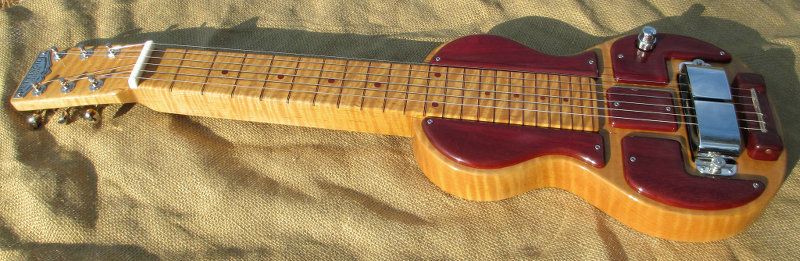
This is a prototype, working out designs. Next one will have a 5 degree bend on the head, and the head will be solid, tuners come up from behind.
I wound the pickup with 2 full ounces of 42AWG wire, I measure 11.64K resistance.
Wayne
|
The Steel Guitar Forum Store
Visit Our Catalog for Strings, Instruction, Music and Accessories |
Click Here to Send a Donation
Steel Guitar Links |
Moderator: Brad Bechtel



Here is a link to another Youtube video of me playing my fry pan guitar. It is not a song but just plucking the strings a bit, showing what the guitar sounds like. Settings are wide open on guitar and amp.Johnne Lee Ables wrote:Impressive, Wayne...very impressive. I can hardly wait to hear it.
jl


That's true, but if you're going for a vintage look, the bottom with a slotted keyhead design would be hard to beat.Jim Rossen wrote:The goal of a straight sting pull from the nut would favor the design at the top.
Jim




The information on the link about the nut is very useful. I've tried a number of different slotting styles, some sound like a sitar, or buzz, or the tone does not come through, basically some of the matters brought out in the web page document. Nice work there, and it's appreciated that people are willing to share their discoveries with others.David Mason wrote:Over on the Unofficial Warmoth forum, which is centered around using Warmoth wood to construct regular electric guitars and basses, we run into a LOT of nut questions. Regarding the slot shapes, I refer them to this:
http://www.lutherie.net/nuts.html
That part about a horn's bell, angling back away from the string-bearing surface right at the forward edge, is about as clear as it gets. I see that you are using a separate piece for the nut, which I think is wise (at least for now). Some early pedal steels and even some lap or console steels to this day have a "unitary" construction, the metal just ramps up and becomes the nut, but that leaves no room for adjustment (or improvement!). As discussed above, the one piece of advice from that article I don't follow on "underarm guitars" is the slot depth. If you're bending strings, you need enough depth to keep them put. Even the pull-off reasons for steel guitar above aren't all that critical, unless you're playing with such enthusiasm as to shatter glass bars on metal nuts, in which case the problem isn't in your guitar case.

If I use 1.5" thick aluminum bar, I can get a 10 degrees bend. It means machining off a lot of metal on the neck, or using two pieces. Aluminum is heavier than most woods, and weight has to be taken into consideration. Anyway, your work is very beautiful!Tom Pettingill wrote:That turned out great Wayne ... Nice job!
Doing a tilt back headstock is more work, but I definitely think its worth the effort. A 5 degree angle on the headstock should help. I generally end up around 7 - 10 degrees depending on the design. Basically I just draw it out so that the end of the headstock does not go past the bottom plane of the instrument so that it can sit flat.
For the shape, I'm partial to the retro Ricky shape, but thats just me. I understand not setting out to recreate an exact copy, but I think its no problem to celebrate the past if you want to.
.
